The Complete Guide to Kitchen Cabinet Hardware Placement
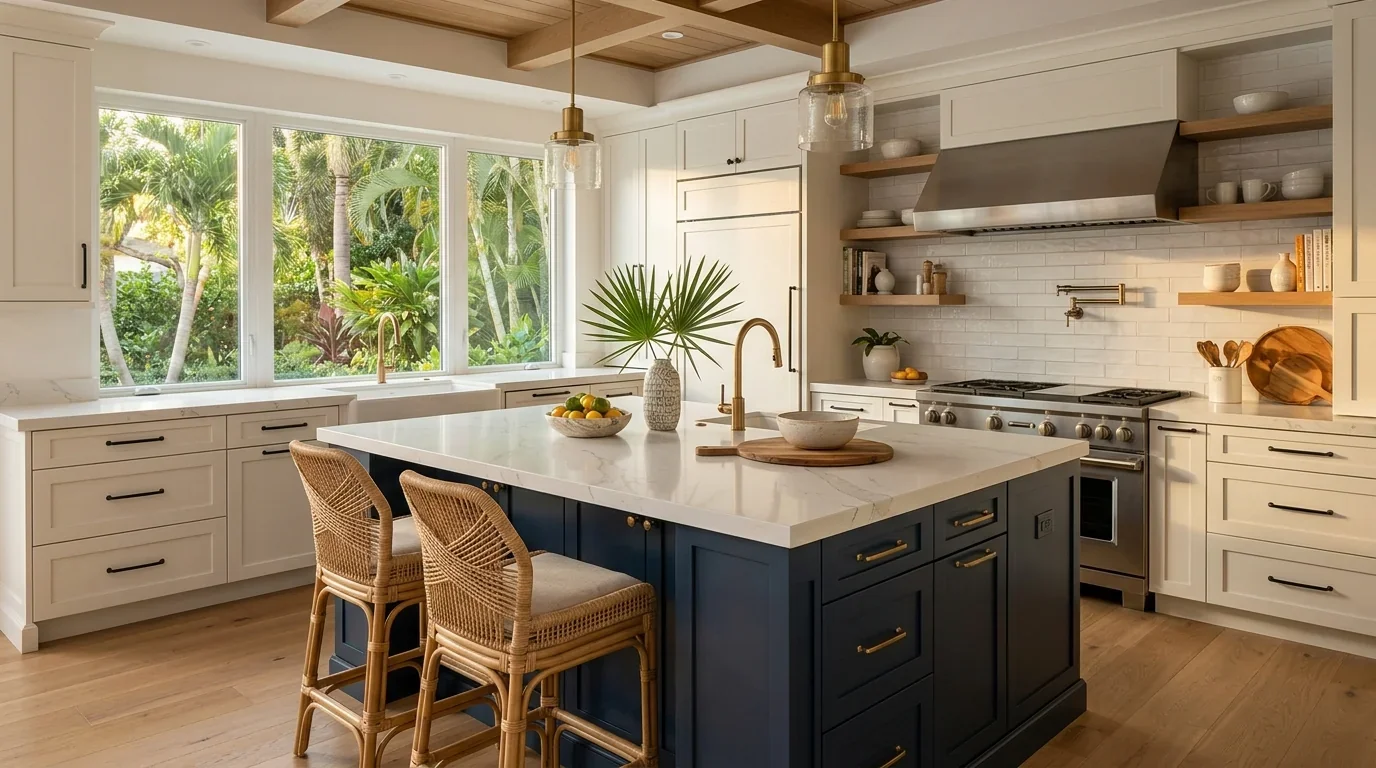
Cabinet hardware placement is one of those details nobody notices when it is done well and everybody notices when it is not. We have installed cabinet hardware on more than 5,000 Palm Beach County kitchens since 2016, and the single biggest callback issue we used to get was hardware that looked slightly off, even when every pull was technically the same distance from the corner. This guide covers the exact placement rules we use in our Boca Raton, Delray Beach, and Jupiter kitchens, plus the edge cases that trip up most DIY installers.
The goal is consistency the eye can read. Your brain processes cabinet hardware as a grid, and the moment one pull sits 1/4 inch off, the whole wall feels wrong.
The Quick Rules (Summary)
If you want the short version before the deep dive, here is what we tell every client:
Measurements are always taken from the inside edge of the door or drawer face, not from the cabinet box. We use a True Position TP-1934 cabinet hardware jig for every install, it eliminates human error and ensures every pull lines up across a run of 20+ cabinets.
Doors vs Drawers: Different Rules
Most homeowners assume hardware placement is the same rule for every cabinet. It is not. Doors and drawers have completely different visual logic.
Door placement
On a door, hardware goes on the side opposite the hinge. That is the side you grab. For upper cabinets, you want the knob or pull near the bottom corner because you are reaching up. For base cabinets, you want it near the top corner because you are reaching down. The 2.5 to 3 inch offset from the corner is the sweet spot, closer feels cramped, farther feels accidental.
For a standard 30 inch tall door on a base cabinet, the pull usually sits 3 inches down from the top and 1.5 inches in from the hinge side. For a standard 36 inch tall upper cabinet door, the pull sits 2.5 inches up from the bottom and 1.5 inches in from the hinge side.
Drawer placement
Drawers are different. You grab them from the front, not the side, so hardware is almost always centered. For drawers under 24 inches wide, one pull centered horizontally and vertically looks balanced. For wider drawers, think a 30 inch pot drawer or a 36 inch base, two pulls spaced at roughly one-third intervals look more professional and give better grip.
The exception is stacked drawer fronts in a base cabinet. If you have three matching drawers in a 24 inch base, we usually center a single pull on each. If one drawer is a false front hiding a sink, it gets dummy hardware to match.
Horizontal, Vertical, or Centered?
This is where most kitchens go sideways. Orientation is not just aesthetic, it affects how the hardware reads from across the room.
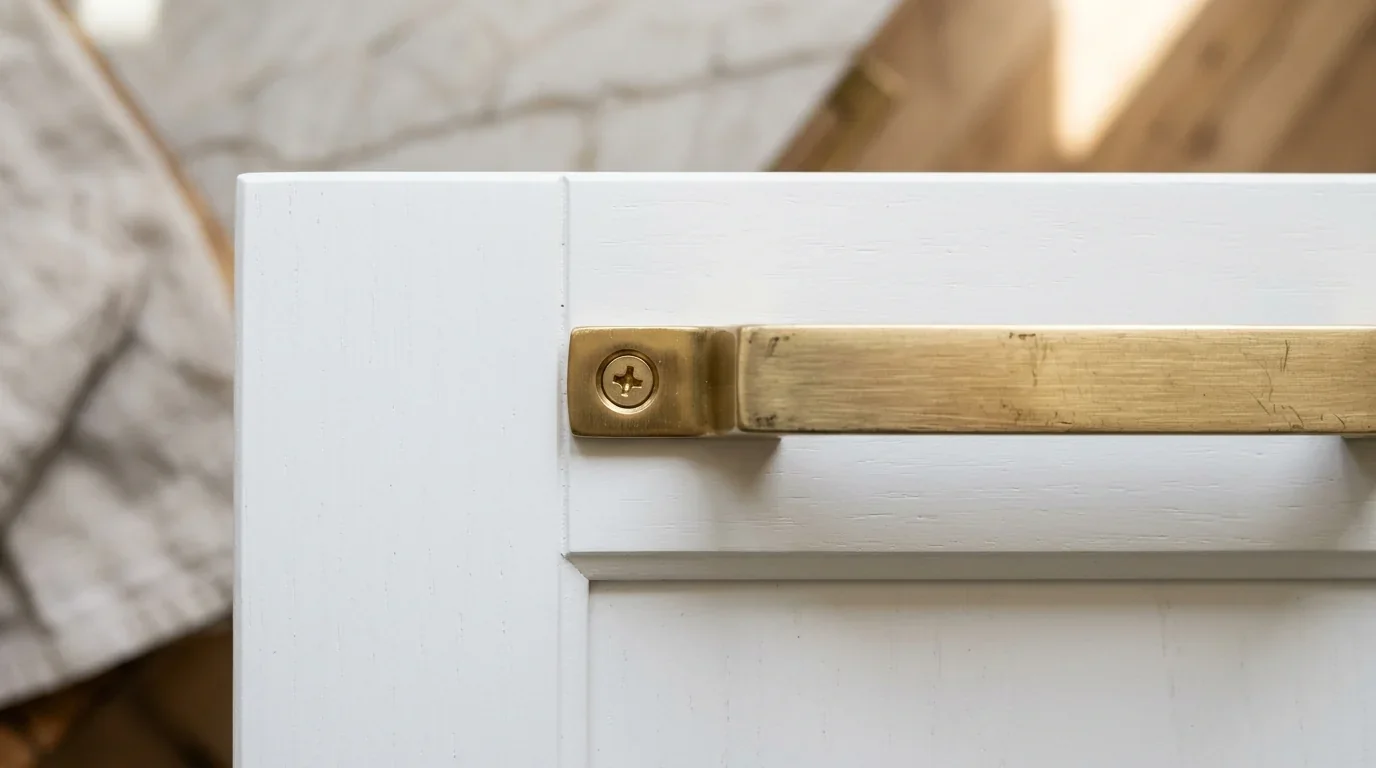
Pulls on drawers are always horizontal. That matches the motion of opening a drawer and gives you the most natural grip. Pulls on cabinet doors can go either way, but we strongly prefer vertical on doors because it matches the motion of swinging the door open. A horizontal pull on a tall door looks like you put a drawer pull on a door by accident, which is exactly what it is.
Knobs are always centered on themselves, there is no orientation question. The question is where the center of the knob sits, which goes back to the 2.5 to 3 inch offset rule above.
One mistake we see constantly in refacing projects: the old holes from previous hardware get reused even when they do not match the new style. If you are refacing and going from knobs to pulls, plan on filling the old holes and drilling fresh. The labor cost is minor. Visual consistency is not.
Edge Cases: Glass Doors, Appliance Panels, Toe Kicks
Standard rules cover about 85 percent of a typical kitchen. The other 15 percent is where hardware planning earns its keep.
Glass-front upper cabinets need the hardware placed identically to their solid neighbors. The glass face does not change the rule, the door still hinges and swings the same way. If your glass doors have muntin grids, make sure the hardware does not visually collide with the grid lines.
Appliance panel fronts (panel-ready dishwashers, refrigerators, warming drawers) need hardware that matches the adjacent cabinetry in both style and vertical position. If your base cabinets have pulls 3 inches down from the top, your dishwasher panel pull sits at the same 3 inch line. This is the single biggest hardware mistake we fix on retrofits.
Toe kick drawers (the hidden drawers at the floor level) usually get small finger pulls or cup pulls, not full-size hardware. A standard pull at floor level just looks wrong.
Corner cabinets with lazy Susans or blind corners get hardware centered on the door itself, ignoring the diagonal cut. The door still swings from a hinge, so treat it like any other door.
Pull-out trash and recycling inside a base cabinet, if the door is a standard swing door, hardware goes in the standard door position. If it is a pull-out front, hardware goes in the drawer position (centered).
How We Install Hardware on a Full Kitchen
For a full kitchen of 30 to 50 cabinets, the difference between a good install and a great one is process. Here is how our crews handle it.
First, we lay every cabinet door and drawer front on the floor in the order they go back on the cabinets. This lets us mark all the hardware locations before any holes get drilled. For a 40 cabinet kitchen, this takes about an hour.
Second, we tape off every hardware location with blue painter's tape and drop the hardware on top of the tape. The homeowner walks through and approves every placement before we drill. Changing your mind at this stage costs nothing. Changing it after drilling costs a new door.
Third, we use the hardware jig. Every hole, every cabinet. Even for a custom kitchen with 15 different cabinet widths, the jig guarantees the hardware centers fall on the same horizontal line across the whole run. This is the difference between a kitchen that looks professionally designed and one that looks DIY.
For budget-conscious clients working through a phased remodel, hardware is one of the easiest and cheapest upgrades to do last, it runs $8 to $25 per pull for good options, and even a full kitchen of 60 pieces can come in under $1,500 in materials. Labor for install runs $4 to $8 per piece when we do it alone, less when bundled into a larger project.
If you are pairing new hardware with a backsplash update or new cabinet doors, order the hardware first and hold it against the cabinet samples. Finishes that look identical online can read very differently in a South Florida kitchen with coastal light pouring through the windows.