Where to Buy Kitchen Cabinets in Palm Beach County
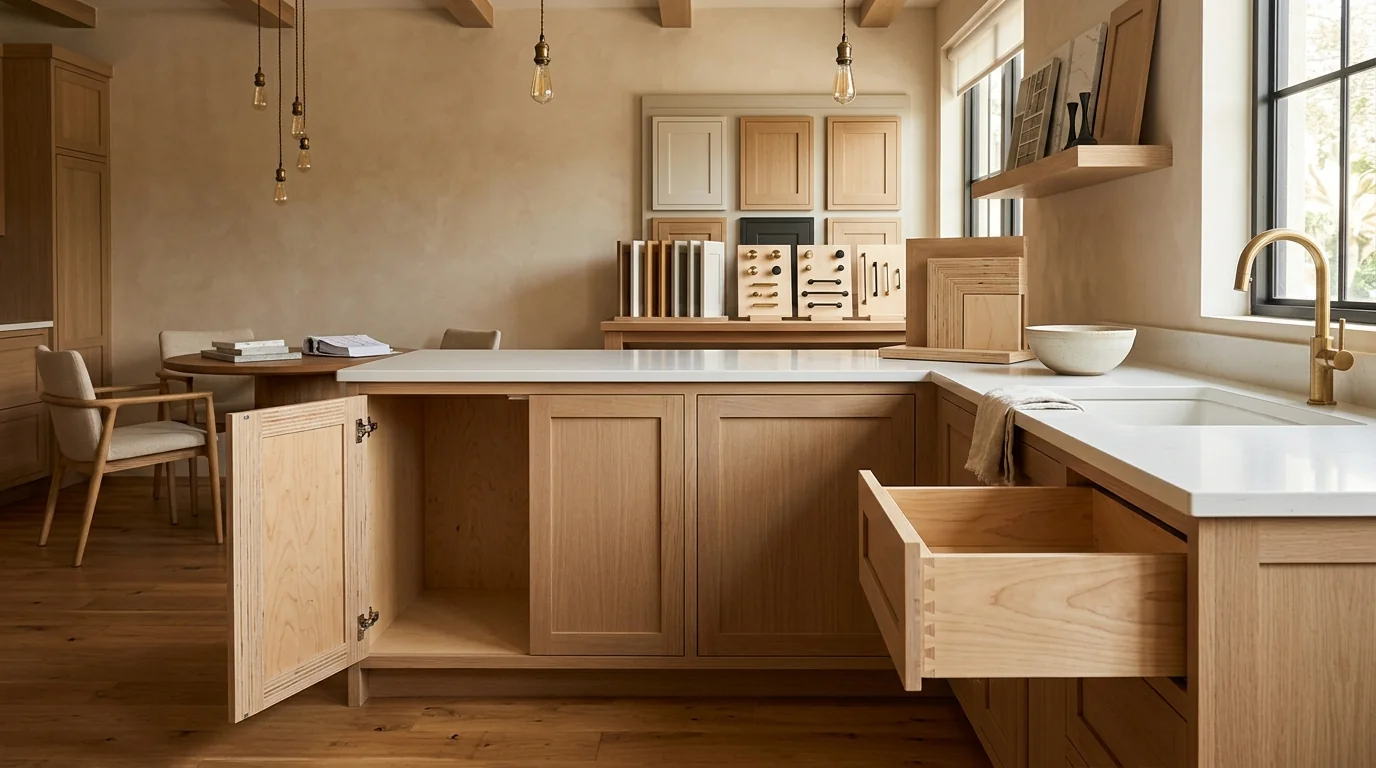
Most homeowners shopping for kitchen cabinets in Palm Beach County end up at one of four places: Home Depot, Lowe's, an online RTA seller like Cabinets.com or Barker, or a local independent showroom. The price spread between them is real. So is what you actually get for that price, and the differences usually show up after install, not on the price tag.
We've ripped out enough seven-year-old big-box cabinets in South Florida humidity to know how this ends. Here's what each option actually gets you, what's inside each cabinet box, and which kind of buyer each source actually fits. If you're earlier in the budget conversation, our Palm Beach County kitchen remodel cost guide sets the broader number context first.
Your Four Main Options
Here's the short version of who each source is for:
- Home Depot, best for tight-budget jobs, rentals, and homeowners who don't mind doing their own project management. Stock and semi-custom lines, mostly particle-board boxes at the base price.
- Lowe's, same budget tier as Home Depot, slightly different brand mix, slightly nicer 3D design software. Same particle-board-by-default reality.
- RTA / online (Cabinets.com, Barker, The Cabinet Joint, Lily Ann), significantly cheaper than retail, often plywood at the base price. You assemble, you measure, you install, you eat any damaged shipments.
- Local independent showroom (us, and 15 to 20 others between Boca and Stuart), full design service, plywood box on every cabinet, dovetail drawers and soft-close as standard, one designer through the whole project. Priced above big-box semi-custom but often even with their full-custom lines.
The right answer depends on how much of the project you want to handle yourself, how long you plan to live with the kitchen, and how much weight you put on having one accountable person to call when something goes wrong.
Home Depot Kitchen Cabinets
Home Depot sells three tiers: stock (Hampton Bay, in-store and online), semi-custom (Thomasville lines and KraftMaid through their special-order program), and custom-order (KraftMaid and Yorktowne through the design center). What you buy at the entry tier and what you can buy if you push the special-order program are very different cabinets.
At the stock tier you're getting particle-board boxes with a thermofoil or melamine veneer on the outside. Hinges are usually basic European cup-style, not soft-close. Drawer boxes are stapled MDF on the cheaper SKUs. These cabinets work fine for a rental kitchen or a quick flip, but they don't age well in South Florida air.
Semi-custom KraftMaid through the HD special-order program does offer plywood boxes on some lines, but you have to specifically ask, specifically pay the upcharge, and verify it's listed on the order form before you sign. The default sheet you get handed at the design counter is the cheaper particle-board build.
The in-store kitchen designer is typically a contractor trained on Home Depot's design software (2020 Design or HD's proprietary tool), not a credentialed kitchen designer. Some are excellent. Some are a week into the job. You don't get to pick.
Install is subcontracted. HD has a network of installers they vet and assign by zip code. The crew you get is whoever's available that week. Quality varies. Schedule moves through HD's project manager, who is managing 30 to 50 active jobs and doesn't know your kitchen by name.
Pricing for a 10×10 stock kitchen runs roughly $1,200 to $2,000 for cabinets only. Semi-custom 10×10 kitchens are typically $4,000 to $7,000 cabinet-only, plus install, plus the plywood-box upgrade if you want it.
Lead times: in-stock for stock cabinets, 4 to 8 weeks for special-order semi-custom.
When Home Depot makes sense: rental properties, flip kitchens, tight-budget primary residences where you've made peace with replacing the cabinets again in 10 to 12 years, and homeowners who genuinely enjoy managing the project themselves.
Lowe's Kitchen Cabinets
The Lowe's story is a near-mirror of Home Depot. Stock line is Diamond Now. Semi-custom lines are Diamond, Schuler, and Shenandoah. Custom-order is available through their kitchen design center. Pricing for equivalent SKUs runs within a few percent of HD on either side.
Construction is the same picture: stock cabinets are particle-board boxes by default. Plywood is an upgrade option on most semi-custom lines. Drawer boxes range from stapled MDF on stock to dovetail plywood on the upper Schuler tier.
Where Lowe's tends to differ in our experience: their Schuler line is a noticeably nicer cabinet than KraftMaid stock, sitting between HD's mid and upper tiers in finish quality. Their kitchen design software gives slightly cleaner 3D renderings than HD's, which matters when you're trying to decide between two layouts. Their installer network is the same model as HD, subcontracted, assigned, variable.
Pricing and lead times are essentially identical to HD on equivalent specs.
When Lowe's makes sense: same situations as HD, with a slight preference if your local Lowe's design center has a designer you've already worked with or if you specifically want the Schuler line.
RTA and Online Cabinet Sources
RTA (ready-to-assemble) cabinets shipped from online retailers have changed the budget end of this market. Cabinets.com, Barker Cabinets, The Cabinet Joint, Lily Ann Cabinets, and Wholesale Cabinets are the names that come up most often in Palm Beach County. We've installed cabinets from all of them at one point or another, usually for clients who sourced their own and hired us for measurement and install.
What's good about RTA: most of these retailers ship plywood-box construction at the base price, not as an upgrade. Door-style selection is broader than what's stocked at HD or Lowe's. Lead times for in-stock SKUs are usually 1 to 3 weeks. Per-cabinet pricing is meaningfully lower than retail equivalents, often 30 to 50 percent below HD's semi-custom tier on similar specs.
The downsides: you're measuring your own kitchen, and a quarter-inch error compounds across a 14-foot run. You're either assembling each cabinet yourself (a 30-cabinet kitchen is a long weekend of assembly) or paying an assembler. You're handling damaged shipments, flat-packed cabinets that moved through five trucks and three warehouses sometimes show up with cracked panels, and returning them is expensive. There's no local showroom to put your hand on the door samples and see how a finish reads in actual light.
It depends on if you're going full DIY or using RTA as a cabinet source while a designer handles the rest. For an experienced DIYer renovating their own kitchen, RTA can be a great fit. Our RTA vs. custom cabinets comparison walks through the trade-offs in more detail, including which RTA brands hold up in our climate and which to skip.
Local Independent Showrooms (Us)
You walk into the showroom. There are eight to twelve display kitchens in different door styles and finishes. The person who greets you is the same person who designs your kitchen, measures your space, places the cabinet order, and is on speed-dial when something goes sideways at install. No phone tree, no rotating cast of project managers.
That's how we run our showroom on Federal Highway in Riviera Beach, and it's how most of the 15 to 20 independent shops between Boca and Stuart run theirs. We compete on service, on plywood-box construction as a baseline, and on knowing the local code, impact glass requirements above sinks, hurricane strap details, what the inspectors actually look at. We don't compete on being cheaper than Home Depot on a stock cabinet, because we can't and we don't try.
What's actually included when you buy from us:
- Plywood box on every cabinet. 1/2-inch plywood sides, 3/4-inch plywood deck. Not an upgrade, not an option, not something we'd ever try to value-engineer out.
- Dovetail plywood drawer boxes with full-extension soft-close glides. Standard, not extra.
- Soft-close door hinges on every door. Standard.
- Custom sizes, not 3-inch increments only. If your wall run measures 97 inches, we build a cabinet to 97. HD will sell you a 96-inch run with a 1-inch filler strip.
- In-home measurement before any cabinet is ordered. We come to your kitchen, lay out the run with a laser, and account for waviness in walls. Our countertop measurement guide walks through how this works on the slab side too.
- One designer, start to finish. Same person from showroom visit to install day. Same direct number, same direct email, same human who answers when something is wrong.
- Installers we work with directly. Same crew on most jobs, not a lottery of whoever's free this week.
Pricing for a 10×10 kitchen with us typically lands in the $7,000 to $10,000 range at our entry door style and $10,000 to $16,000 in the most popular shaker and slab-front lines. That sounds high until you account for what's bundled, design, measurement, plywood throughout, dovetail drawers, soft-close, and install coordination. When you spec an HD or Lowe's order to match those features, the gap closes substantially.
Lead times are 3 to 6 weeks for stock door styles in our cabinet lines, 8 to 12 weeks for full custom door styles or unusual finishes.
When buying from a local showroom makes sense: most homeowners doing a real renovation. Anyone whose kitchen has a quirk that stock sizes don't address, off-square walls, an awkward window over the sink, a load-bearing pony wall in a 1960s ranch. Anyone who values a single accountable person.
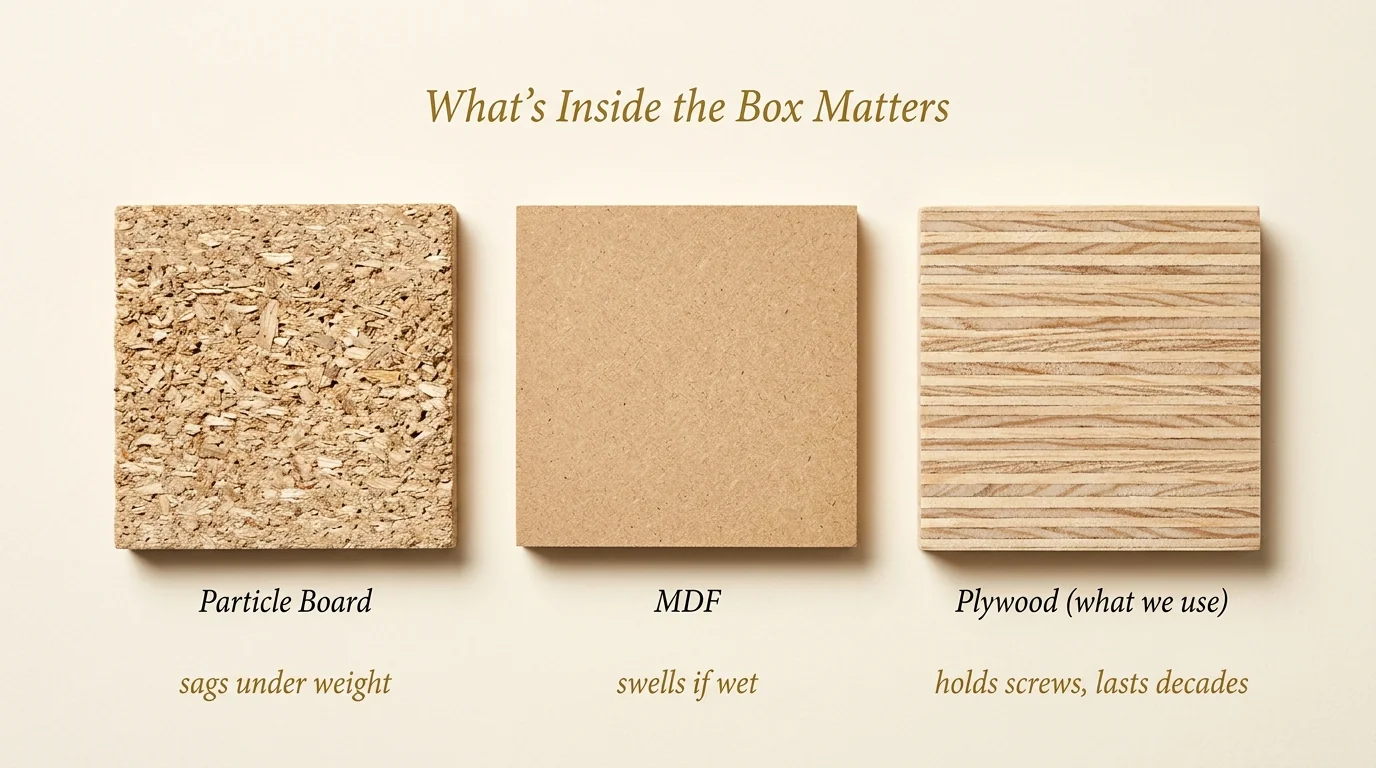
What's Inside the Box: Plywood vs. Particle Board vs. MDF
The cabinet box is the part you don't see, but it's what holds your kitchen together for the next 20 years. Three materials dominate. The differences matter more in South Florida than they do in Denver.
Particle board is the cheapest. Compressed wood chips bonded with resin. Sags under sustained weight, think the constant load of a stone slab on base cabinets, or a stack of dishes in a wall cabinet. Strips out around screws, so once a hinge starts to wobble, the screw can't bite anymore. Swells dramatically if exposed to water. The single most common failure mode on particle-board boxes is the bottom of the under-sink cabinet, where slow drips and condensation off the trap destroy the cabinet floor inside two years. We replace these constantly.
MDF (medium-density fiberboard) is a step up. Smoother, denser, holds paint better, and is the right choice for cabinet doors and end panels even on better cabinets. As a box material, it still swells if wet. It holds screws better than particle board but worse than plywood. It's also heavy, an MDF-box cabinet weighs noticeably more than a plywood-box cabinet of the same size, which matters during install.
Plywood is the standard for cabinets built to last. Layers of real wood veneer cross-laminated for dimensional stability. Holds screws indefinitely. Resists moisture rather than absorbing it, the cross-laminated grain doesn't swell the way single-grain materials do. Lighter than MDF. The one downside is cost. The Kitchen Cabinet Manufacturers Association certifies cabinets against a structural test standard (ANSI/KCMA A161.1), the test covers structural load, door and drawer cycle counts, and finish durability, the categories where plywood-box cabinets consistently outperform both alternatives in real-world use.
Every cabinet we build uses 1/2-inch plywood sides, 3/4-inch plywood deck, and dovetail plywood drawer boxes. That's the spec, not an upcharge. If you're shopping at HD or Lowe's, look for the line item called "all-plywood construction" or "plywood box upgrade" on the spec sheet. If it's not there, you're getting particle board.
The Service Difference
The thing nobody talks about until they're in the middle of a kitchen renovation: who answers the phone when something is wrong.
Big-box model. You have a project manager assigned by the store. They have 30 to 50 active projects. They don't know your kitchen by heart. Your call routes to a customer service line, which routes to whichever installer was assigned that day, who may or may not call back. Wait times of 3 to 5 days for a callback are not unusual when you're in the middle of an install with the old kitchen ripped out and the sink in the garage.
RTA model. You call the manufacturer's customer service. They're helpful within their script. Outside the script, say a cabinet arrived with a cracked side panel and you've already removed the old kitchen, the script breaks down. They'll ship a replacement, which will arrive in 7 to 10 business days while your sink continues to live in the garage.
Local showroom model. You call the designer. The designer answers, or calls back inside an hour. If it's our cabinet that's wrong, our installer fixes it. If it's a delivery issue with the slab, the designer is the one chasing it down. There is one accountable person, and you have their direct line.
Sounds minor on paper. It isn't. Half the bad-renovation stories we hear from clients who came to us mid-project trace back to the same root cause: I couldn't get anyone on the phone. The line that prevents that is short and direct, and it's worth real money to have one.
If you're already holding a quote from one of the big boxes, our guide to reading a contractor quote walks through which line items deserve scrutiny, including the ones that hide who's actually accountable for what.
Real Pricing Comparison
Here's the 10×10 kitchen, the standard test layout in cabinet retail, across all four sources, in current Palm Beach County pricing (April 2026). These are cabinet-only numbers. They don't include countertops, appliances, install labor (HD and Lowe's add labor on top, RTA you hire separately, showrooms typically include or coordinate it), demo, or hardware.
The local showroom row looks high until you spec the big-box equivalent line item by line item: plywood throughout, dovetail drawer boxes, soft-close on every door, custom sizing, design service, in-home measurement, install coordination. When you do that exercise honestly on an HD or Lowe's order, the gap usually narrows to 10 to 20 percent, not 3x. Refacing your existing cabinets is a fifth option worth pricing if your boxes are still solid, our refacing vs. replacement guide walks through when refacing actually pencils out.
South Florida Considerations
Humidity matters more here than just about anywhere else in the country. We sit at 60 to 80 percent relative humidity year-round, and any home east of A1A picks up salt air through the windows. Two specific implications for cabinet shopping:
Box material isn't a luxury question. It's a longevity question. Plywood holds up in this environment. Particle board does not. We've replaced bottom panels on under-sink cabinets in 6-year-old big-box installs where the only "leak" was condensation off the cold supply line on a humid August afternoon. The box doesn't have to get hit by a flood, it just has to live in our air for half a decade.
Hardware corrosion is real. Matte black holds up. Polished chrome holds up. Brass with a clear lacquer coating fails within 3 to 5 years on coastal homes. Solid brass without coating develops a patina that some homeowners love and others hate, know which camp you're in before you order. The Florida Building Code doesn't regulate cabinet hardware specifically, but it does regulate the structural anchoring of upper cabinets in coastal high-velocity wind zones, which most of Palm Beach County and the entire Treasure Coast fall under.
Door style matters more than the catalog suggests. Tropical light is bright, and finishes that look soft and warm under showroom incandescent can read flat under a 2 PM sun pouring through a sliding glass door. Our South Florida kitchen cabinet styles guide covers which finishes hold their character through the year and which fade or yellow under sustained UV.
If you're early in the process and just trying to figure out who to talk to first, the honest answer for most Palm Beach County kitchens is: visit two or three local showrooms and one big box. Get real numbers from each. Bring back the spec sheets and compare them line by line. The decision after that is usually pretty clear.