Contractor Tips · March 2026
How to Read a Contractor Quote: What Every Line Item Actually Means
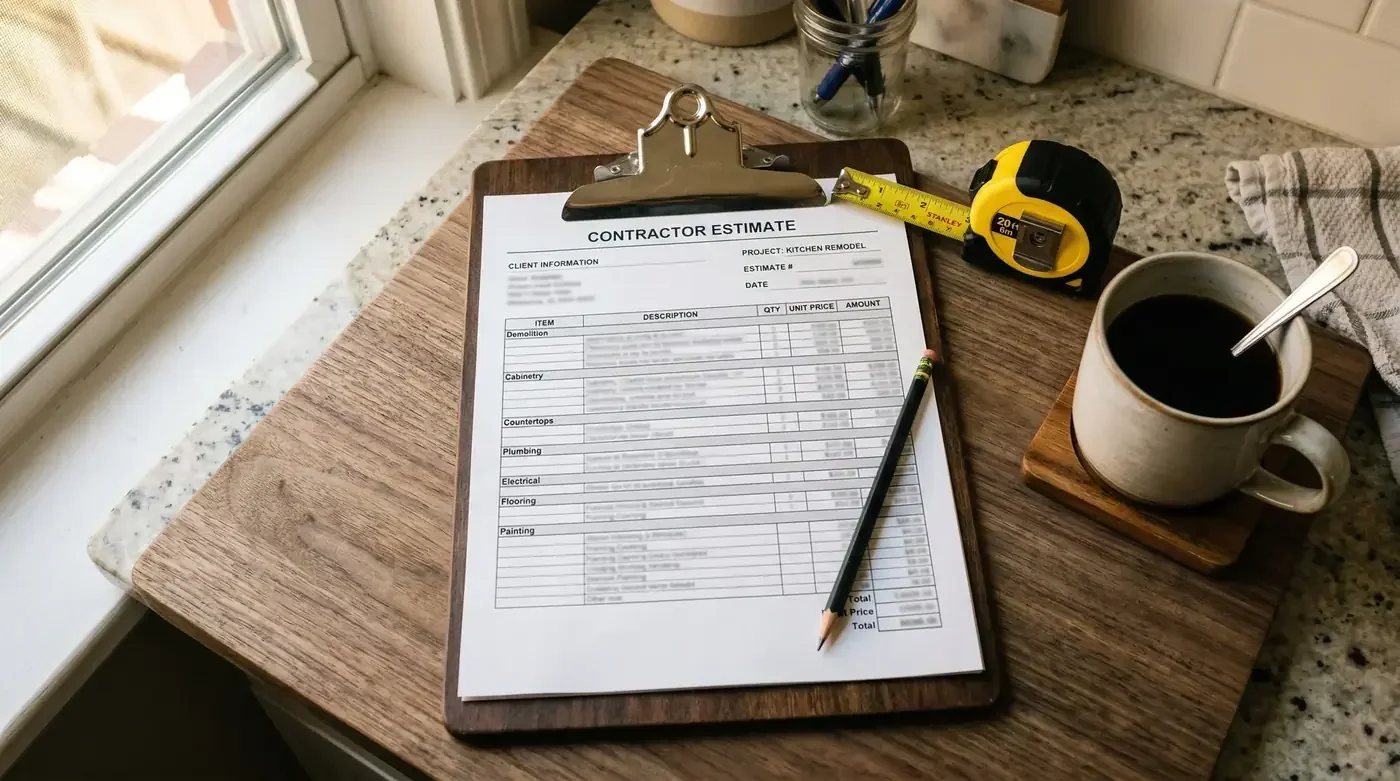
Photo: Palm Beach County homeowner reviewing kitchen remodel contractor quote and estimate documents
By South Florida Kitchen & Bath Design · Palm Beach County · March 2026
You've just received three different quotes for your kitchen remodel. One is $42,000, one is $67,000, and one is $58,500. They all say they'll do the same job, so why the $25,000 difference? The answer is almost always in the line items.
Most homeowners compare remodeling quotes by looking at the bottom number. That approach costs people tens of thousands of dollars every year, either by choosing a contractor who cuts corners, or by paying for things they didn't need. Here's how to read every section properly, using the same method we walk our own clients through before they sign anything.
If you want outside perspective beyond this guide, the FTC's contractor hiring guidance and the Florida DBPR both publish resources on comparing contractors and verifying their credentials.
Why Quotes Look So Different
Three contractors can bid the "same job" and come in tens of thousands apart for reasons that have nothing to do with profit margin. The most common drivers of price spread we see in Palm Beach County:
- Cabinet grade. Stock cabinets from a big-box line run $80-$150 per linear foot. Semi-custom cabinets with plywood boxes run $220-$400 per linear foot. Fully custom runs $500+. If one quote uses stock and another uses semi-custom, that alone can account for a $15,000 difference in a medium-sized kitchen.
- Scope assumptions. Does the quote include drywall repair after plumbing relocation? Patching subfloor if the old tile comes up in chunks? Adding GFCI outlets to bring the kitchen up to current code? These are the "surprises" that show up mid-project if they weren't in the original number.
- Permit and disposal handling. Some quotes roll these in, some leave them for the homeowner. A permit package can add $400-$800. A 30-yard dumpster for demolition adds $500-$800.
- GC margin and overhead. Most Palm Beach County remodelers apply a 15-25% margin on top of direct costs. A quote that looks "cheaper" sometimes just hides this inside inflated line items instead of showing it as a separate fee.
Apples-to-apples comparison is only possible when every quote itemizes to the same level of detail. If one bidder refuses to break their number down, they're not refusing to charge less, they're refusing to let you compare.
Line Items Explained
A well-structured quote should be broken into clear sections. If you receive a quote that's just a single lump sum, no breakdown, no line items, that's your first red flag. Here's what each line item should tell you:
| Line Item | What It Means | Watch For |
|---|
| Demolition | Labor to remove existing cabinets, countertops, tile, flooring. Should include dumpster/haul-away. | ⚠ Red flag if disposal isn't separated, it's often added later as a surprise. |
| Permits | Palm Beach County requires permits for structural, electrical, and plumbing work. Should list specific permit types. | ⚠ Red flag if permits aren't listed at all. Work without permits puts you at serious legal and financial risk. |
| Cabinetry | Should specify brand, line, box construction (plywood vs particle board), and finish. | ⚠ Red flag if quote just says "cabinets" with no manufacturer or spec. |
| Countertops | Should specify material, edge profile, thickness, and square footage. | ⚠ Red flag if no slab origin or grade is listed. |
| Tile / Backsplash | Should include material, size, pattern, grout type, and labor rate per sq ft separately. | ⚠ Red flag if tile material and installation labor are combined. |
| Fixtures & Hardware | Faucets, cabinet pulls, etc. Should list brands/model numbers or state "owner-supplied." | ✓ Good sign if allowances are clearly stated so you know what's included. |
| GC Fee / Overhead | The contractor's margin, typically 15-25% in Palm Beach County. | ⚠ Red flag if this isn't visible at all, it's buried and you can't evaluate it. |
The Allowance Trap
One of the most common ways homeowners get surprised by a final bill $15,000 over the original quote is through "allowances", placeholder amounts for items not yet selected. The problem: allowances are almost always too low for Palm Beach County pricing.
A quote might say "$3,500 countertop allowance" when Taj Mahal quartzite, extremely popular in Palm Beach, runs $90-$130/sq ft installed. If your kitchen needs 50 sq ft, you're looking at $4,500-$6,500 for that item alone.
Pro tip: Ask every contractor to replace allowance figures with real material selections before you sign. If that's not possible, ask them to raise each allowance to a realistic Palm Beach County market rate. This gives you a true apples-to-apples comparison.
Want exact pricing for your remodeling project?
Get a free, no-obligation estimate for your Palm Beach County kitchen or bath.
We respond within 2 hours during business days.
Red Flags in Any Remodeling Quote
- Single lump sum with no breakdown
- No permit costs listed anywhere
- Countertops, cabinets, or tile listed without brand, grade, or spec
- Allowances clearly below South Florida market pricing
- No written warranty on labor
- Quote valid for only 24-48 hours (pressure tactic)
Questions to Ask Before Signing the Quote
Before you put a signature on anything, run the quote through this checklist out loud with the contractor. If they get impatient or vague on any of these, that's information too.
- "Is this scope complete, or will I see change orders?" Every contractor knows which scope items tend to expand. Ask what's likely to come up, and get the answer in writing.
- "What brand and grade of cabinets, countertops, and tile is this pricing?" If any of these three answers is vague, the quote is vague.
- "Are permits, demo disposal, and final cleanup included in this number?" These are the most common "surprise" adds.
- "What's your labor warranty, and is it in writing?" One year minimum on labor is standard in Palm Beach County. Anything less is unusual.
- "What happens if we find rot, termite damage, or galvanized plumbing behind the walls?" In South Florida homes over 20 years old, this is a real possibility. A good contractor has a written process for unforeseen conditions, with an hourly rate or a change-order protocol that doesn't require you to panic-approve a number.
- "Who's my day-to-day contact once work starts?" A named project manager in the contract is better than "we'll figure it out later."
- "When does this quote expire?" Thirty days is normal. Twenty-four hours is a pressure tactic.
Write the answers down. If two contractors give you different answers to the same question, that's your apples-to-apples comparison point.
What a Fair Payment Schedule Looks Like
A legitimate payment schedule is milestone-based, tied to completed phases of work rather than arbitrary calendar dates. Typical milestones include: a structured initial payment at contract signing, a draw after demolition and rough-in completion, another after cabinet installation, another after countertop installation, and a final holdback released at your punch-list walkthrough. The final holdback is your leverage, don't give it up until the small punch items are actually finished.
Florida Statute §489.126 limits what a contractor can collect up front on contracts over $2,500. The law puts the cap at 10% of the contract price plus reasonable material costs before work or deliveries begin. If a quote asks for a large lump sum up front with no tie to materials being ordered, that's worth pushing back on before you sign.
Common Questions
Frequently Asked Questions
Why do kitchen remodel quotes vary so much in Palm Beach County?
Quotes vary because contractors use different pricing structures, material grades, and labor rates. A quote that looks much lower may exclude permits, demo disposal, or use stock cabinets where another quote prices semi-custom. Always compare line by line, not total to total.
What should a kitchen remodel quote include?
A thorough quote should itemize demolition and disposal, cabinets and hardware, countertops, backsplash, flooring, plumbing fixtures, electrical, lighting, permits, labor for each trade, and a payment schedule. Any quote that only provides a single total number without line items is a red flag.
What does allowance mean on a contractor quote?
An allowance is a placeholder amount for materials you have not yet selected, for example "$3,000 tile allowance." If you choose tile that costs more, you pay the difference. Allowances can cause budget surprises. Ask your contractor to specify exactly what is included.
Should the cheapest quote always be avoided?
Not necessarily, but the cheapest quote should always be scrutinized. Ask what is excluded, what grade of materials is assumed, and whether the contractor carries proper insurance and licensing. A lower price sometimes reflects less experienced labor or excluded scope items.
How much should a contractor markup materials?
Contractor markups on materials typically range from 15-30%. This covers their time sourcing, ordering, and managing returns. A transparent contractor will show you material costs and labor separately. Be wary of contractors who refuse to break out costs.
A
About the Author
Andre
Owner of South Florida Kitchen & Bath Design, serving Palm Beach County since 2016. Andre and his team have completed thousands of kitchen and bathroom renovations across Boca Raton, West Palm Beach, Wellington, Delray Beach, and the surrounding communities.
Explore More
Related Pages & Service Areas