How to Measure for New Countertops
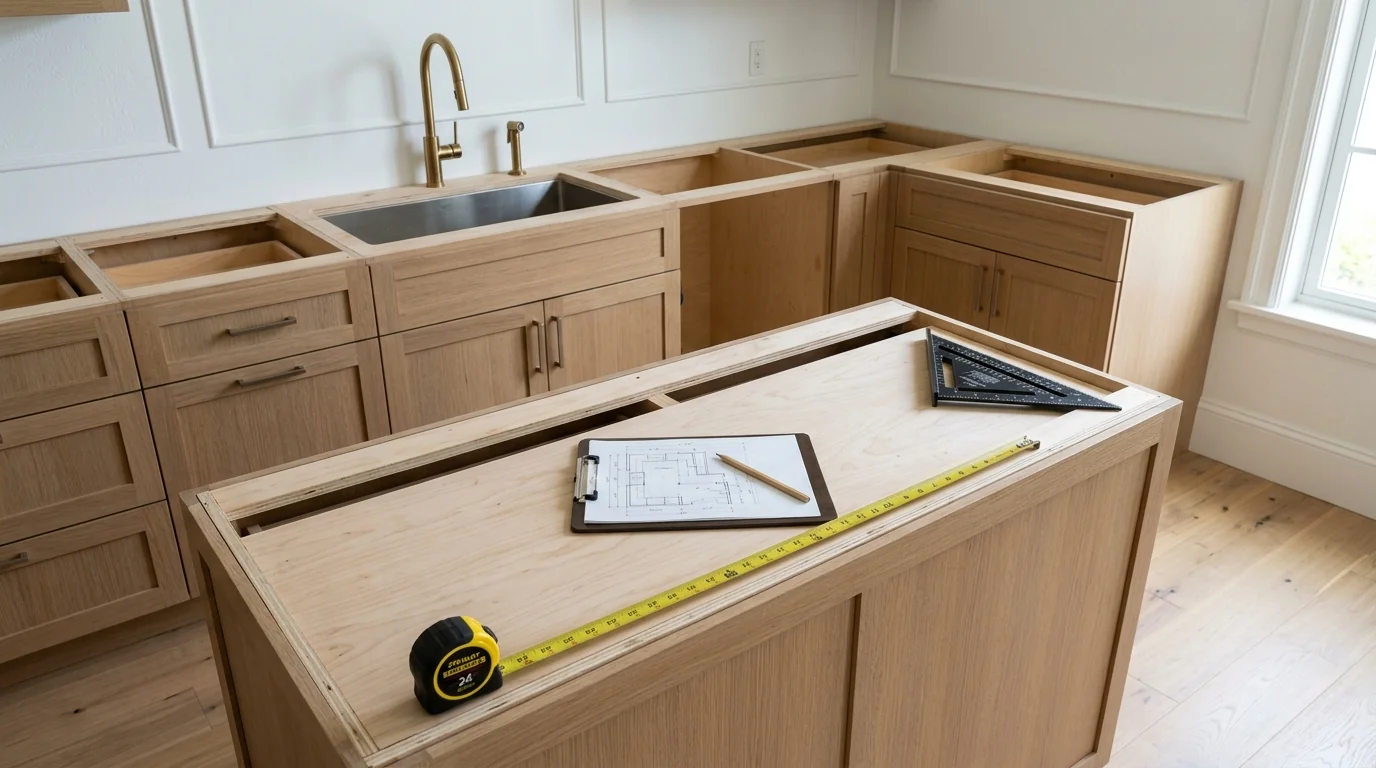
Knowing how to measure countertops before you start shopping is the difference between an honest quote and a surprise mid-install. Our crew templates every job ourselves before fabrication, but homeowners who want a realistic ballpark before signing a contract, or who plan to source their own slabs, can get usable numbers at the kitchen table with a tape, a pencil, and fifteen minutes. Most Palm Beach County kitchens we measure are between 30 and 60 square feet of countertop, and almost every quote we lose to a low-baller turns out to have skipped at least one measurement step we'll cover here.
This guide walks through how to measure for new countertops in quartz, quartzite, granite, marble, or porcelain. The math is the same across materials. What changes is how the slab is fabricated, where seams land, and how much overhang the substrate can carry without cracking. If you're still picking a material, our quartz vs quartzite breakdown covers the daily-use trade-offs before you start measuring.
Tools You'll Need
You don't need much, and most of it is probably already in a drawer somewhere.
- 25-foot tape measure with a positive lock. Cheap tapes wobble at extension and give you a 1/4" wrong number across an island.
- Carpenter's square or speed square to verify that corners are actually 90 degrees. They almost never are in older homes.
- Graph paper or a notepad, pencil, and eraser. Sketch the layout before you start measuring so you have a place to write each number.
- Smartphone. Photograph every measurement with the tape in frame. The fabricator will ask, and the photos will save you a return visit.
- Optional: laser distance measure. Around $40 on Amazon. Worth it if you have an island longer than eight feet or a wall run that doesn't let you get a clean tape pull.
Skip the cloth tape measure, it stretches half an inch over a long pull. Skip yardsticks. Stone fabrication tolerances are tighter than you'd expect (the Natural Stone Institute calls for ±1/8" on most countertop dimensions), and your tape needs to deliver in that range.
Measuring Straight Runs
Start with the longest counter run. Pull your tape along the back wall, not the front of the cabinet. Cabinet faces bow slightly when the door alignment is off, and the wall is your real reference. Measure from inside corner to inside corner of the run.
Then take the same measurement at three points: tight against the back wall, in the middle of the planned counter depth (about 12 inches forward), and at the front edge of the cabinet. Walls are never perfectly straight. Old plaster walls in El Cid bungalows can wander a half inch over an eight-foot run. Use the longest of the three measurements, plus 1/2 inch for overhang on any unfinished end. The fabricator scribes the slab to fit the wall when they install, your job is to make sure the slab is big enough to do that.
Standard depth for a kitchen countertop is 25.5 inches: 24-inch base cabinet plus a 1.5-inch front overhang. Bath vanities are usually 22 inches deep, sometimes 24. Write the depth on your sketch even if it's standard, because the fabricator won't assume.
For the backsplash, decide now whether you want a 4-inch mini splash, a full-height splash, or no splash at all. The decision changes both the slab order and the cost. Our 4-inch versus full-height backsplash comparison walks through when each makes sense.
Corners, L-Shapes, and Islands
Where two runs meet at a corner, you have a seam decision. Most fabricators will join the runs with either a diagonal miter or a square seam. Diagonal seams hide better in figured stone like quartzite or marble, the veining runs across the seam line and your eye reads continuity. Square seams are easier to fabricate and easier to re-template if a cabinet shifts during install. For quartz with a clean pattern, square seams disappear visually anyway. For a heavily veined Calacatta or Taj Mahal quartzite, push for the diagonal.
For an L-shape, measure each leg as a separate straight run, then note the inside corner-to-corner diagonal as a sanity check. If the diagonal doesn't roughly match what the Pythagorean theorem predicts from your two leg lengths, your corner isn't square. Fabricators expect that and will scribe accordingly, but they'll quote the job differently if they know upfront.
For a U-shape, do the same thing on three legs and note both inside diagonals.
Islands and peninsulas need their own treatment. Measure the maximum length and maximum width of the cabinet box, then decide your overhangs separately on each side. Standard overhang on the work side is 1.5 inches. On the seating side it's 12 inches at minimum, 14 to 15 inches if your stools have armrests. Anything past 12 inches needs corbels or a steel knee-brace bracket, slabs don't hold themselves up over a 14-inch cantilever, especially in marble or quartzite where the natural cleavage planes can crack under torque.
If your island has a waterfall edge, slab dropping vertically to the floor on one or both ends, write that down explicitly. The fabricator orders an extra slab piece for the waterfall and matches the veining at the corner miter. Without that note, you'll get a quote based on horizontal square footage only and have to amend it later.
Cutouts: Sinks, Cooktops, Outlets
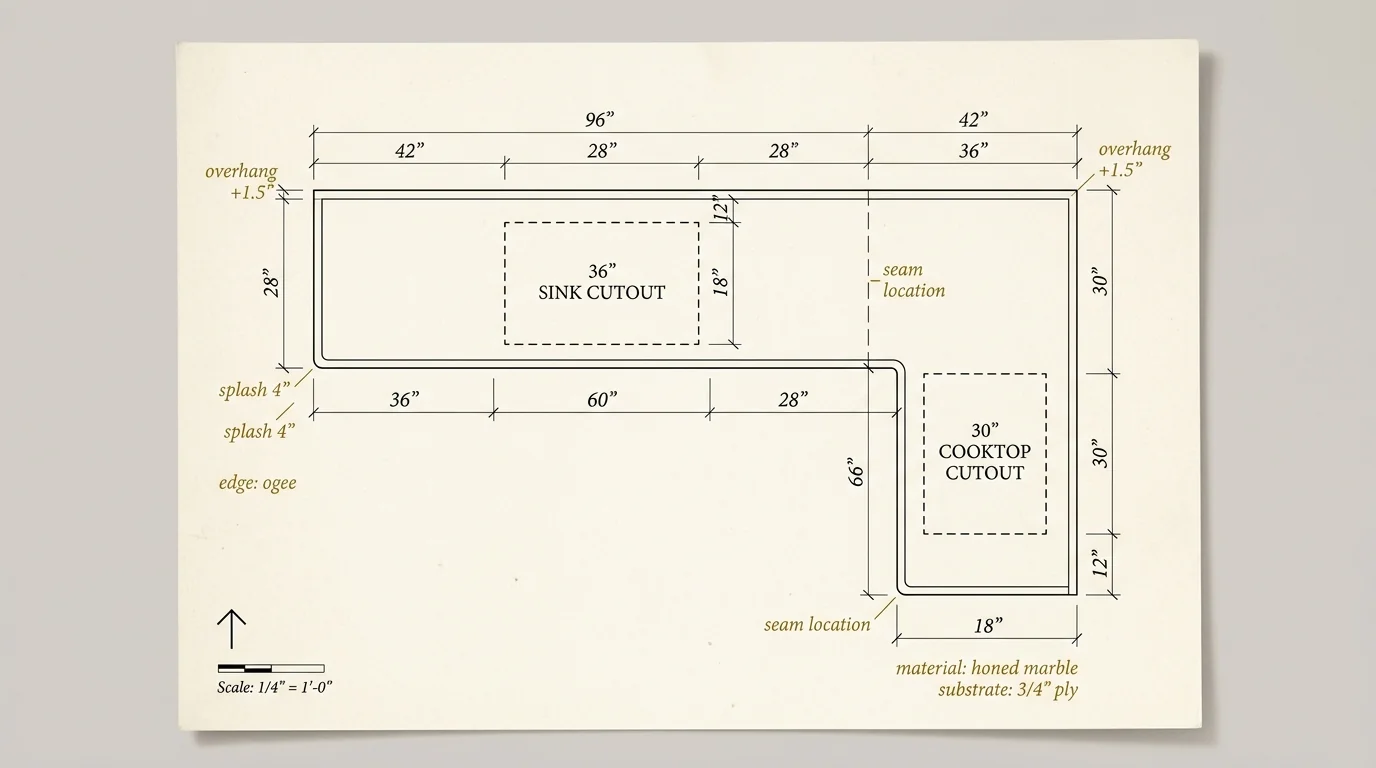
You can't template a countertop without knowing exactly which sink and cooktop will be installed. The fabricator will not eyeball it. They cut to the manufacturer's spec sheet, and if your sink arrives 1/4 inch wider than what they cut for, the slab is scrap.
For sinks, the manufacturer ships a paper template with the box. If you've already ordered the sink, find that template and bring it to the measure. If you haven't, download the cutout dimensions from the manufacturer's website and write them on your sketch with the sink centered on the cabinet below it.
For cooktops, same logic. Gas cooktops typically need a 28- to 30-inch cutout for a 30-inch unit; induction cooktops are usually a snug 28 inches. The model number matters, Wolf, Bosch, and GE all spec slightly different cutout dimensions for what they all call a "30-inch cooktop."
Outlets are the third cutout that nobody plans for and everybody regrets. Walk the back wall and mark every outlet that sits in the planned backsplash zone. Note any pop-up outlets on the island. The fabricator needs to know where the seams cannot land, you don't want a slab seam running through an outlet, because the cutout will weaken the joint and the slab can crack along it within a year.
Edge Profiles and Overhangs
Edge profiles are mostly aesthetic but carry a cost difference. The most common profiles we install in Palm Beach County kitchens, in order of popularity:
- Eased, a clean square edge with the corners knocked off. Modern, durable, low cost. Reads well against figured stone.
- Pencil round, a fully radiused 1/8-inch curve. Soft to the touch, hides chips, hides minor template variation.
- Half bullnose, top edge rounded, bottom edge square. Traditional but not fussy.
- Mitered edge, two slabs joined at 45 degrees so the apparent edge thickness becomes 2 to 4 inches. Looks expensive because it is. Adds 20 to 40 percent to fabrication cost.
- Ogee, double-ogee, beveled, decorative profiles for traditional kitchens. We do them, but they're 30+ years out of fashion in most of South Florida.
For overhang, write down each side separately. Front overhang on a base cabinet: 1.5 inches standard. Back overhang against the wall: 0.5 inch maximum, and most installers prefer 0 if the wall is reasonably straight. End-cap overhang on an unfinished cabinet end: 1.5 inches if it's exposed, 0 if it dies into a wall. Seating overhang on the back of an island: 12 inches minimum.
Anything past 12 inches without support is a slab failure waiting to happen. We've replaced cracked overhangs in homes where the original installer ran 14 inches with no corbels because the homeowner didn't want visible brackets. Steel L-brackets hidden inside the cabinet are the cheapest fix and they're invisible once the slab goes on.
Standard Kitchen Countertop Dimensions
If you just want the reference numbers before you pull a tape, here they are. These are the standard kitchen countertop measurements we work to on most Palm Beach County jobs, and the dimensions our fabrication shop cuts to unless a design calls for something custom. Your own kitchen can vary, but knowing the defaults tells you when a number on your sketch looks wrong.
Depth is the one most people get wrong. A finished kitchen counter measures about 25.5 to 26 inches front to back, not 24. The 24 inches is the cabinet box. The extra inch and a half is the front overhang that lets you wipe crumbs into your hand instead of into the drawer fronts. Bath vanities run shallower, usually 22 inches, so don't carry your kitchen number into a bathroom job.
Thickness comes in two standard cuts. A 3cm slab is roughly 1.25 inches thick and is what we install on most kitchens, since it carries its own overhang and edge profile without extra support. A 2cm slab is about 0.75 inch and is lighter and cheaper, but it usually wants a plywood deck under it or a built-up edge to read as thick at the front. A typical granite countertop in this market is 3cm. So is most quartz and quartzite. If a quote lists 2cm without mentioning a built-up edge, ask why.
Overhang splits by use. The working front edge sits at 1 to 1.5 inches past the cabinet. A seating overhang where stools tuck under wants 10 to 12 inches of clear knee room, and anything past 12 inches needs corbels or a hidden steel knee brace so the stone doesn't crack under weight. For the backsplash, a 4-inch mini splash is the default, while a full-height splash carries the slab up to the bottom of your upper cabinets. Both change the slab order, so decide before you measure.
Common Measurement Mistakes
The mistakes we see most often in DIY measurements:
- Measuring once. Always measure each run three times. Write all three down. Use the longest.
- Measuring the cabinet face, not the wall. The cabinet bows. The wall is your reference.
- Forgetting overhang. A 96-inch wall plus 1.5 inches of right-end overhang gives you 97.5 inches of slab, not 96.
- Skipping appliance model numbers. The fabricator can't cut to "30-inch cooktop." They need the brand and model.
- Mistaking a 4-inch splash spec for a full-height splash. Different slab orders. Different costs. Different templates.
- Eyeballing corners. Use a square. Old Florida homes settle, and 88-degree corners are normal.
- Not photographing the tape. If a number is wrong, the fabricator can re-derive it from the photo. Without the photo, they're calling you for a re-measure.
Cost Guide
Pricing in Palm Beach County varies by material and slab grade. These ranges include fabrication, edge profile, and installation. Sourcing notes, and where the good local stone yards are, live in our guide to buying countertop slabs in Palm Beach County.
Mitered edges add 20 to 40 percent to fabrication. Waterfall ends add the cost of an extra slab matched to the same lot. Demolition of an existing countertop runs $200 to $400 for a typical kitchen. Plumbing disconnect and reconnect, if you don't have a separate plumber on the job, runs another $250 to $500.
South Florida Considerations
Humidity changes the maintenance math. Marble and other porous natural stones need a penetrating sealer every six to twelve months in Palm Beach County, more often near the coast where salt air accelerates everything. Quartz is sealed once at fabrication and never again. Quartzite sits in the middle: most varieties need sealing once a year, some of the harder Brazilian quartzites can go two years between treatments. The full picture is in our guide to countertop materials for Florida humidity.
Lead times locally are usually one to two weeks from final template to install for stock-color quartz, two to three weeks for natural stone where you're picking a specific slab from the yard. Most Palm Beach County yards (Doral, Pompano Beach, Riviera Beach) hold their inventory for 7 to 10 days after a deposit, so don't put down a deposit on a slab until your fabricator is templating within that window.
Hurricane prep doesn't affect countertop selection directly, but it does affect cabinet specs. A 3 cm thick slab of quartzite weighs about 18 pounds per square foot. A 40 sq ft kitchen is 720 pounds of stone sitting on cabinets that need to be properly anchored to studs. Big-box particleboard cabinets often fail this load over a 10-year horizon in South Florida humidity. We spec plywood-box cabinets on every install, partly for moisture, partly for load capacity.
If you've already received a contractor quote based on your measurements, our guide to reading a contractor quote walks through which line items to scrutinize so the slab cost line on paper matches what actually shows up on install day.