Integrated Sinks: The Pros, the Cons, and What They Actually Cost
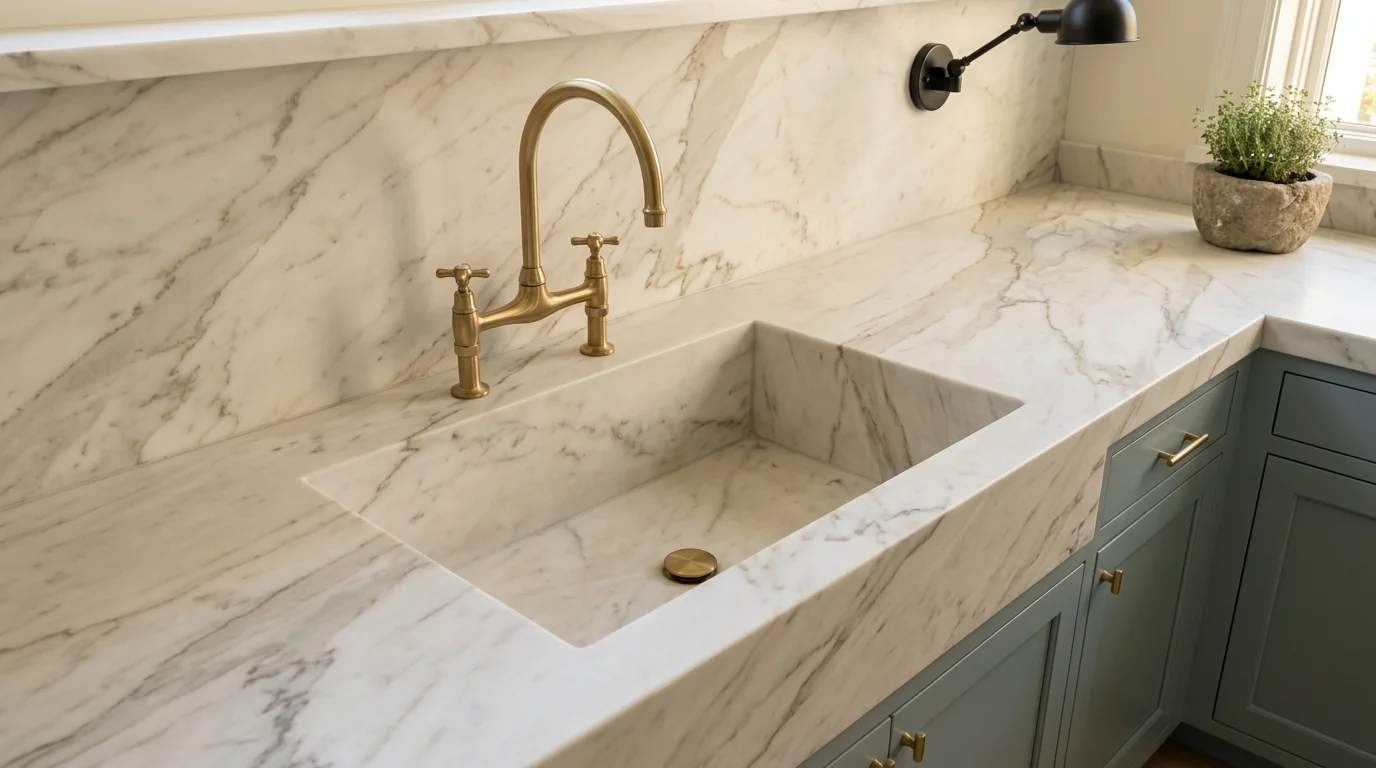
An integrated sink is one where the basin is made from the same material as the countertop. It bonds right into the cutout from below. There is no metal rim on top, no mounting clips, and no visible material change. Look down into the bowl and you see the same stone or solid surface as the counter. It's the most clean sink you can buy. And yeah, it costs.
This guide covers what an integrated sink really is, since it gets confused with undermount all the time. It also covers which materials can be built this way, and what they really cost in Palm Beach County. Then it shows where they're worth the upgrade, and where a standard undermount does the same job for less.
If you're earlier in the broader sink choice, our undermount vs. drop-in sink comparison covers the cheaper options first.
What Is an Integrated Sink?
Here's how it's made. A hole is cut into the counter slab. Then the basin is built on its own as five pieces from the same material as the counter. That's four wall panels plus a bottom. Those five pieces are bonded together to form the bowl. The bowl is then bonded into the underside of the cutout. This is a lot like how an undermount sink mounts, but with no metal clips.
The seams sit between the wall panels and around the edge where the bowl meets the counter. They are color-matched. They get filled with epoxy or color-matched silicone. Then they are polished so it reads as one smooth surface.
How the pieces join depends on the material. For solid surface like Corian, the bond is a true chemical fusion. The material welds together. For concrete, the basin and counter can be cast as one piece in the mold. Stainless welded sinks fuse at the welds. But for stone like quartz, marble, and quartzite, the integrated sink is really a multi-piece bonded build. That holds true even when it looks clean.
The word gets used loosely. We see "integrated" on quotes that are really just standard undermount sinks. Those use a separate metal or porcelain basin held under the counter with clips. There's a visible material change between the stone counter and the metal sink. A real integrated sink uses the SAME material as the counter for the basin. It bonds right to the underside of the cutout with no clips. That's the difference that matters.
One more point to clear up. An integral sink is the same thing as an integrated sink. Different shops use different words. "Integral," "integrated," and "fully integrated" all mean the same thing in practice.
Materials That Work for Integration
Not every countertop material can hold a true integrated sink. Here's the list of what works:
- Quartz (engineered stone). The most common integrated-sink material. Brands like Caesarstone, Silestone, and Cambria sell ready-made integrated bowls in matching colors. Those bond into the counter cutout. For custom sizes, our shop builds the basin from the same slab as the counter. That's four wall panels plus a bottom. The bowl is bonded into the cutout from below. Then the seams are color-matched and polished.
- Solid surface (Corian, Hi-Macs, Staron). The first integrated-sink material. Solid surface bowls fusion-bond to the counter. The seam then vanishes under sanding and polishing. It's the only material where you get a true chemical weld between bowl and counter.
- Concrete. Cast as one piece in the mold. Mostly industrial-modern kitchens, sometimes high-end baths. It's heavy and needs sealing. The design also has to be planned when the forms are built. You can't add an integrated bowl to a concrete counter later.
- Stainless steel. Welded into one piece. The counter and bowl come from one stainless build. It's most common in commercial kitchens. But it shows up in homes when somebody wants a real chef's-kitchen look. The welds are ground and polished smooth so the seam disappears.
- Porcelain slab. Newer to the U.S. market, common in European kitchens. Porcelain is too brittle to thermoform. So a true one-piece integrated porcelain bowl isn't doable at home scale. What gets sold as "integrated porcelain" is usually a CNC-cut undermount bowl bonded from below with color-matched silicone. The gap is very tight, but it's really still an undermount. If a shop quotes you a fully integrated porcelain install, ask exactly how it's built.
Natural stone (granite, marble, quartzite) can be built the same five-piece bonded way as quartz. We do it often. The veining can run right across the basin. We cut the wall panels from back-to-back sections of the same slab and vein-match them. It's the same trick used for waterfall edges and book-matched backsplashes. So the pattern flows from the counter down into the bowl instead of breaking at each panel.
The real trade-offs on natural stone are cost and seams, not looks. The work runs higher because the material is harder to cut and bond cleanly. And the color-matched bonding seams can show a bit more against natural stone than against engineered quartz.
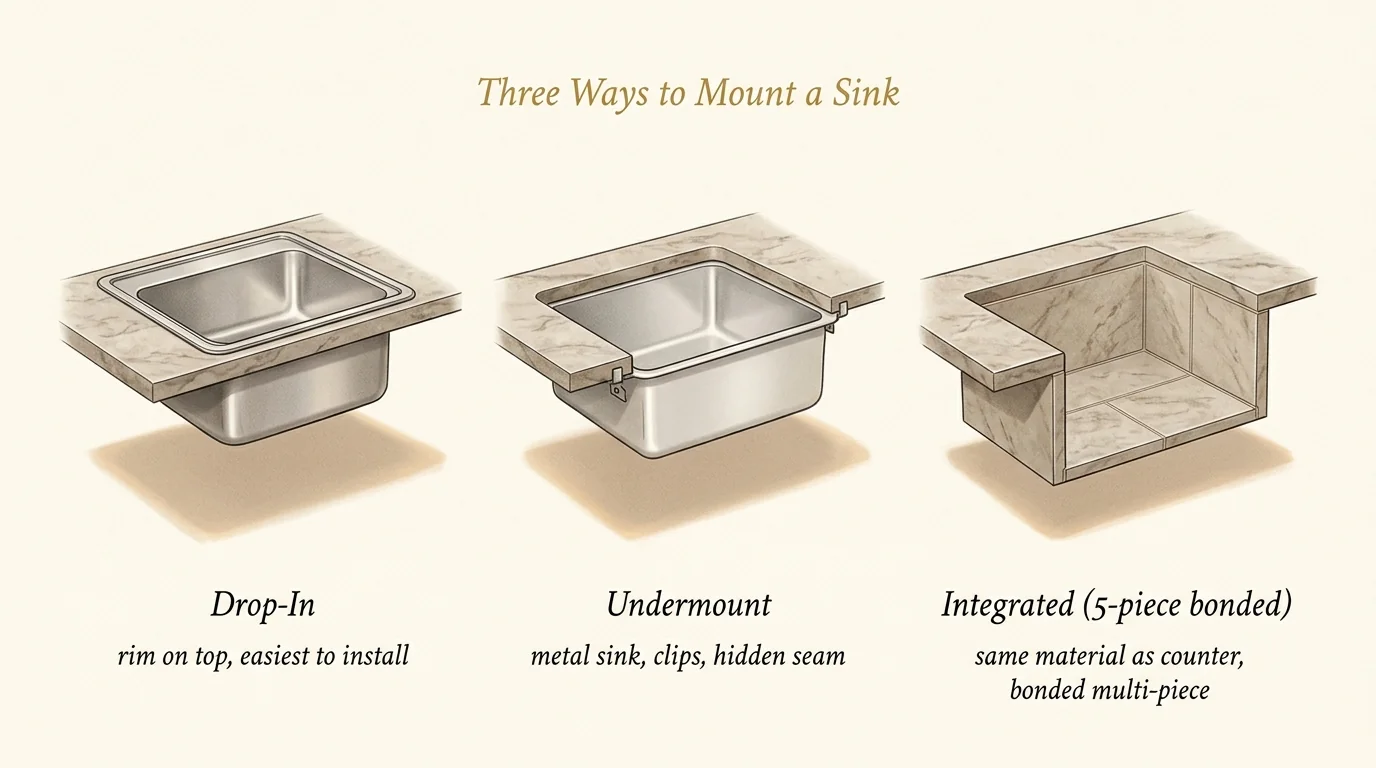
Integrated vs. Undermount vs. Drop-In
Three installs, three price points. They clean very differently too. The diagram above shows the cross-section difference. In short:
- Drop-in sinks have a visible rim that sits on top of the counter. They're the easiest to install and the cheapest. But the rim collects crumbs and water, and the visible edge breaks up the counter line.
- Undermount sinks mount under the counter with clips. The bowl hangs into the cutout. There's a thin flat seam at the rim where it meets the stone. This is standard for Palm Beach County kitchens at the mid-tier and above.
- Integrated sinks use the same material as the counter for the basin. They bond right to the underside of the cutout. There are no clips, no metal rim, and no material change. Stone integrated sinks are really a multi-piece build with color-matched seams. But it reads as one smooth surface. They give the cleanest look and are easiest to wipe down. They're also the most expensive to make.
Want a clean, modern look where the counter reads as one unbroken surface? Go integrated. Just want a sink that works at a fair price? An undermount gets you 95% of the look for way less.
The Pros
What integrated sinks do well:
- No metal rim or mounting clips. This is the single biggest perk. Undermount sinks have a metal rim and clips that can corrode in humid spots. They also have a flat seal at the rim that can fail over the years. Drop-in rims sit on top of the counter and collect crumbs in days. Integrated sinks bond right to the underside of the cutout. So there are fewer parts that can fail down the road.
- One smooth look. The counter and basin are the same material with color-matched seams. In modern and minimalist kitchens this is the whole reason to spec one.
- Cleaner surface. Solid surface (Corian) and welded stainless integrated sinks are truly clean. They offer real hygiene perks. Hospitals and labs use them for that exact reason. Stone integrated sinks have color-matched seams that need a wipe like any other counter joint. But the surface still cleans up easier than a drop-in rim or an undermount metal-to-stone rim.
- Custom bowl shape and size. When the shop CNCs the bowl, you can design the exact size you want. You can go wider than a standard 30-inch undermount, deeper, or with a special curve. Off-the-shelf undermount bowls limit you to what makers stock.
- Strength at the rim. Undermount sinks are held by clips and glue. Over the years the seal can fail. The sink can drop if it's mistreated. Integrated sinks can't fail at the rim because there is no rim.
The Cons
What integrated sinks don't do well:
- Cost. This is the biggest reason most homeowners skip one. A quartz integrated sink can run 2 to 3 times the cost of a standard undermount with the same counter. Custom-CNC integrated bowls cost more still.
- The bonding seams can discolor over time. Stone integrated sinks (quartz, marble, quartzite) are really a multi-piece bonded build. That means four wall panels plus a bottom. They are bonded together and bonded to the counter cutout with color-matched epoxy or silicone. Even when it reads as one smooth surface at install, those seams age. Within 2 to 5 years the bonding lines can yellow, darken, or collect grime the way the rest of the stone doesn't. They then have to be cut out and re-filled to look new again. Solid surface (Corian) integrated sinks don't have this problem. The bond is a true chemical fusion, not a filler line. Concrete cast as one piece in a mold doesn't have it either. Welded stainless integrated sinks fuse at the welds. For everything else, meaning most quartz and all natural stone, the seams are real and need to be planned for down the road.
- Repairs. If the bowl chips or scratches deeply, the fix is harder than swapping out an undermount. With undermount, you replace the sink in a day. With integrated, the bowl is part of the counter. A fix often means remaking a whole counter section.
- Heat (on quartz). Quartz counters can yellow or scorch under steady high heat. A quartz integrated sink near a stove is fine for normal use. But pouring boiling water right into the bowl over and over for years can stress the resin. Solid surface and stainless integrated sinks don't have this issue.
- Lead time. Custom-CNC integrated bowls add 2 to 3 weeks to the build versus a stock undermount install. If your project schedule is tight, plan for that.
Cost Guide
Palm Beach County pricing, late 2026, made and installed. These ranges cover the bowl making and install labor only. They do not include the countertop slab material itself.
Here's the thing to notice. Even the prefab quartz integrated bowl runs 3 to 5 times the cost of an undermount stainless. That's what the continuous look costs. For a deeper look at the whole countertop budget, our Palm Beach County kitchen remodel cost guide walks through where the dollars really go in a typical kitchen.
Where Integrated Sinks Work Best
The applications where the cost premium pays off:
- High-end primary bath vanities. Quartz or solid surface integrated bowls in a primary bath read as a true spa surface. The counter flows into the bowl with no break. That photographs great and wipes down in 10 seconds. This is where most of our integrated-sink installs end up.
- Powder rooms. Small space, big visual punch. An integrated bowl in a powder room with a floating wood vanity reads as one sculpted piece. It's worth the upgrade because the room is small enough that the cost stays in check.
- Wet bars and butler's pantries. You use it less, so the dollars-per-use math is worse than in a kitchen. But an integrated bowl in a wet bar looks a lot more high-end than a tiny undermount.
- Modern minimalist kitchens. Some kitchens are built around a clean, unbroken look. Think slab-front cabinets, panel-ready appliances, and a waterfall stone island. In those, the integrated sink is the obvious finish.
- Commercial and pro-style kitchens. Stainless welded integrated sinks fit a chef's-kitchen design. They clean as fast as the rest of the metal surfaces.
They don't pay off in standard kitchens where the goal is cooking and clean-up. A 30-inch undermount stainless does the same job for a fraction of the cost. We talk plenty of clients out of integrated sinks in standard kitchens. The money is better spent on the cabinets or the countertop slab itself.
Cleaning and Maintenance
Day-to-day cleaning is truly easier with integrated. Wipe the counter with a wet cloth and the basin gets cleaned at the same time. There's no metal-to-stone rim to work around like an undermount. There's no top rim to wipe around like a drop-in.
The bonding seams between the wall panels and around the edge need the same wipe as the rest of the counter. They also need the now-and-then re-fill noted in the cons section. But day-to-day they don't trap dirt the way a metal rim does.
Material-specific maintenance notes:
- Quartz. Skip rough scouring pads. Don't pour boiling water into the bowl over and over. A standard pH-neutral kitchen cleaner is fine. Don't use bleach or full-strength ammonia on quartz over time.
- Solid surface (Corian). The most forgiving. Surface scratches sand out with a fine-grit pad. Stains lift with a mild scrub cleaner. Probably the easiest integrated material to live with for years.
- Concrete. Sealed concrete is tough, but the sealer needs a fresh coat every 1 to 3 years. Acidic foods like lemon and tomato can etch through worn sealer. A mineral-oil rub helps keep the patina.
- Stainless welded. Same care as a stainless undermount. Wipe with the grain, skip steel-wool, and dry it to stop water spots. The welds can't be seen and need no special care.
South Florida Considerations
Two things shape integrated sink choices in Palm Beach County:
Humidity and hard water. Our water has more minerals than most of the U.S. That leaves visible spotting on stainless and quartz over time. Integrated sinks aren't safe from this either. But the one-material surface makes spotting easier to wipe away than the metal rim of a typical undermount. We suggest a water softener for any high-end kitchen install, no matter the sink type.
Coastal salt air. Homes east of A1A see real corrosion on stainless plumbing fittings within 5 to 10 years. Stainless integrated sinks (welded builds) get the same exposure. For coastal homes we usually suggest quartz or solid surface integrated over stainless.
Are you in Palm Beach County and want an integrated sink in marble, quartzite, granite, or quartz? Maybe it's a primary bath upgrade, a powder room build, or a modern kitchen with a one-material counter and basin. Either way, contact us for a free in-home consultation. We design and install integrated sinks across all the cities we serve, from Boca Raton to Jupiter.
We also walk through the cost trade-off honestly, so you don't pay the integrated premium where an undermount would have done the same job. For more on picking the right material in our climate, our guide to countertop materials for Florida humidity covers what holds up here for years.