Slim Shaker Cabinets (Thin Shaker): The 2026 Kitchen Trend Explained
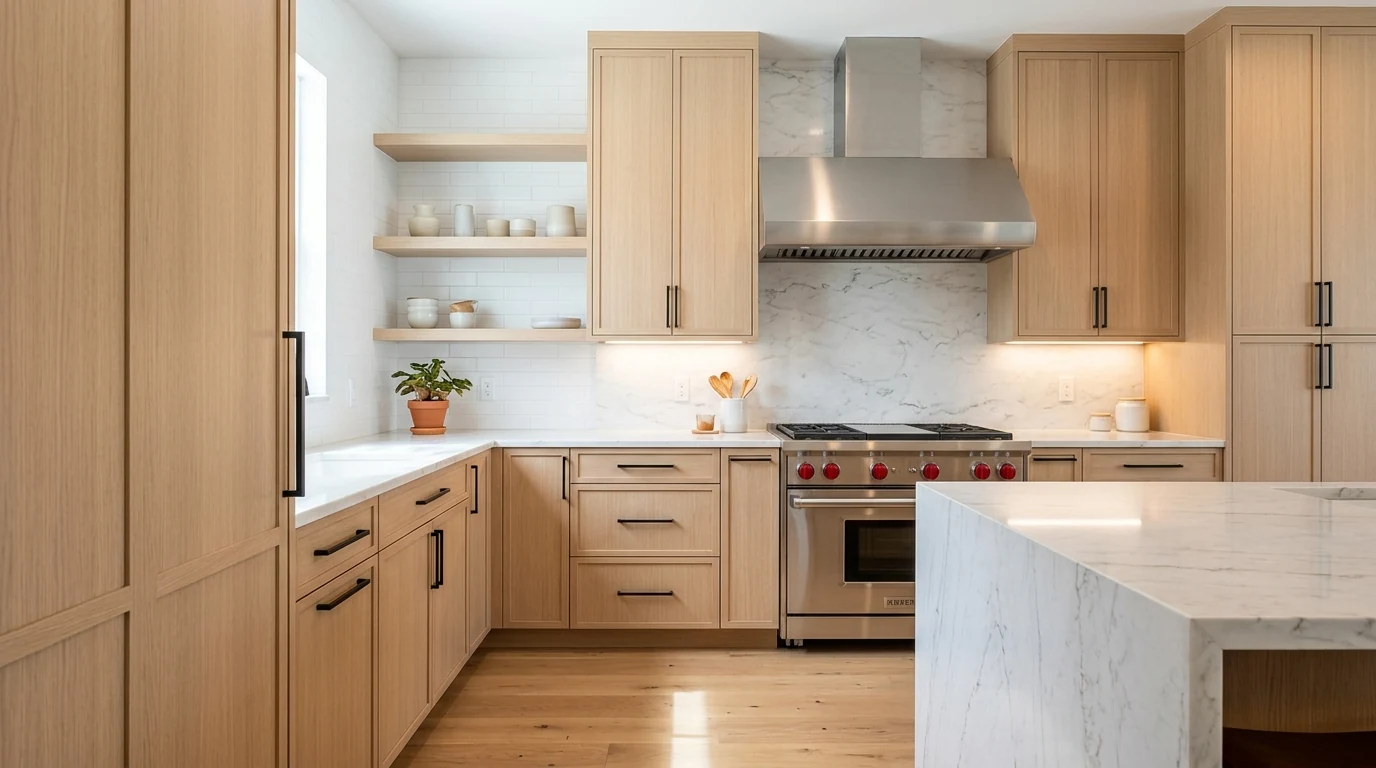
Slim shaker cabinets are the door style walking through our Palm Beach County showroom the most often in 2026. Clients pull up a saved photo, point at the cabinets, and ask what that door is called. Nine times out of ten it is slim shaker, sometimes sold as thin shaker, narrow shaker, or modern shaker, but the same door.
The short version: slim shaker keeps the five-piece flat-panel construction that has been in American kitchens for a century, then shrinks the rails and stiles from about 2.25 inches down to 1.5 inches. That one change makes the door read as modern instead of farmhouse, and it is pulling a lot of homeowners away from full slab and off ordinary shaker at the same time.
We have installed slim shaker in Boca Raton townhomes, Delray Beach coastal cottages, Wellington new-builds, and a couple of Jupiter waterfront renovations. This guide walks through what the door actually is, how it differs from classic shaker, when it is the right call, what it costs in our market, and the details that matter once you get it into a South Florida house.
What Is Slim Shaker (Thin Shaker)?
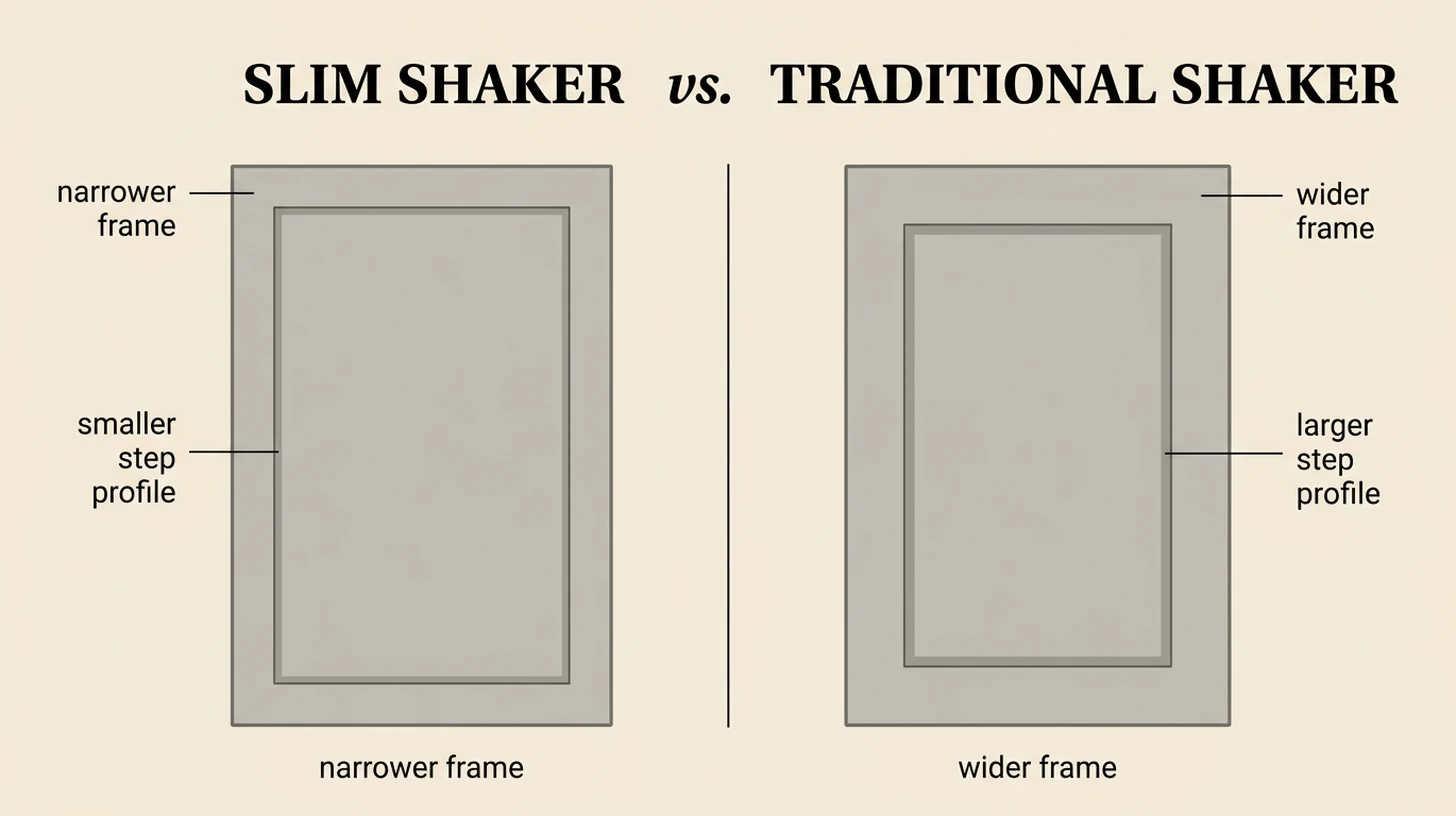
A shaker door is a five-piece frame-and-panel construction: two vertical stiles, two horizontal rails, and a flat center panel. Traditional shaker uses rails and stiles around 2 to 2.5 inches wide. Slim shaker narrows that frame to roughly 1 to 1.75 inches, with 1.5 inches being the most common and the most versatile.
That is really the entire design change. No shaped edges. No applied moldings. No raised panels. Just a thinner frame around the same quiet recessed panel. Because the frame is the only thing that catches light, slim shaker reads almost flat from across a room and more architectural up close.
The style traces back to a cross between two things our team has watched happen over the last decade. European frameless cabinet makers have been doing narrow-rail fronts for years, because thin is easier when you do not have a face frame eating clearance. American cabinet shops started borrowing the proportion around 2020, and by 2024 every major semi-custom line from KraftMaid to Medallion had a slim shaker offering. The National Kitchen & Bath Association flagged narrow-rail shaker in their 2025 design trends report as the second most requested door profile behind flat slab.
In person, slim shaker is the kind of detail most guests will not consciously notice. They will say the kitchen looks "clean" or "modern" or "calm" without being able to name why. That is a compliment to the door. Traditional shaker says farmhouse out loud. Slim shaker says nothing and lets the hardware, countertop, and lighting do the talking.
Slim vs Traditional Shaker: The Rail Difference
The rail width is the only real variable, but it changes everything the eye does with the door. Here is how we break it down for clients who come in unsure which one they want.
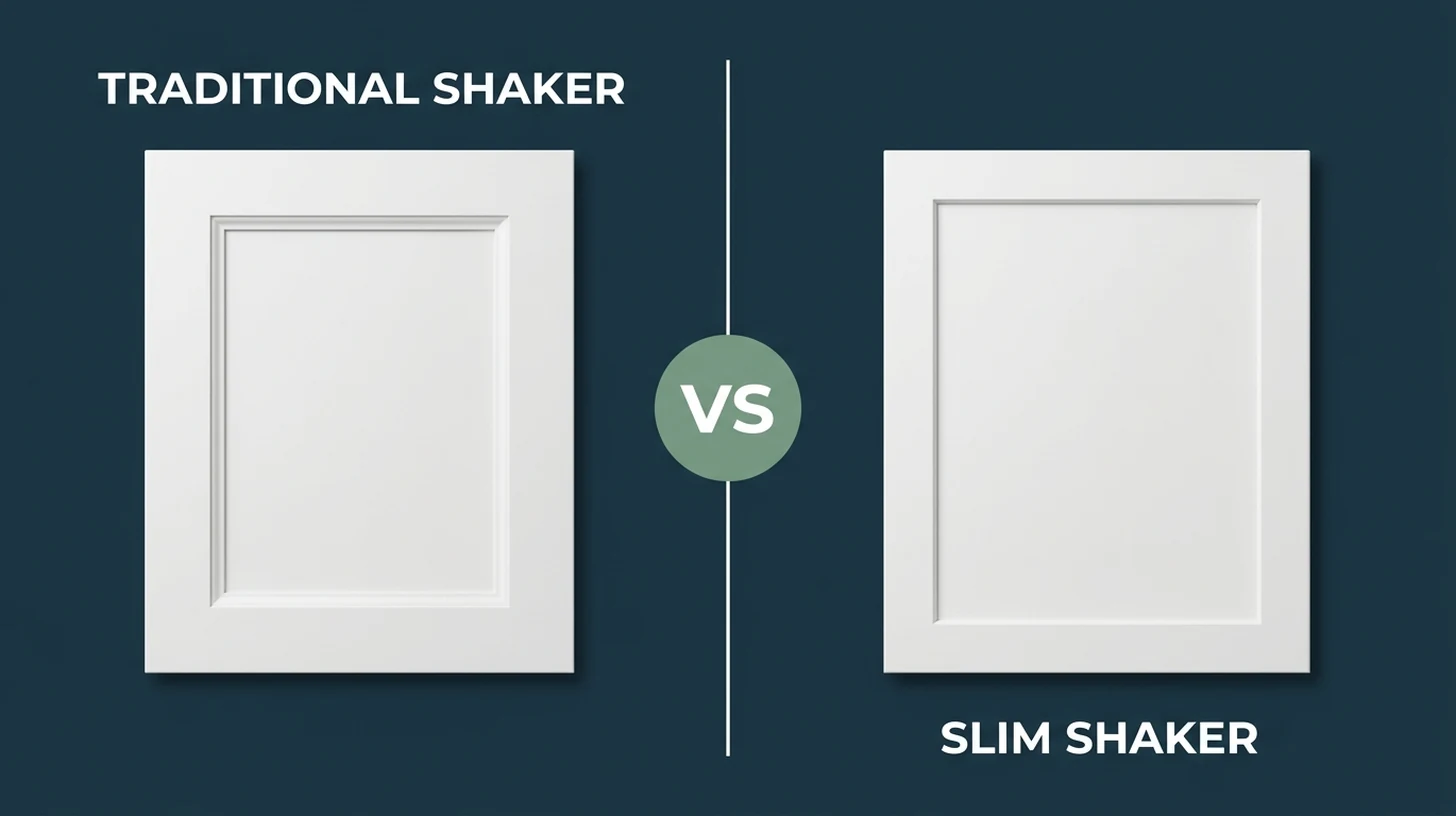
Traditional shaker (2 to 2.5-inch rail). Feels warm, familiar, and slightly farmhouse or craftsman. The thicker frame is forgiving: small gaps and imperfect alignment hide easily behind the visual weight of the wood. Pairs naturally with bead-board, cup pulls, vintage pendants, and butcher block. If you are restoring a 1920s cottage or building a classic white kitchen with subway tile, traditional shaker is usually the right answer. Browse our full kitchen cabinet style guide for how classic shaker sits among the other door profiles we see here.
Slim shaker (1.25 to 1.75-inch rail). Feels modern, European, and quietly luxurious. The thin frame looks almost like a picture frame around the panel, so the door reads as architectural rather than decorative. It asks for precision: gaps, sags, and crooked reveals are obvious at 1.5 inches that would disappear at 2.5. Pairs naturally with bar pulls, simple knobs, honed stone, matte paint, and rift-cut wood grain.
There is a narrower cousin worth mentioning. Some custom shops offer what they call "micro shaker" at around 7/8 to 1 inch. We do not specify it often. The rail gets so thin that the door starts to feel fragile, and on anything larger than a drawer front the panel flex becomes a real problem. Stay between 1.25 and 1.75 inches and the door will wear beautifully.
One more thing worth saying out loud: the panel itself matters almost as much as the rail width. A flat MDF panel gives you the cleanest, most modern look. A solid-wood panel shows grain and movement, which reads warmer but can crack in the dry side of our AC season. For a modern slim shaker, we almost always specify an MDF center panel with a solid-wood frame. Best of both.
When to Choose Slim Shaker
Slim shaker is the right door when the rest of your design is quiet and the cabinets need to recede. It is the wrong door when you are trying to build a warm, ornamented, layered kitchen with a lot of personality in the millwork itself. Here is how we sort clients during a consultation.
Choose slim shaker if:
- You want a modern or transitional kitchen without going to full slab.
- You are specifying a strong countertop (honed marble, waterfall quartzite, dramatic quartz) and want the cabinets to step back so the stone leads.
- You are using rift-cut or quarter-sawn wood and want the grain to show without a thick frame interrupting it.
- Your hardware plan is minimal: bar pulls, small knobs, finger edges. A chunky cup pull will look wrong on a 1.5-inch rail.
- Your house is newer (2005 onward) or recently renovated in a contemporary direction. Slim shaker sits well alongside clean baseboards and simple trim.
Stick with traditional shaker if:
- Your home is historical or explicitly farmhouse, cottage, or Cape Cod in style.
- You want visible, layered millwork: beadboard backs, crown molding, a big range hood with corbels.
- You love the look of cup pulls, bin pulls, or vintage brass knobs. They live on a wider rail.
- Your finish is a soft off-white, sage, or weathered blue painted in a brushed chalky texture. Thicker frames carry those finishes better.
Hardware is where most homeowners trip up. Slim shaker demands a narrow profile. If you are not sure what to pair with it, our cabinet hardware placement guide covers the sizing rules we use on every job, and mixing knobs and pulls walks through the combinations that actually work on thin-rail doors.
Slim Shaker Cabinet Cost Guide
Slim shaker costs a touch more than the same line in traditional shaker, usually 5 to 15 percent, because the tighter tolerances take more time in the shop. The numbers below are our Palm Beach County installed prices per linear foot of cabinetry, including boxes, doors, hardware, and installation labor. They do not include countertop, backsplash, or appliances.
A typical Palm Beach County kitchen with 20 to 25 linear feet of cabinets lands somewhere between $7,200 and $17,000 on the painted semi-custom tier, and $9,200 and $27,500 in rift oak. A full-custom inset slim shaker project, which is the top of the market, can easily cross $35,000 in cabinetry alone on a mid-sized kitchen. For the full breakdown of everything else that goes into a remodel, see our Palm Beach County kitchen remodel cost guide.
If the numbers above are a stretch and your boxes are in decent shape, refacing is worth a serious look. Refacing versus replacement walks through the math, but the short version is that a reface to slim shaker runs roughly 40 to 55 percent of a full replacement in the same finish. On a 25-linear-foot kitchen in painted slim shaker, that is the difference between about $9,000 and $16,000, a meaningful swing if the existing plywood is still square and solid.
Two extras worth pricing in from day one. Inset construction (where the doors sit flush inside the frame rather than overlaying it) roughly doubles the cabinet budget but is the cleanest version of slim shaker you can build. And premium finishes like cerused oak, hand-painted lacquer, or fumed walnut add 15 to 40 percent on top of the base wood price. Neither is necessary, but both show up in magazine-level kitchens.
South Florida Considerations
Slim shaker behaves well in Palm Beach County climate as long as the build specs are right. The two enemies here are humidity swings and salt air, and both hit painted wood hardest.
For painted slim shaker, we specify a conversion-varnish or catalyzed-lacquer finish rather than a straight latex enamel. The catalyzed finishes cure hard, resist moisture, and handle the daily AC-cycle humidity shift better than anything you can roll on. Clients in Jupiter and Palm Beach Gardens, where homes sit closer to the salt spray, especially benefit from the harder finish.
Solid-wood center panels can cup or crack in our climate because the AC dries them out in summer and the shoulder seasons pull moisture back in. We default to an MDF panel inside the solid-wood frame on every slim shaker job. The frame still looks and feels like wood. The panel stays flat. It is a small spec line item that prevents call-backs three years later.
For rift-cut white oak, which is easily the most requested finish in our showroom right now, make sure the shop is using a UV-inhibiting top coat. South Florida sun coming through tall windows will bleach unprotected oak within a couple of seasons, and once it bleaches you cannot stain it back. The industry data from NAHB shows light-wood kitchens keep their resale premium longest when the finish is engineered for UV, not just scratch resistance.
Slim shaker also pairs beautifully with the thick-countertop profiles that have taken over Palm Beach County over the last two years. A 2-inch mitered quartzite edge on top of a 1.5-inch slim shaker drawer bank looks unbelievably balanced. If you are still deciding on the backsplash, our 4-inch versus full-height backsplash comparison covers how each one plays against a thin-rail door.
One last thing about permits. Swapping doors is not a permitted activity in unincorporated Palm Beach County. Adding new electrical for under-cabinet lighting or moving plumbing for a sink relocation usually is. Permits get pulled through the county on any job that crosses those lines, and any general contractor you hire should do the same. If someone waves off permitting on a full kitchen remodel, that is a flag.
Slim shaker is not a fad. It is the natural next step for a door style that has been quietly running American kitchens for a hundred years, and it translates especially well to the bright, light, stone-and-wood aesthetic that Palm Beach County has settled into. Specify the rail width you actually want (not what the brochure assumes), insist on an MDF center panel, pair it with narrow-profile hardware, and it should still look current when your grandchildren show up.