Bathroom Lighting Ideas for Palm Beach County Remodels
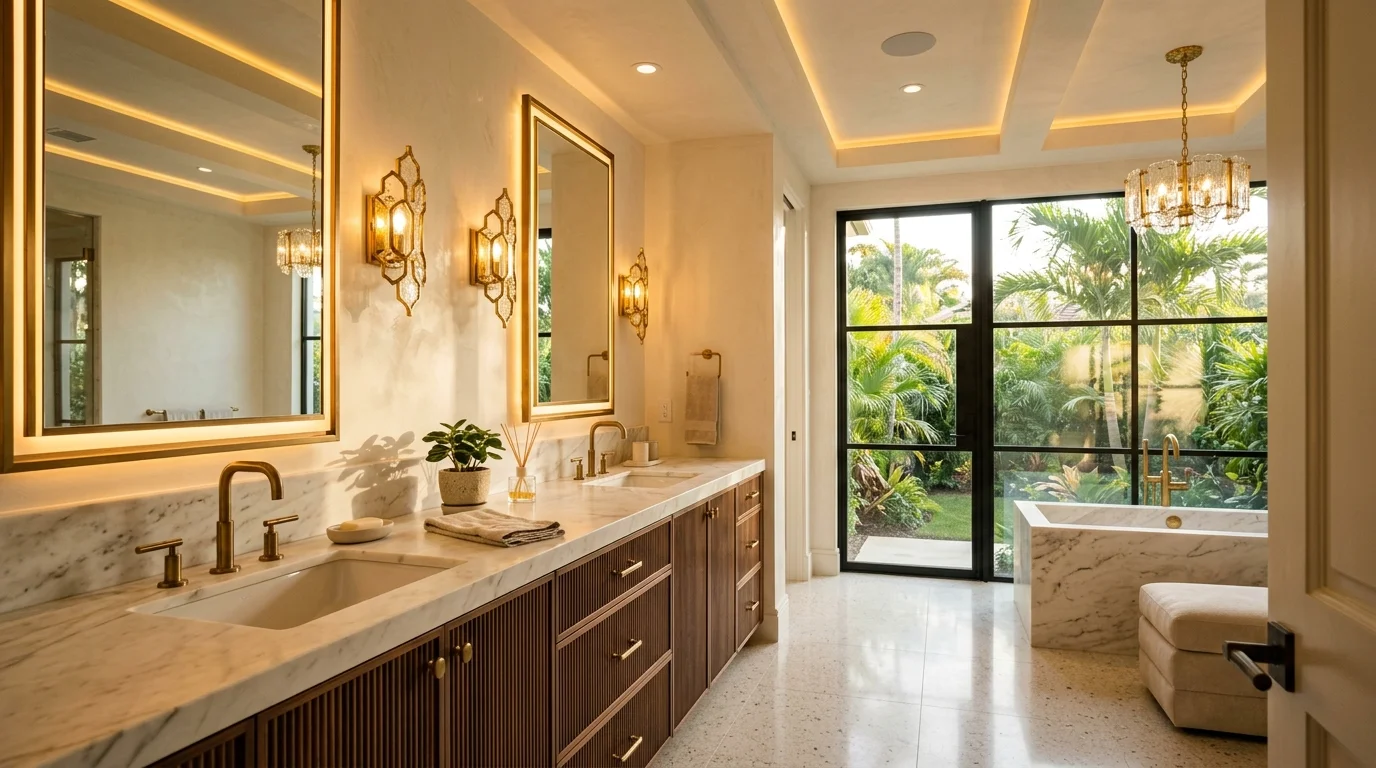
Bathroom lighting ideas are one of the most underestimated decisions in any Palm Beach County remodel. Homeowners spend weeks picking tile and weeks more on vanities, then rush through lighting in an afternoon, and it shows. Bad lighting flattens a beautiful space. The right lighting makes a modest bathroom feel like a boutique hotel. We've worked on bathrooms across Boca Raton, Delray Beach, Wellington, and Jupiter, and the difference between a bathroom that photographs well and one that actually functions well comes down to layering your light sources thoughtfully. This guide breaks down every option, what it costs locally, and what we actually recommend based on years of South Florida work.
Why Lighting Makes or Breaks a Bathroom
Most bathrooms in Palm Beach County were built with a single overhead fixture centered on the ceiling. That fixture throws a shadow directly onto your face at the vanity, makes the shower feel like a cave, and gives the whole room a flat, dated look. A single fixture is not a lighting plan. It's a placeholder.
Proper bathroom lighting uses at least three layers: ambient (general room illumination), task (focused light for grooming), and accent (depth, warmth, and drama). You don't need all three to be elaborate. A recessed ceiling grid handles ambient. Side-mounted sconces handle task. A backlit mirror or LED toe-kick adds accent without any ceiling penetrations at all. That combination, three sources, two or three switch zones, transforms how the room feels at every time of day.
Natural light in South Florida is intense, which is a gift and a problem. Most of our clients have at least one frosted window or glass block in the bath, which means daytime lighting needs to work with strong ambient brightness coming in. At night, the same bathroom goes dark fast without layered artificial light. That swing is why you can't rely on one fixture and call it done.
Lighting is also a finish decision that ties directly to your fixture metal. If you've chosen matte black plumbing fixtures, your light fixtures need to match, or at least coordinate. Check out our thoughts on black bathroom fixtures and whether the trend is worth it before you lock in your finish.
Vanity Lighting: Sconces vs. Bar Fixtures
This is the most important lighting decision in any bathroom. The vanity is where you apply makeup, shave, and check yourself before walking out the door. Get this wrong and nothing else compensates for it.
We recommend side-mounted sconces over a bar fixture above the mirror in almost every situation. Here's why: a bar fixture above the mirror throws light down and forward onto your forehead and nose, leaving your jaw and neck in shadow. Sconces mounted at face height, roughly 60 to 65 inches from the finished floor to the center of the fixture, throw light across your face from both sides, eliminating the harsh shadows that make grooming unreliable.
Side sconces require a rough-in on both sides of the mirror, which means your GC needs to know the mirror size and placement before drywall goes up. This is a sequencing issue we flag early in every project. If the electrical rough-in is already done with a single box centered above the mirror, retrofitting side sconces means opening the wall, a cost that adds up fast. Plan it right from the start.
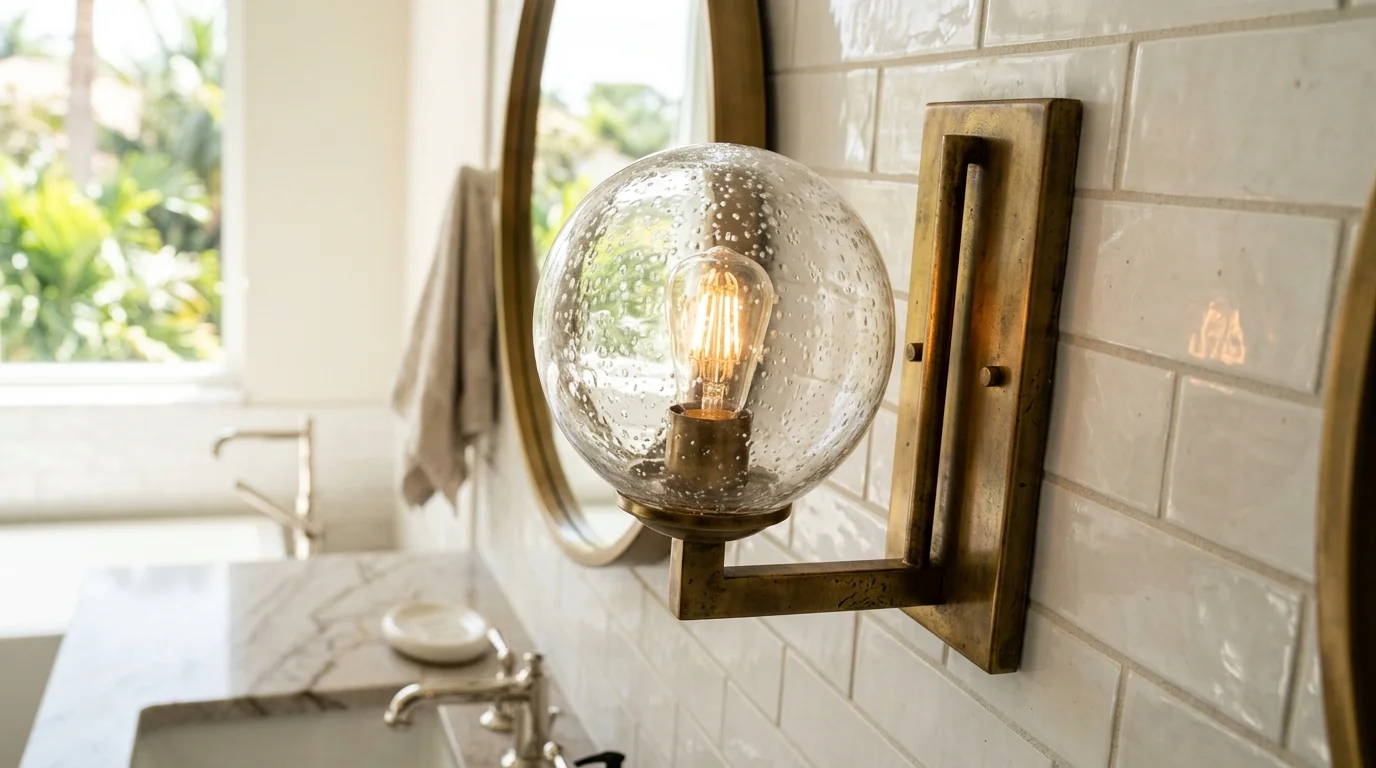
That said, bar fixtures above the mirror are not always wrong. In a powder room with a very wide mirror, or in a guest bath where the vanity is small and space is tight, a quality bar fixture with globe bulbs can work. The key is choosing a fixture with multiple exposed bulbs that spread light rather than a single elongated diffuser that just becomes a bright stripe above your reflection.
For double vanities, which are common in the master baths we work on across Wellington and Jupiter, we typically specify two pairs of sconces, one pair flanking each sink's mirror zone. This gives each person their own dedicated task light and avoids the long, awkward bar fixture that spans the whole vanity wall without purpose.
Fixture sizing matters. A sconce that's too small next to a 36-inch mirror looks lost. We use the rule of thumb that your sconce height should be roughly one-third of your mirror height. So a 48-inch mirror calls for a sconce in the 14-to-18-inch range. Your vanity selection affects this too, see our bathroom vanity ideas guide for how mirror and fixture sizing interact with cabinet depth and width.
Gold and brushed brass fixtures are having a real moment in Palm Beach County right now, and they work particularly well in the Spanish Mediterranean homes common in Boca Raton and Delray Beach. If you're leaning that direction, our gold bathroom fixtures styling guide covers how to keep the look grounded rather than overdone.
Recessed Lighting & Backlit Mirrors
Recessed cans handle the ambient layer, and in South Florida bathrooms they're almost always the right call. The flat, low-profile look works with the contemporary and coastal aesthetics that dominate Palm Beach County, and they don't collect dust and humidity the way pendant or semi-flush fixtures do.
The specification details matter enormously here. Every recessed fixture in a bathroom must be rated for damp or wet locations depending on placement. Fixtures inside the shower enclosure or directly above a tub require a wet-rated fixture. Fixtures outside those zones but still in the bathroom need at minimum a damp rating. Florida Building Code follows the NEC on this, and your GC's electrician will know the zones, but it's worth understanding yourself so you don't spec a fixture that fails inspection.
For layout, we recommend 4-inch recessed cans over 6-inch in most bathrooms. The smaller diameter looks cleaner in tight ceiling planes and gives you more flexibility with placement. Spacing them 36 to 42 inches apart in the center of the ceiling plane gives you even ambient coverage without hot spots. Add one can centered over the shower and one centered over the tub if they're separate.
Dimmer switches are non-negotiable in our opinion. A bathroom at 100% brightness at 6 AM is punishing. At 30% for a late-night visit, it's comfortable. Make sure your recessed fixtures are rated for dimming and that your electrician installs a compatible dimmer, many LED drivers are finicky with standard dimmers and will flicker or hum if mismatched.
Backlit mirrors are where the biggest design impact lives right now. A backlit or LED-framed mirror serves double duty: it provides diffuse task light around the face and gives the bathroom a finished, spa-quality look that photographs beautifully. Many models include built-in dimmers, anti-fog heating elements, and color temperature adjustment (warm to cool white), all useful in South Florida's humidity-heavy environment.
We've been specifying backlit mirrors more frequently in our coastal and modern bathroom projects. They pair particularly well with the floating vanity trend that dominates modern bathroom design in 2026. When the vanity floats off the floor and the mirror glows from behind, the whole wall reads as intentional and polished.
One honest note: backlit mirrors are not a substitute for side sconces in a primary bath where serious grooming happens. The diffuse glow of a backlit mirror is flattering but not precise enough for close work. Use both, sconces for task, backlit mirror for ambient warmth and accent, and you've covered every scenario.
Toe-kick lighting is the last accent layer worth mentioning. An LED strip under a floating vanity cabinet creates a soft glow at floor level that serves as a practical nightlight and adds visual depth. It draws the eye down and makes the vanity look like it's hovering. Low cost, high impact. Your GC can run a low-voltage wire during rough-in and you handle the LED strip at installation.
Cost Guide
These are Palm Beach County market prices based on what we see on actual projects. Fixture cost alone doesn't tell the full story, installation labor, any electrical rough-in changes, and permit costs (if your scope triggers an electrical service change) all add to the total. Permits are scope-dependent: swapping existing fixtures for new ones at the same location typically does not require a permit. Running new circuits or changing panel capacity does. Your GC's electrician will advise based on your specific scope.
A complete lighting upgrade, new recessed cans, side sconces, and a backlit mirror, typically runs $1,500 to $3,500 installed in Palm Beach County when the existing rough-in locations work. If you're relocating boxes or adding circuits, budget closer to $3,000-$5,000 once electrical labor is factored in. That's a small line item relative to what a full bathroom remodel costs. For context on overall project budgets, see our bathroom remodel cost guide for Palm Beach County.
South Florida Considerations
Palm Beach County's climate creates specific requirements that don't apply in other parts of the country. Humidity is the defining factor. Even in air-conditioned homes, bathrooms cycle through significant moisture swings every single day, hot showers, open windows, and the ambient humidity that comes with living in South Florida.
Every fixture you select needs a UL damp or wet rating appropriate to its location. This is not optional and it's not just a code issue, it's a longevity issue. We've seen chrome fixtures in unconditioned coastal bathrooms pit and corrode within two years when the wrong product was specified. Brushed nickel holds up better than polished chrome in humid environments. Powder-coated matte black is durable if the coating is quality. Solid brass with a lacquer finish lasts longest of all.
Choose LED fixtures specifically. Incandescent and halogen bulbs generate heat and are sensitive to moisture infiltration, both problems in a South Florida bathroom. LED fixtures run cool, use a fraction of the energy, and last long enough that you won't be swapping bulbs in a tight recessed housing over a shower every eighteen months. Look for fixtures rated for enclosed locations if they'll be inside a housing.
Color temperature selection matters more here than in colder climates. South Florida bathrooms often use white and light stone palettes, white oak vanities, porcelain tile, quartzite counters. Warm white light (2700K, 3000K) keeps those materials looking rich and inviting. Cool white (4000K+) can make a white bathroom feel clinical. We recommend 2700K for the primary accent layers and 3000K for recessed ambient if you want a slightly crisper feel.
HOA and condo rules are a real factor in Boca Raton and Jupiter high-rises. Electrical work in condos often requires building approval and a licensed electrician who carries condo-specific insurance. Your GC will know the requirements for your building, but plan for a longer lead time if approvals are needed. This is especially true in buildings along A1A where the property management offices are strict about contractor access windows.
For bathrooms that are part of a larger remodel, lighting decisions connect to everything else happening in the room. The tile you choose affects how your lighting reads, glossy large-format tile bounces light around and amplifies it, while matte textured tile absorbs it. If you haven't settled on tile yet, our bathroom floor tile ideas guide covers the options most common in South Florida homes, and the reflectivity differences are worth understanding before you finalize fixture placement.
One mistake we see regularly: homeowners plan their lighting after the vanity and mirror are already ordered, then discover the mirror is too large for side sconces or too small for a backlit version. Lighting, mirror size, and vanity width are all interdependent decisions. Make them together. Our bathroom renovation mistakes guide covers this and a dozen other sequencing errors that cost money to fix after the fact.
If you're working toward a spa-like aesthetic, which is one of the most requested looks we see across Delray Beach and Wellington master baths, lighting is what closes the gap between "nice bathroom" and "resort feel." Layered light on dimmers, a backlit mirror, and concealed LED strips under the vanity or inside a niche accomplish that transformation without a single structural change. Pair that with the right tile and fixtures and you'll have a bathroom that genuinely feels like a retreat. For more on that direction, our spa-like bathroom ideas guide goes deeper on the full package.
Our team at South Florida Kitchen & Bath Design has worked on hundreds of bathrooms across Palm Beach County. The lighting plan is always one of the first conversations we have, not the last. Get it into the design early, coordinate fixture locations with your GC's electrician before rough-in, and choose humidity-rated products that are built for the South Florida environment. Do those three things and your lighting will look as good in ten years as it does the day you move back in.