Porcelain vs Quartz Countertops: Which Is Better for Your Kitchen?
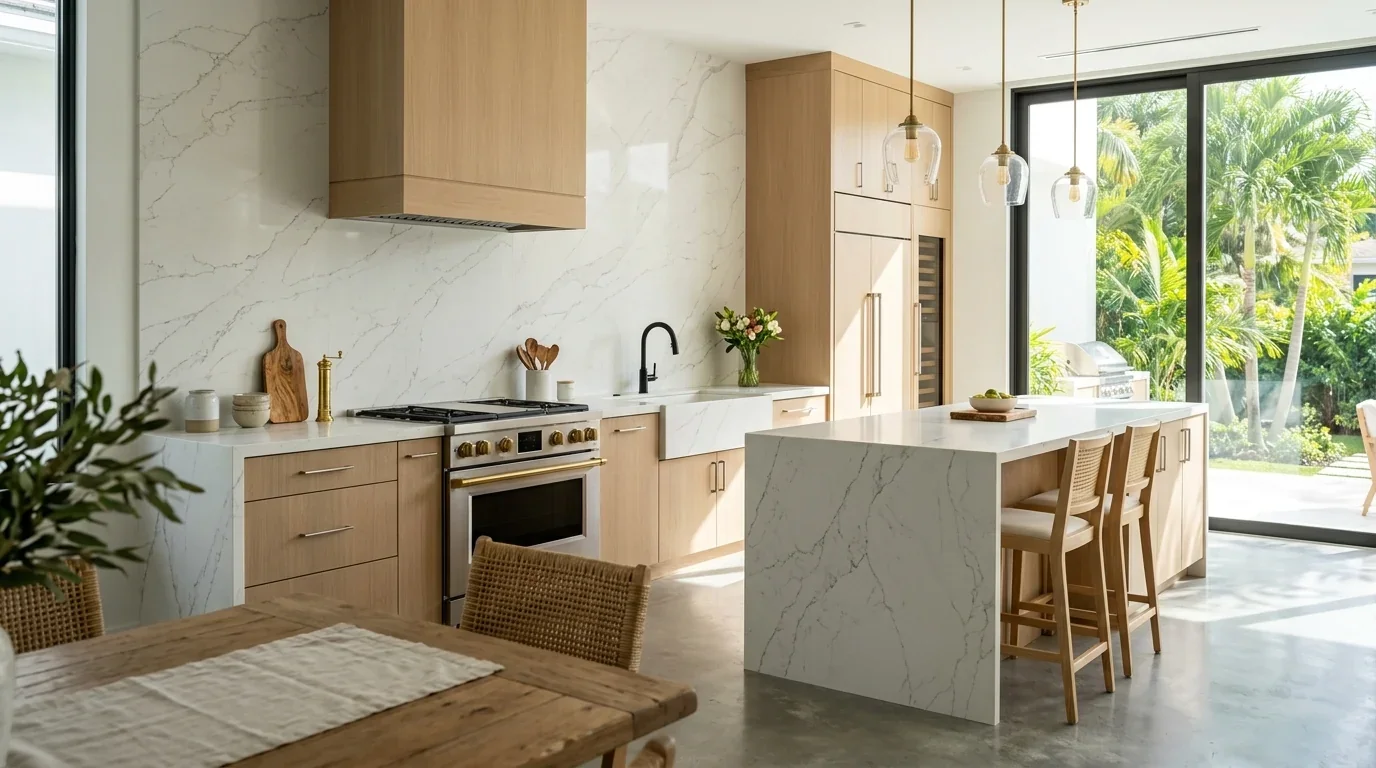
Porcelain countertops are the fastest-growing category in Palm Beach County kitchens in 2026. Clients ask about them every week now, usually after seeing one on Instagram or at a model home, and the most common question is whether to pick porcelain or quartz. Both are engineered, both look similar at a glance, and both sit in a similar price range. They are very different in practice.
After installing hundreds of each across Boca Raton, Delray Beach, and Wellington, here is what we tell clients trying to decide.
The Quick Answer
Pick porcelain if: You want a thin, modern look, full-height backsplash continuity, outdoor kitchen compatibility, or dramatic heat exposure (pizza ovens, high-heat cooking).
Pick quartz if: You want thicker edges, a wider color range, better edge impact resistance, and a more forgiving install.
For most standard Palm Beach County kitchens, quartz remains the default. Porcelain wins in specific use cases, which we will cover.
Composition and Look
Porcelain
Porcelain countertops are made from clay, feldspar, and mineral pigments, fired at temperatures above 2,200°F. The result is an extremely dense, thin slab, typically 12mm (about 1/2 inch) thick. The pattern is printed on the surface during manufacturing, then protected by a glazed top layer.
Because porcelain is fired hot enough to vitrify completely, it is non-porous, heat-proof to very high temperatures, and UV stable. The thinness is the defining visual feature, a porcelain counter can look almost paper-thin from the side, which creates a modern profile that stone cannot match.
Quartz
Quartz countertops are about 90 to 95 percent ground natural quartz crystals bound with 5 to 10 percent polymer resin and pigment. Slabs are typically 2cm or 3cm (about 3/4 inch or 1 1/4 inch) thick, solid through the full depth. The pattern runs through the material, not just on top, so chipped edges expose the same pattern as the surface.
Quartz comes in a wider range of colors and patterns than porcelain, bold blacks, warm creams, solid whites, and every marble imitation you can imagine. The scale of pattern options is currently broader than porcelain, though porcelain is catching up fast.
Heat, Scratch, and UV Performance
This is where porcelain and quartz diverge meaningfully.
Heat resistance
Porcelain is nearly immune to kitchen heat. You can put a 500°F cast iron pan directly on porcelain with no damage. The material was fired at temperatures higher than anything in your kitchen. This is porcelain's biggest performance advantage and the reason it is popular for pizza ovens and high-heat cooking stations.
Quartz fails at around 300°F. The polymer resin softens, discolors, or melts. A hot pan left on quartz for 30 seconds can leave a permanent white mark. Use trivets, always.
Scratch resistance
Both materials are hard to scratch with a kitchen knife. Porcelain wins slightly because it is fired harder than quartz, but the difference is academic, neither will scratch in normal use. Cutting directly on either surface dulls your knives faster than it marks the counter.
Stain resistance
Both are non-porous and handle stains well without sealing. Red wine, coffee, olive oil, wipe clean, no residue. Porcelain has a slight edge because the glazed surface is technically impermeable, but in practice quartz performs identically.
UV and outdoor use
Porcelain is UV stable. It can be installed outdoors in Palm Beach County's direct sun without yellowing or fading. It is one of the few countertop materials approved for South Florida outdoor kitchens.
Quartz cannot be used outdoors. The resin fails under UV exposure within 2 to 5 years, turning yellow, becoming brittle, and eventually cracking. This is the single biggest porcelain-vs-quartz decision point for coastal homes with indoor-outdoor kitchen continuity.
Edge chipping
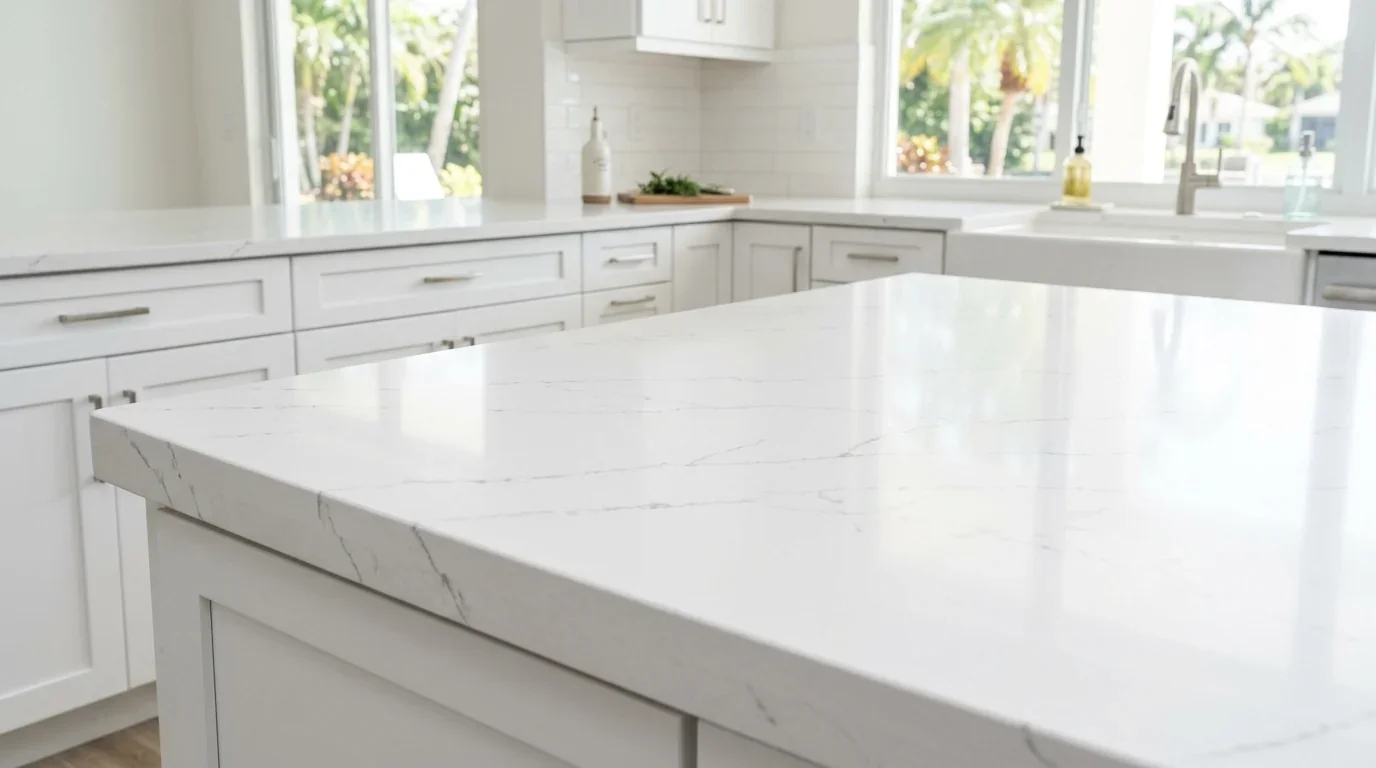
This is where quartz wins. Porcelain's thinness and density make edges more brittle. A dropped pot against a porcelain counter edge can chip the glaze. Quartz absorbs impacts better because it has mass and some flex.
Why porcelain needs a mitered edge
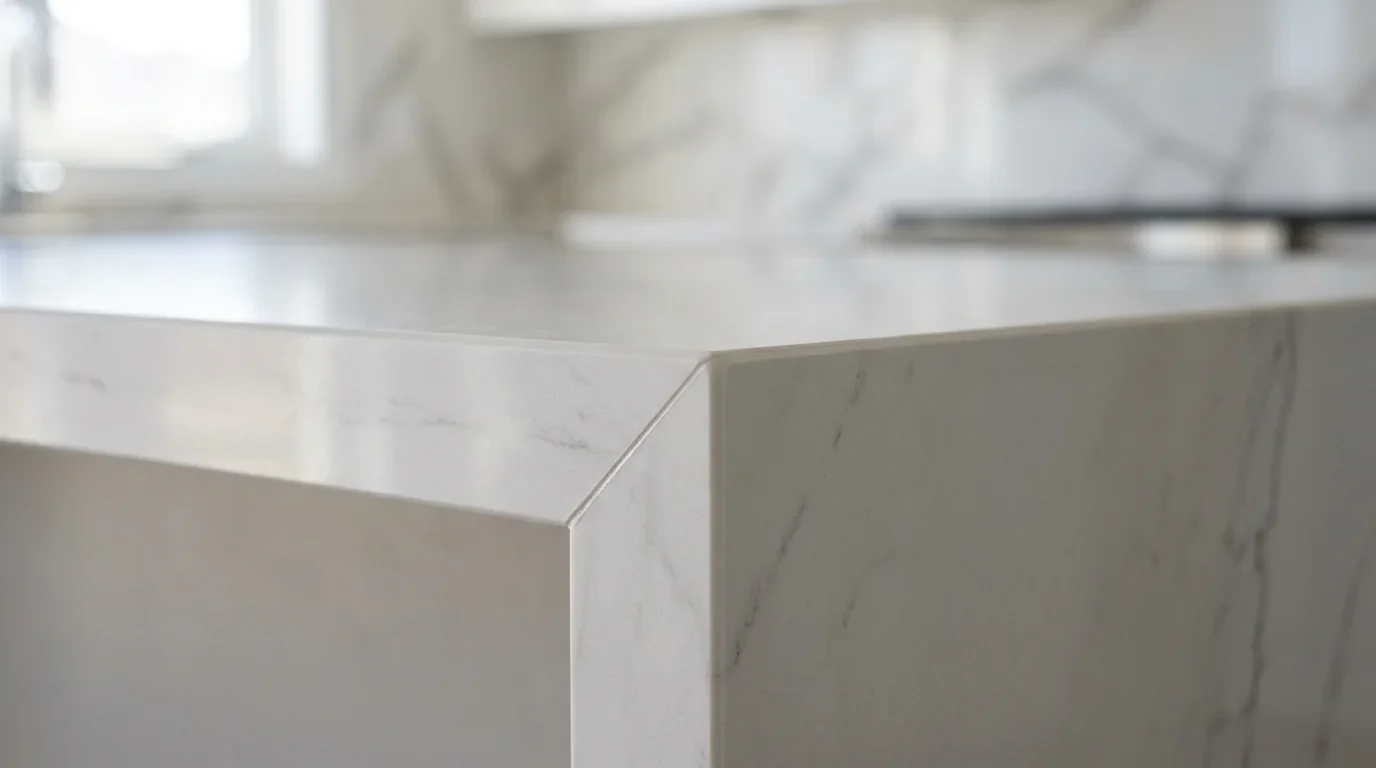
This is the biggest install difference between porcelain and quartz, and the single most important thing to understand before committing to porcelain. Quartz comes in a solid 2cm (3/4 inch) or 3cm (1 1/4 inch) slab, you can get a thick edge profile straight from the slab itself. Porcelain does not. A standard porcelain slab is only 12mm thick (about 1/2 inch), intentionally, because the thinness is what makes the material look modern and reduces its weight.
If you want a thicker visible edge, and most kitchens do, because a 1/2 inch edge reads as cheap, the fabricator has to miter two pieces together. They cut the top slab at a 45-degree angle along the front edge, cut a second piece for the vertical apron at the matching 45-degree angle, and glue the two together so the cut lines meet at the corner. From the top or front, you see one continuous pattern wrapping the edge; from close up, you can spot the thin diagonal glue line.
Why it matters for picking a fabricator: a bad miter is instantly visible. If the 45-degree cuts are slightly off, or the two pattern pieces do not align (patterns do not continue naturally around the miter, they jog), or the glue line sits proud of the surface, the edge looks wrong from every angle. Porcelain demands an experienced fabricator with the right equipment (a wet saw with a 45-degree cutting table, specialty porcelain blades, and vacuum-assisted clamps during glue-up). Not every Palm Beach County slab fabricator handles porcelain, ask specifically and look at a finished kitchen example before you sign.
Quartz skips all of this. A 3cm quartz slab gives you a 1.25 inch edge with zero miter, no alignment issues, and no glue line. This is why quartz installs are more forgiving and faster, even in the hands of a less experienced fabricator.
Cost and Installation in Palm Beach County
Porcelain costs more to install because it requires specialized cutting equipment (a standard stone saw will chip the glaze) and more time during template and fabrication. Not every slab fabricator in Palm Beach County handles porcelain, ask specifically before picking a stone yard.
Material brands we see most in our installs: Dekton, Neolith, Lapitec, and Laminam for porcelain; Caesarstone, Cambria, Silestone, and MSI Q for quartz. All are available locally.
When to Pick Each
Pick porcelain when...
- You are doing an indoor-outdoor kitchen transition and need material continuity
- You want a thin, modern profile (12mm slab look)
- You have a pizza oven, plancha grill, or other high-heat cooking element
- You want full-height backsplash with clean counter-to-wall pattern continuity
- The kitchen gets intense direct sun and you are concerned about quartz yellowing
Pick quartz when...
- This is a standard indoor Palm Beach County kitchen with normal cooking
- You want a wider color and pattern selection
- You prefer thicker edges (3cm or waterfall) without mitered construction
- You want a broader set of fabricators to choose from
- Budget is tight and you need the 20 to 30 percent cost savings
If you are still choosing between all the countertop categories, our four-way countertop comparison covers quartz, quartzite, granite, and marble side by side. And for the fuller kitchen remodel cost picture, countertops are usually the third-largest line item after cabinets and labor.
For authoritative specs on porcelain slab performance, the Tile Council of North America publishes the standards manufacturers test against.