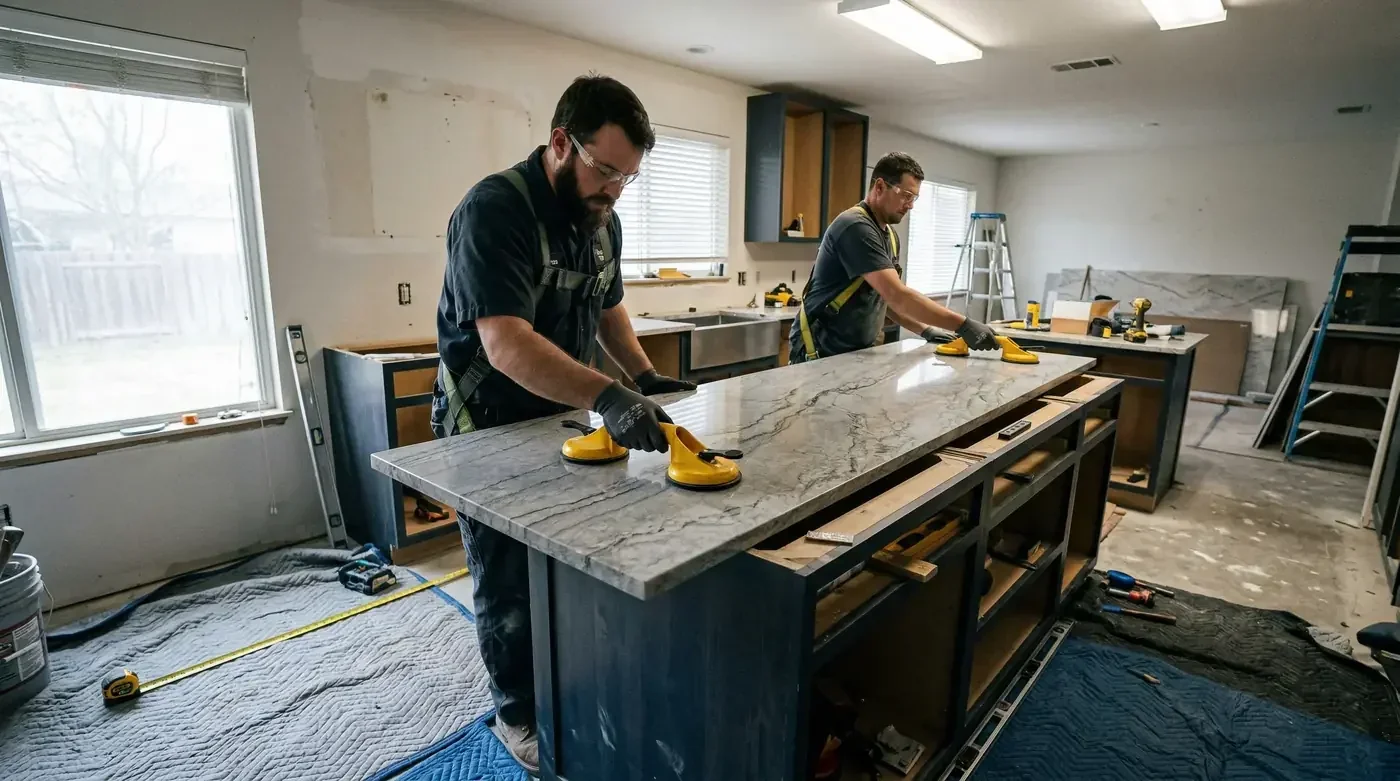
Choosing a countertop in Palm Beach County isn't just about looks. South Florida's year-round humidity, intense heat, and salt air put unique demands on kitchen surfaces that homeowners in northern climates never have to consider. Here's how the most popular countertop materials perform in our climate, based on thousands of installs across Boca Raton, West Palm Beach, Jupiter, and the rest of Palm Beach County since 2016.
Why Florida's Climate Matters for Countertops
Three local factors change the math on countertop choice in South Florida:
Humidity. Average relative humidity in Palm Beach County runs 70-85% most of the year. Porous materials pull moisture from the air and from cleaning, which breaks down sealers faster than in drier climates. Any stone that requires sealing will need it more often here than in Atlanta or Dallas.
UV exposure. South Florida kitchens often have big windows, sliders to a lanai, or full walls of glass facing east or south. Resin-based surfaces (engineered quartz, solid surface) can yellow or discolor under sustained direct sunlight. Natural stone and porcelain are UV-stable.
Salt air. Homes within a few miles of the coast see salt deposits on every exterior surface, and some of that gets inside. Chrome fixtures corrode, soft stones develop faint pitting. Harder-density stones (quartzite, granite, porcelain) handle salt far better than softer materials like limestone or dolomitic marble.
The Natural Stone Institute publishes density and absorption ratings by stone type. Those ratings map almost perfectly onto "how well does this hold up in South Florida." When in doubt, pick the denser stone.
Best Countertop Options for Palm Beach County
Quartzite, The Top Performer
Quartzite has become the most popular countertop material in Palm Beach County, and for good reason. This natural stone has the look of marble, heavy veining, depth, and movement across the slab, with the performance of granite. It handles heat (you can set a hot pan down without worry), resists scratches, and doesn't fade under UV. In our Jupiter and West Palm Beach projects, roughly 50% of clients are choosing quartzite.
The main consideration is periodic sealing, typically once a year in South Florida humidity. Popular quartzite choices include Taj Mahal (warm cream), Sea Pearl (cool gray-green), Fantasy Brown (warm earth tones), and White Macaubas (cool white with subtle veining).
Installed cost: $70-$180 per square foot. Most kitchens run $5,000-$12,000.
Best for: Long-term kitchens you plan to keep for 15+ years, design-forward homeowners, anyone with an outdoor kitchen or lanai bar that needs a continuous counter.
Quartz (Engineered), Low Maintenance Champion
Engineered quartz (brands like Silestone, Caesarstone, and Cambria) is the second most popular choice in our Palm Beach County projects, making up about 30% of installations. The biggest advantage is zero maintenance, no sealing required, ever. Quartz is non-porous, meaning it resists stains, bacteria, and moisture without any effort.
The trade-off is heat sensitivity, you need trivets for hot pans, and prolonged direct sunlight can cause slight discoloration over time. For kitchens with south-facing windows, consider lighter colors or UV-resistant formulations like Silestone's Sunlit Days or Caesarstone's outdoor-rated lines.
Installed cost: $50-$100 per square foot. Most kitchens run $3,000-$6,000.
Best for: Busy families with young kids, rental properties, anyone who doesn't want to think about sealing, homes being sold within five years.
Granite, Best Value for Money
Granite remains an excellent choice for Palm Beach County homeowners who want natural stone at a more accessible price point. It handles Florida's heat beautifully (it's essentially fireproof), resists scratches, and comes in hundreds of color and pattern options. Like quartzite, granite requires periodic sealing, every 1-2 years in our climate.
Granite has gotten a bad rap aesthetically in recent years because of 2000s-era "speckled beige" cuts that dominated builder-grade kitchens. The modern cuts, leathered finishes, dramatic veining on slabs like Black Mist or Alaska White, look nothing like those. Ask your fabricator to show you current yard stock, not catalog samples from five years ago.
Installed cost: $40-$90 per square foot. Most kitchens run $2,800-$5,500.
Best for: Budget-conscious remodels, Boynton Beach and Lake Worth projects where clients want premium durability without the premium price.
Porcelain Slabs, The Modern Contender
Porcelain slab countertops are gaining ground quickly in South Florida. These ultra-thin, ultra-durable surfaces are completely non-porous, UV resistant, heat resistant, and virtually indestructible. They come in large-format slabs that can mimic marble, concrete, or wood grain without the maintenance demands of those materials.
The downside is that porcelain can chip on exposed edges if struck hard, and fabrication requires specialized equipment that not every Palm Beach County fabricator has. Mitered waterfall edges are challenging but not impossible. Top brands include Neolith, Dekton, Laminam, and Lapitec.
Installed cost: $80-$160 per square foot.
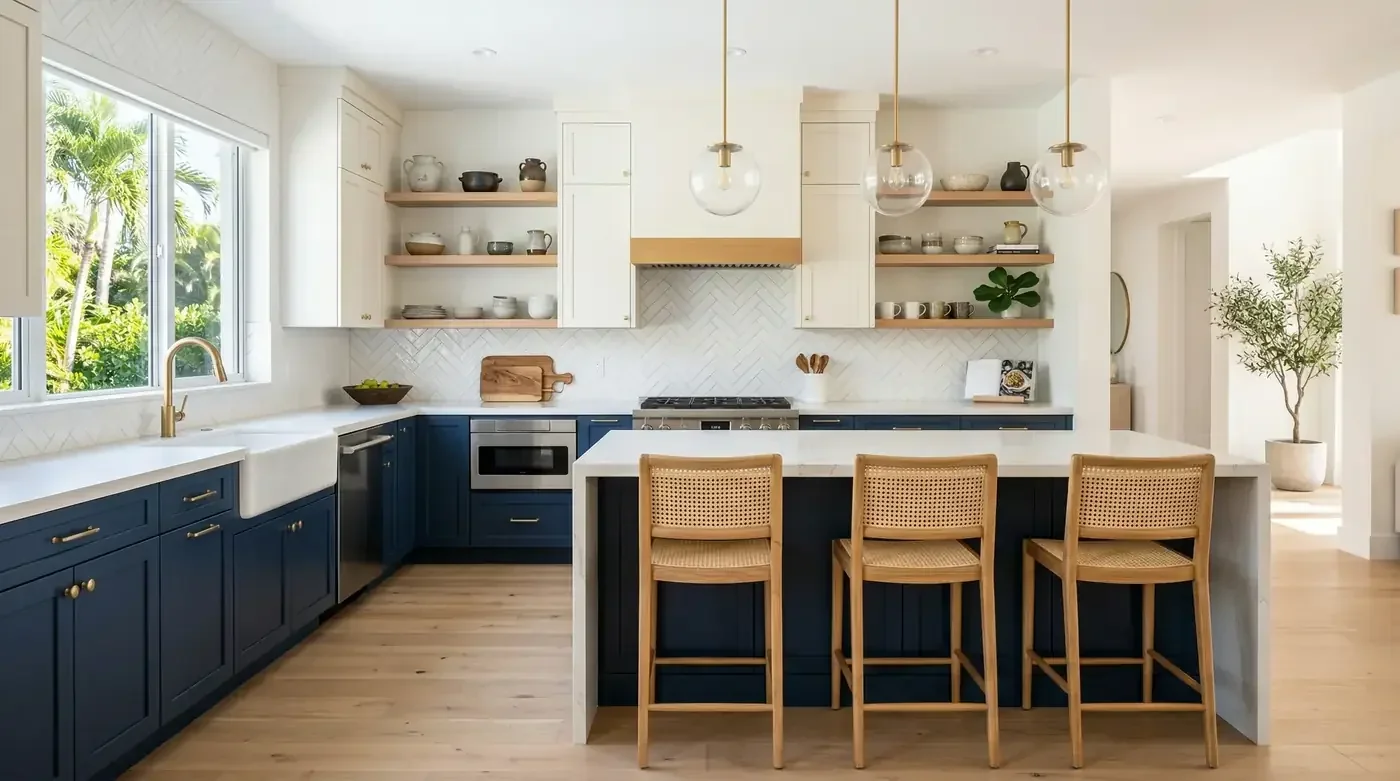
Best for: Outdoor kitchens and lanai bars (where porcelain is arguably the best option available), high-traffic waterfront homes, modern aesthetic projects.
Marble, Luxury with a Lifestyle Commitment
Marble is stunning. There's no material that matches its luminous depth and timeless elegance. However, marble is softer and more porous than quartzite or granite, which means it etches from acidic foods (citrus, wine, tomato sauce) and stains more easily. In South Florida's humidity, marble requires diligent sealing every six months.
We recommend marble for homeowners who appreciate the natural patina that develops over time and are willing to invest in care. Calacatta and Statuario remain the most requested varieties. For a close visual match without the etching, look at quartzite varieties like Calacatta Macchia Vecchia.
Installed cost: $100-$250 per square foot.
Best for: Formal kitchens where the homeowner values character over perfection, low-use second homes, butler pantries and dry bars.
What to Avoid in South Florida
Not every popular countertop material holds up in our climate. These are the ones we steer Palm Beach County clients away from, or at least flag the real trade-offs on:
Solid surface (Corian and similar acrylics). Popular in the early 2000s. In South Florida kitchens with direct sunlight, solid surface yellows within 3-5 years and can't be fully restored by refinishing. The seams are invisible, which is nice, but nothing else about the material earns it a spot in a modern kitchen here.
Butcher block. Beautiful on Pinterest, a nightmare in our humidity. Wood countertops swell in Palm Beach County summers and shrink in the drier winters, which means seams gap, finishes crack, and the surface needs oiling monthly. The exception is a small butcher block insert at a prep station, where you can replace it every 10 years without much cost.
Limestone and travertine. Soft, porous, and prone to etching from citrus and any cleaner with a pH above 9. Even sealed, these stones get pitting from salt air in coastal homes. Stay on the patio or bathroom floor with these.
Cheap laminate. Modern laminate (Wilsonart Quartz, Formica 180FX) actually holds up decently in Florida if installed well. But $20/sq ft builder-grade laminate peels at the seams within 2-3 years because humidity works under the edge banding. If budget forces laminate, spend enough to get a premium line with full backsplash integration.
Concrete. Custom concrete counters look incredible in modern homes, but hairline cracks from humidity expansion are near-universal within the first two years. If the look draws you, consider porcelain slabs with a concrete-look texture instead, you get the aesthetic without the cracking.
Our Recommendation
For most Palm Beach County kitchens, we recommend quartzite or quartz as your starting point. If you want natural beauty with strong performance, quartzite is the move. If you want zero-maintenance convenience, quartz wins. For outdoor kitchens, porcelain slab is the right answer almost every time.
Every kitchen and homeowner is different, that's why we offer a free consultation where you can see and touch slab samples, compare options side by side, and get guidance tailored to your kitchen, your cooking habits, and your budget. We'll also take you to one of the West Palm Beach stone yards if you want to hand-pick your exact slab. Call (561) 401-0064 to schedule yours.
Best Countertop Materials, Ranked for Florida Kitchens
People ask us all the time for a simple ranking. The honest answer is that the best countertop material depends on your kitchen, but after thousands of installs across Palm Beach County we do see a clear order of recommended countertops for our climate. Here is how the materials stack up when you weigh heat, humidity, UV, and real maintenance.
- Quartzite. Our most recommended countertop material for long-term Florida kitchens. Natural stone looks, near-granite hardness, UV-stable, heat-friendly. Needs sealing about once a year. Best overall when budget allows.
- Quartz (engineered). The best countertop material for homeowners who never want to seal anything. Non-porous and stain-proof, just keep hot pans on trivets and lean toward UV-rated lines near big windows.
- Porcelain slab. The top pick for outdoor kitchens and lanai bars, where its UV and weather resistance pulls ahead of everything else. Indoors it ranks just behind quartz for low-maintenance modern looks.
- Granite. The best value of the bunch. Heat-proof, durable, hundreds of patterns, sealed every one to two years. A smart choice when you want natural stone without the quartzite price.
- Marble. Gorgeous but the highest-maintenance option on this list. We rank it last for everyday Palm Beach County kitchens and reserve it for low-use, formal spaces.
If you only remember one thing: for a hard-working family kitchen the best type of countertop for the kitchen is usually quartzite or quartz. Both earn their spots near the top because they shrug off our heat and humidity with almost no fuss.
How to Choose the Right Countertop Material
Picking the best kitchen counter top material gets easier when you answer four questions about how you actually live. We walk every client through these during a consultation, and you can run them yourself right now.
How do you cook? If you set hot pans straight onto the counter and chop without a board, you want heat tolerance and scratch resistance, so look at quartzite, granite, or porcelain. If you are tidy and use trivets, quartz opens up.
Where is your light? Walk your kitchen at noon. South and west walls of glass push you toward UV-stable surfaces (natural stone and porcelain) over resin-heavy ones. We cover this trade-off in depth in our guide to countertops and Florida humidity.
How long are you staying? Selling within five years rewards low-maintenance quartz that shows well to buyers. Staying fifteen years justifies the best material for a countertop you will love daily, which is usually quartzite.
What is your real budget? Set a per-square-foot range before you fall for a slab. To see how the four most-requested stones compare head to head on price and care, read our breakdown of quartz vs quartzite vs granite vs marble, then browse the full lineup on our countertops and granite pages.
Frequently Asked Questions
What is the best countertop material for a Florida kitchen?
Quartz is the most popular choice for Florida kitchens due to its durability, heat resistance, and low maintenance. It does not require sealing and holds up well in humid conditions. Porcelain slab countertops are also gaining popularity for their UV resistance, important near windows in South Florida.
Does heat and humidity affect kitchen countertops in Palm Beach County?
Yes. Natural stone like marble can stain and etch more easily in humid conditions if not properly sealed. Direct sunlight through windows can fade certain materials over time. Quartz and porcelain are the most resistant to Florida's climate challenges.
Is quartzite worth the extra cost in a South Florida kitchen?
Quartzite offers a natural stone look that quartz cannot replicate, and it performs well in Florida's climate when properly sealed annually. The premium cost of $70-$120 per square foot installed is justified in high-end kitchens where natural stone aesthetics are a priority.
How often do you need to seal granite countertops in Florida?
Granite should be sealed every 1-2 years in Florida due to the humidity and heat exposure. A simple water bead test tells you when it's time to reseal, if water soaks in instead of beading, it's due for sealing.
What countertops are easiest to maintain in a Florida kitchen?
Quartz and porcelain slab countertops require the least maintenance, no sealing, no special cleaners, and they resist most stains. Laminate is also very low maintenance but shows wear over time. Avoid marble in high-use kitchens as it requires consistent care.
What is the best countertop material?
For most South Florida kitchens, quartzite is the best countertop material overall. It pairs natural stone looks with near-granite hardness, stays UV-stable next to big windows, and handles heat well. The trade-off is sealing about once a year. If you would rather never seal anything, engineered quartz is the best low-maintenance pick.
What countertop material is most recommended?
In our Palm Beach County projects, quartzite and quartz are the two most recommended countertops. Together they make up roughly 80% of our installs because both resist Florida's heat, humidity, and salt air with little upkeep. Porcelain slab is the most recommended option specifically for outdoor kitchens and lanai bars.
What is the best type of countertop for a kitchen?
The best type of countertop for a busy family kitchen is a hard, non-porous or dense surface that takes daily use without much care. That points to quartz for zero maintenance or quartzite for natural beauty with strong durability. Match the material to how you cook, your light exposure, and how long you plan to stay in the home.
Owner of South Florida Kitchen & Bath Design, serving Palm Beach County since 2016. Andre and his team have completed thousands of kitchen and bathroom renovations across Boca Raton, West Palm Beach, Wellington, Delray Beach, and the surrounding communities.