Corner Cabinet Solutions: Lazy Susan, Super Susan & More
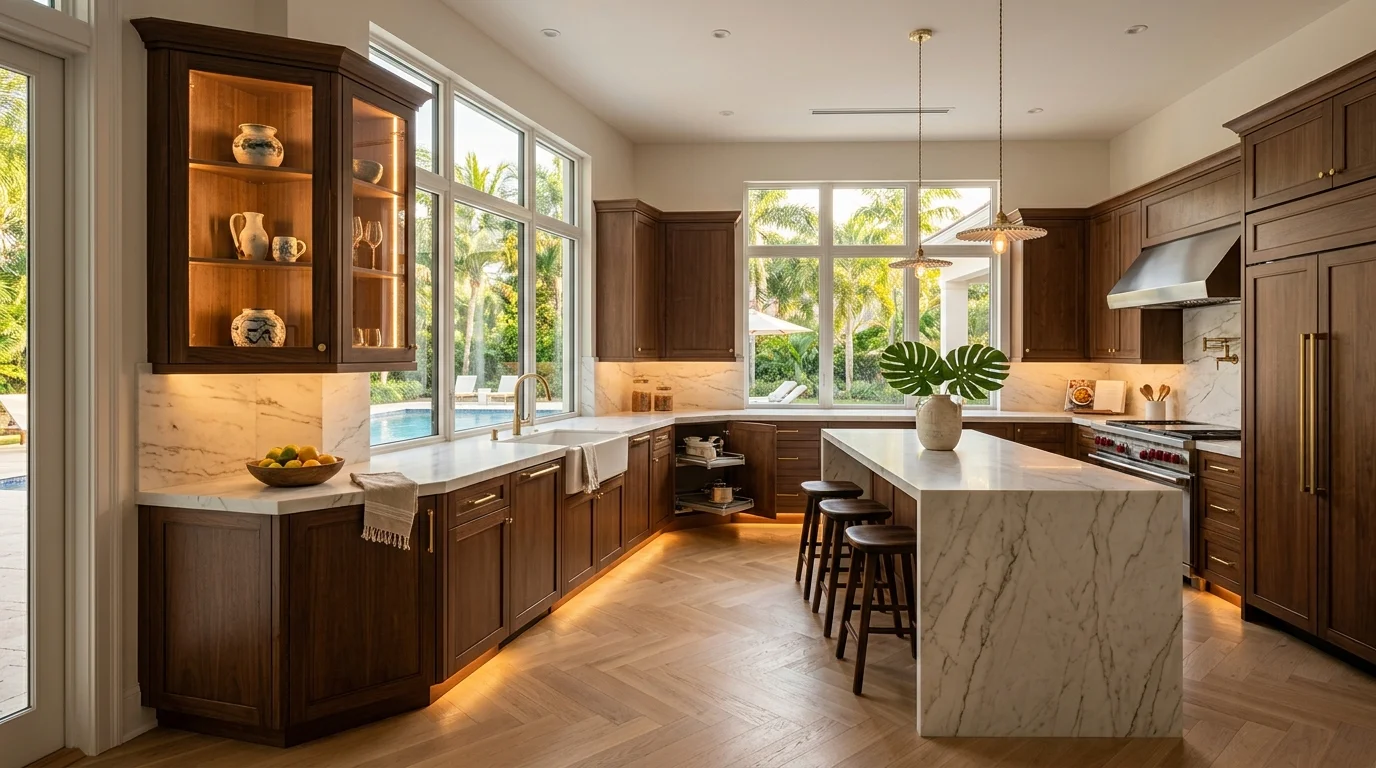
Corner cabinet solutions are one of the most frequent topics that come up in our design consultations across Palm Beach County. Homeowners walk in frustrated. They have a perfectly sized kitchen on paper, but those two corner cabinets are black holes where pots and pans go to disappear. The good news is that the hardware industry has come a long way. Whether it's a classic lazy susan, a super susan, or a blind-corner pull-out system, there's a real solution for almost every corner configuration. The bad news is that the wrong choice for your specific layout can make the problem worse, not better. Here's how we think through it.
Why Corners Are the Hardest Part of Kitchen Design
In an L-shaped or U-shaped kitchen, you almost always end up with at least one corner where two runs of base cabinets meet at 90 degrees. That corner space can hold anywhere from 30 to 40 inches of dead depth per run. Standard cabinet boxes only use a fraction of it. The rest sits behind a false wall or gets jammed against an adjacent cabinet side panel, completely unreachable without getting on your hands and knees.
The two main corner configurations we see are the standard corner (where both cabinet runs are accessible from the front, creating a classic L) and the blind corner (where one run butts flush into a wall or another cabinet, blocking access to half the interior). Each configuration has different best solutions, and mixing them up is one of the biggest kitchen remodel mistakes we see homeowners make when they buy hardware online without verifying their cabinet box dimensions first.
Cabinet box dimensions matter more here than almost anywhere else in the kitchen. A lazy susan that works perfectly in a 36-inch corner base will bind and jam in a 33-inch box. A blind-corner pull-out needs a minimum face-frame opening, and frameless cabinets handle it differently than face-frame construction. If you're unsure about the difference, it's worth reading up on frameless vs. framed cabinets before you start comparing hardware options.
Lazy Susan Options: Classic, D-Shape & Super Susan
The lazy susan is the most recognized corner cabinet solution, and it's been around long enough to accumulate a bad reputation in some circles. That reputation is partly deserved for the cheap versions. Partly. The real problem isn't the concept, it's the execution. Flimsy plastic shelves, no door coordination, and a center pole that eats up usable space killed a lot of older installations. Today's systems are a different animal.
Classic Round Lazy Susan
Two full round shelves that rotate on a center pole. Works inside a standard corner base where the cabinet door configuration is either a bi-fold door or two independent doors. The entire interior is accessible, which is genuinely useful. The limitation is that round shelves in a square cabinet always waste the corners of the cabinet itself, and items near the edges of the shelf can slide off during rotation if the shelves don't have a lip. We recommend this option for clients with larger corner boxes, typically 36 inches or more, and who are storing lighter items like dry goods or mixing bowls.
D-Shape (Half-Moon) Lazy Susan
This version uses two half-moon shaped shelves that swing out as the door opens. Because the flat edge of the D sits flush against the door, the shelves actually clear the door frame when you open it. It's cleaner than a round susan in face-frame kitchens. The tradeoff is slightly less total shelf area. For clients who want a more refined look without going to a pull-out system, the D-shape is a solid middle ground.
Super Susan
This is the one we most often recommend for new cabinet installs. The super susan uses full-extension, full-round shelves mounted on a center pole, but the shelves are engineered to clear the door frame completely on rotation. Higher-end versions from manufacturers like Rev-A-Shelf include soft-close mechanisms so the shelves decelerate before hitting the cabinet sides. No slamming, no spilling. It pairs well with full-overlay door styles, which are increasingly popular in South Florida coastal modern kitchens. If you're choosing between painted and stained cabinet finishes and want a high-end interior hardware package to match, the super susan fits naturally into that upgrade tier.
One thing we tell every client: lazy susans of any type do not work well in blind-corner configurations. Trying to force one in there creates a shelf that rotates partway and then hits the adjacent cabinet wall. That's where pull-out systems take over.
Blind Corner Pull-Outs: The Better Alternative
A blind corner is exactly what it sounds like. One side of the corner is accessible through the cabinet door. The other side is hidden behind the adjacent cabinet's side panel, with no door of its own. In older kitchens, that hidden portion was just dead storage. You'd slide things in there and forget about them until a remodel forced you to retrieve them.
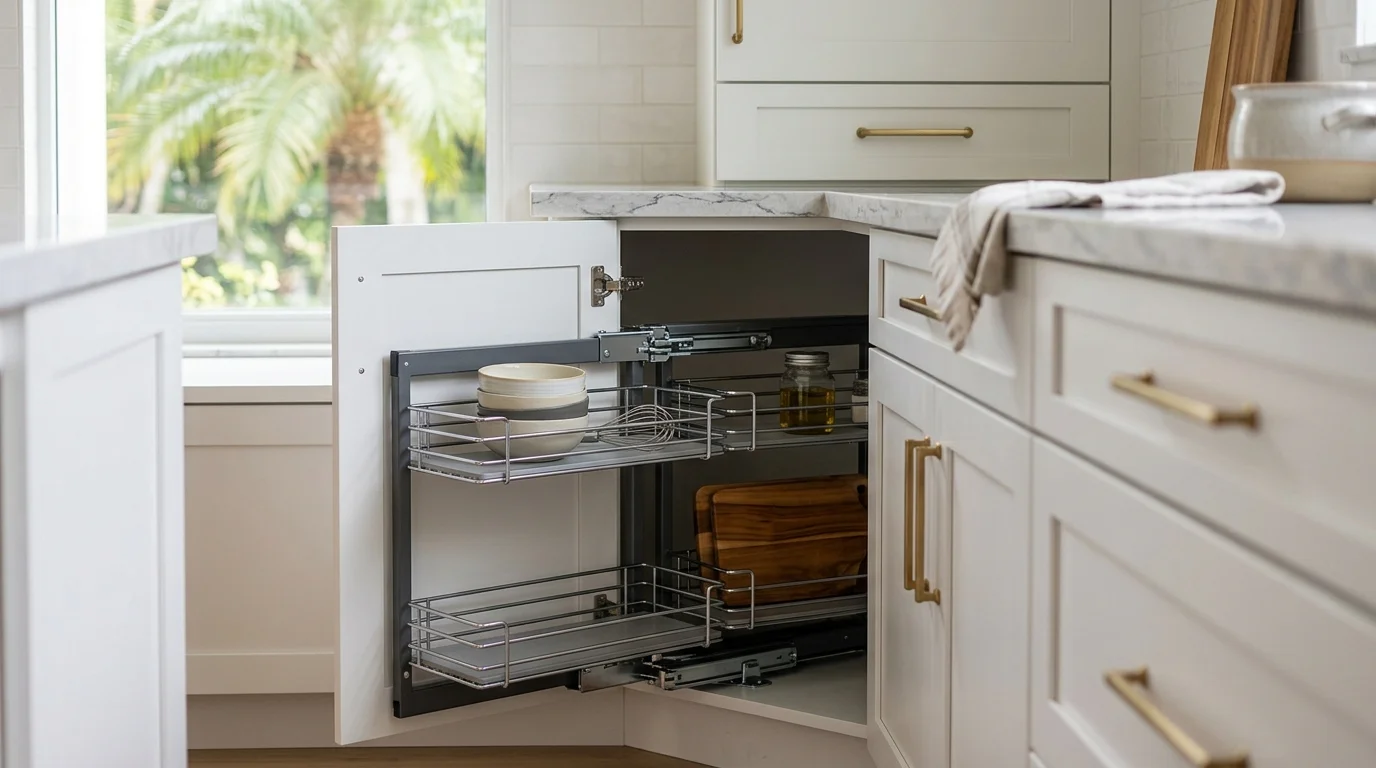
Blind-corner pull-out systems solve this with a two-stage mechanism. The primary shelf pulls straight out through the door opening, then swings sideways to reveal the secondary shelf hidden behind the panel. Both shelves come fully into the room and sit at counter height, giving you complete access to everything stored there. No crawling, no fishing around in the dark.
There are a few variations worth knowing:
Swing-out pull-outs: The most common type. One large shelf swings out on a pivot arm as you open the door. Best for blind corners where the hidden depth is 12 inches or more. Brands like Hafele and Grass make excellent versions with smooth, weight-bearing slides.
LeMans (kidney-shaped) pull-outs: A two-shelf system where each shelf is kidney-shaped, designed to swing out simultaneously in a coordinated arc. Named for the German manufacturer that popularized them. More expensive than a basic swing-out, but they maximize every inch of the blind corner and handle heavier loads. Our team installs these frequently in mid-range and luxury remodels where the client wants the interior hardware to match the cabinet quality.
Magic corner / diagonal pull-outs: These systems use a diagonal cabinet box placement, with pull-out baskets that extend straight out the diagonal face. Less common in Florida due to the layout requirements, but worth knowing about if you're planning a full kitchen redesign from scratch. If you're also rethinking your kitchen's overall layout, a good companion read is our guide to kitchen cabinet organization to think through the whole picture before committing to a corner solution in isolation.
Installation matters as much as hardware choice. A blind-corner pull-out requires precise alignment so the primary shelf clears the door opening and the swing doesn't bind against the face frame. Our crews measure the face-frame opening, the cabinet depth, and the adjacent panel clearance before specifying hardware. Buying a system online and hoping it fits is a gamble we'd advise against.
Cost Guide
Pricing for corner cabinet solutions in Palm Beach County depends on the hardware grade, the cabinet configuration, and whether you're retrofitting into existing cabinets or specifying hardware for a new install. Retrofitting is usually more labor-intensive because old cabinets rarely have the exact clearances required and may need modification. Here's a realistic breakdown based on what we see in the market today.
A few notes on these numbers. The retrofit column assumes an experienced installer is modifying an existing face-frame or frameless cabinet to accept the hardware. If the cabinet box itself needs to be rebuilt or a new box needs to be cut in, that's additional cost and should be quoted separately. For clients in Boca Raton or Delray Beach who are doing a full kitchen remodel, corner hardware is typically specified in the cabinet package and rolled into the overall project cost. For someone in Wellington or Jupiter just updating an aging kitchen without a full gut, the retrofit figures above are what to budget.
If you're trying to understand how corner hardware costs fit into a broader kitchen remodel budget, our Palm Beach County kitchen remodel cost guide breaks down the full picture by tier. And if you're specifically weighing a cabinet refresh against a full replacement, the cabinet refacing vs. replacement guide covers when it makes sense to swap hardware into existing boxes versus starting fresh.
South Florida Considerations
South Florida kitchens have a few quirks that affect corner cabinet decisions more than homeowners in other parts of the country might expect.
Humidity is the first issue. Palm Beach County averages high indoor humidity year-round, and cabinet interiors are no exception, especially in homes that run air conditioning aggressively and create condensation cycles. Lazy susan shelves made from particleboard with a thin melamine skin can swell and warp over time. We specify melamine shelves with sealed edges as a minimum, and we prefer solid polymer or coated steel shelving in any pull-out system. Soft-close hardware with stainless or nickel-plated components holds up far better than hardware with unsealed iron components. This applies to every interior fitting, not just corners. It's the same reason we talk about material durability in our guide to the best kitchen cabinet styles for South Florida.
The second issue is layout. Florida homes built in the 1980s and 1990s, particularly in communities around Boca Raton, Boynton Beach, and Wellington, were designed with galley or U-shaped kitchens that can have two or even three corner cabinets in the same run. Older homes from that era often have 33-inch corner base cabinets instead of the more standard 36-inch, which limits hardware options. A super susan that fits beautifully in a 36-inch box will bind in a 33-inch box. Our team always verifies box size before specifying. If you're working through a 1980s-era kitchen, our post on remodeling a 1980s Florida kitchen covers a lot of the other surprises those projects bring.
The third issue is condo and HOA rules. If you're in a high-rise in Boca or a gated community in Palm Beach Gardens, your HOA documents may restrict the scope of what you can change in your kitchen without board approval. Cabinet hardware swaps that don't touch plumbing or electrical generally don't require permits and fall outside HOA renovation restrictions. But if your corner solution is part of a larger project that involves moving plumbing or opening walls, your general contractor will need to coordinate with the building department and follow the applicable review process. For a broader overview of when permits apply to kitchen work in Palm Beach County, the permit guide is a good resource.
Coastal salt air also affects hardware longevity in homes near the water in Jupiter or Tequesta. Anything with exposed metal slides or pivot arms should be a marine-grade or powder-coated finish. It's a small upgrade that adds years to the hardware's life. We've pulled out pull-out systems in oceanfront condos that were five years old and completely corroded because the original builder used standard interior hardware. That's a preventable failure.
One more thing worth mentioning for South Florida homeowners: kitchen upgrades like quality corner hardware and interior storage systems do add measurable value to a home. Buyers notice functional storage. It's one of the quieter items on the list of kitchen upgrades that add the most value in Florida, but it consistently shows up in buyer feedback during showings. If you're remodeling before a sale, don't overlook the corners.