Kitchen Cabinet Organization Ideas That Actually Work in South Florida
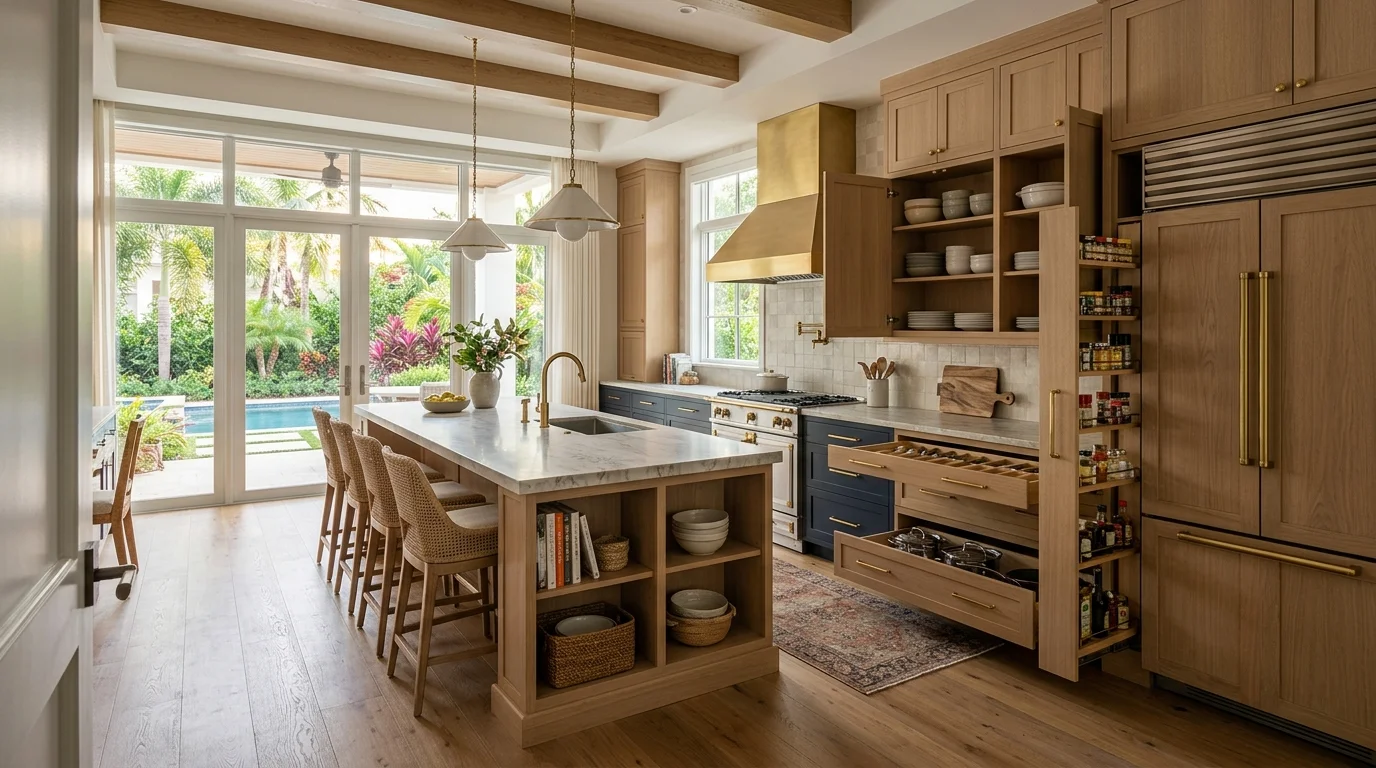
Kitchen cabinet organization ideas are a dime a dozen on Pinterest. What you rarely see is an honest breakdown of which options actually hold up in a real kitchen, how much they cost in Palm Beach County, and where homeowners go wrong when they try to retrofit organization into cabinets that were never designed for it. Our team at South Florida Kitchen & Bath Design has installed hundreds of kitchens across Boca Raton, Delray Beach, Wellington, and Jupiter, and we have strong opinions on what works. Pull-outs, deep drawers, and proper divider systems are the three categories that move the needle most. Everything else is secondary.
Why Organization Starts at the Design Stage
Most people treat kitchen organization as an afterthought. They finish the remodel, move everything back in, and then start buying drawer organizers from Amazon. That approach works up to a point, but it leaves a lot of storage capacity on the table.
Real organization is built into the cabinet box itself. That means specifying the right interior fittings before the cabinets are ordered, not after they arrive. Pull-out shelves, drawer peg systems, spice inserts, and tray dividers are all options that need to be coordinated with cabinet dimensions at the design stage. Trying to add a full-extension pull-out to a base cabinet that was built without the right clearance is frustrating and expensive.
Our crew walks every client through their storage habits before finalizing a cabinet layout. How many pots do you own? Do you bake regularly? Do you have a collection of sheet pans that never has a home? Those answers directly shape which interior fittings make sense. A household that cooks five nights a week needs a completely different interior configuration than someone who primarily uses their kitchen for entertaining.
If you are still deciding whether to tackle a full remodel or just refresh your existing cabinets, it is worth reading our breakdown of kitchen refresh vs. full remodel to understand where your budget is best applied. Sometimes the cabinet boxes are solid but the interiors just need upgrading. Other times the layout itself is the problem, and no amount of organizers will fix poor cabinet placement.
One more thing worth saying: NKBA research consistently shows that storage and organization rank among the top priorities homeowners cite when remodeling a kitchen. It is not a luxury add-on. For most families, it is the whole point.
Pull-Outs and Rollouts: The Biggest Game-Changer
If we had to pick one upgrade that transforms how a kitchen functions, it would be full-extension pull-out shelves in base cabinets. No debate. The standard fixed shelf in a 24-inch-deep base cabinet is a dead zone. Whatever you put at the back becomes invisible. You end up with a graveyard of rarely used appliances and canned goods you forgot you bought.
Full-extension pull-outs, sometimes called rollouts, bring the entire shelf out to you. You can see everything. You reach everything without crouching and digging. It sounds simple because it is, and it makes a dramatic difference in day-to-day kitchen use.
Here is what matters when specifying pull-outs:
Extension rating. Full-extension slides pull out 100% of the shelf depth. Three-quarter extension is cheaper but leaves the back of the cabinet unreachable. Pay the difference for full extension. It is worth every dollar.
Weight capacity. Cast iron pans are heavy. Specify slides rated for at least 75-100 lbs per shelf if the pull-out will hold cookware. Undermount slides from quality hardware brands like Blum carry solid weight ratings and come standard with soft-close action.
Soft-close mechanism. This matters more than people expect. Hard stops in a cabinet that you open fifty times a day get annoying fast. Soft-close slides absorb the impact and keep the cabinet quieter. Our team specifies soft-close as a baseline on every project. For a deeper look at why this matters, see our guide on soft-close cabinet drawers and how to add them.
Where to put them. Base cabinets flanking the range are the highest priority. That is where pots, pans, and lids live, and those are the heaviest, most awkward items in any kitchen. Corner base cabinets are another area where pull-outs shine. A lazy Susan is the traditional solution for corners, but a well-designed pull-out system, sometimes called a magic corner or a blind corner optimizer, actually recovers more usable space and keeps items better organized.
Sink base cabinets are a separate category. Because the plumbing runs through the center, you are typically limited to two narrow pull-outs on either side. Plan for cleaning supplies on one side and a pull-out recycling or trash system on the other. It keeps the sink area tidy and puts waste management exactly where you generate it.
Deep Drawers Done Right
Deep drawers are the single most underutilized storage option in kitchens. Homeowners see drawers and think silverware. Contractors who have been doing this for years know that a well-specified deep drawer stack next to the range is more functional than any base cabinet with a fixed shelf.
A standard three-drawer stack in a 15-inch or 18-inch base cabinet gives you a shallow top drawer for utensils, a medium drawer for lids and smaller items, and a deep bottom drawer that can hold your everyday pots and pans stacked vertically or laid flat. You open a drawer. You see everything. You grab what you need. No bending, no digging, no frustration.
The shift our team has seen in the past few years is clients moving away from two-door base cabinets entirely in favor of drawer bases wherever possible. The cooking zone, the prep zone, and areas near the dishwasher are all natural locations for drawer stacks. Near the dishwasher specifically, deep drawers let you unload dishes directly into storage at a comfortable height without overhead reaching.
A few specs to nail down when ordering deep drawers:
Drawer box material. Solid wood or quality plywood drawer boxes are the right call for deep drawers that will carry heavy loads. Thin MDF drawer boxes flex over time under the weight of cookware. This is not the place to cut costs. Our article on MDF vs. plywood vs. solid wood cabinets covers the construction differences in detail.
Interior height. A bottom drawer needs to be at least 10-12 inches of usable interior height to fit a standard saute pan standing on its side. Confirm the interior dimensions, not just the cabinet opening height, before the order is placed.
Peg systems and dividers inside the drawer. A large, open deep drawer becomes chaos quickly. A simple adjustable peg system, the kind you find in Scandinavian-style cabinetry, lets you configure the interior to hold plates, bowls, or pans without them sliding around. It works better than anything you will find at a home goods store, because it is designed specifically for the drawer dimensions.
Dividers, Inserts, and Specialty Organizers
Once pull-outs and deep drawers are handled, the remaining organization work lives in the details. This is where dividers, inserts, and specialty fittings solve the specific frustrations that come up in every kitchen.
Tray dividers for vertical storage. Sheet pans, cutting boards, cooling racks, and baking sheets are awkward to store horizontally because they stack into a pile where the item you want is always at the bottom. Vertical tray dividers, typically installed in a tall cabinet or upper cabinet section, let you slide each item in and out individually. This is one of the most-requested organizational upgrades from clients who bake regularly.
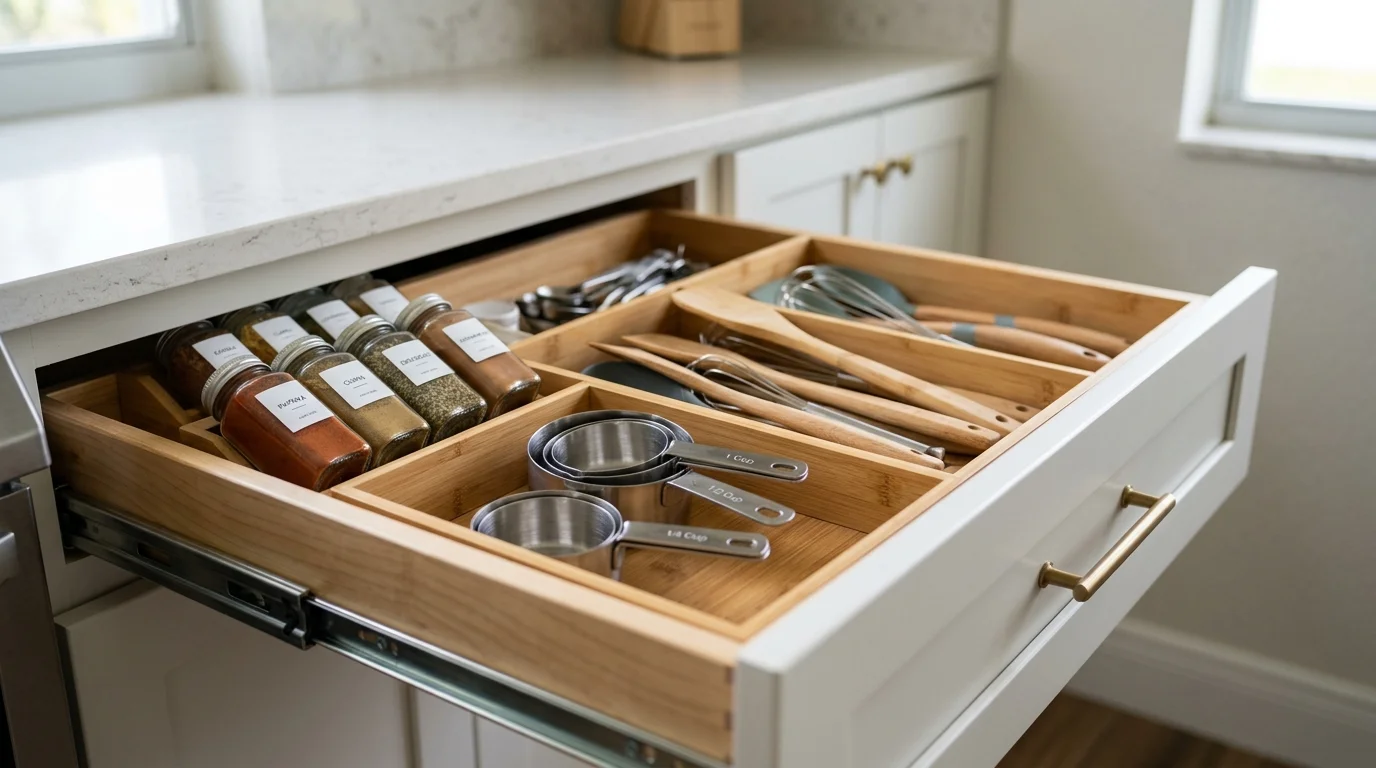
Spice drawer inserts. Spice storage is a perennial problem. Wall-mounted racks look fine but take up backsplash space. Upper cabinet shelves mean you are reading labels from the side or bottom of the container. A dedicated spice drawer with an angled insert solves it. Every jar lays at an angle so you read the label at a glance from above when you open the drawer. It takes a shallow top drawer and makes it genuinely useful.
Knife blocks and utensil inserts. In-drawer knife blocks keep blades protected and counters clear. A well-designed insert fits the specific drawer width and holds both full-size knives and paring knives without them sliding. Pair it with a bamboo utensil divider in the adjacent drawer for a clean, functional prep zone.
Pull-out waste and recycling. South Florida municipalities, from Boca Raton to Jupiter, all have recycling requirements. A pull-out dual-bin system in the sink base or a dedicated waste cabinet near the prep zone makes sorting automatic. It is tidier than a freestanding bin and integrates with the cabinetry so it disappears when the drawer is closed.
Pull-out pantry columns. In kitchens where a full walk-in pantry is not an option, a tall pull-out pantry column, sometimes called a larder unit, recovers a dramatic amount of storage from a narrow 9-inch or 12-inch space. Full-extension slides on multiple shelves let you see and reach every item. Our separate article on kitchen pantry design ideas for South Florida homes goes deeper on how to configure these for different kitchen footprints.
Cabinet door organizers. The interior of a base cabinet door is frequently wasted space. A mounted rack for lids, foil and wrap dispensers, or cleaning supply holders puts that surface to work without taking up shelf depth. These are one of the few areas where aftermarket products work reasonably well, because they attach to the door itself rather than needing to integrate with the cabinet box.
Upper cabinet inserts. Upper cabinets typically hold dishes, glasses, and pantry items. Adjustable shelving is standard, but a few targeted upgrades make a real difference. Wine glass racks mounted to the underside of a shelf keep stems safe and visible. Riser shelves inside an upper cabinet effectively double the usable shelf count for shorter items like spice jars and mugs.
For clients doing a broader cabinet update and curious about how hardware choices interact with organization, our guide on how to choose kitchen cabinet hardware covers pull and knob selection alongside functional considerations.
Thinking about how all of this fits into a broader cabinet selection? The kitchen cabinet trends for 2026 article covers how storage features are becoming a standard expectation in new cabinet specifications, not an upgrade tier.
Cost Guide
Organization upgrades range from modest add-ons to a significant line item in a full cabinet order. Here is a realistic cost range for Palm Beach County homeowners based on what our team sees on actual projects. These figures cover product and installation labor together.
These ranges reflect Palm Beach County pricing in 2025-2026. Retrofitting organizers into existing cabinets costs more per unit than specifying them during a new cabinet order because installation takes longer and sometimes requires modifications to the box. If you are already doing a full cabinet replacement, bundling all the organization features into the initial order is significantly more cost-efficient. See our full breakdown of custom kitchen cabinet costs in Palm Beach County for context on the broader cabinet investment.
South Florida Considerations
Organizing a kitchen in South Florida comes with a few factors that do not show up in national content about this topic.
Humidity and cabinet interiors. Palm Beach County's humidity is real, and it affects cabinet interiors over time. Cabinets that seal well and use moisture-resistant finishes on the interior box hold up better than bare particleboard interiors. When specifying pull-out shelves and drawer systems, choose hardware with a corrosion-resistant finish, stainless or nickel-plated over bare steel. This matters especially in kitchens that get significant airflow from open windows or doors.
Gated community and HOA rules. Most organizational upgrades happen entirely inside your cabinets and require no permits, no structural changes, and no HOA approval. Pull-outs, drawers, and inserts are interior finish work. If you are doing a broader cabinet replacement that involves changes to the layout, moving a sink, or adding new electrical for under-cabinet lighting, those scopes may trigger permit requirements depending on what your GC is doing. Our guide to kitchen remodel permits in Palm Beach County explains exactly when permits are required based on project scope.
Condos in Boca Raton and Delray Beach. Condo kitchens tend to be compact. Every square inch matters more than in a single-family home. Pull-out systems and deep drawer stacks are even more impactful in a galley-style or L-shaped condo kitchen because you are recovering space that would otherwise be completely dead. Our team works in condos throughout the county regularly. The organizing principles are the same but the execution needs to account for tighter dimensions and sometimes lower ceiling heights that affect tall cabinet specifications.
Older homes in Wellington and Jupiter. Many homes in these areas were built in the 1980s and 1990s with standard frameless or face-frame cabinets that are structurally fine but have zero interior organization. Rather than a full replacement, a targeted retrofit can address the worst problem areas. We recommend prioritizing pull-outs in the cooking zone base cabinets and a deep drawer stack near the range as the first priorities. Everything else can follow. If the existing cabinets have good bones, this approach adds meaningful function at a fraction of full replacement cost.
Larger family kitchens in Wellington estates and Jupiter single-family homes. Bigger kitchens have more cabinet runs, which means organization planning gets more complex. The risk is specifying so many features that the budget bloats unnecessarily. Our recommendation: start with the zones where the friction is highest. Cooking zone, prep zone, and cleanup zone. Nail those three before adding specialty organizers for the pantry zone or baking zone. Function over completeness.