Frameless Shower Glass Options: What to Know Before You Buy
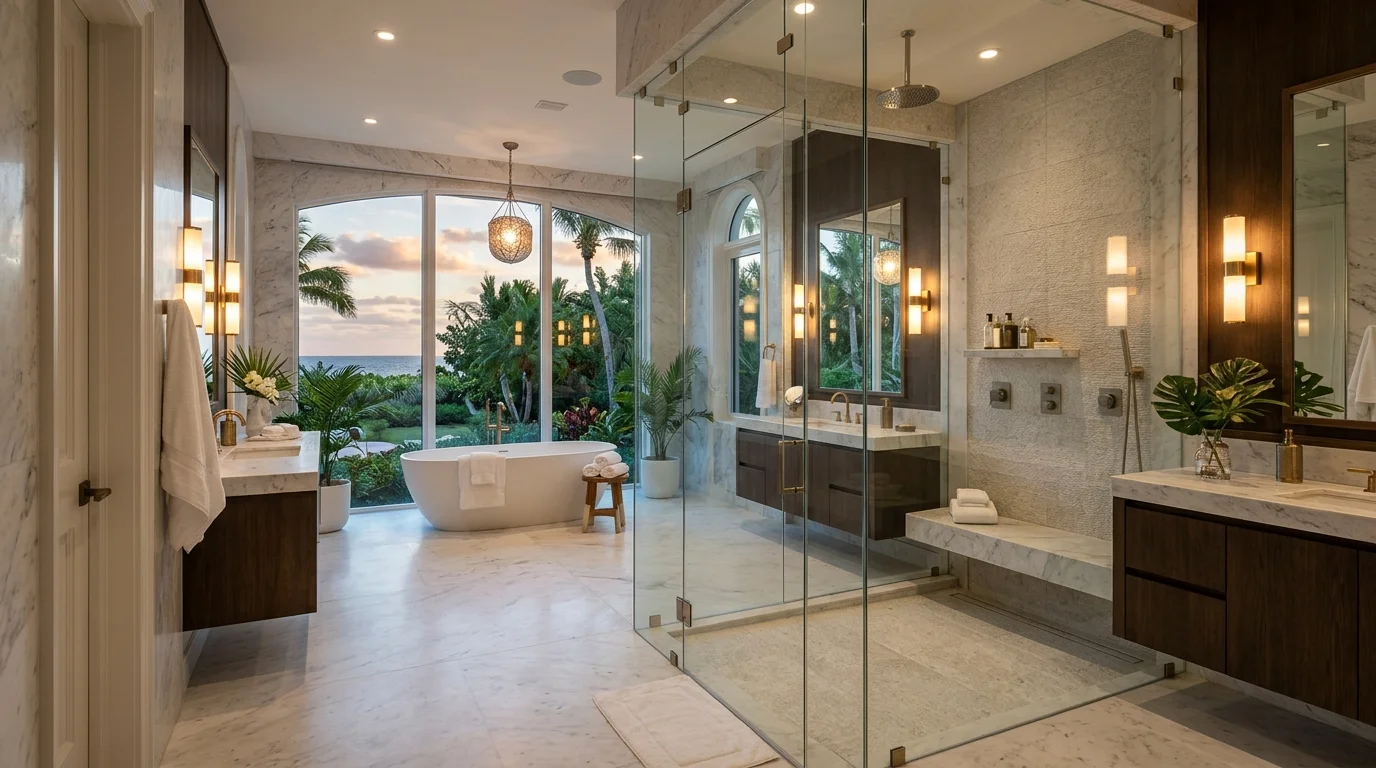
Frameless shower glass is one of the most requested upgrades we see in Palm Beach County bathrooms right now, and for good reason. A properly installed frameless enclosure opens up a bathroom visually, holds up well in Florida's humidity, and doesn't trap mold the way metal-framed channels do. But not all frameless glass is the same, and the choices you make on thickness, coating, and configuration will determine how the enclosure looks, cleans, and performs five years from now. This guide breaks down everything homeowners in Boca Raton, Delray Beach, Wellington, and Jupiter need to know before signing anything.
Frameless vs Semi-Frameless: Real Differences
People use these terms loosely, so let's be precise. A fully frameless shower enclosure uses thick tempered glass, typically 3/8" or 1/2", with no metal frame wrapping the glass edges. Hardware is minimal: a few wall-mounted hinges, a single handle, and sometimes a fixed panel clip or two. The glass carries itself. Semi-frameless designs use thinner glass, usually 1/4" or 5/16", supported by a partial metal frame, most often along the top rail and sometimes at the bottom. The door panel itself may be frameless, but the fixed panels have channel support.
Our take: go fully frameless if your budget allows it. The look is cleaner, the hardware is bolder, and there are no horizontal metal channels collecting soap scum and mildew. That matters a lot in South Florida where showers get used daily and humidity stays high year-round. Semi-frameless is a legitimate middle ground when budget is tight, but don't expect it to disappear into the tile the way a true frameless enclosure does.
Framed shower doors, the kind with a full aluminum frame wrapping every edge, are the least expensive option but the hardest to keep clean. We rarely recommend them for primary bathrooms. Guest baths and rental properties are a different conversation. For more on how shower design choices fit into the full bathroom picture, see our guide on walk-in shower design ideas for South Florida bathrooms.
One thing homeowners often miss: frameless doesn't mean watertight by default. The glass panels are held with minimal hardware, so proper sealing at the wall channel and bottom sweep matters. A poorly installed frameless enclosure leaks. That's an installation quality issue, not a product defect, and it's why you want an experienced team doing the work.
Glass Thickness: 3/8" vs 1/2"
This is where most homeowners get confused because the specs sound minor but the real-world difference is significant. Standard frameless shower glass comes in two thicknesses: 3/8" and 1/2". A handful of budget suppliers sell 5/16" as "frameless," but we don't consider that true frameless construction.
3/8" glass is the entry point for real frameless enclosures. It's sturdy enough for most residential applications, works fine with standard swing doors and fixed side panels, and costs less than the half-inch option. Most of the frameless enclosures we install in mid-range bathroom remodels use 3/8" glass.
1/2" glass is heavier, has a noticeably more substantial feel when you open and close the door, and looks more impressive from across the room. The edge thickness is visible and reads as quality. It's also more forgiving if the door is on the larger side, say 36" wide or more. The downside: the hinges, handles, and wall anchors all need to be rated for the extra weight, and the installed cost climbs accordingly.
Our recommendation for primary bathrooms in Boca Raton and Jupiter homes: 1/2" glass if the shower door span is wider than 30" or if the design calls for a frameless pivot door. For smaller enclosures or guest baths, 3/8" does the job without the premium price. If you're weighing these choices as part of a larger bathroom budget, our bathroom remodel cost guide for Boca Raton gives you a realistic starting point for overall project numbers.
All shower glass used in Florida residential construction must meet Florida Building Code requirements for safety glazing, which means tempered glass only. Laminated glass is an option for enhanced safety, particularly in households with young children, but it costs more and has a slightly different visual quality. We'll cover that briefly in the FAQ section.
Glass Coatings That Actually Matter
This section might be the most underrated part of choosing frameless shower glass. The glass type gets all the attention, but the coating determines how much time you spend scrubbing it every week.
Hydrophobic coatings, sometimes called water-repellent or easy-clean coatings, cause water to bead and sheet off the glass rather than sit and dry into mineral deposits. South Florida has notoriously hard water in many areas, and that hardness leaves white calcium scale on untreated glass fast. A quality hydrophobic coating doesn't eliminate maintenance, but it cuts it down significantly.
There are two ways to get a coated enclosure. The first is factory-applied coatings, which are bonded to the glass surface during manufacturing. Products like permanent glass protection systems from specialty manufacturers fill the microscopic pores in the glass surface, making it harder for minerals and soap to bond. Factory coatings last longer than aftermarket ones and don't require re-application for years. The second option is aftermarket sealers applied after installation. They work, but they need to be reapplied every six to twelve months depending on how frequently the shower is used.
Our position: specify a factory-applied hydrophobic coating when you order the glass. The upcharge is usually $150-$400 for a standard enclosure and it's worth every dollar when you're dealing with Wellington well water or Delray Beach municipal supply. If you're already installing frameless glass and skipping the coating to save money, you're making the wrong trade-off.
Low-iron glass is another option worth knowing about. Standard clear glass has a subtle green tint that becomes noticeable on thicker panels, especially at the edges. Low-iron glass is optically clearer, almost water-white, and makes a visible difference in the overall look of the enclosure. It costs roughly 20-30% more than standard clear glass and pairs especially well with neutral tile palettes. For shower tile ideas that complement clear frameless glass, take a look at our bathroom shower tile ideas for South Florida homes.
Frosted, rain, or textured glass is available for frameless enclosures if privacy is a priority. These are less common in primary baths where the design intent is usually to show off the tile work, but they're a smart choice for guest baths that open directly onto a bedroom or for shared bathrooms where multiple people use the space at different times.
Hardware, Doors, and Panel Configurations
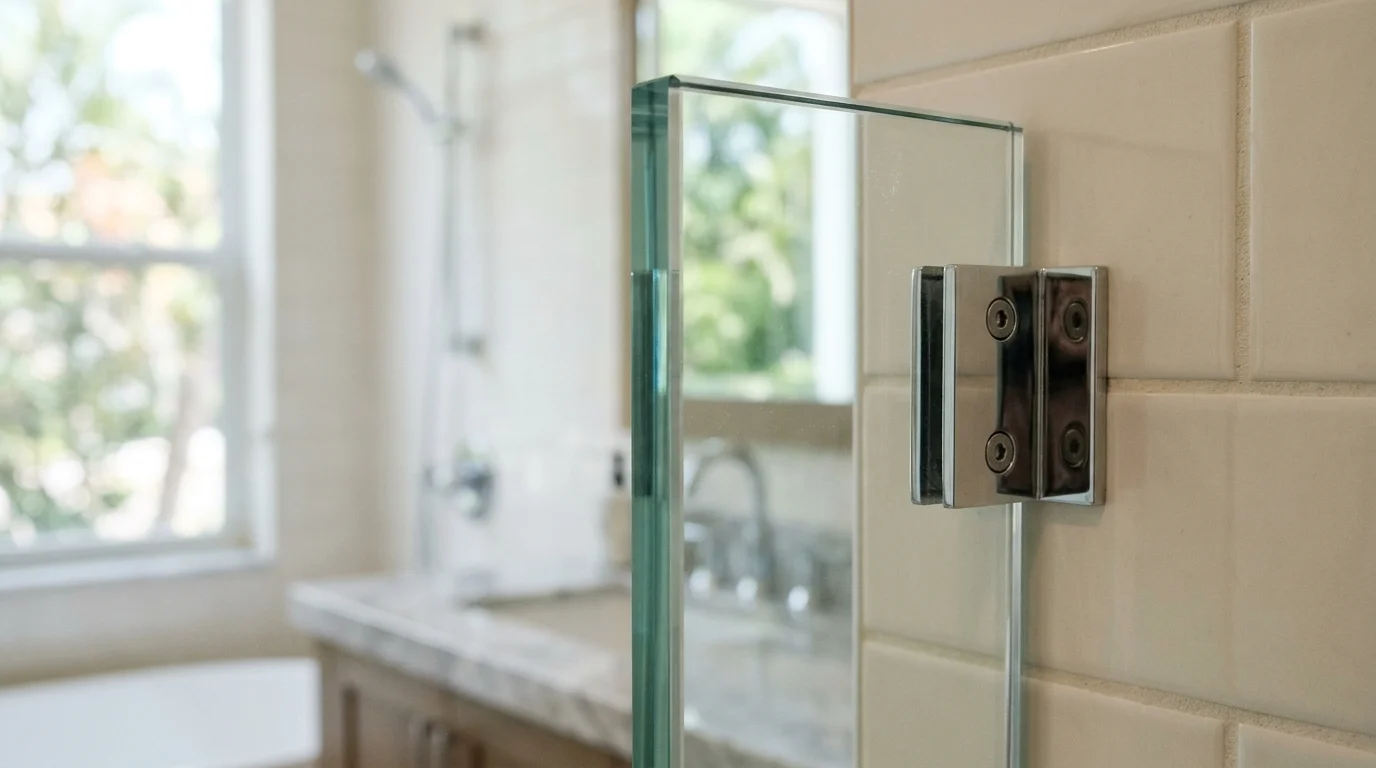
The hardware on a frameless enclosure does real structural work, not just decorative work. Hinges, pivot brackets, and wall-mount clips are load-bearing, and the finish needs to hold up to daily moisture exposure without corroding or pitting. Brushed nickel and matte black are the two most popular finishes in Palm Beach County right now. Chrome is classic and durable. Polished brass is having a moment in higher-end homes in Jupiter and Boca, especially paired with warm stone tile.
Avoid cheap zinc alloy hardware. It looks fine in the showroom and starts to corrode within a year of daily shower use in a humid Florida bathroom. Solid brass or stainless steel hardware costs more and lasts dramatically longer. This is not a place to cut costs.
Door configurations break down into a few main types. Swing doors, also called hinged doors, are the most common for frameless enclosures. They open in or out and require clearance space outside the shower. Pivot doors use top and bottom pivot points instead of side hinges and can carry heavier glass panels smoothly. Sliding or barn-style frameless doors are an option for smaller bathrooms where swing clearance is limited, though they're harder to seal properly and don't have quite the same clean look as a hinged panel.
Frameless enclosures can be configured as a single door with no fixed panel, a door with one fixed panel, a door between two fixed panels (also called a tub-to-ceiling configuration), or fully open neo-angle or walk-in designs with no door at all. Walk-in configurations, sometimes called doorless showers, are increasingly popular and pair well with curbless entries. If you're considering that direction, our piece on curbless zero-threshold showers covers the waterproofing and design requirements in detail.
Shower niches, built-in shelving, and bench details all interact with how the glass panels are positioned. The glass measurements need to be templated after tile is complete, not before, because even small variations in how tile is set can affect panel sizing. This is a step that experienced installers know well and inexperienced ones get wrong regularly.
Cost Guide
Frameless shower glass pricing in Palm Beach County varies based on glass thickness, coating, enclosure size, hardware quality, and configuration complexity. The numbers below reflect what homeowners are actually paying in our market right now, not national averages that don't account for South Florida labor and material costs. Keep in mind that installation cost is separate from glass cost and depends on the complexity of the opening, wall conditions, and tile substrate.
These ranges assume a standard residential shower opening with accessible walls and no major structural complications. Custom shapes, neo-angle configurations, and unusually tall ceilings add cost. If a full shower remodel is on the table, not just the glass, our shower remodel cost guide for Palm Beach County breaks down the full project scope including tile, waterproofing, and fixtures.
South Florida Considerations
Florida's climate creates specific challenges that homeowners in colder markets don't face. Humidity is constant, water quality varies significantly across Palm Beach County, and bathrooms that aren't properly ventilated will grow mold behind a frameless enclosure just as fast as behind a framed one. The glass choice is only part of the equation.
Ventilation matters more than most people realize. A bathroom exhaust fan rated for the room's square footage, run during and for at least 15 minutes after every shower, is not optional in Boca Raton, Delray Beach, or Wellington. Without it, even the best frameless glass with a premium hydrophobic coating will have moisture issues at the wall connections and silicone joints. That's where mold starts.
Water hardness is a real issue in many parts of Palm Beach County, particularly in areas served by well water or older municipal systems. Calcium and magnesium deposits etch unprotected glass over time and are very difficult to remove once they bond. This is the single best argument for specifying a factory-applied hydrophobic coating at the time of purchase. Aftermarket products help but are not as durable.
Silicone joints on frameless enclosures need inspection once a year and replacement every three to five years depending on shower use and water quality. This is routine maintenance, not a sign of a defective installation. Silicone breaks down over time, especially with daily exposure to Florida's chlorinated and mineral-heavy water. Budget for it.
Lighting interacts with frameless glass in ways that matter to the final design. Clear frameless glass with low-iron panels and good shower lighting makes the tile the focal point. If you're investing in a detailed tile installation, don't undermine it with a heavy framed enclosure. For ideas on how to light the space effectively, our bathroom lighting ideas for Palm Beach County remodels covers fixture placement, color temperature, and wet-rated requirements.
HOA and ARB approvals apply to some projects in gated communities and historic districts across the county. The design drawings and material samples for those submissions are typically assembled by your general contractor. Our team supplies the design documentation and specifications that support that process, but the actual submission goes through your GC.
Waterproofing behind the tile, before the glass ever gets templated, is what determines whether a shower lasts 5 years or 25. Frameless glass looks beautiful on a properly waterproofed shower. It becomes an expensive problem on one that wasn't done right. If you're not sure what's behind your tile, our bathroom waterproofing guide for Florida homes explains what proper substrate preparation looks like and what questions to ask your contractor before work begins.
One more thing specific to South Florida: salt air. Homes within a mile or two of the coast in Jupiter, Palm Beach, or Delray Beach see accelerated corrosion on hardware finishes. If your bathroom has any coastal exposure, solid brass or marine-grade stainless steel hardware is worth the extra investment. Plated finishes that look identical in the showroom will pit and tarnish faster than you expect in a coastal environment.