Wet Room Bathrooms: Pros, Cons & Cost
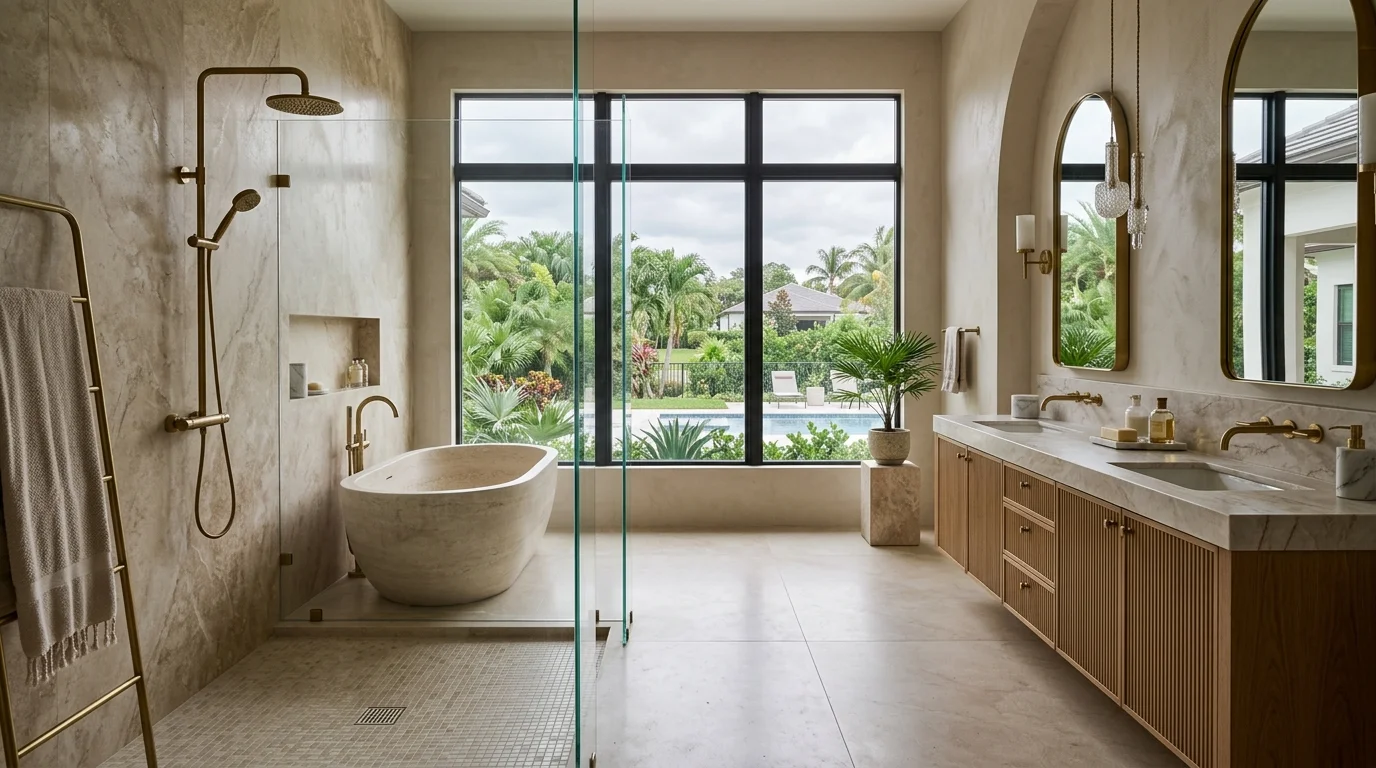
A wet room is one of the most requested bathroom upgrades we see right now across Palm Beach County, and for good reason. The concept is straightforward: the entire bathroom, or a dedicated zone within it, is fully waterproofed so water can flow freely across the floor to a drain. No shower door. No threshold. No curtain. Just open, tiled space that doubles as your shower zone. If you're designing a primary suite in Wellington or renovating a condo bathroom in Boca Raton, the wet room format offers real design freedom. But it also demands real waterproofing discipline, especially here in South Florida where humidity never takes a day off.
What Is a Wet Room?
Most people picture a walk-in shower when they hear "wet room," but the two aren't the same thing. A walk-in shower is a waterproofed enclosure within a bathroom. A wet room waterproofs the entire floor, and often the walls, of the entire bathroom or a large open zone, so water can be directed anywhere across the surface to one or more drains. The toilet, vanity, and storage typically live in a drier section of the room, but the shower area has no defined enclosure walls or door.
Some wet rooms incorporate a freestanding tub inside the wet zone, which is one of the more dramatic looks we install. You can bathe and shower in the same open area. Others keep the tub outside the wet zone and use the open wet room purely as the shower. Either way, the defining characteristic is full-floor waterproofing with intentional drainage pitch, not just a waterproofed shower pan.
For a deeper look at how waterproofing systems actually work in Florida's climate, our bathroom waterproofing guide for Florida homes covers the membrane systems, substrate requirements, and common failure points we encounter in older homes from Delray Beach to Jupiter.
Pros of Wet Room Bathrooms
There are genuine advantages to this format, and we'd recommend it to the right homeowner without hesitation. Here's where wet rooms actually deliver:
Accessibility is the biggest practical win. No threshold to step over means wet rooms work beautifully for aging-in-place renovations, households with mobility concerns, or anyone who simply wants a safer bathroom. Palm Beach County has a large population of homeowners in 55-plus communities who want that ground-level entry without the institutional look of a grab-bar-and-bench setup. A wet room can be gorgeous and accessible at the same time.
They photograph well and add perceived value. Open, tiled, spa-caliber bathrooms are what buyers in Jupiter, Palm Beach Gardens, and Boca Raton expect at the luxury price point. A well-executed wet room with large-format porcelain, a linear drain, and clean fixtures reads as high-end immediately. For our luxury bathroom remodel clients, wet rooms are consistently one of the most impactful moves on the design board.
Cleaning is simpler than you'd expect. No track on a shower door. No grout lines in tight corners where mold colonizes. When the entire floor is properly pitched and drained, a quick rinse-down handles most of the maintenance. That's a real benefit in Florida where mold is not a hypothetical problem.
Design flexibility opens up. You're not constrained by a prefab shower enclosure or a specific alcove dimension. Large-format tile can run continuously from wall to wall. You can bring a freestanding tub into the wet zone, something that's nearly impossible to do safely in a conventional bathroom without dedicated waterproofing underneath. If you're weighing that decision, our comparison of freestanding tub vs built-in options walks through the value and practical tradeoffs in detail.
Tile continuity looks expensive. When the same large-format tile runs from dry zone to wet zone with no break, the room reads as significantly bigger. That matters in the smaller bathroom footprints common in older Boca Raton and Delray Beach homes.
Cons and Real Challenges
We're not going to pretend wet rooms are right for every situation. There are real tradeoffs, and some of them bite hard if you don't plan for them upfront.
Waterproofing has zero margin for error. This is the single biggest risk in a wet room build. When you waterproof a standard shower, a failure typically stays contained to that shower pan area. When you waterproof an entire floor, a failure means water is working its way under the entire slab or subfloor. In a wood-framed second-story bathroom, common in newer construction in Wellington and some Jupiter communities, that's a disaster. Your general contractor needs to specify the right membrane system from day one, and the tile installation has to follow it precisely. Shortcuts here are expensive mistakes.
Humidity management in the rest of the bathroom gets harder. Open shower zones mean steam travels freely. Your exhaust fan needs to be sized correctly for the full room volume, not just a standard bathroom calculation. In South Florida, where outdoor humidity is already running 70-80% for much of the year, an undersized exhaust fan in a wet room leads to mold on the vanity mirror, the ceiling, and behind the toilet. That's not a minor inconvenience.
The floor pitch has to be engineered, not eyeballed. A properly functioning wet room floor drops toward the drain at a consistent pitch, typically 1/4 inch per foot minimum. In a larger open wet zone, that pitch has to be planned before a single tile is set. If the pitch is inconsistent, you get standing water pooling in corners. Fixing that after the tile is down means tearing it out. Our team is precise about this, but it's one of the reasons wet rooms cost more than standard shower builds.
Privacy disappears. If two people share the bathroom simultaneously, there's no enclosed shower to retreat to. That's a lifestyle decision, not a construction problem, but it catches people off guard.
Heat loss in cooler months. Yes, South Florida gets "cool", by our standards, anyway. When there's no enclosure to trap steam and warmth, your shower experience in December or January feels colder than a conventional enclosed shower. Not a dealbreaker for most, but worth knowing.
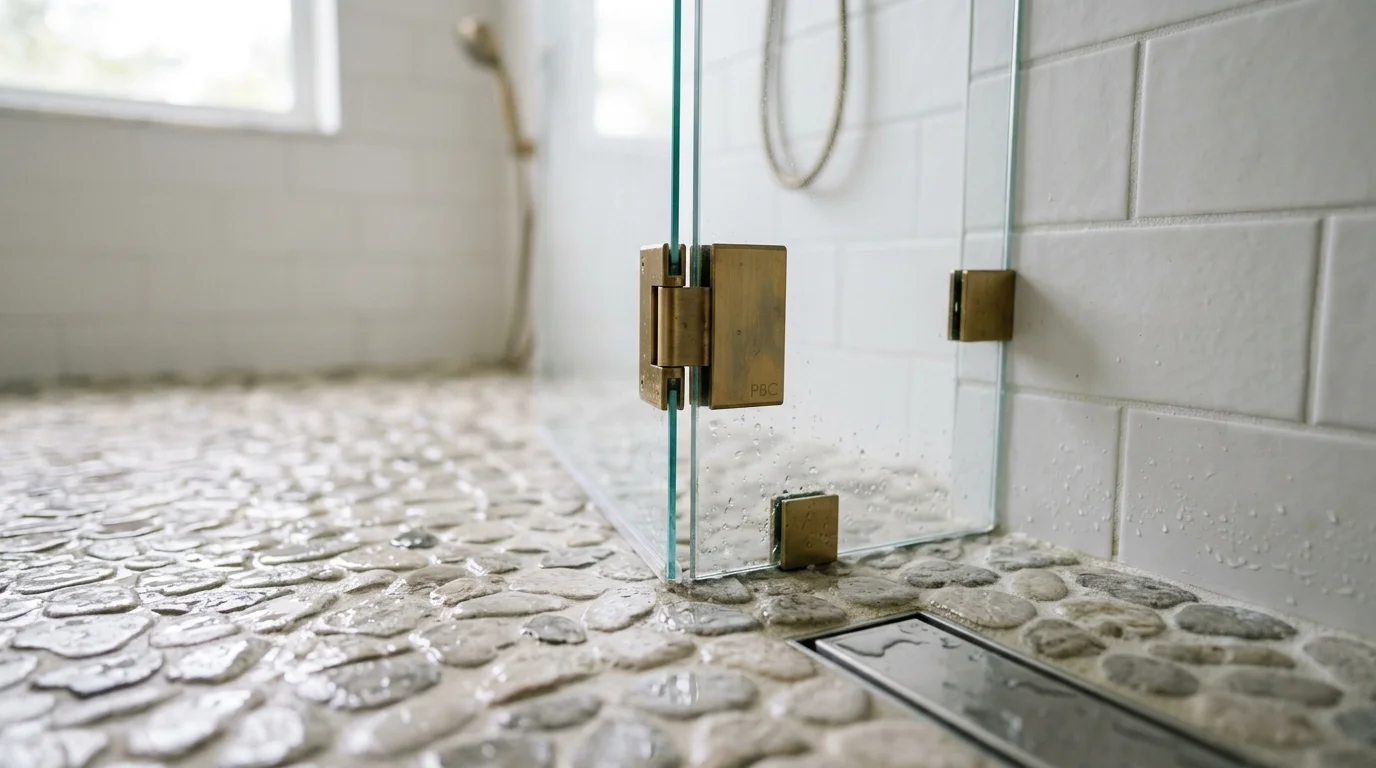
One more thing: the tile choice matters enormously in a wet room. The entire floor gets wet regularly, so slip resistance is non-negotiable. Our bathroom floor tile ideas for Palm Beach County homes covers coefficient of friction ratings and which formats hold up best in high-moisture zones. Large-format tiles with minimal grout lines can work well when the pitch is right, but textured finishes and smaller mosaic tiles give better grip underfoot.
Cost Guide
Wet rooms cost more than a comparable walk-in shower build. The waterproofing scope is larger, the drainage work is more complex, and the tile labor is more demanding because of the pitch requirements. Here's how pricing breaks down in the Palm Beach County market. Note that these ranges cover SFKB's design and installation scope, cabinetry, tile, countertops, and finish work. Plumbing rough-in, electrical, and permit fees where required are your general contractor's scope and are not included in these figures.
Permits for a wet room conversion depend on scope. If your GC is relocating the drain, adding circuits for heated floors, or moving supply lines, permits will be required. A straight tile-and-waterproofing upgrade on an existing drain location in most Palm Beach County jurisdictions typically does not trigger a permit, but confirm with your GC based on your specific municipality. Check the Florida Building Commission for statewide code guidance and your local building department for jurisdiction-specific rules.
The full bathroom remodel cost, vanity, countertop, toilet, lighting, and all finish work around the wet room, adds to these figures. For complete bathroom remodel pricing in this market, our bathroom remodel cost guide for Palm Beach County gives you a realistic full-project picture. And if you want to understand how to evaluate the total investment against your home's value, the 30 percent rule in remodeling is worth reading before you finalize your budget.
South Florida Considerations
Building a wet room in Palm Beach County isn't the same as building one in Chicago or Portland. The climate, construction methods, and local building culture all change the equation.
Humidity is the enemy of shortcuts. South Florida's year-round humidity means any gap in the waterproofing system, around a niche, at a floor-wall transition, behind a drain flange, will eventually find water trying to push through it. We specify modified bitumen sheet membranes or liquid-applied systems like Schluter KERDI on wet room builds. Both are proven in high-humidity environments and give tile setters a reliable substrate to work from.
Concrete slab construction is common and works in your favor. Most single-family homes in Boca Raton, Delray Beach, and Wellington are slab-on-grade. That means the wet room floor is concrete, a stable, moisture-tolerant substrate that handles the demands of full-floor waterproofing better than wood framing. If you're in a second-story condo or a wood-framed home in certain Jupiter neighborhoods, your GC needs to evaluate the subfloor before any wet room scope is committed to.
HOA and ARB approvals matter in gated communities. Many of the larger communities in Palm Beach County, from Boca West to Ibis to Admirals Cove, have architectural review boards that require design submissions before remodeling work begins. Your GC handles the permit submission; our team supplies the design drawings, tile specifications, and material samples needed for those packages. Get that process started early. Approvals can take weeks.
Tile selection should be designed for South Florida use. We push clients toward porcelain over ceramic for wet rooms, denser body, lower absorption rate, and better performance when the floor stays wet. Our detailed breakdown of porcelain vs ceramic tile for South Florida bathrooms explains why absorption ratings matter more here than they would in a drier climate. For wall tile in the wet zone, large-format slabs with minimal grout lines cut down on long-term mold maintenance dramatically.
Think carefully about ventilation from the start. We recommend a minimum 110 CFM exhaust fan for a wet room, 150 CFM or better for larger footprints. Humidity sensors that run the fan automatically are worth every dollar in this climate. This is your GC's electrical scope, but it needs to be specified during design, not added as an afterthought after the tile is done.
Avoid common mistakes that haunt South Florida bathrooms. Wet rooms are less forgiving than conventional shower builds when waterproofing is rushed or drainage is underengineered. For a full list of decisions that cause expensive problems, our bathroom renovation mistakes to avoid guide covers the pitfalls we see repeatedly across Palm Beach County remodels.
If you're drawn to the aesthetic but want to explore other high-impact shower design directions before committing to a full wet room build, our walk-in shower design ideas for South Florida bathrooms covers frameless glass enclosures, curbless entries, and tile configurations that deliver a similar luxury feel at a lower construction complexity level.