How to Remove Stains From Granite Countertops

Knowing how to remove stains from granite countertops can save you a professional restoration bill, and a lot of frustration. Granite is durable, but it is not impervious. It is a porous natural stone, and when the sealer wears thin, liquids work their way in. Oil, red wine, coffee, rust from canned goods, and the iron-laden well water common across Palm Beach County, Wellington, and western Boca Raton all leave marks that a dish rag will not touch. This guide covers every major stain type, the poultice method that actually works, and why proper sealing is the real fix, not just a recommendation you ignore.
Why Granite Stains in the First Place
Granite is formed under enormous heat and pressure, but it still has a network of microscopic pores running through it. Those pores are what make granite breathe, and they are also what let staining agents in. When you set a wet cast-iron pan on an unsealed or under-sealed granite surface, the oil and moisture get drawn in by capillary action. The stone does not absorb stains the way a sponge does, it traps them. And once a staining agent is below the surface, surface wiping accomplishes nothing.
The sealer is the defense layer. A quality penetrating sealer fills those pores with a resin that repels liquids long enough for you to wipe them up. When the sealer fails, and in South Florida's heat and UV exposure, it fails faster than manufacturers admit, granite becomes vulnerable. If you want the full picture on sealer selection and application schedules, our article on granite countertop sealer covers exactly what to use and how often to apply it down here.
The practical takeaway: a stain on your granite is almost always a sealer-failure event, not a stone-quality problem. Fix the stain. Then fix the sealer.
Identify Your Stain Type Before You Treat It
This matters more than most people realize. The wrong treatment does nothing, or makes things worse. There are five stain categories you will encounter on granite:
Oil-based stainscooking oil, butter, grease, salad dressing, skin oils. These darken the stone and tend to spread slightly as they penetrate deeper over time. You will notice a dark patch that looks wet but is not.
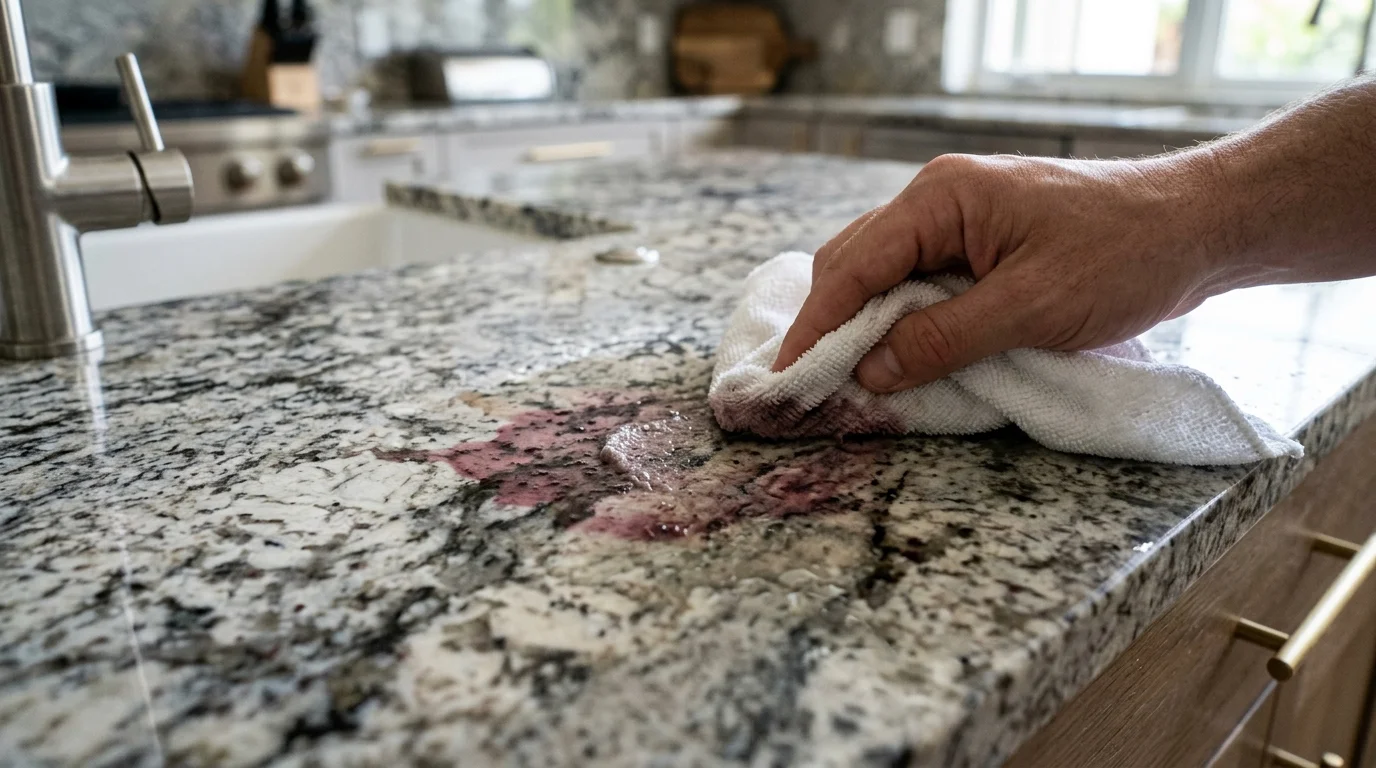
Organic stainscoffee, tea, wine, juice, fruit, food residue, even leaves left on an outdoor granite surface. These leave a pinkish-brown discoloration and respond well to hydrogen peroxide-based poultices.
Rust stainsleft by canned goods, cast iron, steel wool, or metal furniture feet on outdoor slabs. They appear as orange-red rings or streaks. Rust is one of the harder stains to remove from granite and sometimes requires a commercial rust remover formulated for stone.
Hard-water and mineral depositswhitish, crusty buildup around the sink or faucet base. These are not true stains, the minerals sit on top of the stone rather than inside it, but they can etch if left untreated, especially on softer granite varieties.
Ink, dye, or chemical stainsfrom markers, food coloring, paint, or chemical spills. Less common, but they need a solvent-based approach rather than oxidizing agents.
Once you know what you are dealing with, the treatment is straightforward. Mis-diagnose, and you will spend a weekend on something that will not work.
The Poultice Method: How to Pull Stains Out of Granite
A poultice is the gold standard for removing deep stains from granite. The concept is simple: mix an absorbent material with a chemical agent, pack it over the stain, seal it with plastic wrap, and let it dry slowly over 24-48 hours. As it dries, it pulls the staining agent out of the stone the same way it went in, through capillary action, but in reverse.
Here is how to do it correctly:
What you need: An absorbent powder (baking soda, diatomaceous earth, kaolin clay, or unbleached flour), a chemical agent matched to your stain type, plastic wrap, painter's tape, and a plastic scraper. Never use metal scrapers on granite.
Step 1, Clean the surface first. Wipe the area with a pH-neutral stone cleaner. Do not use vinegar, bleach, or anything acidic. You want a clean, dry surface before the poultice goes on.
Step 2, Mix your poultice. For oil stains: mix your absorbent powder with acetone or mineral spirits to a peanut-butter consistency. For organic stains: mix with 12% hydrogen peroxide (available at beauty supply stores, not the 3% drugstore version) and a few drops of ammonia. For rust stains: use a commercial rust remover for natural stone such as MB Stone Care products mixed with the powder base. Do not improvise with hardware-store rust removers, most contain hydrochloric or phosphoric acid that will damage granite permanently.
Step 3, Apply it thick. Spread the poultice about a quarter-inch thick over the stain, extending an inch beyond the edges in all directions.
Step 4, Seal with plastic wrap. Press plastic wrap over the poultice and tape the edges down with painter's tape. You want it to dry slowly. If it dries in a few hours, it pulls nothing out. A slow 24-48 hour dry is what does the work.
Step 5, Remove and rinse. Once fully dry, remove the plastic wrap, let the poultice air-dry another hour if it still feels damp, then scrape it off gently with your plastic scraper. Rinse the area with clean water and dry immediately.
Step 6, Repeat if needed. Deep stains often require two or three applications. Do not panic if the first pull is incomplete. The stain is lightening even if it is not gone.
After the stain is out, apply fresh sealer to the area. A localized touch-up now is far easier than a full resurface later.
Stain-by-Stain Removal Guide
Cooking oil and grease: Acetone-based poultice as described above. Acetone evaporates cleanly without leaving a residue in the stone. Mineral spirits also work and are gentler if you have a darker granite where you are worried about lightening. Apply the poultice, wait 48 hours, repeat as needed. Most fresh oil stains come out in one or two applications. Oil that has been sitting for months is harder, be patient.
Coffee and red wine: Hydrogen peroxide poultice (12% strength). Coffee and wine are organic tannin stains and they respond well to oxidation. Mix your powder with the hydrogen peroxide, add a drop or two of ammonia to boost the action, and apply as above. On very light-colored granite, this approach is highly effective. On dark granite, test a small hidden spot first, concentrated hydrogen peroxide can occasionally lighten certain dark stones.
Rust rings: This is the one stain that genuinely requires a specialty product. Standard household remedies will not move rust that is bonded inside stone. Use a commercial iron stain remover formulated specifically for natural stone, MB Stone Care's MB-9 or a similar product. Mix it with your poultice base per the manufacturer's instructions. For severe rust staining, you may need a professional stone restoration company to buff the surface. Do not use CLR, naval jelly, or any acid-based rust remover sold at hardware stores. They will strip the sealer, etch the surface, and potentially cause permanent discoloration.
Hard-water buildup: This is a deposit problem, not a penetrating stain. Mix a small amount of non-acidic stone-safe hard water remover (products labeled for natural stone specifically) with water and apply with a soft cloth. For light buildup, a paste of baking soda and water rubbed gently in circles can reduce mineral deposits. Rinse thoroughly and dry completely. Repeat weekly if you have a high-mineral water supply. The real fix is sealing the stone properly so hard water sits on the sealer, not on the granite itself.
Ink and markers: Acetone on a cotton ball applied directly to fresh ink marks. Blot, do not rub. Rubbing spreads the ink further into the pores. For set-in ink, an acetone-based poultice is your best option. For paint spatters, let the paint dry fully before attempting removal, a plastic scraper at a shallow angle removes dried latex paint without scratching the stone.
If you have marble in other areas of the home and deal with similar stain issues, the approach overlaps but differs in important ways, you can read our guide on how to remove stains from marble countertops to see where the methods diverge.
South Florida Considerations: Hard Water, Iron & Well Water
South Florida homeowners, particularly in western Palm Beach County, Wellington, Loxahatchee, and parts of Jupiter, deal with something homeowners in drier climates rarely face: high-iron well water. If your home pulls from a private well or an older municipal supply with iron content, you will see orange-brown staining around the sink base and faucet that looks like rust from your fixtures. It is not. It is iron oxide depositing directly from the water onto and into the granite.
This is a different beast from a canned-good rust ring. It is persistent, it re-appears after treatment unless you address the source, and it can be mistaken for a sealer problem. The stone-safe iron stain removers mentioned above will handle it temporarily, but the permanent solution is a whole-house iron filtration system. Without one, you will be poulticing that sink surround every few months indefinitely.
Hard water is nearly universal across Boca Raton, Delray Beach, and the barrier island communities. The calcium and magnesium in municipal South Florida water leaves white mineral film on granite fast, often within weeks of installation if you do not seal aggressively and wipe dry after every use. We see this constantly on granite installed around undermount sinks where water pools at the joint. The countertop looks dull and chalky even though it was beautiful six months ago.
Our recommendation for South Florida granite: seal twice a year, not annually. The combination of humidity, UV exposure through large impact windows, and mineral-heavy water accelerates sealer breakdown here faster than the national guidance suggests. If you do the water-bead test, drop a few tablespoons of water on the granite and watch what happens, and the water soaks in rather than beading up within four minutes, your sealer is gone. Reseal immediately.
Choosing the right countertop material also matters from the start. If you are comparing options for a kitchen remodel, our breakdown of the best countertop materials for Florida's humidity and heat gives you an honest comparison of granite, quartz, quartzite, and other surfaces in our specific climate conditions.
One more South Florida-specific note: outdoor granite surfaces on lanais and summer kitchens take the hardest beating. The combination of sun, rain, pool chemicals, and humidity means outdoor granite needs quarterly sealing and is particularly prone to organic staining from leaves, mold, and algae. Algae staining on outdoor granite is treated with diluted hydrogen peroxide, not bleach, and then a thorough rinse. Bleach will strip your sealer instantly.
If you are thinking about a full kitchen update and wondering how granite fits into the bigger picture of countertop investment and home value, take a look at what we have written about granite countertops cost in Palm Beach Countyit covers material grades, installation, and what drives pricing in this market. And if you are comparing granite against engineered options, our article on quartz vs quartzite vs granite vs marble breaks down each material's real-world performance.
One thing we see often when homeowners start noticing countertop issues: the staining problem reveals that the kitchen as a whole is overdue for a refresh. If that sounds familiar, our guide on how to clean granite countertops properly covers the day-to-day maintenance that prevents stains from forming in the first place, it pairs directly with what you have read here.