How to Remove Stains From Marble Countertops
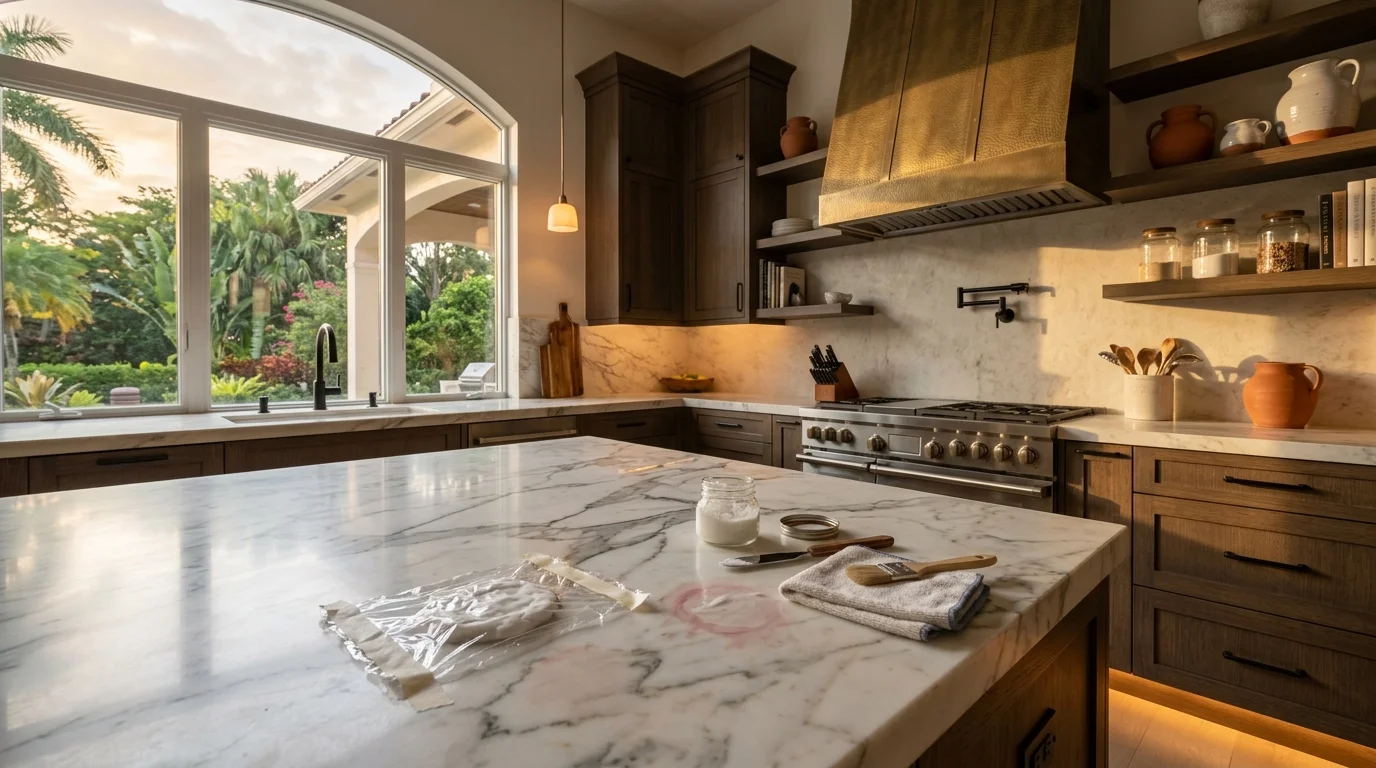
Knowing how to remove stains from marble is one of those skills every homeowner with a marble countertop eventually needs. Marble is porous, reactive, and gorgeous, and that combination means it picks up oil, wine, rust, and hard-water marks faster than most people expect when they first install it. We see this constantly on jobs across Palm Beach County, Boca Raton, Delray Beach, Wellington, and Jupiter. The good news: most stains are fixable at home if you catch them early and use the right method. The bad news: most homeowners either do nothing and let the stain set, or they reach for the wrong cleaner and make things worse.
Stain vs. Etch: Know the Difference First
This is the single most important thing to understand before you touch your marble. A stain and an etch are two completely different problems, and treating one like the other will get you nowhere.
A stain is discoloration caused by a substance absorbing into the stone, oil, coffee, wine, rust, organic matter. The surface texture feels normal. The problem is below the surface.
An etch is physical damage to the stone's surface caused by acid. Lemon juice, vinegar, tomato sauce, wine (yes, wine can do both), and even some cleaning products will chemically react with the calcite in marble and leave a dull, lighter-looking mark. The surface texture changes, it feels slightly rough or matte compared to the polished areas around it. That's not a stain. No amount of poultice will fix it. Etching requires professional honing or polishing to remove.
Run your finger over the mark. If it feels flat and the discoloration sits below a smooth surface, you're dealing with a stain. If the area feels rougher or duller than the surrounding marble, that's an etch. This guide covers stains. For routine surface care and avoiding future etching, our article on how to clean marble countertops covers the day-to-day side of marble maintenance.
One more thing: water rings are often mistaken for stains. If your water ring wipes away when the surface dries, it was just mineral residue sitting on top, that's a cleaning issue. If the ring persists after drying and feels like it's in the stone, it's either a true hard-water stain that's bonded to the surface or a mild etch from acidic well water. We'll cover both.
The Poultice Method for Deep Stains
The poultice is the professional approach to pulling stains out of porous stone. It works by drawing the staining substance back out of the marble the same way it went in, through absorption. You apply an absorbent material saturated with a cleaning agent, let it sit sealed against the surface, and it slowly pulls the stain out as it dries. Done right, it's remarkably effective on oil-based and organic stains.
Here's the process step by step.
Step 1: Identify your stain type. Oil-based stains (cooking oil, grease, lotion, cosmetics) need a degreasing agent, acetone or mineral spirits work well. Organic stains (coffee, tea, wine, food, mold) respond to hydrogen peroxide (12% concentration, available at beauty supply stores, works better than drugstore 3%). Rust stains need a dedicated rust remover formulated for natural stone, do not use generic hardware-store rust removers, as many contain acids that will etch the marble.
Step 2: Make your poultice. Mix your chosen cleaning agent with an absorbent powder, kaolin clay, diatomaceous earth, or plain unbleached flour all work. The consistency should be like peanut butter. Thick enough to hold its shape on a vertical surface, wet enough to stay in contact with the stone.
Step 3: Apply and seal. Spread the poultice about a quarter-inch thick over the stain, extending half an inch beyond the edges. Cover it with plastic wrap and tape the edges down with painter's tape. The plastic wrap slows the drying process, which forces the poultice to pull harder as it dries rather than just evaporating from the top down.
Step 4: Wait. For light stains, 24 hours is usually enough. For deep or set stains, especially anything that's been sitting for weeks, leave it for 48 hours. Don't rush this part.
Step 5: Remove and rinse. Peel away the plastic, let the poultice dry completely if it isn't already, then scrape it off with a plastic putty knife. Never use metal on marble. Rinse the area with clean water and buff dry with a soft cloth.
Step 6: Repeat if needed. Older stains often need two or three rounds. Each application pulls more of the stain out. If you've done three rounds and the stain is still clearly visible, it may have set deep enough that professional stone restoration is the next step.
Pre-mixed poultice products like Marble Technics are available and work well if you'd rather not mix your own. Follow the manufacturer's ratio instructions, too wet and it won't draw properly.
Removing Specific Stain Types
Different stains call for different approaches. Here's how we handle the most common ones we see on marble countertops across Palm Beach County homes.
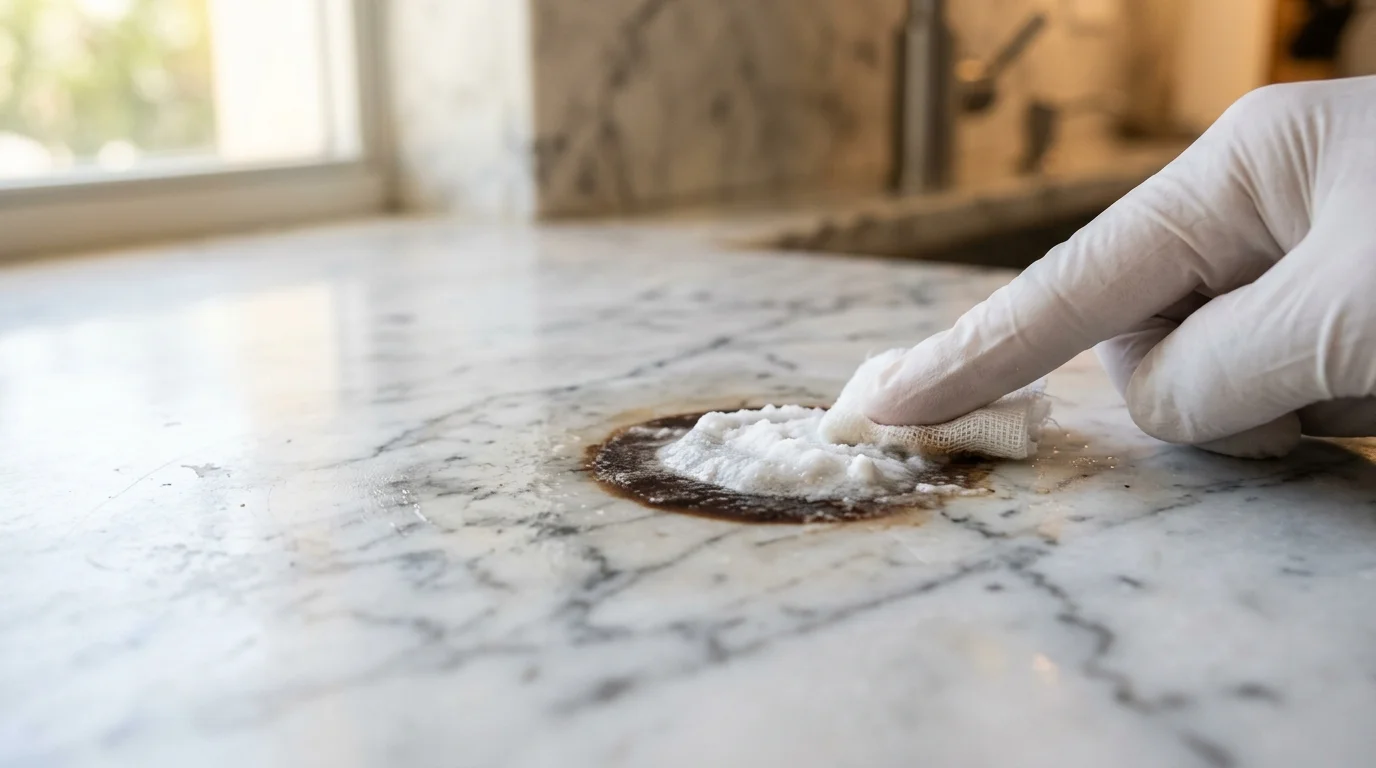
Oil and grease stains. These show up as darker patches, usually near the stove or prep areas. The marble literally absorbs cooking oil over time. Acetone-based poultice is your best tool here. Act fast, fresh oil stains respond after a single 24-hour treatment. Stains that have been sitting for months may need multiple rounds.
Red wine and coffee. Both are organic stains, and hydrogen peroxide is the right agent. Use 12% concentration for anything that's been sitting more than a day. Fresh wine spills can sometimes be lifted with a hydrogen peroxide-soaked cloth held firmly on the spot for 10-15 minutes without a full poultice, but if the color has had time to absorb, go straight to the poultice method.
Rust stains. These are among the toughest. Rust usually comes from a metal object left sitting on the counter, a can, a cast iron pan, metal decorative objects. The iron oxidizes and transfers into the stone. Use a poultice made with a stone-safe rust remover. Products specifically formulated for natural stone are available from stone suppliers in Boca Raton and West Palm Beach. Don't improvise with CLR or similar products, the acid content will etch the marble badly.
Hard-water and mineral rings. This is the one that's genuinely specific to South Florida. Our municipal water supply across Palm Beach County is notably high in calcium and magnesium. Water left sitting on marble evaporates and leaves behind white mineral deposits that can bond to the surface. If simple wiping doesn't remove them, try a paste of baking soda and water, gently rub with a soft cloth. If that doesn't work, a pH-neutral stone cleaner with chelating agents (marketed specifically for hard-water deposits on natural stone) is your next step. Do not use vinegar, lemon, or acidic descalers, they will etch the marble immediately. If the rings have been there long enough that they've bonded firmly, a stone restoration professional can hone them out without harming the surface.
Organic surface stains (mold, mildew, algae). In South Florida's humidity, marble in bathrooms and kitchens near exterior walls can develop dark organic staining. Hydrogen peroxide poultice handles these well. For surface-level organic growth, a diluted hydrogen peroxide solution applied with a soft brush works before moving to a full poultice. This is also a waterproofing issue worth addressing, if moisture is getting behind or under your marble, that needs attention from your GC.
Ink, dye, and cosmetics. Acetone works for ink and most cosmetic stains. Apply via poultice, not direct scrubbing. On light-colored marble, you can try hydrogen peroxide if acetone seems too aggressive, but acetone is generally safe on marble when used correctly, it doesn't etch calcite the way acids do.
If you're weighing whether marble is really the right surface for a high-traffic kitchen, our breakdown of best countertops for Florida kitchens lays out how marble compares to quartz, quartzite, and granite in real use conditions.
South Florida Hard-Water and Humidity Factors
Homeowners in Boca Raton, Delray Beach, Wellington, and Jupiter deal with countertop maintenance challenges that don't come up the same way in other parts of the country. Two factors stand out: hard water and humidity.
Palm Beach County water hardness runs high, typically in the 200-350 parts per million range depending on your municipality and if you're on well water. That means every drop of water that sits on your marble and evaporates leaves behind a mineral deposit. Over time, those deposits build up into a hazy film or distinct rings that look like stains but are actually mineral scale. The approach described above for hard-water rings applies, but if your home doesn't have a whole-house water softener, this will be an ongoing maintenance task rather than a one-time fix.
Humidity creates a different problem. Marble is porous, and in a humid climate, that porosity means the stone stays more receptive to staining agents year-round. A kitchen in Wellington that sits at 70-75% indoor humidity in August absorbs spills faster than the same stone would in a climate-controlled environment. This is part of why sealing is more important here than the national guides suggest, we'll cover that in the next section.
It's also worth noting that some older homes in South Florida, particularly in established neighborhoods of Delray Beach and Boca Raton, have marble that hasn't been resealed in years. If your marble is drinking up water within a few minutes of contact (do the water-bead test: drop water on the surface and watch, if it soaks in within 4 minutes, the seal is gone), stain removal alone won't solve your problem long-term. Reseal first, then address remaining stains.
For homeowners thinking about whether to keep their marble or switch materials during a remodel, it's worth reading about quartz vs. quartzite vs. granite vs. marble to understand what the trade-offs actually look like in practice. Marble is beautiful and worth maintaining, but it's not a low-maintenance surface, and South Florida's climate makes that more true, not less.
One more South Florida-specific note: if you have a coastal property in Jupiter or along the Boca Raton intracoastal, salt air can accelerate surface degradation on marble, particularly on kitchen islands or counters near open windows. This isn't a staining issue, but it can make the surface more porous over time, which increases stain susceptibility. Annual professional sealing is worth the cost in those environments.
Prevention After You've Cleaned
Getting a stain out is satisfying. Preventing the next one is smarter. Here's what actually works in a South Florida kitchen or bathroom.
Seal properly and on schedule. A quality impregnating sealer, not a topical coating, is what you want for marble. Brands like Miracle Sealants 511 Impregnator or Tenax Hydrex are well-regarded in the stone industry. In Palm Beach County's climate, we recommend sealing marble countertops every 12-18 months in kitchens and every 12 months in bathrooms. Do the water-bead test annually. When water stops beading and starts absorbing within a few minutes, it's time to reseal. Our article on how to seal granite countertops walks through the mechanics of sealing natural stone, the process is nearly identical for marble.
Use trivets and cutting boards religiously. Heat doesn't stain marble the way it can discolor some engineered surfaces, but it can cause thermal shock cracking in thinner slabs and will accelerate sealer breakdown over time. Cut directly on marble and you'll etch it with citric acid from produce before you stain it.
Wipe spills immediately. Seriously. Marble staining is almost always a function of time. A wine spill wiped up in 30 seconds is almost never going to stain. The same spill left for 20 minutes while you finish dinner has a real chance of setting.
Choose the right cleaner for daily use. pH-neutral stone cleaners only. Nothing with bleach, ammonia, vinegar, or citrus. Many popular spray cleaners, including some marketed as "natural", are acidic enough to etch marble with repeated use. If you're not sure about a product, check the guidance in our marble cleaning article before using it on your countertops.
Consider your layout. If you're planning a remodel and love the look of marble but are worried about maintenance, consider using marble in lower-risk areas, a bathroom vanity, a butler's pantry, a perimeter countertop, and choosing a harder, less reactive stone like quartzite or quartz for the main prep areas. That's a design conversation worth having before the slabs are templated. If you're evaluating stone options and want to understand what quartzite actually requires in terms of upkeep, our piece on whether quartzite needs to be sealed is a useful comparison point.
One last thing on prevention: if you're installing new marble or have had recent countertop work done, make sure the stone was properly sealed before it left the fabricator's shop, and seal it again yourself after installation. Fabricators seal for transport and handling, not for long-term South Florida kitchen use. Treat the first seal as a baseline and maintain from there.