How to Clean Granite Countertops the Right Way
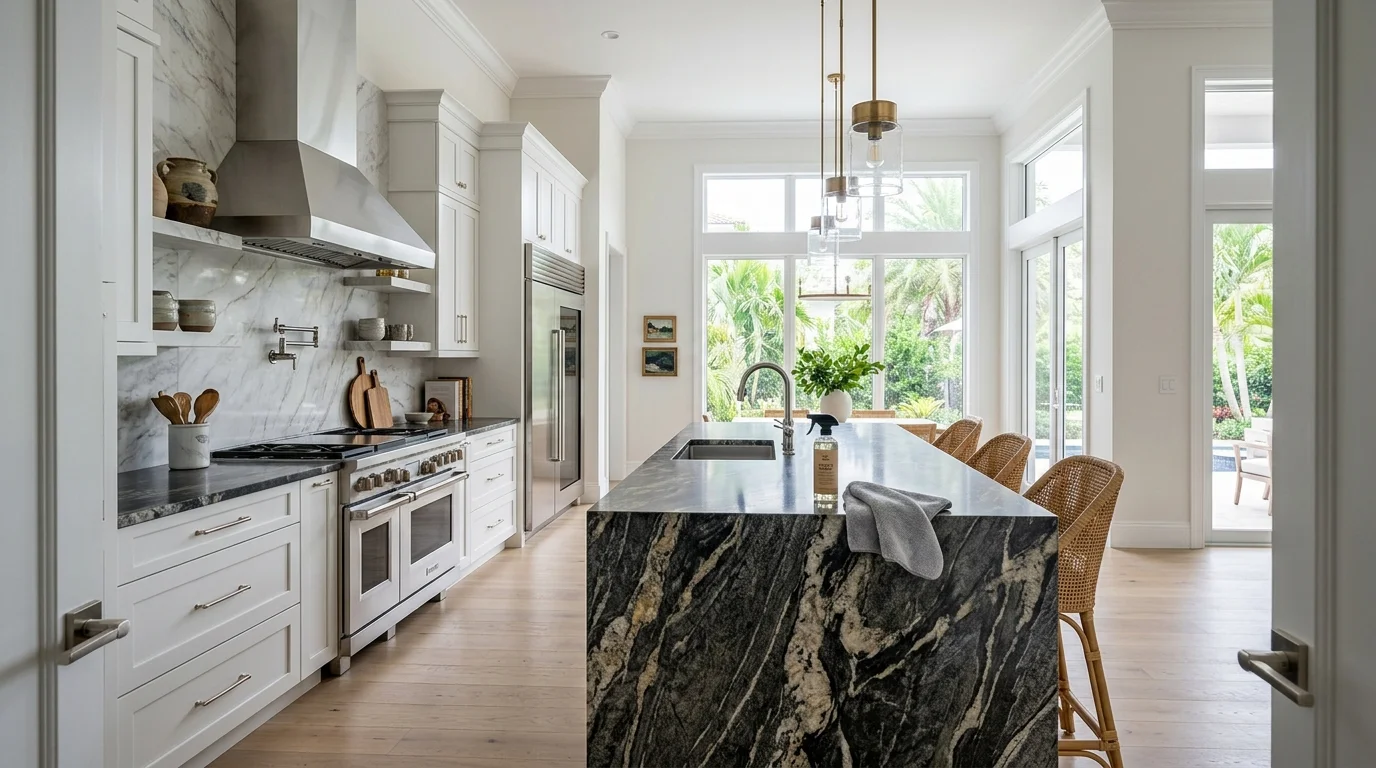
If you want to know how to clean granite countertops correctly, the short answer is: pH-neutral soap, warm water, a soft cloth, and a dry wipe after every use. That's it for daily care. The longer answer covers what actually damages granite, and that list is longer than most homeowners expect. At South Florida Kitchen & Bath Design, our team has installed granite countertops across Palm Beach County, from Boca Raton to Wellington to Jupiter, and the number-one reason we see granite lose its finish early is improper cleaning. Not neglect, cleaning with the wrong products.
Why Your Cleaning Method Matters
Granite is a natural stone, which means it's porous. Even a properly sealed slab has microscopic pores that can absorb liquids, harbor bacteria, and, with the wrong cleaners, deteriorate faster than they should. The sealer applied during fabrication and installation creates a protective layer over those pores, but it is not indestructible. Acidic or alkaline cleaners break down sealer over time. Once the sealer degrades, the stone itself becomes vulnerable.
This matters more than people realize. We've seen granite in Delray Beach kitchens that's been cleaned daily with vinegar or lemon juice, both extremely common "natural" cleaning suggestions, come out dull, etched, and stripped of its sealer within two years of installation. Vinegar has a pH around 2.5. Granite sealer starts breaking down below pH 5. Those two facts alone explain why that advice is wrong, no matter how many websites recommend it.
The same problem applies to bleach-based cleaners, ammonia-based window cleaners like Windex, and most generic multi-surface sprays. They clean the visible surface but quietly damage the stone underneath. If you're weighing granite against other options, our guide to the best countertops for Florida kitchens breaks down how granite compares to quartz, quartzite, and porcelain, including how each handles daily cleaning demands.
Bottom line: the cleaning method matters because granite is an investment. In Palm Beach County, granite countertops typically run $45-$90 per square foot installed, depending on slab origin and edge profile. Treating them poorly shortens their life and dulls what should be a decades-long surface.
Daily Cleaning Routine
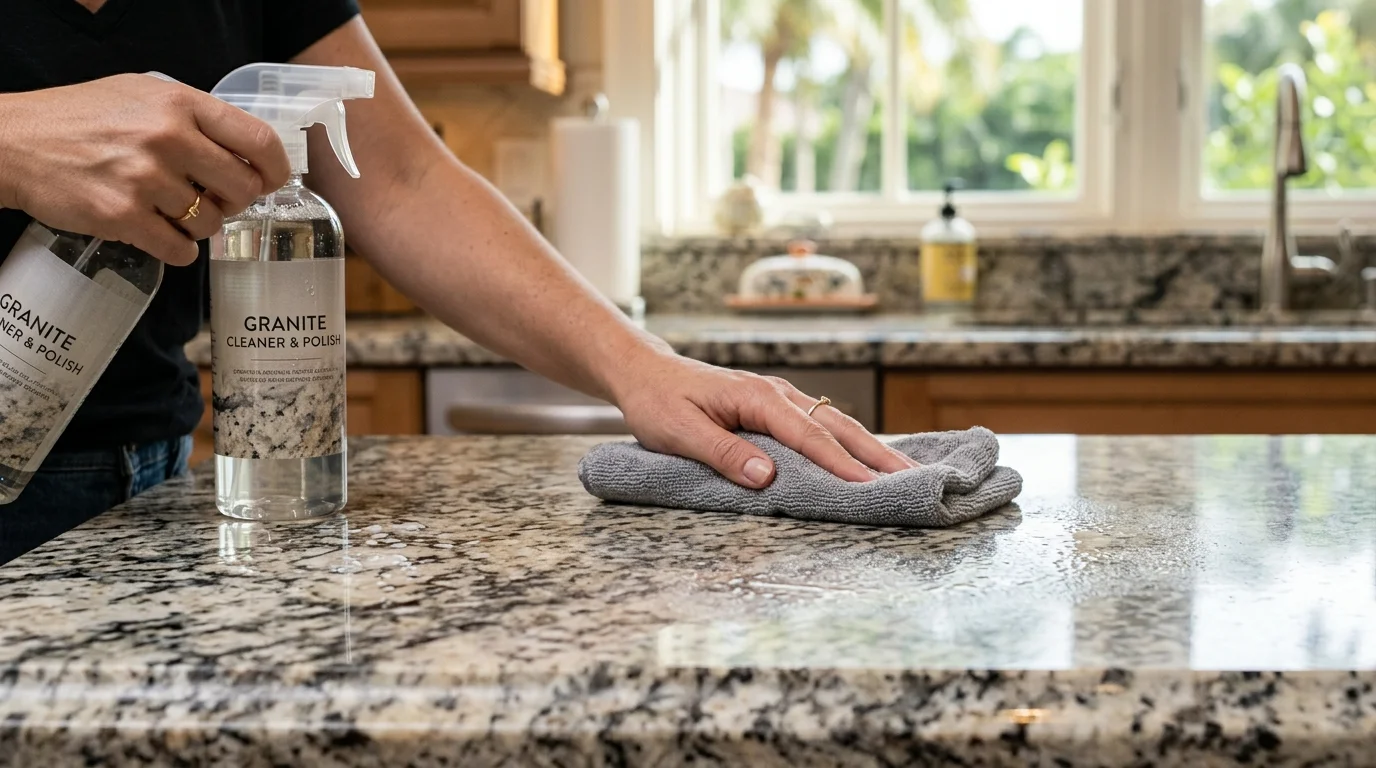
Keep it simple. Our team tells every homeowner the same thing after installation: warm water, a few drops of dish soap, a microfiber cloth, and a dry follow-up wipe. That routine handles 95% of what happens on a kitchen countertop, food prep residue, cooking splatter, crumbs, water spots.
Here's how to do it properly:
Step 1, Wipe loose debris first. Use a dry cloth or paper towel to sweep crumbs and loose particles off the surface before you introduce any moisture. This prevents scratching during the wet wipe.
Step 2, Mix your cleaner. A few drops of mild dish soap in warm water is all you need. We recommend Dawn or a comparable pH-neutral dish soap. Do not use concentrated degreasers or antibacterial dish soaps with harsh chemical additives.
Step 3, Wipe in sections. Use a soft microfiber cloth dampened (not soaked) in your soap solution. Wipe in circular or overlapping motions. Don't let pooling water sit on the surface.
Step 4, Rinse the surface. Follow with a clean cloth dampened in plain water to remove soap residue. Soap film left on granite can dull the finish over time.
Step 5, Dry immediately. This step is non-negotiable in South Florida. Hard water is widespread across Palm Beach County, and standing water leaves mineral deposits, white chalky spots, that etch into the finish if left to dry on their own. A dry microfiber wipe after every cleaning takes ten seconds and prevents a problem that's genuinely annoying to reverse.
What to avoid entirely: abrasive sponges or scrub pads, steel wool, vinegar, lemon juice or citrus-based cleaners, bleach, ammonia, and any multi-surface spray not specifically formulated for natural stone. Those products belong nowhere near granite.
Disinfecting Granite Without Damaging It
This is where homeowners run into the most confusion. The instinct is to reach for bleach or a Lysol spray after handling raw meat. Both of those will work on a biological level, but both will also degrade your granite sealer with repeated use. There's a better approach.
The most reliable disinfectant that's safe for sealed granite is isopropyl alcohol diluted to 70% concentration. Mix equal parts 70% isopropyl alcohol and water in a spray bottle. Spray the surface, let it sit for three to five minutes, then wipe clean with a damp cloth and dry. This kills bacteria and viruses without attacking the sealer.
There are also stone-specific disinfecting cleaners on the market, products from brands like Stone Guard or StoneTech are formulated to be effective against pathogens while maintaining a pH that doesn't harm natural stone. These are worth keeping under the sink if food prep is frequent on your granite surfaces.
A few things to remember about disinfecting: don't spray and immediately wipe. Contact time matters for killing bacteria. Give the solution at least three to five minutes of dwell time before wiping. And always follow with a plain water rinse and dry cloth, no product residue should be left sitting on the stone.
For households with young children or immunocompromised family members where disinfecting is a regular need, we often recommend quartz for high-traffic kitchen surfaces precisely because it's non-porous and easier to sanitize. That comparison is covered in detail in our quartz vs quartzite vs granite vs marble guide. But if you've got granite and love it, the alcohol-based method above is your best ongoing option.
Removing Stains from Granite
Even with good daily habits, stains happen. The key is knowing what type of stain you're dealing with, because the treatment differs depending on whether the stain is oil-based, organic, or mineral-based.
Oil-based stains (cooking oil, grease, cosmetics), These darken the stone and usually appear as a slightly wet-looking shadow. The fix is a poultice: mix baking soda with acetone (nail polish remover) into a thick paste. Spread it over the stain, cover with plastic wrap, tape the edges, and let it sit for 24-48 hours. The poultice draws the oil out of the stone as it dries. Wipe clean, rinse, and dry. Repeat if needed.
Organic stains (coffee, tea, wine, fruit juice), These tend to leave pinkish or brownish marks. Mix baking soda with hydrogen peroxide (3% concentration, standard drugstore variety) into a paste. Apply, cover with plastic wrap, leave for 24 hours, then wipe and rinse. The hydrogen peroxide lifts organic pigments without damaging sealed granite at this concentration. Do not use higher concentrations.
Water spots and mineral depositsCommon in hard-water areas like Boca Raton and West Palm Beach. These look like white hazy patches or rings. A specialty stone cleaner or a paste of baking soda and water, worked gently with a soft cloth, usually handles light deposits. For stubborn hard water buildup, a product like Bar Keepers Friend (the powder version, not the spray, the spray contains bleach) applied briefly with minimal pressure and rinsed immediately can help. Use it sparingly and not regularly.
Etch marksThese aren't technically stains. Etching is physical damage to the stone surface caused by acid (vinegar, citrus, wine). It appears as dull patches where the stone's polish has been eaten away. Light etching can sometimes be improved with a granite polishing powder, but significant etching requires professional refinishing. This is exactly why we're so direct about keeping acids off granite.
When dealing with stains, avoid scrubbing aggressively. Patience and dwell time beat force every time with natural stone. And once the stain is gone, that's a signal to check whether your sealer is still performing, if a liquid penetrated deeply enough to stain, the sealer may be due for a refresh.
Sealing and Long-Term Protection
Cleaning granite properly keeps the surface clean. Sealing granite properly keeps it protected. These two things work together, and skipping one undermines the other.
Most granite needs resealing every one to three years depending on usage and stone density. Darker, denser granites like Absolute Black or Ubatuba tend to be less porous and may only need sealing every two to three years. Lighter, more porous granites like Kashmir White or Colonial White may need annual sealing. The simple water test tells you where you stand: pour a tablespoon of water on the surface and watch how it behaves. If it beads up and sits on top, your sealer is intact. If it soaks in and darkens the stone within a few minutes, it's time to reseal.
Our full guide on granite countertop sealer, how to seal and how often covers product selection, application technique, and timing in detail. For the short version: use an impregnating sealer (not a topical coating), apply it to a clean, dry surface, work in small sections, let it absorb for the time specified by the manufacturer, then buff off excess before it hazes. Don't apply over a dirty or damp surface, the sealer traps whatever is underneath.
Between sealings, a spray-on granite conditioner or daily stone cleaner with a light sealer component (like Granite Gold Daily Cleaner) can extend your sealer's life. These products aren't a substitute for a proper impregnating seal, but they help maintain the surface between full applications.
One more protection tip: use trivets and cutting boards. Granite can withstand heat and is hard enough not to scratch easily, but direct heat from pots can cause thermal shock in some slabs, and knives will eventually dull the polish on any natural stone surface. These aren't scare tactics, they're just habits that preserve a surface that should last 30 years or more.
South Florida Considerations
Cleaning granite in Palm Beach County has a few specific variables that homeowners in other parts of the country don't deal with at the same level.
Hard water is aggressive here. Municipal water in Boca Raton, Delray Beach, and most of Palm Beach County runs hard. That means mineral deposits build up faster on granite than in softer-water markets. The daily dry-wipe step matters more here than almost anywhere else. If you're seeing white haze develop quickly despite consistent wiping, a water softener or under-sink filtration system is worth discussing with a plumber.
Humidity affects sealer longevity. South Florida's humidity, high most of the year, doesn't damage granite directly, but it does affect how cleaners and sealers behave during application. Applying sealer on a humid day can result in uneven absorption and hazing. Our team always recommends sealing countertops on a cool, lower-humidity morning with the AC running. This is especially relevant during summer months in Wellington and Jupiter, where afternoon humidity can top 90%.
Outdoor granite needs more frequent attention. Outdoor kitchens are popular across Palm Beach County, and granite shows up in a lot of them, especially on islands and bar tops. UV exposure, rain, and salt air from coastal areas like Boca and Delray accelerate sealer breakdown. Outdoor granite may need resealing annually or even twice a year. If your outdoor kitchen has granite and you're not sure what it's working with, our guide to outdoor kitchen countertops best for Florida covers the maintenance demands of each material side by side.
Humidity and mold around the sink. The area where granite meets the sink is the most vulnerable spot in a Florida kitchen. Standing water, high humidity, and the joint between stone and sink create ideal conditions for mold and mildew growth in the caulk line. Keep that joint dry, inspect it every few months, and replace deteriorated caulk promptly. For sink material comparisons that affect how this joint performs, our best kitchen sink material guide is worth reading before your next upgrade.
If you're in a 55+ community in Palm Beach County, granite is a smart choice for aging-in-place kitchens because it's durable and doesn't require complex maintenance once the care habits are established. Pair it with the right edge profile, eased or beveled rather than sharp ogee or bullnose, and you've got a surface that's easy to wipe clean and forgiving to lean on. Our team designs a lot of kitchens in these communities, and the countertop edge profiles guide for Palm Beach County covers the functional and aesthetic tradeoffs of each option.
One last Florida-specific note: if your granite is part of a kitchen that's due for a refresh or a countertop swap, cleaning habits can actually extend that timeline meaningfully. A properly maintained granite slab that's ten years old often looks better than a neglected one that's three years old. We've seen it. Before you decide the stone is past its prime, have a professional assess whether refinishing and resealing could restore it, the cost is almost always a fraction of replacement.
For homeowners weighing granite against newer countertop materials, our overview of countertop design trends for 2026 covers what's moving in the Palm Beach County market right now, including where granite sits relative to porcelain slabs and leathered quartzite. And if you're thinking about a broader kitchen refresh, our guide to choosing countertop colors helps connect the stone selection to the rest of your design.