MDF vs. Plywood vs. Solid Wood Cabinets: What Actually Holds Up in South Florida
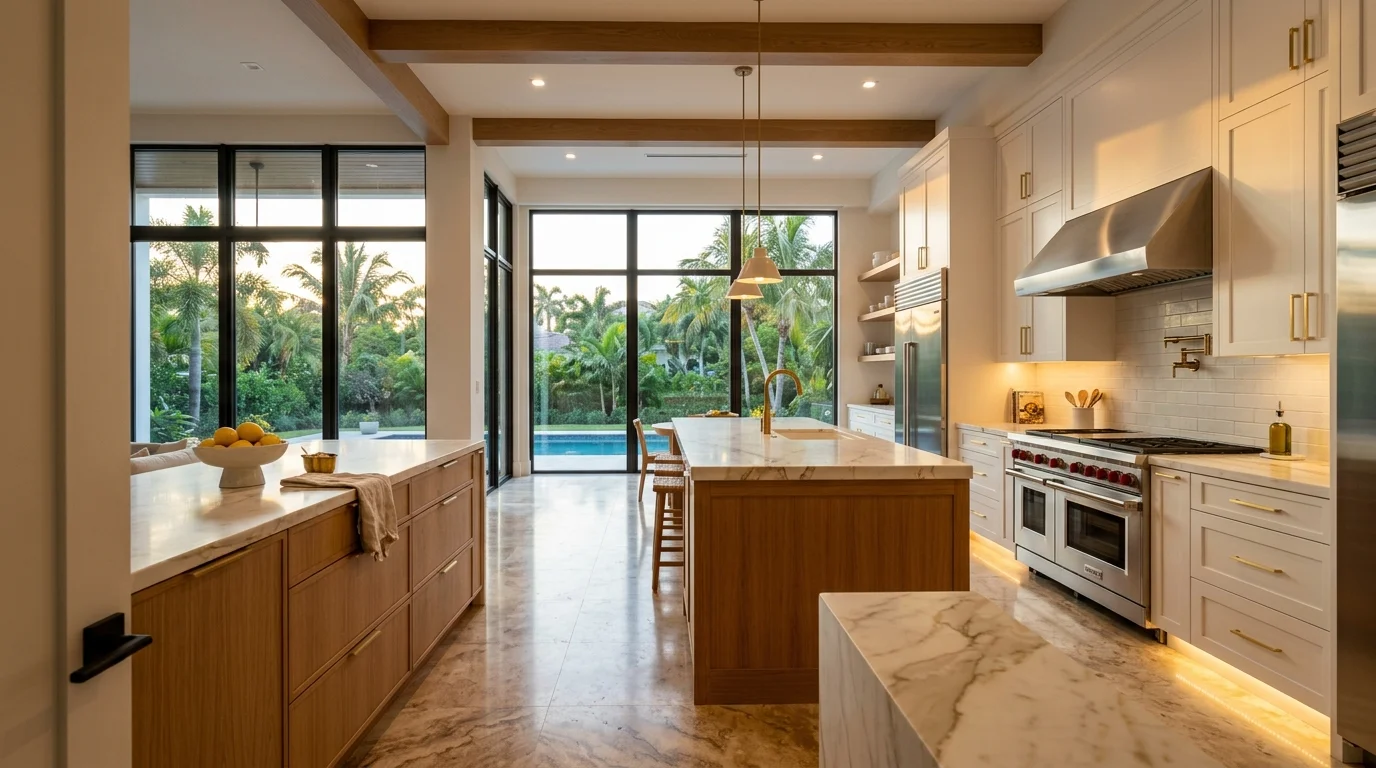
When homeowners in Palm Beach County ask us about cabinet materials, the mdf vs plywood cabinets debate comes up on almost every project. It sounds technical, but the answer really comes down to one thing: humidity. South Florida's climate is not like the rest of the country, and the materials that work fine in a dry climate can fail fast in Boca Raton, Delray Beach, Wellington, or Jupiter. Our team has seen the results of the wrong choice, and we are not neutral on this topic. Here is exactly what we recommend, what we install, and why.
Why Cabinet Material Matters More in South Florida
The average relative humidity in Palm Beach County sits between 70 and 80 percent for much of the year. That moisture gets into everything. Cabinet boxes that perform fine in Minnesota or Arizona can swell, delaminate, and fail within a few years here. We see it constantly in older kitchens, especially homes built in the 1980s and 1990s where particleboard boxes were standard.
There are really two separate decisions to make when you are choosing cabinet materials. First: what is the cabinet box made of? That is the carcass, the actual structural shell that hangs on your wall. Second: what are the doors and drawer fronts made of? Those two decisions do not have to match, and in many cases they should not. Getting both right is what separates a cabinet installation that lasts 20 years from one that starts showing problems in five.
If you are thinking about a cabinet-only refresh without touching your layout, read our breakdown on remodeling kitchen cabinets without a full renovation to understand the scope of what is involved.
MDF vs Plywood Cabinet Boxes
This is the most important decision in the whole cabinet-material conversation, and we have a clear opinion: for South Florida, plywood boxes win. Every time.
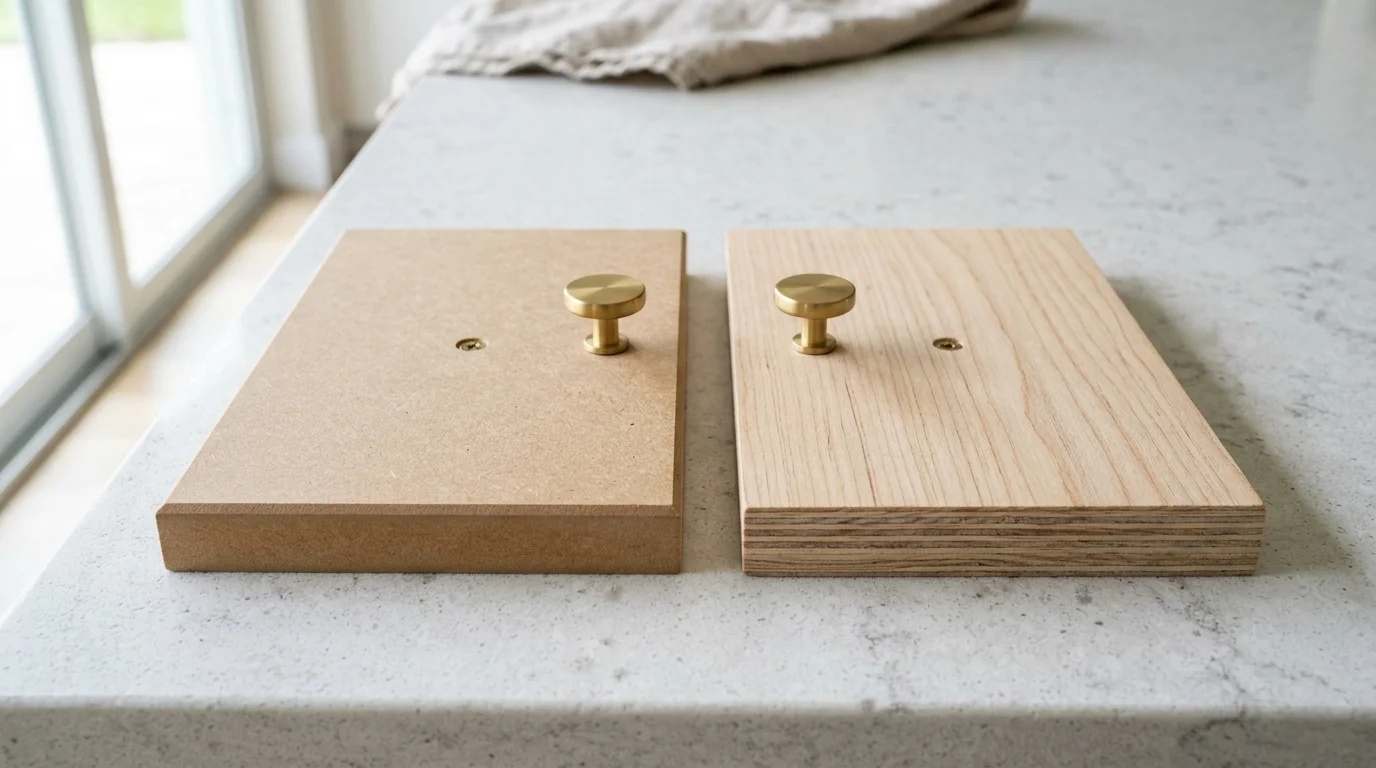
MDF stands for medium-density fiberboard. It is made from wood fibers, wax, and resin compressed under high heat and pressure. It is dense, consistent, and takes paint exceptionally well. On a flat surface like a cabinet door, MDF can be a good choice. But as a box material in a humid environment, it has one serious flaw: it absorbs moisture. When MDF gets wet, it swells. It does not recover. The edges are especially vulnerable. A leaky dishwasher, a slow drip under the sink, or even consistent high humidity over years can cause MDF box walls to swell, bubble, and lose their structural integrity.
Plywood is built from cross-laminated wood veneers. Those alternating grain layers resist expansion and contraction far better than MDF under humid conditions. Plywood also holds screws much more reliably. When our crews are installing hinges, drawer slides, and shelf pins, screw-holding strength matters. A plywood box holds a hinge screw far longer than an MDF one, especially after years of daily use. For this reason, the Architectural Woodwork Institute identifies plywood as the preferred substrate for kitchen cabinet construction in high-humidity environments.
There is a cost difference. Plywood boxes cost more to manufacture than MDF boxes. Depending on the cabinet line, you might pay 10 to 20 percent more for plywood construction at the box level. We think that premium is worth every dollar in South Florida, and we spec plywood boxes as our standard recommendation on every kitchen project we design.
Particleboard deserves a mention here because it still shows up in stock cabinets at big-box stores. Particleboard is even more moisture-sensitive than MDF and offers worse screw-holding strength. In our opinion, particleboard boxes have no place in a South Florida kitchen. If a cabinet line cannot tell you whether its boxes are MDF or plywood, that is usually a sign they are particleboard. Walk away.
Our article on frameless vs framed cabinets covers how box construction interacts with the door-hanging system, which is another decision that affects long-term performance.
Solid Wood for Cabinet Doors
Now for the doors and drawer fronts. This is where the conversation shifts, because the priorities are different. You are no longer worrying primarily about structural integrity. You are thinking about appearance, paint or stain adhesion, and how the material responds to temperature swings between your air conditioning and outdoor humidity when you open and close windows.
Solid wood doors are beautiful. Species like maple, alder, cherry, and white oak all look excellent and can be stained to show their grain. But solid wood moves. It expands and contracts with changes in temperature and humidity. In a South Florida home that is air-conditioned to 72 degrees while outside is 90 degrees and 80 percent humidity, that movement is real. A solid wood door on a shaker cabinet will develop small gaps at the panel joints over time. That is not a defect. It is just wood behaving like wood. Most homeowners accept this with stained cabinets because the natural variation is part of the look.
For painted cabinet doors, MDF is actually our preferred choice. Here is why: MDF does not have wood grain telegraphing through the paint film. It stays dimensionally stable enough in a painted door application (where it is not exposed to direct moisture) that the paint finish remains smooth and crack-free far longer than paint on solid wood. If you have ever seen painted solid wood doors develop hairline cracks along panel edges after a few years, that is wood movement causing the paint to split. MDF painted doors largely avoid that problem.
The right answer, then, is usually a combination: plywood box with either solid wood doors for stained finishes or MDF doors for painted finishes. That is the spec we recommend most often, and it is what the better semi-custom and custom cabinet lines build to.
Thermofoil is another door material worth mentioning. It is MDF wrapped in a vinyl film. The cost is lower, and the finish is easy to clean. The downside is that the film can peel in hot environments, especially near ranges and dishwashers. We cover the full picture in our thermofoil cabinets pros, cons, and cost article if you want to go deeper on that option.
Door style plays into this too. A shaker door with a five-piece construction behaves differently than a flat slab door. Our flat front vs shaker cabinets guide for South Florida walks through how each style interacts with material choice and finish.
Cost Guide
Cabinet material choice is one factor in the total cabinet budget. Here are realistic Palm Beach County cost ranges based on what our team actually quotes. These reflect cabinet supply and installation. Countertops, plumbing, and electrical work are separate scopes handled by your general contractor.
For a deeper breakdown of what drives kitchen remodel costs in this market, our Palm Beach County kitchen remodel cost guide covers everything from material tiers to labor rates. If you are working within a tighter budget, our kitchen remodel on a budget article is worth reading before you finalize your scope.
South Florida Considerations
What works in a showroom in Atlanta does not automatically translate to a kitchen in Wellington or a condo in Delray Beach. South Florida has specific conditions that change the calculus on cabinet materials.
Humidity is the obvious one, and we have covered it. But there are a few others worth flagging.
Air conditioning cycling is a real issue. Homes here run the AC hard from May through October. That means the interior air is frequently very dry, while outside is very humid. Every time a door or window opens, moisture floods in. This cycling puts more stress on solid wood than a home in a more temperate climate experiences. It is one reason we are careful about specifying certain exotic wood species for door construction. Some species move more than others. Maple and MDF painted doors handle this cycling better than open-grain species like oak for painted applications.
Under-sink areas deserve special attention. This is the highest-risk zone in any kitchen for moisture exposure. We recommend plywood boxes everywhere, but especially in the base cabinet under the sink. If you ever have a slow leak from a supply line or a dripping P-trap, a plywood box gives you much more time before structural damage sets in compared to MDF. Some homeowners add a waterproof liner to the interior base of the sink cabinet as an extra precaution. That is a smart call.
Coastal communities like Jupiter and Boca Raton also deal with salt air, which can accelerate corrosion on hardware and affect finishes over time. Solid wood with a quality conversion varnish or catalyzed finish holds up better in those environments than thin thermofoil or low-grade lacquer. This is one area where spending more on the finish coat pays off long-term.
HOA and ARB restrictions in gated communities throughout Palm Beach County can affect material choices indirectly. Some communities have rules about what work can be done and when, which may affect your project timeline. Your general contractor manages any required submissions to the building department or HOA. Our team provides design drawings and material samples to support that process, but the submission itself sits with your GC. Our guide to remodeling a kitchen in a gated community explains what to expect.
One more thing: warped doors. If you are already dealing with a cabinet door that has twisted or bowed, that is usually a sign of moisture exposure or an improper finish on one side of the panel. Our guide to fixing a warped cabinet door covers whether it is repairable or whether replacement is the smarter move. In South Florida, a warped MDF door in a high-humidity zone usually means replacement, not repair.
Bottom line: plywood boxes, every time. Painted doors in MDF, stained doors in solid wood. Skip particleboard and skip thermofoil near any heat source. That combination gives you the best shot at cabinets that look good and function well for the life of your kitchen. When you are ready to pick a direction, our team in Palm Beach County is straightforward about what we recommend and why. No upselling just to upsell. The material choices above are genuinely what we would put in our own kitchens.