Touchless Kitchen Faucet: Pros and Cons for South Florida Kitchens
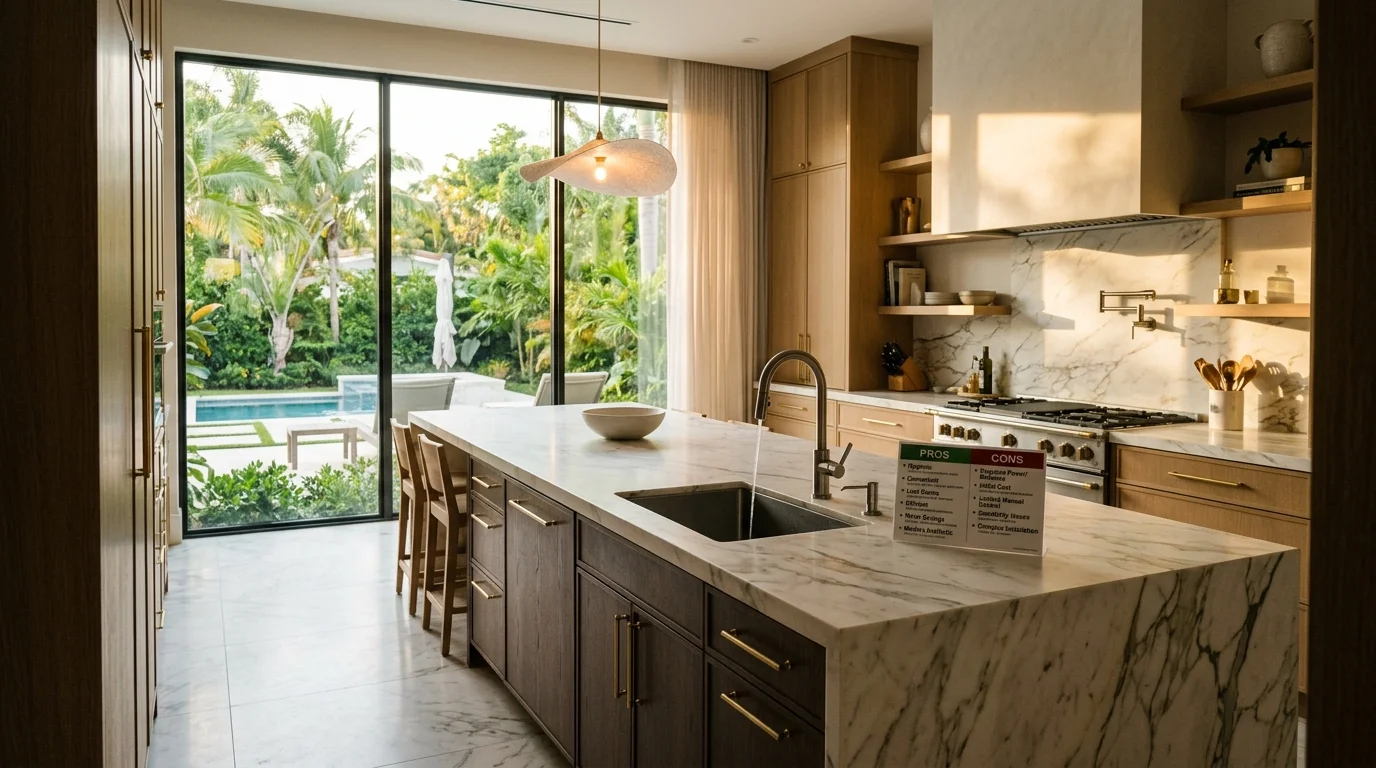
Considering the touchless kitchen faucet pros and cons for your Palm Beach County kitchen remodel? These sensor-activated faucets promise convenience and hygiene, but they come with trade-offs that every homeowner should understand before making the switch. Our team has installed hundreds of touchless faucets in homes from Boca Raton to Jupiter, and we've seen both the benefits and the frustrations firsthand.
The technology sounds appealing: wave your hand, and water flows. No handles to turn with messy hands. No cross-contamination when handling raw chicken. But touchless faucets also introduce complexity, maintenance needs, and potential failure points that traditional faucets simply don't have.
We'll break down the real-world performance of touchless kitchen faucets, covering everything from sensor reliability to power options to long-term costs. By the end, you'll know whether this technology makes sense for your South Florida kitchen.
How Touchless Faucets Work
Touchless kitchen faucets use infrared sensors to detect motion or proximity. When you place your hands or an object near the sensor (usually located at the base of the spout), it triggers a solenoid valve that opens the water flow. Remove your hands, and the water stops after a preset delay, typically 2-4 seconds.
Most models also include a manual override option. This might be a small button, a handle that can be pulled down, or a separate control for temperature adjustment. The manual feature serves as backup when sensors malfunction or when you need continuous flow for tasks like filling large pots.
Power comes from either batteries (usually 4-6 AA batteries housed in the cabinet below) or direct electrical connection to a 120V outlet. Battery-powered units are easier to install during a kitchen remodel on a budget, while hardwired models eliminate battery replacement but require electrical work.
The sensor range is typically adjustable, usually between 2-6 inches from the spout. Too sensitive, and you'll trigger accidental activation when reaching around the sink. Too limited, and you'll find yourself waving frantically trying to get water to flow.
Pros of Touchless Kitchen Faucets
Hygiene Benefits
This is the biggest selling point, especially post-2020. When you're handling raw meat, dirty dishes, or messy ingredients, you don't have to touch faucet handles with contaminated hands. Simply wave to rinse, then wash your hands thoroughly without recontaminating the faucet.
Water Conservation
Touchless faucets automatically shut off after a few seconds, preventing the waste that happens when you walk away from a running faucet. According to the EPA's WaterSense program, this can save thousands of gallons annually in busy households.
Convenience for Multitasking
Cooking involves a lot of hand-washing between tasks. Touchless operation means you can rinse utensils, wash hands, and fill pots without stopping to operate handles, especially helpful when your hands are full or messy.
Easier for Children and Elderly
No need to grip or turn handles, which helps kids reach water more easily and assists those with arthritis or limited hand mobility. The automatic shutoff also prevents kids from leaving water running.
Modern Aesthetic
Touchless faucets often feature sleek, minimalist designs that complement contemporary kitchen styles. They're particularly popular in all white kitchen designs where clean lines and uncluttered surfaces are priorities.
Cons of Touchless Kitchen Faucets
Sensor Reliability Issues
This is the big one. Infrared sensors can be finicky. They might not respond when your hands are too close or too far. Soap residue, water spots, or kitchen grease on the sensor can cause misfires or non-response. We've had clients call us because their faucet stopped working, only to discover the sensor needed cleaning.
Temperature Control Limitations
Most touchless faucets preset the water temperature through a separate control, but you can't make quick adjustments during use like you can with traditional handles. Want to switch from cool water for drinking to hot for cleaning? You'll need to access the manual controls.
Battery Replacement Hassle
Battery-powered models typically need new batteries every 1-2 years, depending on usage. The batteries are usually housed in the cabinet below the sink, requiring you to crawl underneath and unscrew a battery pack. It's not difficult, but it's an ongoing maintenance task traditional faucets don't require.
Higher Initial Cost
Touchless faucets cost significantly more than comparable traditional models. You're paying for the sensor technology, electronics, and solenoid valve systems. Installation can also be more complex if electrical connections are needed.
Potential for Accidental Activation
Sensors can trigger when you don't want them to. Reaching for dishes, cleaning around the sink, or even reflected light can cause unwanted water flow. This is particularly frustrating during cabinet hardware placement when you're working around the sink area.

Battery vs AC Power Options
Battery-Powered Advantages:
- Easier installation, no electrical work required
- Works during power outages
- No need for nearby electrical outlet
- Can be installed in any sink location
Battery-Powered Disadvantages:
- Regular battery replacement (every 12-24 months)
- Risk of unexpected failure when batteries die
- Environmental waste from disposable batteries
- Slightly less reliable sensor response as batteries weaken
AC-Powered Advantages:
- No battery maintenance
- Consistent power and sensor response
- More environmentally friendly
- Often includes additional features like LED indicators
AC-Powered Disadvantages:
- Requires electrical outlet under sink or hardwired connection
- Higher installation cost if electrical work is needed
- Non-functional during power outages (though manual override still works)
- Limited placement options based on electrical access
Our recommendation? Go with AC power if you're doing a complete kitchen remodel and can easily add electrical. Choose battery power for simple faucet replacements or budget-conscious updates.
Best Brands for Reliability
Moen leads in sensor reliability and customer support. Their MotionSense technology has multiple sensor zones and generally responds well. The brand offers both battery and AC options across different price points. Replacement parts are widely available, and their customer service actually helps when sensors malfunction.
Delta offers solid middle-ground options with their Touch2O Technology. Their sensors tend to be more forgiving with hand placement, and the manual override systems are intuitive. Delta's warranty support is strong, which matters with electronic components.
Kohler makes reliable touchless faucets but at premium prices. Their sensors are precise (sometimes too precise), and build quality is excellent. However, replacement parts can be expensive and harder to find than Moen or Delta components.
American Standard and Pfister offer budget-friendly touchless options, but sensor reliability can be inconsistent. We've seen more service calls on these brands, particularly after the first year.
Avoid generic or unknown brands entirely. When sensors fail (and they will eventually), you want a company that stocks replacement parts and honors warranties. We've had clients stuck with non-functional $400 faucets because the manufacturer disappeared or stopped supporting their electronic components.
Cost Guide
Touchless kitchen faucet costs vary significantly based on brand, features, and installation requirements. These ranges reflect current Palm Beach County pricing as of 2024:
Remember that touchless faucets typically cost $200-400 more than equivalent traditional faucets with similar finish and build quality. Factor in potential repair costs, electronic components can fail outside warranty periods, and sensor assemblies often cost $100-200 to replace.
If you're considering a touchless faucet as part of a larger kitchen upgrade, it makes more sense from a cost perspective. The installation labor gets absorbed into the overall project, and the convenience factor has more impact in a completely updated space.
South Florida Considerations
Humidity and Electronics Don't Mix
South Florida's humidity can affect electronic components over time. We've seen more sensor malfunctions in coastal homes from Delray Beach to Jupiter, where salt air and moisture create challenging conditions. Choose faucets with IP65 or higher water resistance ratings if you're within a few miles of the ocean.
Power Outages During Hurricane Season
Battery-powered touchless faucets continue working during power outages, but AC-powered models revert to manual operation only. During extended outages common in hurricane season, this can be inconvenient. However, manual overrides on quality faucets work fine without power.
Hard Water Considerations
Many areas of Palm Beach County have hard water that leaves mineral deposits on fixtures. These deposits can interfere with sensor operation, requiring more frequent cleaning. Consider pairing touchless faucets with water-resistant countertop materials that are easy to clean around sensors.
Pool and Outdoor Kitchen Integration
If your kitchen connects to outdoor living areas or pool zones, touchless faucets make sense for quick hand-washing before heading outside. The convenience factor increases significantly when you're moving between indoor cooking and outdoor entertaining, common in Florida lifestyle homes.
Energy Efficiency in Year-Round Cooling
Touchless faucets can help reduce cooling costs by preventing accidental hot water flow that adds humidity and heat to kitchens. In homes where air conditioning runs 8-10 months annually, every bit of waste heat reduction helps.
For Wellington and Boca Raton clients who entertain frequently, touchless faucets prove most valuable during party prep and cleanup. The convenience of sensor activation really shows during high-activity periods when traditional handles become bottlenecks.