Bathroom Mirror Ideas: Backlit, Framed & Medicine Cabinet Styles for South Florida Homes
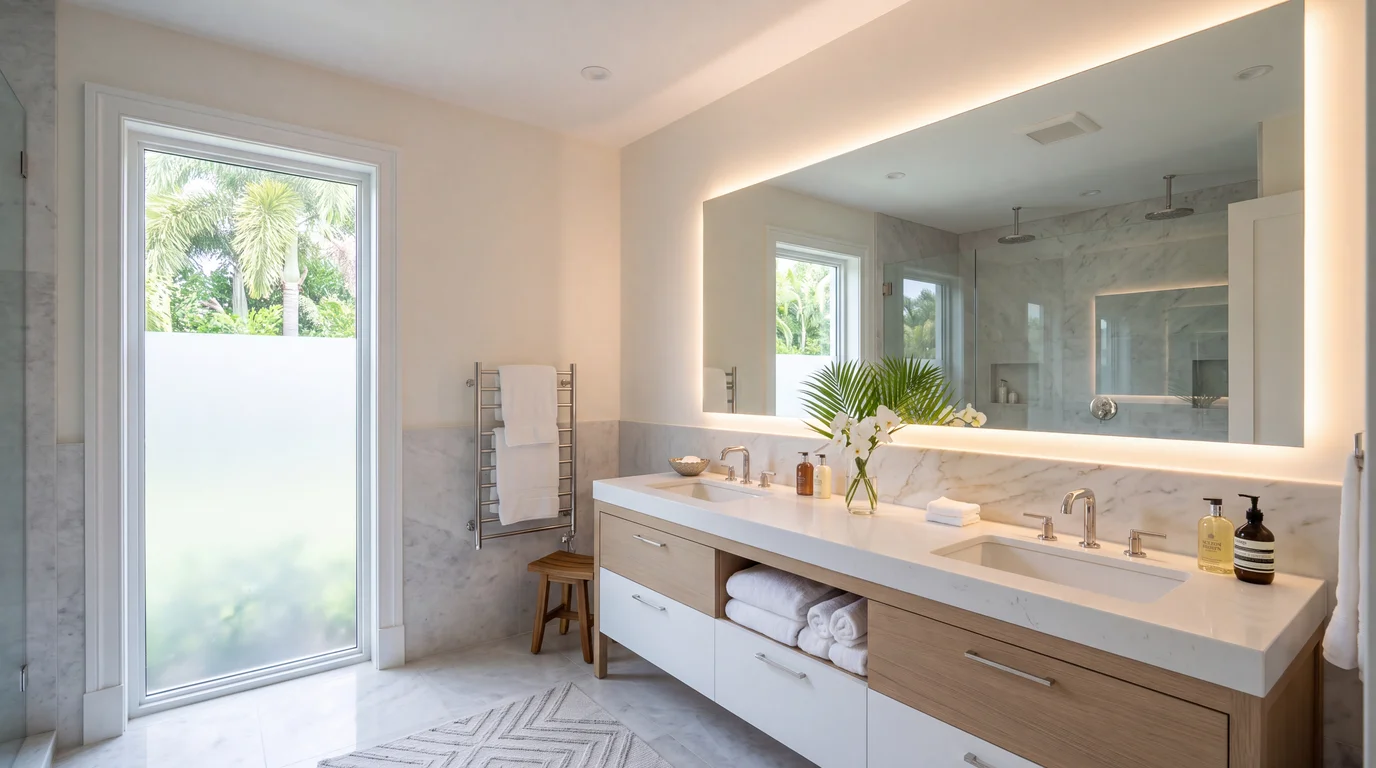
Bathroom mirror ideas are one of those remodeling topics homeowners underestimate until they're standing in a half-finished bathroom realizing the mirror looks wrong. The mirror is the focal point of every vanity wall. It sets the tone for the whole space. Get it right and the room feels pulled together. Get it wrong and even a gorgeous vanity looks incomplete. At South Florida Kitchen & Bath Design, we work with homeowners across Palm Beach County, from Boca Raton to Wellington to Jupiter, and the mirror conversation comes up on every single bathroom project. This guide covers the three styles we recommend most: backlit LED mirrors, framed mirrors, and medicine cabinet mirrors. We'll talk about what works where, what things actually cost in this market, and where most people go wrong.
Why the Mirror Matters More Than You Think
Most homeowners budget carefully for tile, vanity, and fixtures, then treat the mirror as an afterthought. That's a mistake. The mirror is typically the largest vertical element on your vanity wall. Its frame finish, shape, and size either reinforce your design direction or contradict it.
Size is the most common error we see. A mirror that's too small makes a wide vanity look awkward. The general rule our team uses: the mirror should be close to the width of the vanity, stopping just short of the outer edges of the cabinet. For a 60-inch double vanity, that usually means a mirror somewhere between 54 and 58 inches wide, or two individual mirrors each around 24-28 inches wide. Matching your mirror finish to your fixture finish matters too. If you've chosen matte black faucets and pulls, a chrome-framed mirror is going to feel out of place. This is the same logic we apply when helping clients choose bathroom vanity ideas that coordinate across every element in the room.
Height placement is the other thing people get wrong. The center of the mirror should land roughly at eye level for the people using the space most. For most adults, that's around 60-65 inches from the finished floor to the mirror's center. If you have recessed lighting or a sconce setup above the mirror, that height may shift slightly. The point is: don't just hang it wherever feels convenient on the first try.
Backlit LED Mirrors
Backlit mirrors have become the dominant choice in bathroom remodels we design across Palm Beach County. And for good reason. They solve two problems at once: they provide task lighting directly at face level, and they create a visual effect that makes the bathroom feel larger and more finished. The glow around the perimeter of a backlit mirror adds depth to the wall in a way that overhead lighting alone can't replicate.
There are two versions of this style. The first is a backlit mirror where the LED strip is mounted behind the mirror itself, creating a halo effect against the wall. The second is a front-lit mirror where LEDs are integrated into the face of the mirror, often along the top or sides, providing task lighting without the wall glow. We prefer the halo-style backlit mirror for primary bathrooms and the front-lit style for powder rooms and secondary baths where the wall effect is less critical.
What makes backlit mirrors especially practical in South Florida is the humidity factor. Quality backlit mirrors are rated for bathroom use with IP44 or IP54 moisture resistance ratings. The U.S. Department of Energy notes that LED lighting uses at least 75% less energy than incandescent bulbs and lasts up to 25 times longer, which matters in a room that sees daily use. Look for mirrors with adjustable color temperature, ideally ranging from 3000K (warm) to 6000K (daylight). The daylight setting is what you want for applying makeup or grooming. The warm setting creates the spa-like ambiance that sells the room on first impression.
Many backlit mirrors now include additional features: anti-fog heating elements, touch dimmers, built-in Bluetooth speakers, and even digital clocks. We tell clients to prioritize the anti-fog feature above everything else, especially in South Florida where humidity levels spike year-round. A mirror that fogs up every time someone showers defeats the purpose. The dimmer is a close second. Touch dimmers let you dial back the intensity for nighttime use without stumbling around with overhead switches.
For single vanities in a 48-60 inch range, a 36x28 or 48x30 backlit mirror covers most applications well. For double vanities, you can go with one large backlit mirror spanning the full width or two individual backlit mirrors, one over each sink. We lean toward one large mirror on a wide double vanity for a cleaner, more modern look. Two mirrors read more traditional and can work nicely when paired with a framed design rather than frameless backlit panels. Pairing your mirror choice with the right overhead and sconce lighting is something our team covers in detail when we discuss bathroom lighting ideas for each project.
Framed Mirrors
Framed mirrors are the most versatile category. They work in transitional, traditional, coastal, and Mediterranean bathrooms, all of which are common throughout Delray Beach and the older neighborhoods of West Palm Beach. The frame material and finish define the character of the mirror more than its shape does.
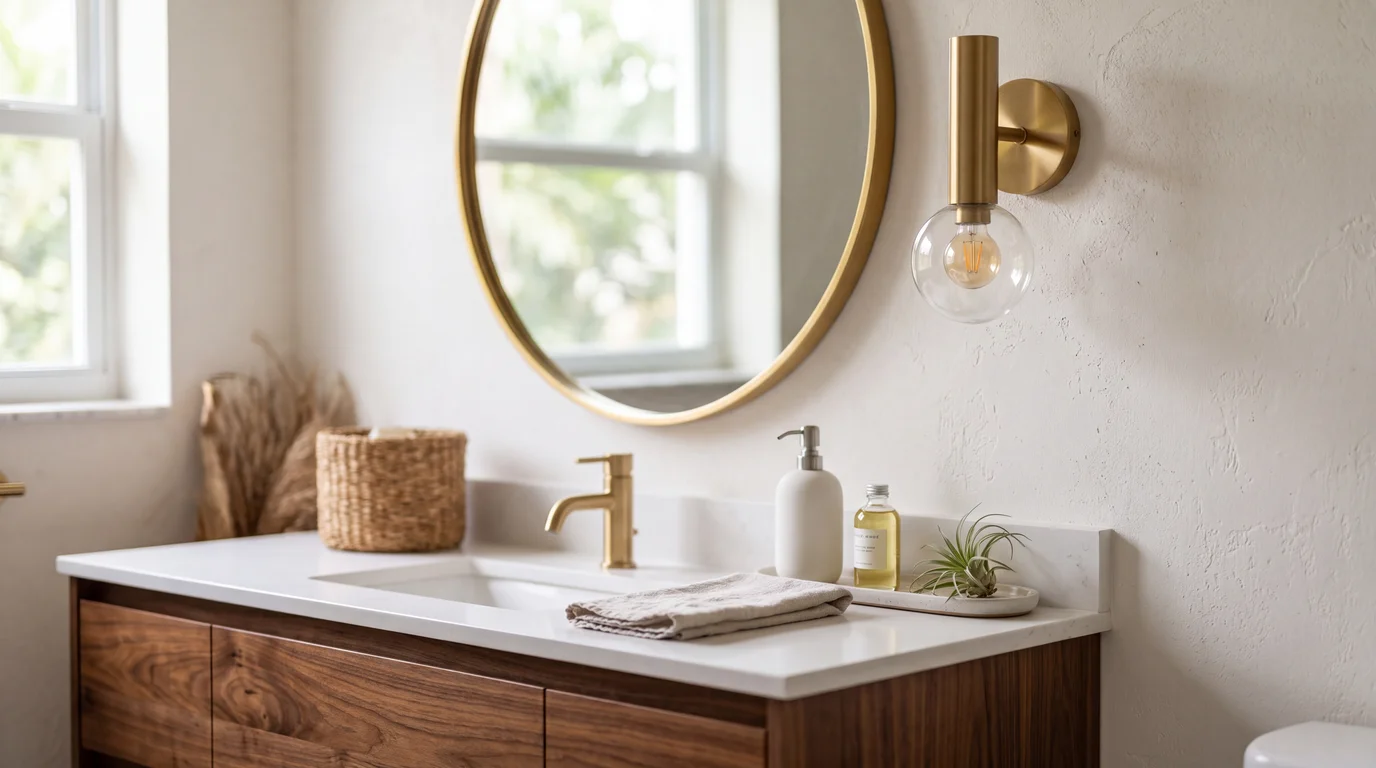
Metal frames in matte black, brushed nickel, brushed gold, and satin brass are the finishes we spec most often right now. Matte black reads modern and pairs well with white or light gray tile. Brushed gold has become a strong performer in coastal and transitional bathrooms, particularly in homes near the water. It doesn't read as flashy as polished gold and coordinates naturally with warm-toned stone countertops. We wrote about this same finish trend in our guide to gold bathroom fixtures, and the same logic applies here: brushed finishes age better than polished ones in a humid environment.
Wood frames are having a moment right now, particularly in natural oak and walnut tones. If your vanity has a wood element or you're working with a warm, organic palette, a wood-framed mirror connects those elements visually. The concern in South Florida is moisture. Solid wood frames in a bathroom without proper ventilation will warp or split over time. We recommend engineered wood frames with a sealed finish, or metal frames that simply mimic a wood look, for any bathroom without a strong exhaust fan setup.
Arch-top mirrors deserve a mention here because they've seen a significant surge in popularity across Palm Beach County remodels. The arched shape breaks up the horizontal linearity of most vanity walls and adds a bit of drama without requiring a full design overhaul. They work particularly well in powder rooms where you want one strong visual statement. A 24-30 inch arch mirror centered over a single sink in a powder room can be the difference between a forgettable space and one that gets noticed. For more ideas on making a small bathroom feel intentional, our powder room design ideas guide covers layout and fixture combinations that complement mirror choices like this.
One thing we push back on regularly: oversized frameless mirrors cut to fit the full wall above the vanity. They were popular in the 2000s and early 2010s and we still see them in a lot of older Palm Beach County homes. They're not inherently bad, but they're hard to update later, they show every water splash from the faucet, and they don't photograph well for resale. If you want a large mirror presence, a large backlit mirror or a wide framed mirror accomplishes the same visual weight with better long-term flexibility.
Medicine Cabinet Mirrors
Medicine cabinet mirrors are the practical choice that a lot of homeowners feel they have to apologize for. They shouldn't. A well-designed recessed medicine cabinet looks just as sharp as a standard mirror, and it adds real storage that improves daily function in the bathroom. For smaller bathrooms in Boca Raton condos, Wellington townhomes, and older Jupiter ranch homes where square footage is tight, a medicine cabinet mirror is often the smartest call in the room.
There are two types: recessed and surface-mounted. Recessed medicine cabinets sit flush with the wall or slightly proud of it, requiring your GC to cut into the wall cavity. Surface-mounted cabinets project out from the wall and don't require any wall modification. If your bathroom walls are on an exterior face or have electrical runs behind the vanity wall, surface-mounted is usually the simpler path. If you're doing a fuller remodel where walls are already being opened, recessed is cleaner and worth the extra step.
The mirror finish on medicine cabinets matters just as much as it does on standalone mirrors. Most come with a simple frameless edge, but framed medicine cabinets in metal finishes are widely available and look significantly more intentional. We've been specifying frameless recessed cabinets with integrated LED lighting on the interior shelves for clients who want the storage benefit without sacrificing the clean look of a backlit mirror. Some manufacturers now offer medicine cabinets with backlit mirror fronts, combining both features into one unit. That's a strong choice for a primary bathroom where storage and aesthetics both matter.
Width matters here too. A single medicine cabinet over a single sink should match the sink cabinet width as closely as possible. For a 24-30 inch vanity, a 24-inch wide medicine cabinet works well. For double vanities, two individual medicine cabinets flanking a central mirror is a classic arrangement that our team uses in transitional master bathrooms regularly. It provides storage on each side while keeping the center wall as a design feature. This approach pairs naturally with the double vanity dimension guidance in our double vanity ideas and dimensions article.
Depth is the spec most people overlook. Standard medicine cabinets are 3.5 inches deep, which fits between standard wall studs. That's enough for small bottles and daily-use items. If you need more capacity, 5-inch deep cabinets are available but require either a thicker wall or strategic placement to avoid conflicts with wiring or plumbing inside the wall. Talk to your GC before committing to a deep recessed cabinet. For a broader look at how to maximize bathroom storage beyond just the mirror wall, the bathroom storage ideas guide covers every category worth considering.
Cost Guide
Mirror pricing in Palm Beach County varies considerably depending on size, style, and features. The ranges below reflect what our clients actually pay for materials and installation in this market. Installation typically means your GC or a handyman mounting and wiring if electrical is involved. Backlit mirrors with hardwire connections require an electrician for the junction box connection; that cost is separate and runs $75-$150 per connection in this area.
Keep in mind that mirror cost is a small line in the overall budget of a bathroom remodel. For a full picture of what a bathroom renovation runs in this market, the bathroom remodel cost Palm Beach County guide breaks down every category by scope and neighborhood. If you're watching your budget closely, the bathroom remodel on a budget article covers where to spend and where to hold back without sacrificing the look.
South Florida Considerations
Humidity is the defining factor in every material decision we make for South Florida bathrooms. This isn't just about the shower steam. Palm Beach County's outdoor humidity, especially from June through October, pushes moisture through every gap in a home's envelope. Bathrooms with windows that get opened, or those without mechanical ventilation, are especially vulnerable.
For backlit mirrors, this means specifying IP44 as a minimum moisture resistance rating, with IP54 preferred for bathrooms that don't have a strong exhaust fan. For framed mirrors, it means avoiding raw wood frames and uncoated metal frames that will rust or warp. Powder-coated or brushed metal frames hold up significantly better than polished chrome in this climate, which is a point we also make when clients are choosing black bathroom fixtures: matte and powder-coated finishes simply last longer here than their polished counterparts.
Anti-fog is not a luxury feature in South Florida. It's a practical necessity. A mirror that fogs every morning in a household where the shower runs hot is a mirror that gets ignored. The anti-fog heating element in quality backlit mirrors draws minimal wattage and runs off the same hardwire connection as the LED strip. It's worth the small upcharge every time.
HOA and ARB considerations apply to some communities in Boca Raton, Palm Beach Gardens, and Wellington. Interior remodeling decisions like mirror choice almost never require HOA approval, but if your bathroom remodel involves any structural modifications, electrical panel upgrades, or layout changes, your GC handles the permit and approval process with the relevant building department. The Palm Beach County Building Division is the authority on what triggers a permit in unincorporated areas of the county. Municipalities like Boca Raton and Delray Beach have their own building departments with similar scope-based requirements. A mirror swap by itself does not require a permit. If you're hardwiring a backlit mirror into an existing junction box, your electrician will advise whether that work falls under permit scope in your specific municipality.
Coastal homes in Jupiter and Juno Beach face an additional consideration: salt air. Salt-laden air accelerates corrosion on metal components. For backlit mirrors near oceanfront properties, look for units with sealed internal components and frames that use marine-grade or powder-coated finishes rather than bare metal. This is the same guidance we give for fixture selection in coastal bathrooms. It's not about aesthetics, it's about longevity. A mirror that looks perfect at installation and starts showing rust spots within two years is not a good investment regardless of what it cost.
Finally, consider the relationship between your mirror and your overall bathroom remodel scope. If you're updating tile, vanity, and fixtures as part of a larger project, the mirror selection should happen in the design phase, not as an afterthought during the final week. Our team includes mirror selection as part of the finish coordination process for every bathroom we design. It's one of those details that takes ten minutes to decide correctly and months to regret getting wrong.