Bathroom Vanity Sizes: Standard Dimensions Guide
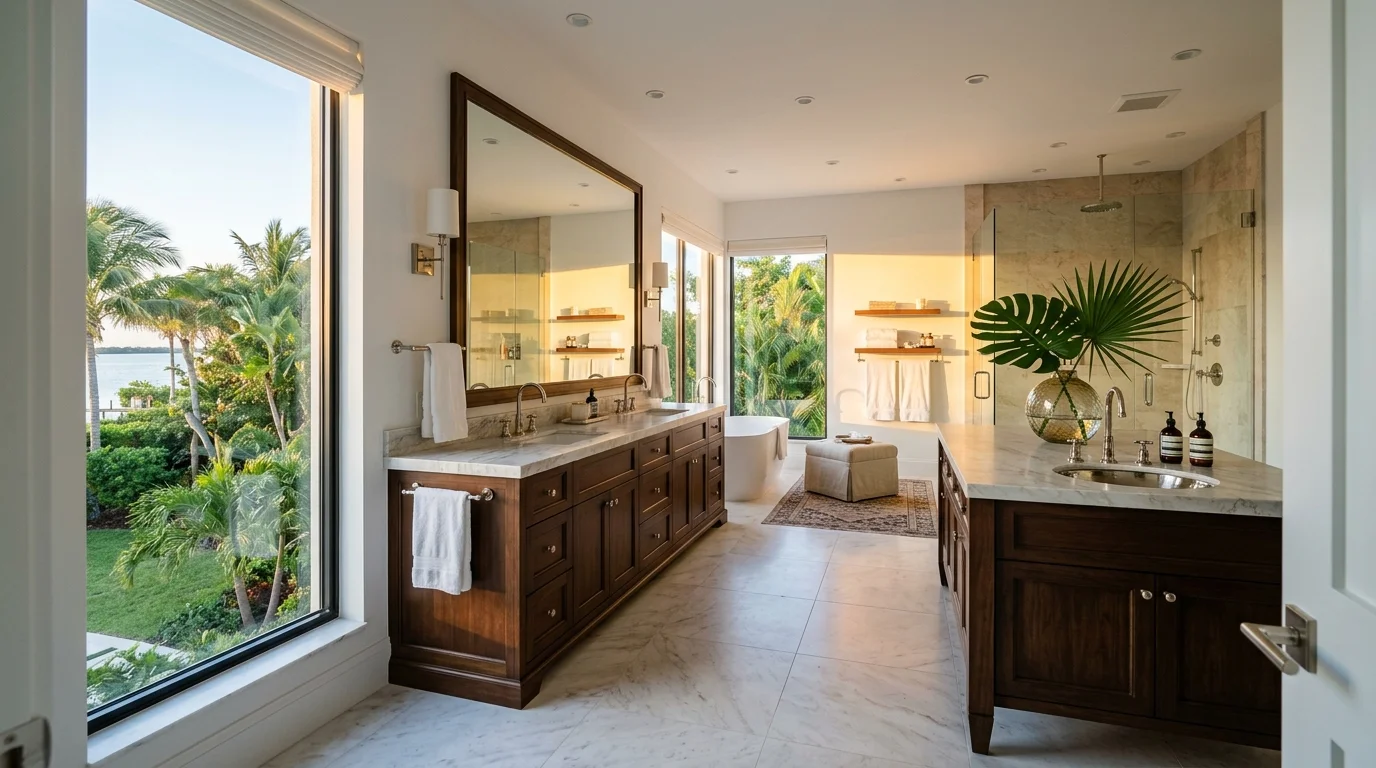
Bathroom vanity sizes are the one spec most homeowners skip until it's too late. You fall in love with a 60-inch double vanity online, order it, and then discover your bathroom door swings right into the side panel. Or you go with a 30-inch single and realize there's no room for a second sink, which your spouse has been asking for since 2019. Getting the dimensions right before you order anything is how you avoid those headaches. This guide covers standard widths, heights, and depths, single versus double configurations, comfort-height options, and how to correctly measure your space so what you order actually fits.
Why Vanity Dimensions Matter More Than Style
Style is easy to change. Dimensions are not. A vanity that's two inches too deep blocks the toilet. One that's four inches too wide means the door can't open fully. We see both of these mistakes regularly on jobs in Boca Raton, Delray Beach, and Wellington, usually when a homeowner ordered online without measuring properly first.
There are three numbers that define every vanity: width, height, and depth. Width is the most obvious, it determines whether you get one sink or two. Height affects daily comfort, especially for taller users. Depth controls traffic flow in the bathroom and how the door operates. All three have to work together with your specific floor plan.
Before you pull up any manufacturer's website, grab a tape measure and record these four things: the full width of the wall where the vanity will sit, the distance from that wall to the nearest door swing, the distance from the vanity wall to the toilet (you need at least 15 inches of clearance from the centerline of the toilet to any obstruction, per Florida Building Code), and the current rough plumbing locations. Those four measurements will eliminate 80% of the vanities that won't work in your space before you even start shopping.
For homeowners tackling a full bathroom update, our guide on bathroom renovation mistakes to avoid covers several more planning errors we see repeatedly in Palm Beach County bathrooms.
Standard Vanity Widths: Single & Double
Vanity widths follow fairly consistent industry standards, though individual manufacturers vary by an inch or two. Here's how we break it down for clients.
Single-sink vanities typically run from 24 inches up to 48 inches wide. The 24-inch vanity is the small-bathroom workhorse, powder rooms, guest baths, and older Florida homes with tight layouts. It fits a single undermount basin comfortably but leaves minimal counter space on either side. The 30-inch and 36-inch single vanities are the sweet spot for most master baths that only need one sink. You get a decent basin plus enough counter for toiletries without eating the whole wall. The 42-inch and 48-inch singles give you a larger basin or a wider bowl with real counter space on both sides. Some people go this route instead of a double when the wall allows it but the plumbing is centered on one drain location.
Double-sink vanities start at 48 inches and go up from there. A 48-inch double is possible, but tight, both basins end up small and there's almost no counter between them. We don't recommend it unless the client has no other option. The 60-inch double is the most popular size we install across Jupiter, Palm Beach Gardens, and Wellington. It fits two undermount sinks with workable counter space between and on the sides. The 72-inch double is where things get comfortable, each person gets real territory. Anything 84 inches or wider starts feeling like a hotel, which some clients in larger master suites absolutely want.
One thing to watch: vanity width is measured from outside edge to outside edge of the cabinet box. The countertop typically overhangs by about 1 inch on each side, so a 60-inch vanity cabinet will have a roughly 62-inch countertop. Account for that when measuring your wall clearances.
Thinking about vanity style alongside the size decision? Our bathroom vanity ideas for Palm Beach County remodels covers configurations, finishes, and hardware combinations worth considering.
Vanity Height & Depth: The Numbers You Need
Width gets all the attention, but height and depth are where comfort and function actually live.
Standard vanity height has been 32 inches from floor to countertop for decades. That measurement comes from the same era that gave us 36-inch kitchen counters and 17-inch toilet bowls, an era when the average American was shorter. For many adults, especially anyone over 5'8", bending over a 32-inch counter twice a day to brush teeth is a real annoyance that compounds over time.
Comfort height (also called ADA-compliant height or ergonomic height) runs 34 to 36 inches from floor to countertop. This is what we recommend for most of our clients now. It aligns with kitchen counter height, which most people already find comfortable. For households with kids, 34 inches is a reasonable compromise, most children over eight can reach it fine, and adults aren't hunched over. If you have a dedicated primary master bath that no children use, go straight to 35 or 36 inches.
Floating vanities (wall-hung, no legs touching the floor) give you complete control over height. You can mount them at exactly whatever height works for the people using the space. We install these frequently in modern and transitional bathrooms in Boca Raton and Delray Beach. The trade-off is that the wall must be properly blocked or reinforced to carry the weight, a standard drywall wall without blocking won't hold a fully loaded 72-inch vanity. Your general contractor needs to address that before installation.
Standard vanity depth (front to back) runs 18 to 21 inches for most production vanities. The 18-inch depth is more common on smaller 24-inch to 30-inch units. Most 36-inch and wider vanities run 21 inches deep, which is where the standard has settled. Custom cabinetry can go shallower (down to 16 inches for very tight spaces) or deeper (up to 24 inches if you want more storage).
Depth matters most when it comes to door clearance. A bathroom door that swings into the vanity space needs at least 2 to 3 inches of clearance between the fully open door and the front edge of the vanity. Measure it. Don't estimate. We've seen projects in older Wellington and Jupiter homes where a 21-inch deep vanity blocked the door by half an inch, which meant either rehinging the door or pulling the vanity away from the wall, neither of which is a fun conversation after the countertop is already fabricated.
Countertop overhang: The vanity countertop typically overhangs the cabinet by 1 inch on the front and sides. Factor that into your depth calculation. A 21-inch deep cabinet becomes a 22-inch deep countertop at the front edge.
Under-sink clearance for vessel sinks changes the height equation. If you're going with a vessel sink, the basin sits on top of the counter rather than dropping below it. A vessel adds 5 to 7 inches of height above the countertop surface. That means a 32-inch vanity with a vessel sink puts the rim of the basin at 37 to 39 inches, closer to kitchen faucet height. If you want the finished rim height to land around 35 to 36 inches, the cabinet itself should be 29 to 30 inches tall. This is one of the most common miscalculations we see in vessel-sink installations.
Vanity Cost Guide for Palm Beach County
Vanity costs in Palm Beach County vary widely based on cabinet construction, countertop material, sink type, and if you're doing a straightforward swap or reconfiguring the plumbing location. If your plumbing is staying put and you're swapping vanity-for-vanity, the installed cost is lower. If your GC is moving drain lines or supply lines to accommodate a new layout, that work adds to the overall project budget, check our full bathroom remodel cost guide for Palm Beach County for broader project cost context.
These ranges reflect Palm Beach County market pricing as of 2025. Stock vanities from big-box stores sit at the lower end of supply costs but often require additional finish work to look custom. Semi-custom and full custom cabinetry built to your exact dimensions with your countertop material choice, quartz, marble, quartzite, will push into the upper ranges. For guidance on which countertop materials hold up best in our climate, the best countertop materials for Florida's humidity article is worth reading before you spec anything.
Hidden costs in vanity projects often involve tile work around the new vanity (especially if the old one was a different size and left gaps or patching needs), mirror or medicine cabinet replacement, and lighting adjustments. Our post on hidden costs in bathroom remodels breaks those line items down in detail.
South Florida Considerations
Vanity selection in Palm Beach County, Boca Raton, Delray Beach, Wellington, and Jupiter comes with a few local factors that national guides don't account for.
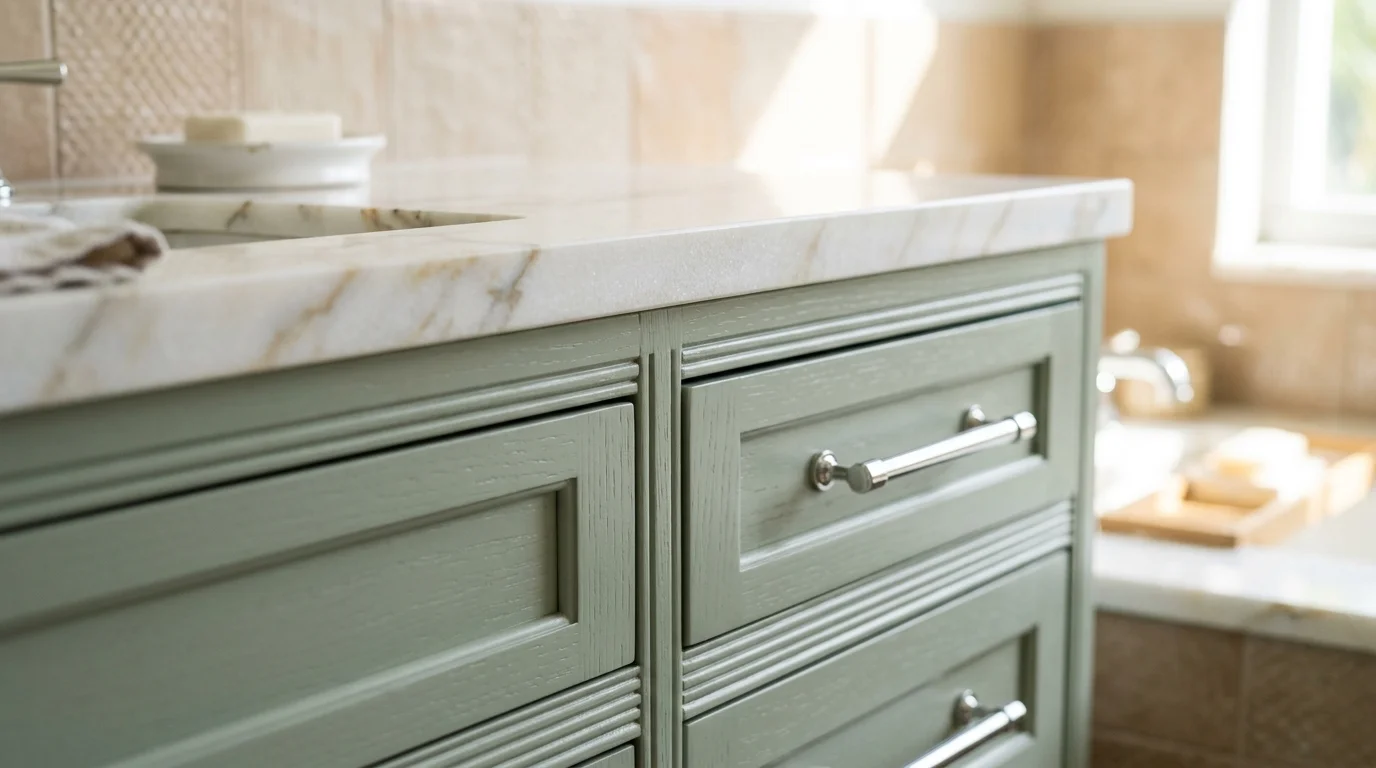
Humidity and cabinet construction. South Florida's humidity is relentless. Solid wood face frames and doors in a bathroom with poor ventilation will eventually warp, swell, or delaminate. We recommend plywood box construction (not particleboard) for any vanity going into a South Florida bathroom, and thermofoil or painted MDF doors over raw wood for anything that takes direct steam exposure near a shower. If you want the look of real wood, specify a closed-grain species like maple or go with a painted finish over MDF, it holds up far better than stained oak in a humid bathroom. Curious about how humidity affects cabinet materials beyond the bathroom? Our article on how to fix a warped cabinet door in humid Florida explains exactly what happens and how to prevent it.
HOA and condo restrictions. Many communities in Palm Beach County, particularly gated developments, 55-plus communities, and high-rise condos, have rules about when work can occur, how materials move through common areas, and what modifications require ARB or HOA approval. In condos, your GC typically handles any approval submissions. Our crew handles the design drawings and material samples needed for that package. Plan for a few extra weeks if your building has an approval process.
Plumbing and permit scope. A straight vanity swap, same footprint, same drain location, typically doesn't require a permit. If you're widening from a 36-inch single to a 60-inch double and the second drain needs to be added, or if you're moving the vanity to a different wall entirely, your GC will need to pull permits for the plumbing work. That's the GC's scope, not ours. We handle the cabinet and countertop installation once the rough plumbing is set. Don't let anyone convince you to skip permits on real plumbing moves, inspections protect you at resale.
Countertop material for vanities. Quartz is still the dominant choice in Palm Beach County master baths, low maintenance, no sealing, resistant to moisture. Natural marble looks incredible and we use it frequently in luxury Boca Raton and Jupiter projects, but it requires sealing and will etch from common bathroom products. Quartzite is a harder natural stone that performs better than marble in wet areas. For a direct comparison, see our breakdown of quartz vs. quartzite countertopsthe same considerations that apply to kitchens apply to vanity tops.
Mirror sizing relative to vanity width. A common proportion rule: the mirror or medicine cabinet should be the same width as the vanity cabinet or up to 2 inches narrower on each side. On a 60-inch double vanity, two 28-inch mirrors side by side often look better than one large 60-inch mirror, particularly when there's a light fixture between them. This is a detail we work through in every design consultation because the wrong mirror scale can make an otherwise well-executed vanity look unfinished.
Integrated vs. undermount sinks. Integrated sinks (the counter and basin are one continuous piece) are growing in popularity in South Florida's modern and transitional bathrooms. No seam at the basin means nothing for mold or caulk to collect around, a real advantage in our climate. They cost more upfront but the maintenance payoff is real. We covered this in depth in our integrated sinks pros, cons, and cost article if you want the full comparison.
When you're ready to look at the broader bathroom picture, not just the vanity, our bathroom remodel ideas for 2026 covers the full scope of what South Florida homeowners are doing this year, from walk-in shower expansions to floating vanity configurations and large-format tile. The vanity is the focal point, but it works best when the whole bathroom is designed as a single composition.