Can You Cut on Quartz Countertops?
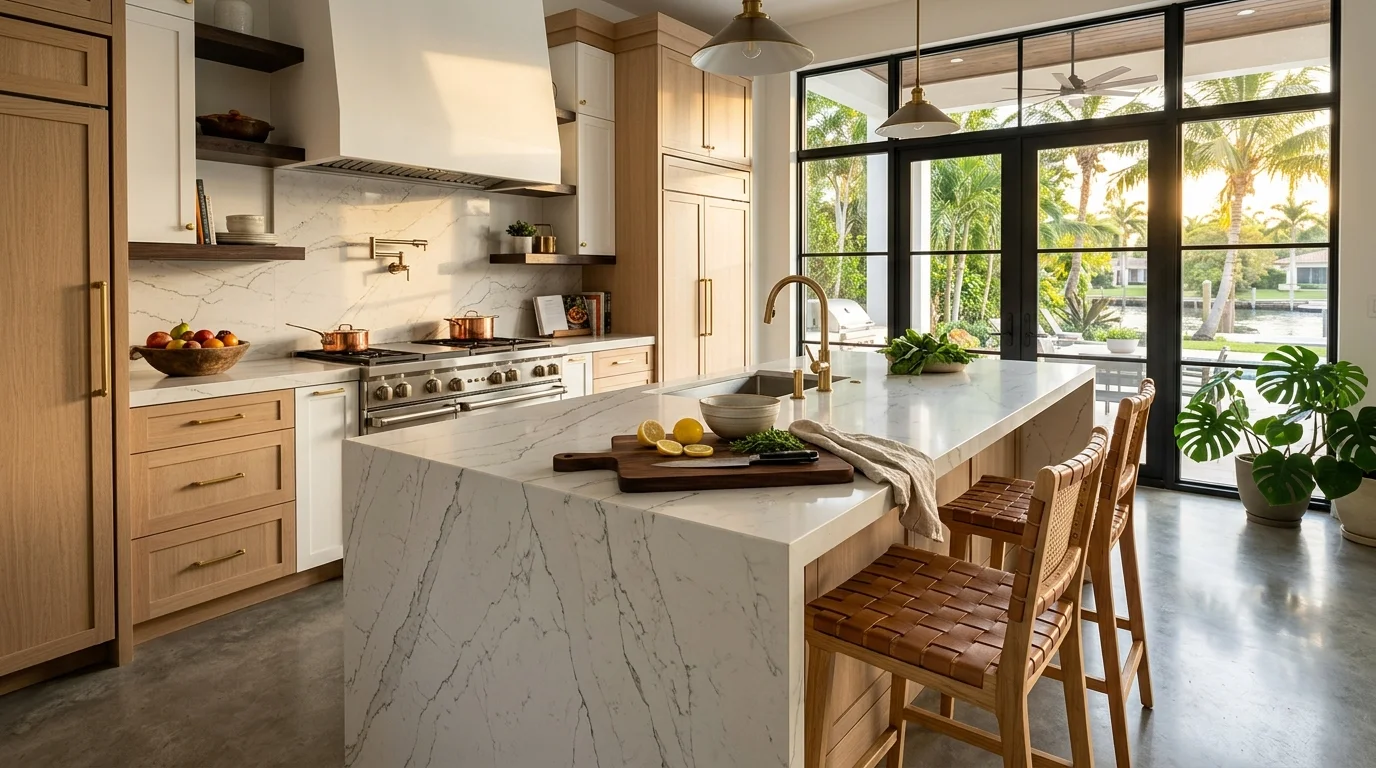
Can you cut on quartz countertops? Technically, yes, quartz is hard enough that a knife won't slice through it. But that doesn't mean you should. Cutting directly on quartz is one of the fastest ways to dull your knives, leave faint surface marks, and void your slab warranty. We've installed quartz in hundreds of kitchens across Palm Beach County, Boca Raton, Delray Beach, Wellington, and Jupiter, and the homeowners who treat their quartz right are the ones still happy with it a decade later. The ones who skip the cutting board? They call us a few years in asking whether the surface can be buffed out. Sometimes it can. Often it can't.
The Short Answer
Don't cut directly on quartz. Use a cutting board. Every time. That's the entire rule.
Quartz is an engineered stone, typically around 90-93% crushed natural quartz bound with polymer resins. The Natural Stone Institute rates quartz at roughly 7 on the Mohs hardness scale, which means steel knife blades (rated 5.5-6.5) are softer than the surface. So your knife won't scratch quartz in the traditional sense. What actually happens is more nuanced, and worse in some ways.
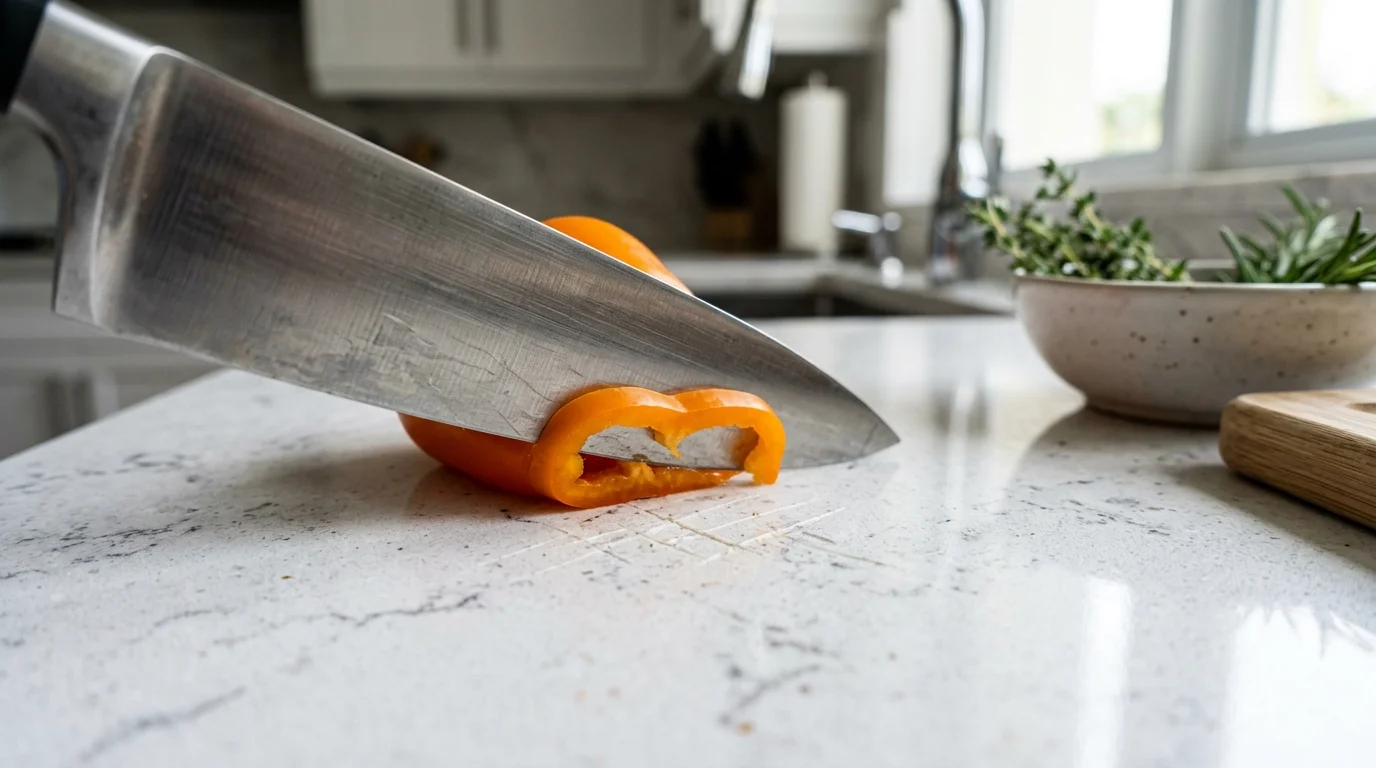
The resin binders that hold the quartz particles together are softer than the stone itself. When a blade drags across the surface repeatedly, it micro-abrades those resin areas. Over time that creates a dull, hazy band right where you prep food. It's subtle at first. Then it's obvious. And it's permanent.
The other victim is your knife. A quality chef's knife dragged across a hard quartz surface will lose its edge faster than if you ran it across a honing rod. You're essentially microhoning the blade in the wrong direction against a surface much harder than steel. Good knives are expensive. Cutting boards are not.
Why Cutting Damages Quartz (and Your Knives)
Here's what's actually happening at the surface level when you cut directly on quartz without a board:
Quartz slabs have a polished finish applied after fabrication. That polish is what gives the surface its depth and sheen. A knife blade doesn't need to scratch the quartz crystals themselves to do damage, dragging it across the finish layer repeatedly degrades the surface gloss in a localized area. The result is a matte patch that catches light differently from the rest of the countertop. On a lighter quartz like Calacatta or White Arabesque, it shows up fast. On darker or more textured slabs, it takes longer to notice, but it's still happening.
Beyond the finish, there's the issue of contamination. Cutting raw meat, citrus, or anything acidic directly on the surface without wiping immediately can cause staining. Quartz is non-porous, which means liquids can't absorb into it, but they can sit in micro-pockets created by surface wear. If you've already degraded the finish through regular knife contact, staining becomes more likely. For a deeper look at keeping the surface clean, our guide on how to remove stains from quartz countertops covers what actually works and what makes things worse.
One more thing worth saying: warranty. Most quartz manufacturers, Cambria, Silestone, MSI, Caesarstone, include surface damage from cutting and impact in their exclusions list. If you're filing a claim for a surface defect and there's evidence of knife marks, the warranty claim goes nowhere. Read the fine print before you assume you're covered.
Heat and Other Risks to Watch
Cutting is the most common way homeowners damage quartz, but heat runs a close second. Quartz is not heat-proof. The resin binders that make engineered quartz so consistent and non-porous are also what make it vulnerable to sudden thermal shock. Pulling a cast iron skillet off the stove and setting it directly on quartz can cause discoloration, cracking, or surface delamination. It won't happen every time, but it only needs to happen once.
Always use trivets or hot pads. This is non-negotiable. A silicone trivet costs three dollars. A quartz repair or slab replacement in Boca Raton or Wellington costs considerably more.
Other things that can damage quartz that people don't always think about:
- Harsh chemicals, bleach-based cleaners, drain cleaners, paint removers, or anything with a pH above 8 or below 4 can break down the resin binders over time.
- Abrasive scrubbing pads, steel wool and rough scrubbers will scratch the finish just like a knife would.
- Standing water near seams, while the quartz itself is non-porous, the epoxy at seams can degrade with prolonged moisture exposure.
- Heavy impact, dropping a cast iron pan or a heavy ceramic dish at the right angle can chip an edge or corner, especially at cutouts around the sink.
If you're weighing quartz against other materials and wondering how it handles Florida's conditions overall, our breakdown of the best countertop materials for Florida's humidity and heat puts everything side by side in honest terms.
How to Protect Your Quartz Surface
The rules for keeping quartz in good shape long-term are simple. They just require consistency.
Use cutting boards. Hardwood, bamboo, or plastic, all of them are fine. Keep one near every main prep zone. If your countertop has a dedicated prep area, consider a built-in wood insert. Some of our clients in Jupiter and Delray Beach have us design pull-out cutting board drawers directly under the prep zone. That's the move if you cook seriously.
Use trivets for hot items. Every time. Build the habit before the first time you forget and learn it the hard way.
Clean with pH-neutral soap and water. For daily cleaning, warm water and a small amount of dish soap on a microfiber cloth is all you need. For stubborn grease, a diluted isopropyl alcohol solution (no more than 50%) works well. Avoid anything abrasive.
Don't use quartz as a workspace for everything. Gluing, painting, stripping hardware, if you're doing any of that in the kitchen, lay down protection first. Super glue on quartz is particularly stubborn. Our article on how to remove super glue from countertops has specific steps that won't make things worse.
Seal? No. Unlike granite or marble, quartz does not need to be sealed. The resin binders already make it non-porous. If someone is trying to sell you a quartz sealer, you don't need it. For more on that topic, our article on whether quartz countertops need to be sealed walks through exactly why sealing is unnecessary and potentially counterproductive.
If you're currently shopping for countertops and quartz is one of the options you're weighing, it's worth understanding the full picture, including where quartz performs well and where it has limitations. Our quartz countertops pros and cons guide covers the material honestly, including how it compares to natural stone options that some of our clients ultimately prefer for their South Florida kitchens.
And if you're comparing quartz to something like porcelain slab, which is gaining traction in Palm Beach County for both kitchen and outdoor use, we have a direct comparison at porcelain vs. quartz countertops that breaks down durability, heat resistance, and cost differences in real numbers.
South Florida Considerations
Quartz holds up well in South Florida's climate compared to natural stone. It doesn't react to humidity the way marble can, and it won't absorb moisture the way an improperly sealed granite will. That's a real advantage in a coastal environment where humidity levels between June and October are no joke.
That said, quartz has one climate-specific vulnerability that matters in Florida: UV exposure. Most engineered quartz manufacturers explicitly state their products are not rated for outdoor use, and direct prolonged sunlight can cause resin-based quartz to discolor or yellow over time. If you have a kitchen with large sliding doors that stay open or a passthrough to a lanai, position your quartz countertops away from extended direct sun exposure, or consider a more UV-stable material for that run. For outdoor kitchen surfaces specifically, we typically recommend materials other than quartz. Our guide to outdoor kitchen countertops goes through what actually holds up in Florida's sun and salt air.
For interior kitchens in Palm Beach County, if you're in a Boca Raton high-rise, a Wellington single-family home, or a Jupiter waterfront property, quartz remains one of our top recommendations at the mid-range price point. It's consistent, low-maintenance, and widely available from local fabricators. Our clients in gated communities and 55-plus neighborhoods particularly appreciate that the surface doesn't require annual sealing or special maintenance routines.
If you're still in the planning stages and want to understand what quartz countertops actually cost in this market, our quartz countertops cost guide for Palm Beach County has current pricing from local suppliers, not national averages that don't reflect what you'll actually pay at a South Florida fabricator.
Bottom line: quartz is a great surface. Treat it right and it'll look sharp for 15-20 years. That means cutting boards, trivets, and mild cleaners. Skip those habits and you'll be staring at a hazy prep zone inside three years wondering what happened.