Quartz Countertops: Pros and Cons for South Florida Homes
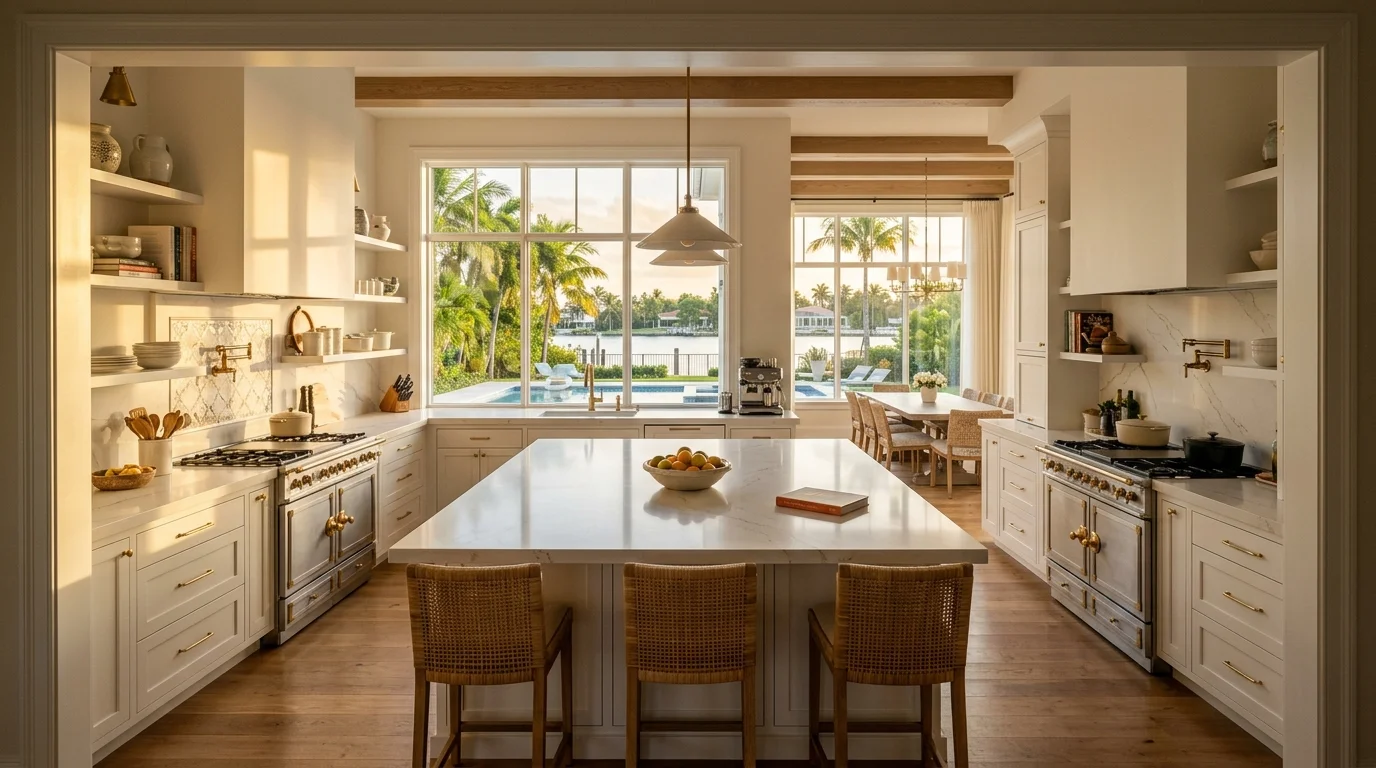
When homeowners in Boca Raton, Delray Beach, and Wellington ask us about countertop options, quartz comes up in almost every conversation. It makes sense, quartz countertops pros and cons are widely discussed online, but a lot of that information glosses over the real-world performance issues that matter specifically in South Florida. Heat exposure. UV fading from our intense sun. Humidity. HOA approval cycles in gated communities. These aren't abstract concerns here. We install countertops across Palm Beach County every week, and we've watched quartz perform beautifully in some kitchens and disappoint homeowners in others. This article tells you exactly when quartz is the right call, and when it isn't.
What Is Quartz (and What It Isn't)
Quartz countertops are engineered stone. That's the key word: engineered. They're made from roughly 90-93% ground quartz mineral bound together with polymer resins and pigments. The result is a slab that looks like stone but behaves more like a manufactured product, consistent in pattern, non-porous by nature, and factory-calibrated to tight tolerances.
That distinction matters because a lot of homeowners confuse quartz with quartzite. They are not the same material. Quartzite is a natural metamorphic rock, it requires sealing, it can etch, and it has the unpredictable character of real stone. Quartz is manufactured. If you want to understand that difference in detail before you choose, our guide on quartz vs. quartzite countertops breaks it down side by side.
The major brands, Silestone, Cambria, Caesarstone, MSI, and others, all produce quartz slabs, but their resin formulations, warranties, and UV-resistance ratings differ. Brand matters more than most homeowners realize, and we'll cover that below.
The Real Pros of Quartz Countertops
Quartz earns its popularity for legitimate reasons. Here's what it genuinely does well.
Non-porous surface. Because it's engineered with resin binders, quartz has virtually no open pores. That means bacteria, mold, and moisture have nowhere to hide. You never need to seal it. For South Florida kitchens where humidity is a constant presence, this is a meaningful advantage over granite, marble, or quartzite, all of which require regular sealing to stay protected.
Consistency in pattern and color. Natural stone slabs vary slab to slab. With quartz, what you see in the showroom is very close to what lands in your kitchen. If you're doing a large kitchen with an island and need two or three slabs to match, quartz makes that coordination far easier. We recommend seeing physical slabs rather than relying on digital samples, but the consistency is real.
Scratch and stain resistance. Quartz ranks around 7 on the Mohs hardness scale, harder than most knives and significantly harder than marble. Day-to-day kitchen abuse: cutting boards dragged across the surface, cast iron pans set down, acidic foods left out, quartz handles it well. It's not bulletproof, but it's forgiving in a way that marble simply is not.
Low maintenance. Soap, water, and a microfiber cloth handle 95% of quartz cleaning. No annual sealing appointments, no specialty stone cleaners required. For busy households in Jupiter or Palm Beach Gardens, that practical simplicity has real value.
Wide design range. Today's quartz manufacturing has gotten genuinely good at mimicking marble veining, concrete looks, and even quartzite patterns. If you want the marble aesthetic without the maintenance anxiety, a well-chosen quartz slab gets you most of the way there. When we're putting together an all-white kitchen design, quartz in a Calacatta or Statuario pattern is almost always in the conversation.
Warranty backing. Most name-brand quartz manufacturers offer 10-15 year limited warranties. That's something you don't get with natural stone.
The Real Cons of Quartz Countertops
Here's where we're going to be straight with you. Quartz has real limitations, and in South Florida, two of them are more significant than national remodeling content usually admits.
Heat damage, and it's permanent. The polymer resins that make quartz non-porous also make it vulnerable to heat. Set a 400°F cast iron skillet directly on quartz and you risk discoloration, cracking, or surface scorching that cannot be repaired. No trivet. No second chance. Granite handles that same pan without complaint. If you cook hard, daily cast iron use, frequent large roasting pans pulled straight from a hot oven, we usually steer clients toward granite or quartzite for the cooking zone. Quartz works fine near the range when the homeowner commits to using trivets consistently, but that's a habit change worth acknowledging upfront.
UV fading, a real problem in South Florida. This is the one that surprises people most. Quartz is not UV-stable. Prolonged exposure to direct sunlight causes the resins to yellow, fade, or develop a chalky appearance over time. In most northern markets, this is a minor concern. In Boca Raton or Delray Beach, where kitchens often have east- or west-facing windows pouring in intense sun, it's a genuine issue. Impact-resistant windows reduce but don't eliminate UV transmission. If your countertop will see direct sun for several hours a day, quartz is a risk. Porcelain or quartzite handles UV exposure far better. Our full breakdown of the best countertop materials for Florida's humidity and heat covers UV performance across all the major options.
Seams show more than on natural stone. Because quartz patterns are manufactured, seams between slabs can be more visible than on a matched natural stone. Color-matching grout and careful placement by an experienced installer minimizes this, but a long run countertop or a waterfall island will always have a seam, and on some quartz patterns it's more noticeable than homeowners expect. Ask to see photos of previous installations with the specific slab you're choosing.
Outdoor kitchens: a hard no. The UV and heat sensitivity that creates issues indoors makes quartz a poor choice for outdoor kitchen countertops entirely. If you're building an outdoor cooking space in your backyard, look at porcelain, quartzite, or sealed granite instead. We cover that in detail in our guide to outdoor kitchen countertops for Florida.
Heavy and requires solid substrate support. A standard 3cm quartz slab weighs roughly 18-20 lbs per square foot. Cabinets and the substrate underneath need to be in sound condition before installation. This rarely causes problems in new construction, but older Palm Beach County homes with original cabinet boxes occasionally need reinforcement first.
Can't be re-honed or refinished. Natural stone can be professionally honed or re-polished if it gets dull or etched. Quartz cannot. If the surface gets damaged badly enough, the slab needs replacing. That's a meaningful difference for a 20-year countertop investment.
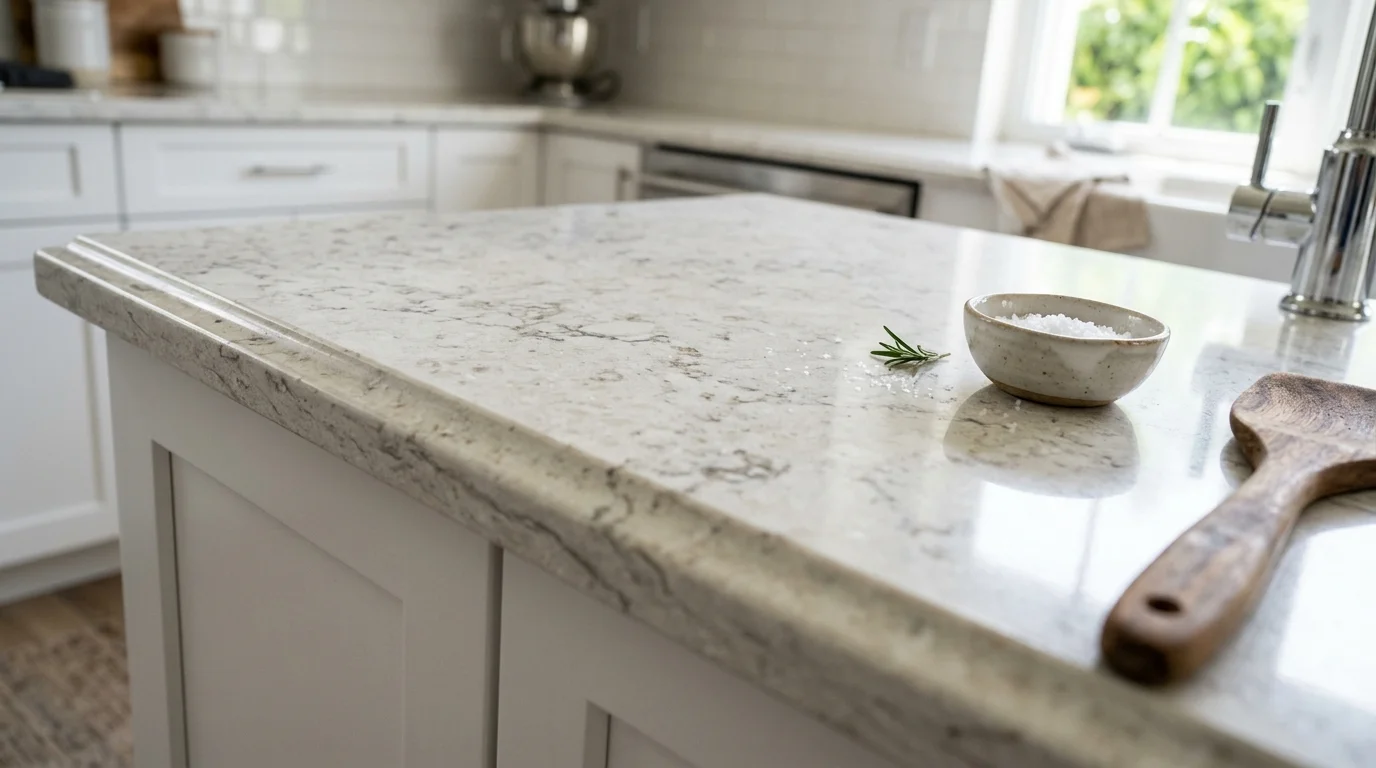
Quartz vs. Granite: How They Stack Up
This is the comparison we get asked about most. Both are solid choices. The right answer depends on how you cook and where your kitchen sits relative to the sun.
Granite is natural stone, each slab is unique, with natural variation in pattern and color. It requires annual sealing to stay stain-resistant. It handles heat without any concern. It's UV-stable. In South Florida sun-drenched kitchens, granite's heat and UV performance is a genuine advantage. The tradeoff is maintenance: skip sealing for a few years and it starts absorbing oils and stains more readily.
Quartz beats granite on maintenance simplicity and consistency. No sealing ever. Predictable patterns. But heat caution is non-negotiable, and if the countertop will see direct sun, granite holds up better long-term.
Our honest opinion: for heavy cooks with sun-exposed kitchens, granite or quartzite usually wins. For homeowners who want low-maintenance, want a specific modern pattern, and keep their countertops shaded, quartz is an excellent choice. For a complete side-by-side across four stone types, see our guide on quartz vs. quartzite vs. granite vs. marble.
One more comparison worth knowing: porcelain slab countertops have emerged as a strong competitor to quartz, particularly for UV exposure and heat resistance. If quartz's limitations concern you, porcelain deserves a look. We break that down in our porcelain vs. quartz countertop comparison.
Quartz Countertop Cost in Palm Beach County
Pricing varies based on slab brand, edge profile, square footage, and complexity of the layout. The ranges below reflect what we see in the Palm Beach County market, not national averages, which tend to run lower.
Keep in mind that countertop cost is only part of a kitchen remodel budget. Our full kitchen remodel cost guide for Palm Beach County covers the complete picture, cabinets, tile, labor, and everything that comes with a full project. And if you want a dedicated deep-dive on quartz pricing specifically, our quartz countertops cost guide has current slab pricing, brand comparisons, and what drives the number up or down.
Edge profiles are one of those decisions that can shift your cost and dramatically change the look of the finished countertop. We recommend reviewing the options before you finalize your slab choice, our guide to countertop edge profiles in Palm Beach County walks through every option with visuals.
South Florida Considerations
Homeowners in Palm Beach County face a few specific conditions that should directly influence your countertop decision.
Sun exposure is not optional. South Florida kitchens frequently have large windows, sliding glass doors to lanais, and open-plan layouts that pull in intense east and west light. Before choosing quartz, walk through your kitchen at peak sun hours. If the countertop will be in direct sunlight for more than two to three hours daily, we'd have an honest conversation about quartzite or porcelain instead. The UV fading risk is real and it accumulates over years, not overnight.
Gated communities and HOA approvals. If you're in a Wellington equestrian community, a Boca Raton country club development, or any HOA-governed property, your countertop selection may need to be submitted as part of an architectural review package. Your general contractor handles the submission process; we provide the design drawings and material specifications. Quartz brands are generally easier to specify and describe for review boards than natural stone with unique slab variations.
Humidity doesn't hurt quartz, it's one of quartz's actual strengths here. The non-porous surface doesn't absorb moisture, doesn't harbor mold, and doesn't need seasonal sealing in the way that granite does. For bathrooms and laundry rooms in humid South Florida environments, this is a legitimate plus.
Contractor quality matters as much as material quality. Quartz seams, cutouts for sinks, and edge fabrication need to be done precisely. A poorly fabricated seam on an expensive Cambria slab is worse than a well-fabricated seam on a mid-grade product. When you're evaluating who to work with, ask to see examples of their quartz installations specifically. Our article on how to find a good kitchen remodeler in Palm Beach County covers exactly what to look for and what questions to ask before you sign anything.
Permits: scope-dependent, not automatic. A straight countertop replacement on an existing layout does not require a permit in Palm Beach County. Permits come into play when your project involves moving the sink, relocating plumbing, changing electrical service, or opening walls. Your general contractor manages permit applications when your scope requires them, not us. If you're curious about where the line falls, the Palm Beach County Building Division publishes current permit requirements by scope.