Neolith Countertops: Pros, Cons & Cost
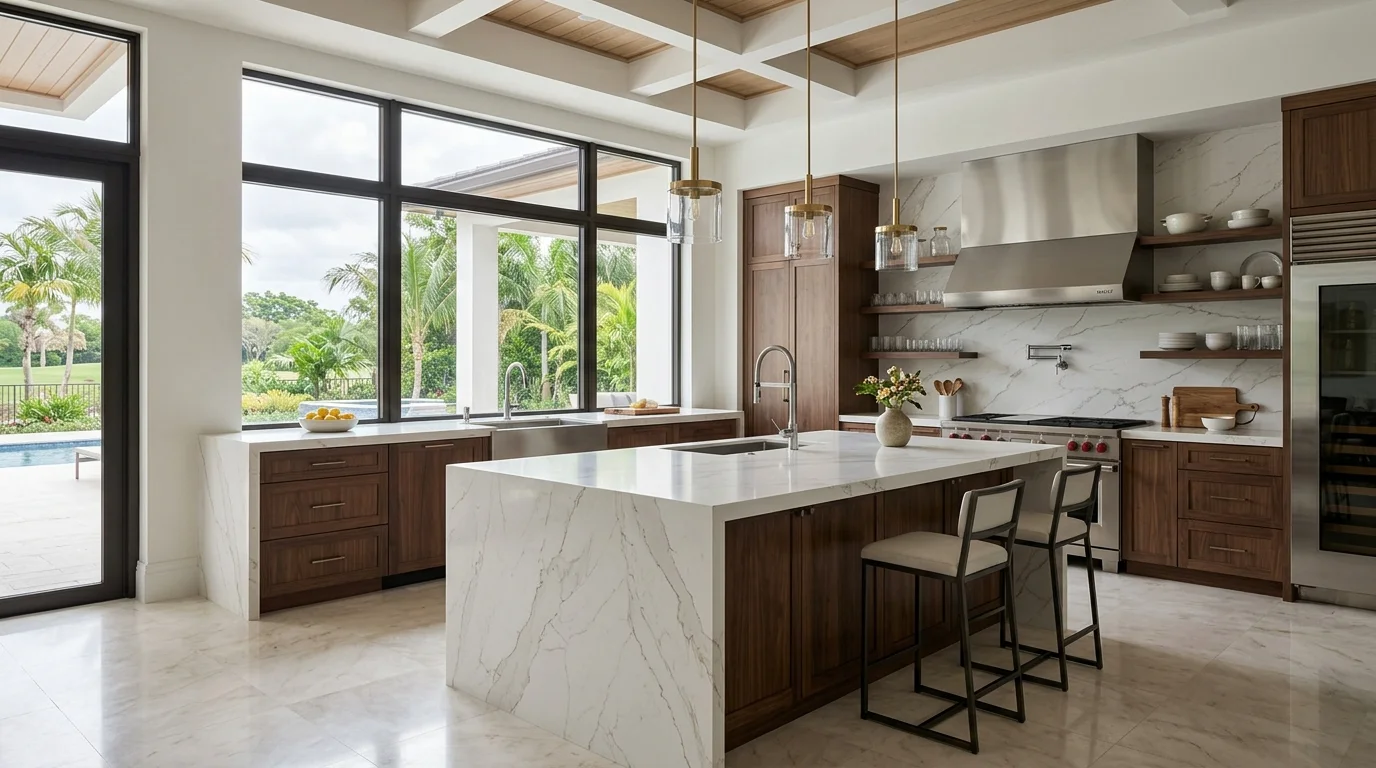
If you've been pricing countertop materials lately, you've probably run across Neolith. Neolith countertops cost more than standard quartz or granite, and homeowners in Boca Raton, Delray Beach, and Wellington want to know whether the premium is justified. The short answer: for the right kitchen or outdoor project, it absolutely is. For a straightforward indoor kitchen where you mostly prep vegetables and pour coffee, there are less expensive options that perform just as well day-to-day. We carry Neolith at South Florida Kitchen & Bath Design and we're going to give you the honest picture, what it is, where it shines, where it falls short, and exactly what you'll pay in the Palm Beach County market.
What Is Neolith?
Neolith is a sintered stone surface made by The Size Group, a Spanish manufacturer. Sintered stone means the material is produced by subjecting a blend of natural raw materials, clays, feldspar, silica, and mineral oxides, to extreme heat and pressure. No resins. No polymer binders. The result is a 100% inorganic slab that's essentially non-porous from the factory.
The process mimics what happens in nature when stone forms over millions of years, compressed into a manufacturing cycle of hours. Slabs typically come in 6mm, 8mm, or 12mm thicknesses. The 12mm profile is what most of our clients choose for kitchen countertops because it fabricates similarly to natural stone and holds up better at the edges. Thinner profiles (6mm) work well for vertical cladding, backsplashes, and slab backsplash waterfall panels.
Neolith offers dozens of collections, everything from concrete looks to marble-inspired veining to solid industrial tones. The Neolith official site catalogs the full range. Collections like Iron, Basalt, and Calacatta Gold are the ones we see requested most often here in South Florida. The large-format slabs (up to 320 × 150 cm) mean fewer seams, which is a real visual advantage in open-concept kitchens.
If you want to see how sintered stone compares to the broader countertop category, our guide on best countertops for Florida kitchens walks through all the major material types side by side.
Pros and Cons
No material is perfect. Here's where Neolith earns its price tag and where it creates real-world headaches.
The genuine advantages:
Heat resistance is the headline. You can set a 500°F cast iron skillet directly on Neolith and it won't scorch, discolor, or crack from thermal shock the way quartz can. Quartz contains resins that start to break down above roughly 300°F, Neolith does not have that limitation. For a household that cooks seriously, this matters.
UV stability is the other major win for South Florida homeowners. Quartz fades in direct sunlight over time. Neolith doesn't. That makes it one of the best countertop choices for outdoor kitchens, covered lanais, and pool bars, environments where quartz will yellow or dull within a few years. Our article on outdoor kitchen countertops covers this topic in depth if you're building an exterior cooking space.
Scratch resistance is excellent. Neolith rates a 6-7 on the Mohs hardness scale, which puts it on par with quartzite and above most quartz products. Cutting directly on the surface is still not recommended, you'll dull your knives before you hurt the stone, but accidental drags from ceramic dishes and cookware won't leave marks.
No sealing required. Ever. Because the material is fully sintered and non-porous, bacteria, mold, and moisture have nowhere to go. In a humid South Florida home, that's meaningful. You'll never have to remember to reseal the way you would with quartzite countertops or granite.
The aesthetic range is wide. Neolith's large-format slabs let fabricators create continuous veining across an island with almost no visual interruption. For dramatic marble-look designs, the kind you see in Jupiter and Palm Beach Gardens luxury builds, Neolith delivers a convincing result without natural stone's maintenance demands.
The real drawbacks:
Fabrication is harder and more expensive. Sintered stone is dense and brittle compared to granite or quartz. It requires diamond-blade tooling and an experienced fabricator who knows the material. A bad cut can crack the slab. This is one of the reasons Neolith costs more to install than quartz, it's not just material cost, it's labor cost. Not every fab shop in Palm Beach County works with it regularly. We've built relationships with fabricators who know sintered stone, and that vetting matters.
Edge profiles are somewhat limited. Intricate ogee or detailed carved edges don't work well in sintered stone without risk of chipping. Clean, simple profiles, eased, beveled, mitered, are the way to go. If you're set on an ornate edge, a different material is probably a better fit. See our countertop edge profiles guide for what fabricators can realistically achieve in different materials.
It can chip at the corners if impacted hard. Unlike quartz, Neolith doesn't flex at all, it's rigid. A hard impact on a thin overhang or a corner can cause a small chip. Mitered waterfall edges in 6mm material are particularly vulnerable. The 12mm profile with proper overhang support is a safer choice for busy households with kids.
Cost. Plain and simple. Neolith is a premium product and it's priced accordingly. If your priority is value per square foot, quartz wins. If your priority is performance ceiling, especially for outdoor use or serious cooking, Neolith justifies the number.
Neolith vs. Dekton vs. Porcelain
Sintered stone is a category, not a brand. Dekton by Cosentino and Neolith by The Size Group are the two dominant sintered stone brands in the U.S. market. Porcelain slabs are related but not the same thing. Here's how we think about the differences.
Neolith vs. Dekton: Both are fully sintered. Both are non-porous, UV-stable, and heat-resistant. The differences come down to aesthetics and price positioning. Dekton has slightly wider availability in South Florida showrooms and a broader collection at the luxury end. Neolith tends to price a touch lower per slab in most markets, though the gap isn't huge. We've installed both extensively. Our team doesn't have a strong preference on performance grounds; it usually comes down to which collection has the specific look the client wants. If you're curious about the Dekton side of the comparison, read our full Dekton countertops breakdown.
Neolith vs. Porcelain slab: Porcelain slabs (think Iris Ceramica, Atlas Plan, or Florim) are fired ceramic rather than sintered stone. They're harder than standard tile, non-porous, and come in large formats. But they're not as dense as sintered stone, and most porcelain slabs are thinner (6mm is common, 12mm is less so). Heat resistance is good but generally not at the same ceiling as sintered stone. Porcelain slab countertops cost less, usually $45-$85/sq ft installed in this market, making them a strong mid-range alternative if the full Neolith budget is a stretch. Our full breakdown is at porcelain countertops: are they worth it?
Bottom line on the three-way comparison: for outdoor applications or households with serious cooking habits, we recommend Neolith or Dekton over porcelain slab. For indoor kitchens where UV stability and extreme heat resistance aren't priorities, porcelain slab is a legitimate, less expensive alternative. For homeowners who prioritize budget and don't need that performance ceiling, engineered quartz remains the most practical choice in the Palm Beach County market.
Neolith Countertops Cost Guide
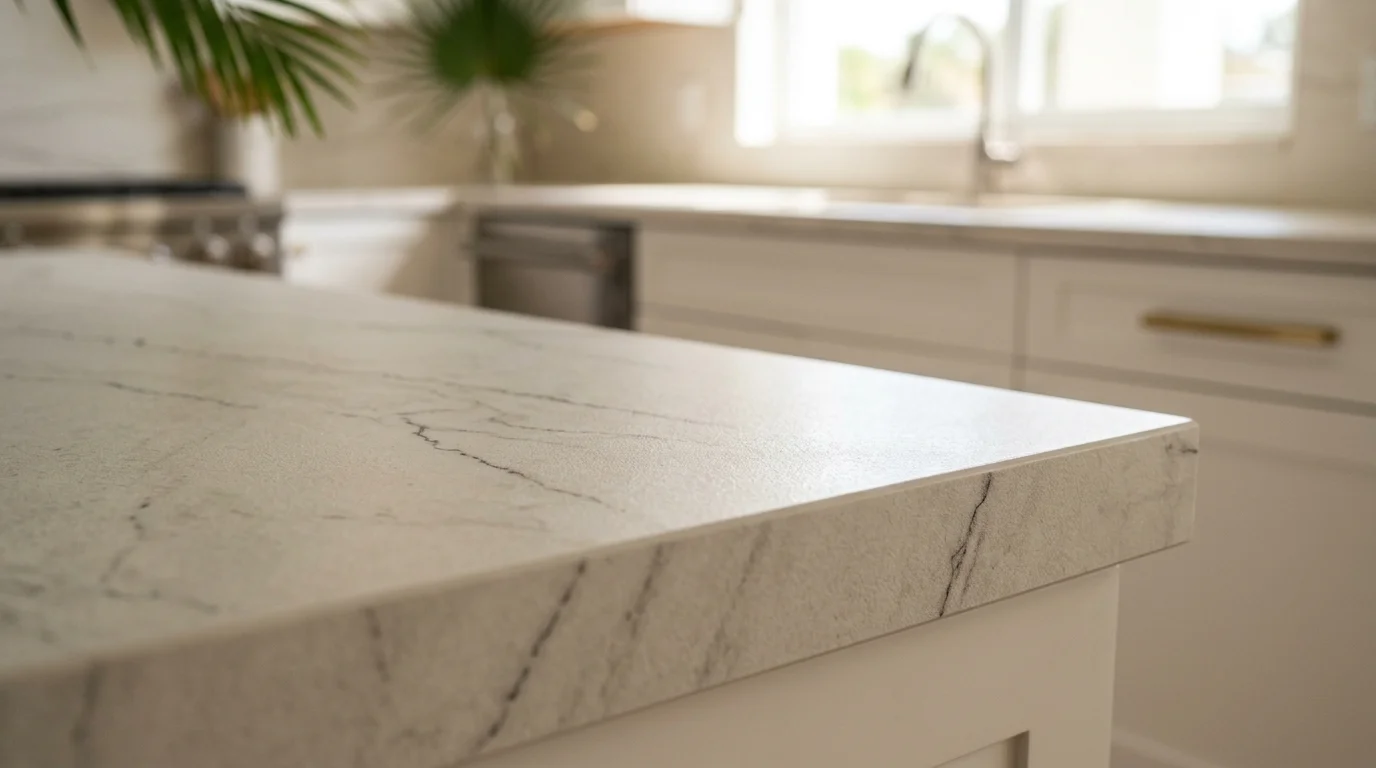
Neolith countertops cost in Palm Beach County typically runs $65-$130 per square foot installed, depending on slab collection, edge profile, thickness, and how complex the layout is. That range covers material, fabrication, and installation. It does not include demo of existing countertops (add $200-$600 depending on material and scope) or any plumbing reconnection, which your general contractor handles separately.
Here's a breakdown of what drives cost within that range:
A few notes on these numbers: The countertop-only swap, same footprint, no layout changes, no moving the sink, is typically the simplest job and doesn't require permits in most Palm Beach County jurisdictions. Permits are required when the project involves moving the sink location, relocating the dishwasher drain, running new electrical circuits, or opening walls. Those are your general contractor's scope to manage, not ours.
If you want the full picture on how countertop costs stack up across all materials in this market, our countertop installation cost guide for Palm Beach County covers it in detail.
One thing worth knowing: the 30% rule in remodeling suggests your countertop investment shouldn't exceed roughly 30% of the room's total remodel budget. A $5,000 Neolith countertop job makes sense in a $25,000+ kitchen remodel. It looks a little out of place in a $12,000 budget kitchen with stock cabinets. Read more about that principle at our 30 percent rule in remodeling article.
South Florida Considerations
Palm Beach County homeowners deal with conditions that make material selection genuinely different than most of the country. Here's how Neolith performs against South Florida's specific environment.
UV exposure. We have 265+ days of sun per year in Boca Raton and Delray Beach, and the angle of that sun is aggressive. Covered lanais and outdoor kitchens still get significant UV exposure. Neolith's sintered composition means colorfast pigments with no organic binders that can bleach out. We've seen quartz countertops on partially-covered outdoor bars turn noticeably dull within two to three years in this climate. Neolith holds its color. That's not marketing, it's something we've observed on our own installations over time.
Humidity and mold. Florida's humidity is relentless. Any countertop material with even micro-porosity can absorb moisture, and in a high-humidity kitchen, that contributes to mold growth at the substrate level. Neolith's non-porous surface eliminates that pathway. No sealer to reapply, no grout lines if you run it as a full-height backsplash, and no concern about moisture wicking into the slab at the edges.
HOA and ARB requirements. Many communities in Wellington, Jupiter, and Palm Beach Gardens have Architectural Review Board processes for exterior modifications. Outdoor kitchen additions, including countertop material selection, sometimes require design drawings and material samples for approval. Our team prepares the design drawings and sample documentation your GC or HOA coordinator needs to submit. We've worked through this process in numerous gated communities across Palm Beach County. Our guide on remodeling a kitchen in a gated community covers what to expect from that process.
Coastal salt air. Properties in Jupiter Inlet Colony, Singer Island, and coastal Delray Beach deal with salt air corrosion that eats through metal fixtures and degrades certain stone sealers quickly. Neolith doesn't require any metal hardware or organic sealer to perform, the material is self-sufficient. For homeowners within a few blocks of the water, sintered stone is one of our top countertop recommendations for both interior and exterior applications.
Design trends in this market. The 2026 countertop direction in South Florida is moving toward dramatic veining, warmer tones, and full slab backsplashes, all areas where Neolith's large-format slabs perform beautifully. If you want to see where the broader countertop design trends are heading, our countertop design trends 2026 guide covers what we're seeing in Palm Beach County showrooms and new installs right now.
The Florida Building Code governs what requires a permit at the county level. For a straight countertop replacement on an existing layout, the work generally doesn't trigger a permit in most Palm Beach County jurisdictions, but if your GC is moving plumbing or electrical as part of a broader kitchen remodel, that's a different conversation. Ask your GC directly; they're the right person to make that call.
If you're in the early planning stages of a full kitchen remodel and want to understand total project budgets before committing to a countertop material, our kitchen remodel cost guide for Palm Beach County is the right starting point.