Porcelain Countertops: Are They Worth It?
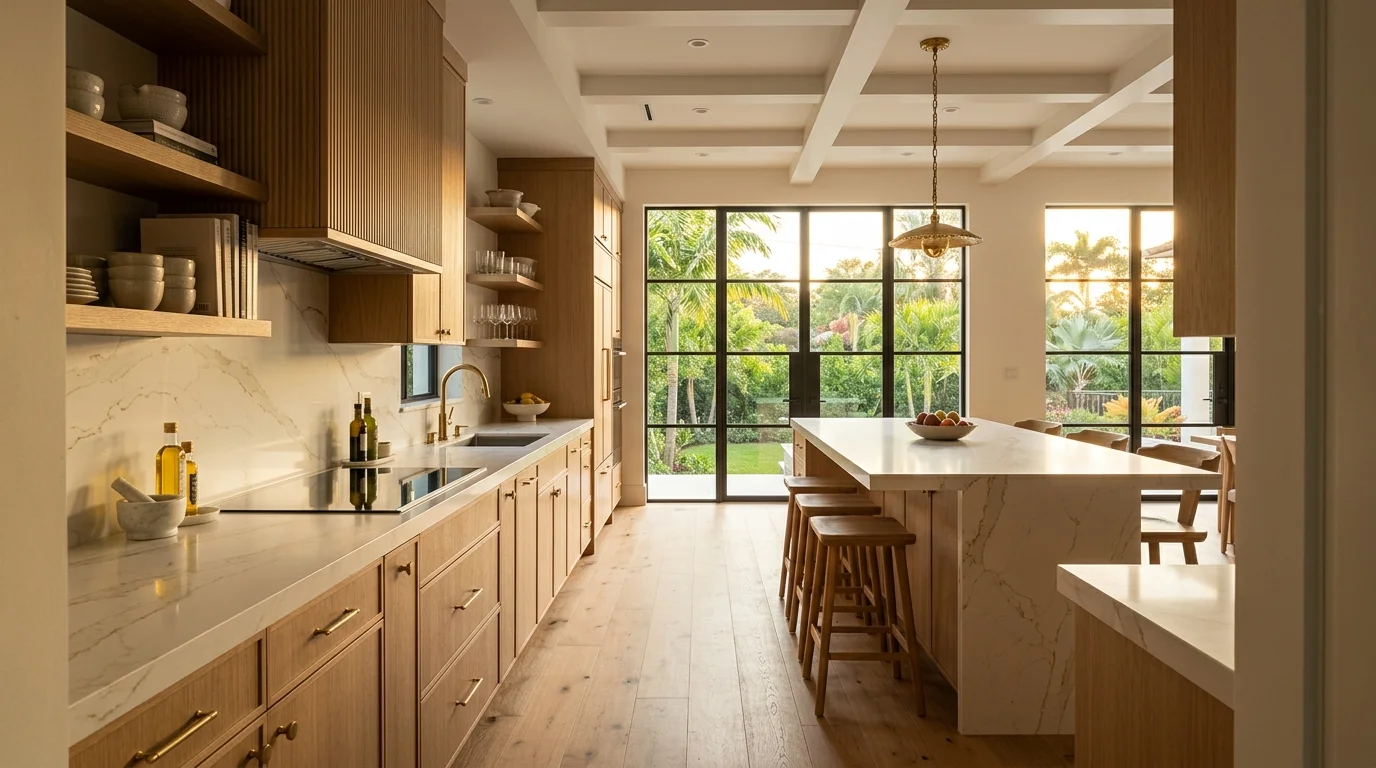
Porcelain countertops are one of the fastest-growing surface choices we're seeing in Palm Beach County kitchens right now, and homeowners in Boca Raton, Delray Beach, Wellington, and Jupiter are asking us about them constantly. That makes sense. Porcelain brings a dramatic, natural-stone look without the maintenance baggage of marble or quartzite. But it's not the right call for every kitchen. Before you commit a few thousand dollars to a material you've never lived with, here's what our team actually sees in the field: the real strengths, the real limitations, and the real cost in our market.
What Porcelain Countertops Actually Are
Porcelain countertops, sometimes called sintered stone or ultra-compact surfaces, are not the same as the ceramic tile you'd put on a shower floor. They're made by compressing a mixture of fine-grained clays, minerals, and pigments under extreme heat and pressure, typically between 2,200°F and 2,500°F. The result is a non-porous slab that is fired to a density and hardness most natural stones can't match.
The terms can get confusing. "Sintered stone" is a broader category. Brands like Dekton by Cosentino and Neolith fall under it. Porcelain slabs from manufacturers like Fiandre and Atlas Plan also qualify. The production process varies slightly, but the practical performance characteristics are similar enough that most homeowners can treat them as the same category.
What you get is a slab, usually 3/8" to 1/2" thick in the standard configurations, that can be printed with incredibly detailed surface patterns. Carrara marble looks, dramatic book-matched veining, concrete textures, solid colors. The imaging technology has gotten good enough that even professionals sometimes need to look twice. If you want the look of marble without sealing it every year, this is the product category to explore. We cover the broader material comparison in our guide on the best countertop materials for Florida's humidity and heat, which is worth reading alongside this article.
One thing to set straight: porcelain countertops are not the same as porcelain tile glued to a substrate. Proper porcelain countertops are full-thickness slabs fabricated and installed by a shop with the right equipment. The cutting and installation requires diamond blades, specialized tooling, and experienced fabricators, because the material, while extremely hard, can crack if handled incorrectly. That's not a reason to avoid it. It's a reason to work with a shop that knows what they're doing.
Durability, Heat & UV Resistance
This is where porcelain genuinely earns its reputation. The material scores between 7 and 8 on the Mohs hardness scale, which puts it above most quartzite and well above marble. Practically speaking, your keys, rings, and everyday kitchen debris are not going to scratch it. Quartz, by comparison, sits around 7 on the scale but uses polymer resins in its composition, more on that in a moment.
Heat resistance is a real differentiator. Quartz countertops use resin binders that can discolor or warp if you set a hot pan directly on them. Porcelain has no resin. It's fired at temperatures far beyond anything your kitchen will ever produce. A 400°F cast iron skillet coming off the stove is not a threat to a porcelain surface. That said, we still recommend trivets as a general habit, not because the surface needs protection, but because thermal shock from extremely rapid temperature changes can stress any material over years of use.
UV resistance is the big one for South Florida. Quartz manufacturers are clear in their warranties: prolonged UV exposure can cause fading and discoloration. If your kitchen gets direct sun through west-facing windows in the afternoon, which is common across Palm Beach County, a quartz countertop can show yellowing over time, especially in lighter colors. Porcelain does not fade in sunlight. The color goes all the way through the slab. This is also why porcelain is the dominant choice for outdoor kitchen countertops in Florida, where UV and humidity would destroy most other surfaces within a few years.
Stain resistance is another genuine strength. Because the surface is non-porous, no resin, no open pores, there's nothing for red wine, coffee, or citrus juice to soak into. Wipe it up and it's gone. No sealing required. Ever. Compare that to granite, which needs sealing at least annually, and to quartzite, which needs it even more frequently. If you want to understand the sealing demands of other materials, our article on whether quartzite needs to be sealed lays it out plainly.
Where porcelain has a real limitation: it chips. The surface is hard, but hard doesn't mean flexible. Drop a cast iron pan on a corner or knock a heavy object against an edge and you can chip the material. Chips on porcelain are difficult to repair invisibly. Quartz is more forgiving in this regard, small chips can often be filled with matching resin. This is worth factoring in if you have an active kitchen with small kids, or if you cook heavily with cast iron.
Thin Profile and Design Flexibility
Standard porcelain countertop slabs run 3/8" to 1/2" thick. Compare that to the 3/4" to 1-1/4" thickness of most quartz and granite slabs. That thin profile isn't a weakness, it's actually one of the material's design advantages. Waterfall edges on a thin slab look sleeker and more contemporary. The reduced weight matters on islands and peninsula overhangs. And the material can be used continuously on both countertops and full-height backsplashes without the visual weight you'd get from thicker stone.
The full-height backsplash application has become one of the most popular looks we're installing right now. A single slab running from countertop to upper cabinet line creates a clean, uninterrupted visual that works particularly well in modern and transitional kitchens. If you're deciding between a standard 4-inch splash and a full-height slab application, our breakdown on 4-inch vs. full-height backsplash walks through the trade-offs in detail.
Edge profiles are more limited with thin-slab porcelain than with thicker stone. You can double or triple stack the edges to create the appearance of thickness, a common technique for waterfall islands, but intricate ogee or bullnose profiles that require material depth aren't typically possible with a 3/8" slab. Eased, mitered, and pencil edges work well. If elaborate edge profiles are important to your design, that's worth discussing with your fabricator upfront. Our guide to countertop edge profiles in Palm Beach County shows what's achievable across different slab thicknesses.
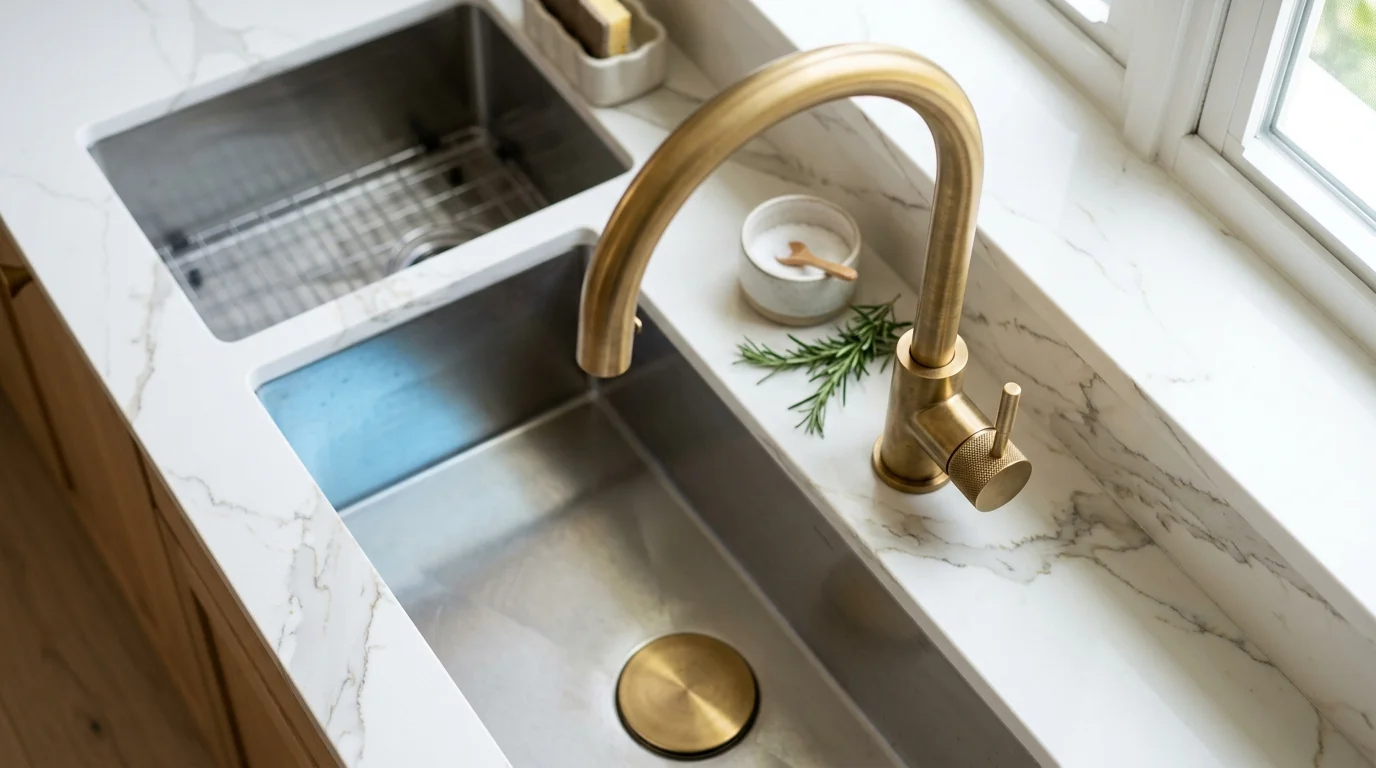
Porcelain also integrates well with undermount sinks, though the fabrication requires precision cutting. The thinness of the slab means the undermount reveal looks clean and modern. We generally pair it with stainless or composite sinks, the hard surface responds poorly to heavy impact at cutout edges, so sink selection matters.
Cost Guide: Porcelain vs. The Competition in Palm Beach County
Pricing in our market has shifted as porcelain has become more mainstream. Supply has improved, more fabricators are equipped to handle it, and the cost gap with quartz has narrowed. Here's how it stacks up for a typical Palm Beach County kitchen. These are installed prices, material, fabrication, and installation.
The takeaway: porcelain is not the budget option. Entry-level porcelain runs about the same as mid-range quartz, and premium sintered stone brands sit at the top of the market alongside premium quartzite. What you're paying for is a combination of performance (UV resistance, zero sealing, heat tolerance) and a look that's genuinely competitive with natural stone.
For a typical Palm Beach County kitchen with 40-55 square feet of countertop, a porcelain installation at the mid-range tier runs $3,600-$7,150 in material and installation costs. That's before cabinetry, appliances, or any layout changes. If you're scoping a full kitchen refresh, cabinets, countertops, backsplash, hardware, our kitchen remodel cost guide for Palm Beach County gives you the full picture on what to budget across all trades.
Fabrication labor also runs slightly higher for porcelain than for quartz in most shops, because the tooling requirements are more demanding and the margin for cutting error is smaller. Don't choose a fabricator based on the lowest bid, choose one with demonstrated experience on thin-slab porcelain. We've seen botched cutouts that split slabs straight through the sink opening. That mistake costs you the entire slab.
South Florida Considerations
Our climate is genuinely different from most of the country, and countertop choices should reflect that. A few things specific to Palm Beach County, Boca Raton, Delray Beach, Wellington, and the coastal communities in Jupiter:
The UV issue we mentioned above isn't theoretical here. South Florida gets roughly 3,000 hours of sunlight per year, well above the national average. Kitchens with east or west exposures get direct sun during cooking hours. If you have a quartz countertop in a sun-exposed kitchen and you're unhappy with how it's yellowing, porcelain is a legitimate solution. The color stability under UV is one of its strongest practical advantages in this region.
Humidity doesn't affect porcelain the way it affects wood or natural stone. There are no resin components to soften, no pores to absorb moisture, no risk of the kind of staining that can happen to unsealed granite in a humid environment. That makes it an excellent choice for kitchens in waterfront homes, where salt air and humidity are ongoing concerns.
Porcelain's surface hardness also makes it a natural fit for outdoor kitchen applications, a growing segment of our work across Palm Beach County. If you want a cohesive look from your indoor kitchen to your covered lanai or outdoor cooking area, porcelain is one of the few materials that performs equally well in both environments. Most quartz warranties specifically exclude outdoor use.
One South Florida-specific consideration worth raising: HOA and ARB approval processes in gated communities. If you're in a community that requires design review, common across Wellington, Boca Raton, and Jupiter, material changes sometimes need documentation. Your general contractor handles the submission process; our team supplies the specification drawings and material samples. If you're remodeling in one of these communities, our guide on remodeling a kitchen in a gated community in Palm Beach County covers what to expect.
We also see porcelain showing up more in condo remodels, where weight restrictions on upper floors can be a factor. The thinner slab profile means less weight per square foot than granite or quartzite, which matters in some older concrete construction buildings. If you're in a condo and planning a kitchen update, our piece on condo kitchen remodels and HOA considerations is required reading before you start.
So is porcelain worth it? Our honest answer: yes, for the right kitchen and the right homeowner. If you have significant sun exposure, you cook heavily, you want natural-stone aesthetics without the maintenance commitment, and you're willing to pay mid-to-premium countertop pricing, porcelain is an excellent choice. If you're budget-sensitive, have an active household where heavy impacts on edges are likely, or your kitchen gets minimal direct sunlight, quartz probably makes more financial sense. Our detailed head-to-head comparison at porcelain vs. quartz countertops goes deeper on that specific decision if you're still on the fence.