The Best Types of Kitchen Faucets for South Florida Homes
Choosing the right types of kitchen faucets sounds simple until you're standing in a showroom staring at sixty options with zero idea what the differences actually mean for your daily cooking routine. We work on kitchens across Palm Beach County every week, from Boca Raton condos to Wellington farmhouses to Jupiter waterfront homes, and the faucet conversation comes up constantly. Get it right and you barely think about it. Get it wrong and you're annoyed every single time you use the sink. This guide covers the four faucet types we see most often: pull-down, bridge, touchless, and pot fillers. We'll give you honest opinions, real cost numbers, and the South Florida-specific details the generic buying guides skip.
Why Faucet Type Matters More Than You Think
Most homeowners spend months picking cabinets and countertops and then grab a faucet off a big-box shelf on the way to checkout. That's a mistake. The faucet is one of the highest-touch items in your entire kitchen. The average household uses the kitchen sink upwards of forty times a day. That means finish durability, spray head ergonomics, and water pressure compatibility all have a real impact on how much you enjoy your kitchen.
Faucet type also affects your sink choice. An undermount apron-front sink pairs best with a bridge faucet aesthetically, while a tight single-basin undermount usually calls for a pull-down or touchless model. If you're still working through your sink material options, nail that down first, then come back to the faucet. They have to work together visually and functionally.
Finally, faucet type interacts with your hole configuration. Most standard sinks have one to four holes punched in the deck. Bridge faucets typically require three holes. Single-hole pull-downs need just one. Getting this wrong after your countertop is templated is a costly fix, so plan it all at the same time during your design phase.
Pull-Down Faucets: The Everyday Workhorse
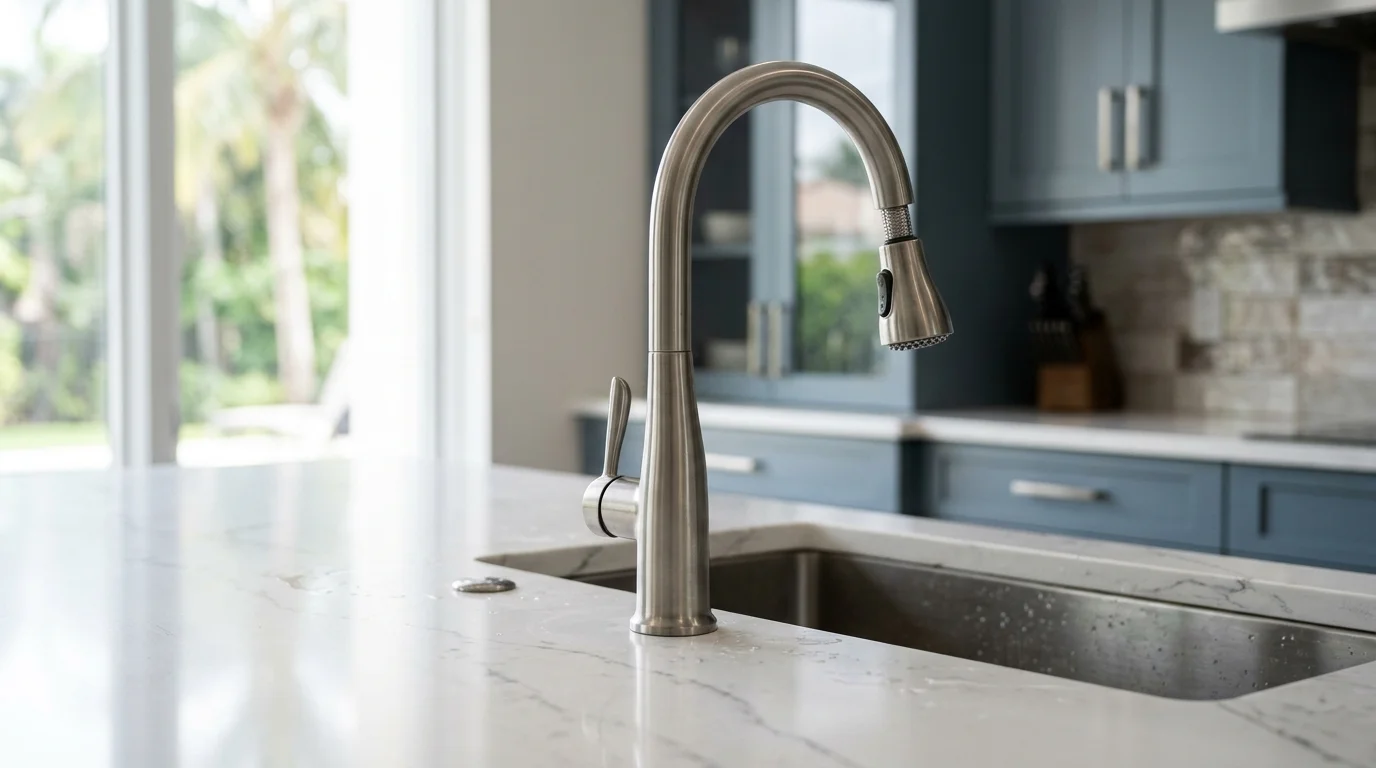
Pull-down faucets are, by a wide margin, the most popular type we install across Palm Beach County kitchens. The spray head is integrated into the spout and retracts down into the sink basin. That gives you a long reach for rinsing large pots, filling pots off to the side, and cleaning the corners of the sink without contorting your wrist.
The practical advantages are real. The hose on a quality pull-down typically extends 20 to 30 inches. The head locks into place magnetically on better models, so you're not dealing with a drooping spray head after six months. Brands like Moen and Delta have refined the docking mechanisms significantly over the past several years, and we've had very few callbacks on either brand.
We recommend pull-down over pull-out for most kitchens. Pull-out faucets have a shorter spout that arches lower, which limits clearance for tall pots. The hose on pull-out models also tends to kink more often over time. Pull-down gives you a higher arc and better clearance. The only situation where we lean toward pull-out is a kitchen with very low overhead cabinetry directly above the sink, where a tall pull-down spout would create a visual conflict.
Finish matters too, and this is where South Florida homeowners sometimes make a choice they regret. Matte black and brushed nickel are both popular right now, and both look great at first. But the finish needs to hold up against hard water. Palm Beach County water runs on the harder side, and mineral deposits show fast on dark matte finishes if you're not wiping the faucet dry after each use. Polished chrome is the easiest to clean. Spot-resistant stainless is a close second. If you love the matte black look, go for it, but be honest with yourself about how much time you want to spend maintaining it.
Cost range for a quality pull-down: $150 to $600 for the fixture itself. Installation by your plumber runs $150 to $300 depending on accessibility and whether old valves need replacing.
Bridge Faucets: Old-World Style That Actually Works
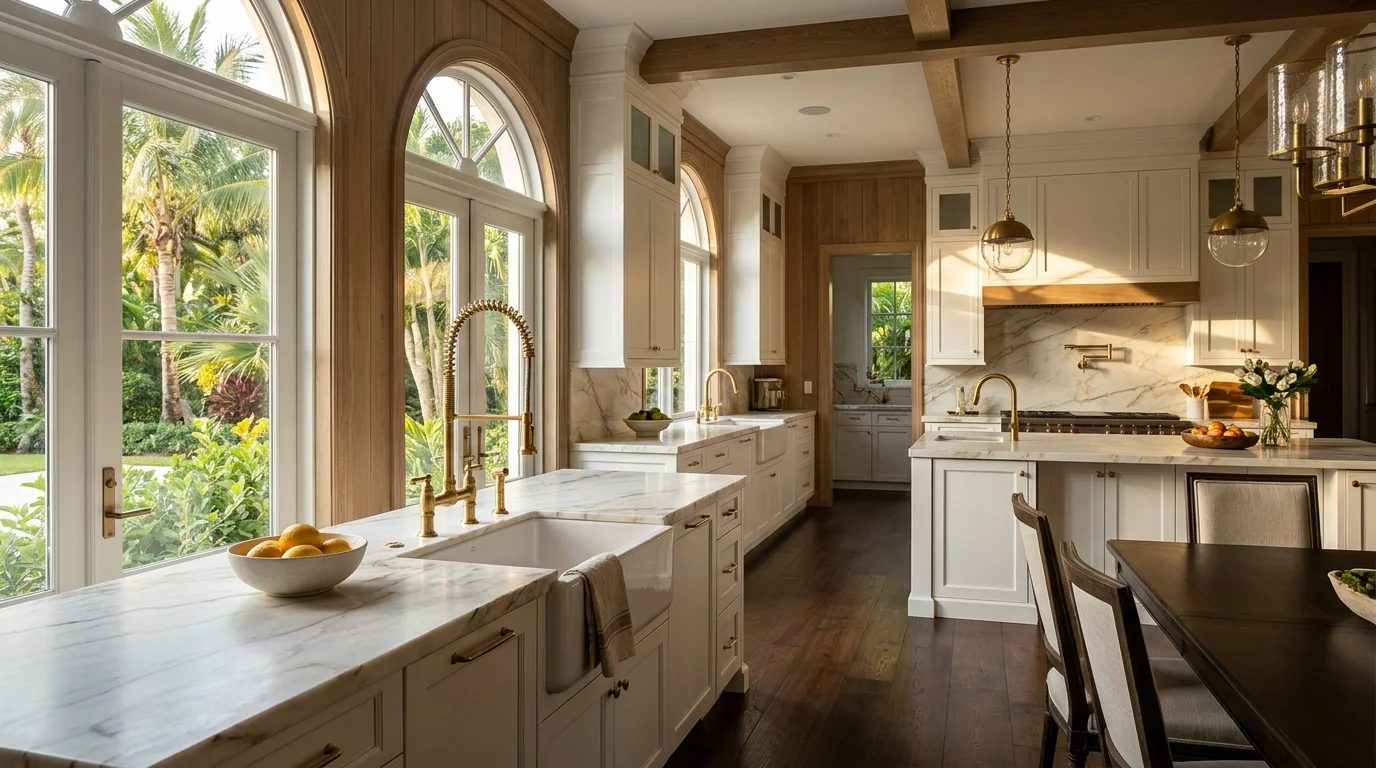
A bridge faucet has two separate handles on either side of the spout, connected by a horizontal bridge at the base. It's a classic plumbing configuration that was standard in American kitchens for decades before the single-handle faucet took over. It's come back in a serious way, especially in farmhouse kitchens, traditional designs, and the Mediterranean-style homes common throughout Delray Beach and Palm Beach Gardens.
We love bridge faucets in the right context. Paired with an apron-front sink and traditional cabinet hardware, they look like they belong. They feel substantial in the hand. The dual-handle design also gives you precise temperature control, which some cooks genuinely prefer over a single-lever system.
The trade-off is installation complexity. Bridge faucets require a three-hole or four-hole deck configuration. If your existing sink only has one hole, your plumber will need to add holes, which means coordinating with a stone fabricator if you have a countertop-mounted setup. This needs to be planned well in advance. We've seen homeowners fall in love with a bridge faucet after countertops are already installed, and adding holes to quartz or granite after the fact is risky and expensive.
Bridge faucets also sit lower to the deck than most pull-down models. If you're regularly filling tall stock pots at the sink, that lower clearance can be frustrating. Our honest recommendation: if you're going for a farmhouse or traditional kitchen and your sink is a wide apron-front model, the bridge faucet is a strong choice. If your kitchen is more contemporary or your sink is a standard single-basin undermount, stick with a pull-down.
Cost range: $300 to $1,200 for quality bridge faucets. Unlacquered brass and oil-rubbed bronze versions at the upper end of that range hold up well, but they require regular maintenance to develop and preserve their patina.
Touchless Faucets: Convenient but Know the Trade-offs
Touchless faucets use motion sensors, usually infrared, to activate water flow without you touching the handle. You wave your hand in front of the sensor or place a dish under the spout and the water starts. It sounds great in theory. In practice, our experience installing and following up on these faucets gives us a more nuanced view.
The real benefits are specific. If you're handling raw meat constantly, touchless is genuinely more hygienic. If you have young kids who forget to turn faucets off, the auto-shutoff prevents water waste. For homeowners with arthritis or reduced grip strength, sensor activation removes a physical barrier. We write about this in more detail in our full touchless faucet breakdown, but the short version is: touchless works best for specific lifestyles, not as a universal upgrade.
The complaints we hear most often: accidental activation when reaching for something in the sink area, sensor lag on cheaper models, and battery replacement hassle on battery-operated units. Hard-wired touchless faucets eliminate the battery issue but require an outlet under the sink, which your electrician needs to plan for. In South Florida's humidity, under-sink electrical planning matters. Make sure connections are properly rated and protected.
We recommend Delta's Touch2O and Moen's MotionSense lines for reliability. Both have been around long enough that the sensor technology is dialed in. Budget $350 to $900 for a quality touchless unit. Avoid the sub-$200 touchless faucets. The sensors on cheaper models drift in accuracy within the first year.
One more thing: touchless faucets typically still have a manual handle as a backup. If the sensor or battery fails, you're not stuck with a non-functional faucet. That fallback matters, especially if you're in a vacation home in Jupiter or Tequesta that sits empty for part of the year. A dead battery shouldn't mean a non-functional kitchen.
Pot Fillers: Worth It or a Gimmick?
Pot fillers mount directly to the wall above your range or cooktop. The arm swings out over your burner so you can fill a pot of water right where it'll be heated, without lugging a heavy stockpot from the sink across the kitchen. We have a full article dedicated to this, but the answer to "is it worth it" is: yes, for certain cooks, and no for others.
If you make pasta regularly, boil large batches for meal prep, or use a multi-burner professional range, a pot filler earns its cost fast. A 16-quart stockpot full of water weighs roughly 34 pounds. Walking that across a kitchen, potentially past a kitchen island, is a back and wrist issue over time. The pot filler eliminates that trip entirely.
If you rarely boil large volumes of water, a pot filler becomes a conversation piece and nothing more. We're honest with our clients about this. It's not a resale booster on its own, though it does photograph well and appeals to buyers who cook seriously.
Installation is the catch. A pot filler requires a cold water supply line run through the wall behind the range. That's your GC and plumber's scope, and it should be planned during the rough-in phase of a remodel, not as an afterthought. Retrofit installations in an existing finished wall cost significantly more and sometimes require opening the drywall. If you're mid-remodel with walls open, now is the time to add one. Doing it after is three to four times the cost.
Our full guide at pot filler faucets: are they worth it goes deeper on placement height, double-joint vs. single-joint arms, and finish matching with your range hardware. Read it before you commit.
Cost for the fixture: $150 to $600. Rough-in plumbing to get water to the wall location: $300 to $800 depending on how far the supply needs to run and whether walls are open. Total installed cost in a remodel context: $450 to $1,400. Done as a retrofit in a finished kitchen: potentially double that.
Cost Guide
Here's a straightforward breakdown of what you'll pay for each faucet type in the Palm Beach County market. These are fixture-only ranges plus a separate line for typical installation labor. Prices assume a standard sink replacement or remodel scenario. Retrofit situations with wall access issues or old valve replacement will add to labor costs.
A note on faucet quality tiers: we don't recommend going below the $150 mark on a pull-down or touchless model. The internal cartridges on sub-$150 faucets tend to fail within two to three years in South Florida's hard water environment. Spending $300 to $500 on a quality pull-down from a reputable brand is money well spent when you consider you're touching this thing forty times a day. Think of it like countertop edge profiles: the choice you make is minor in the overall remodel budget, but you'll notice it every single day.
South Florida Considerations
Palm Beach County water is mineral-heavy. Hard water accelerates aerator clogging, leaves white calcium deposits on faucet bodies, and degrades cheaper internal cartridges faster than you'd expect. This influences our recommendations in a few specific ways.
First, finish selection. We steer South Florida clients toward spot-resistant stainless, brushed nickel, and polished chrome over unlacquered brass or matte black if they're not committed to regular maintenance. Unlacquered brass is beautiful in a Wellington farmhouse kitchen, but it needs wiping down after each use or mineral deposits become a real issue. If you love the brass look without the upkeep, opt for a PVD-coated brushed gold finish instead. It's more resistant and holds its color far longer.
Second, aerator cleaning schedule. Plan on cleaning your faucet aerator every three to six months regardless of which type you choose. It's a two-minute job with a wrench and some white vinegar, but skipping it reduces your flow rate and puts strain on the cartridge. This applies to every faucet type we've discussed.
Third, think about how your faucet integrates with the rest of your kitchen design. A coastal kitchen with white shaker cabinets and a marble-look countertop has different faucet demands than a dark, contemporary kitchen in Boca Raton. If you're working through coastal kitchen design ideas, the bridge faucet or a clean brushed nickel pull-down typically fits best. A sleek matte black pull-down reads better in a contemporary or Japandi-inspired space.
Fourth, consider your HOA or ARB if you live in a gated or historic district. Most faucet swaps don't require any approval because you're not changing the exterior of the home. But if your kitchen remodel includes layout changes, like relocating the sink or adding a pot filler that requires opening a wall, your general contractor handles permit coordination with the Palm Beach County Building Division. The Palm Beach County Building Inspection Division outlines which scope triggers permit requirements. Permits are scope-dependent: a simple faucet swap almost never requires one, while moving the sink location or running a new gas line to the range (before adding a pot filler's water supply) typically does.
If you're planning a broader kitchen upgrade, take a look at what kitchen upgrades add the most value in Florida homes. Faucets alone don't move the needle much on resale appraisals, but paired with countertop and cabinet improvements, the combined effect is real. And if you're putting this faucet decision into context of a full remodel budget, our kitchen remodel cost guide for Palm Beach County gives you the full picture of what to expect to spend.
One final point: faucet type should be confirmed before your countertop is templated. If you're going with a bridge faucet that needs three holes, or a touchless faucet that needs an under-sink outlet, those decisions need to be locked in before slabs are cut and before your electrician closes up walls. Our team flags this at the design stage every time. It's one of those details that creates expensive problems when left to the last minute, and we'd rather have the conversation early.