Pot Filler Faucets: Are They Worth It?

A pot filler is one of those kitchen features that divides homeowners straight down the middle. Half the people who walk into a showroom immediately point at one and say, "I want that." The other half say, "What's the point? I have a sink." Both reactions are valid. Our team at South Florida Kitchen & Bath has installed pot fillers in kitchens across Palm Beach County, from Jupiter to Boca Raton to Wellington, and the honest answer is: it depends heavily on how you cook and how your kitchen is laid out. This guide cuts through the hype and gives you the real picture on cost, plumbing, placement, and whether a pot filler actually earns its keep in a South Florida remodel.
What Is a Pot Filler?
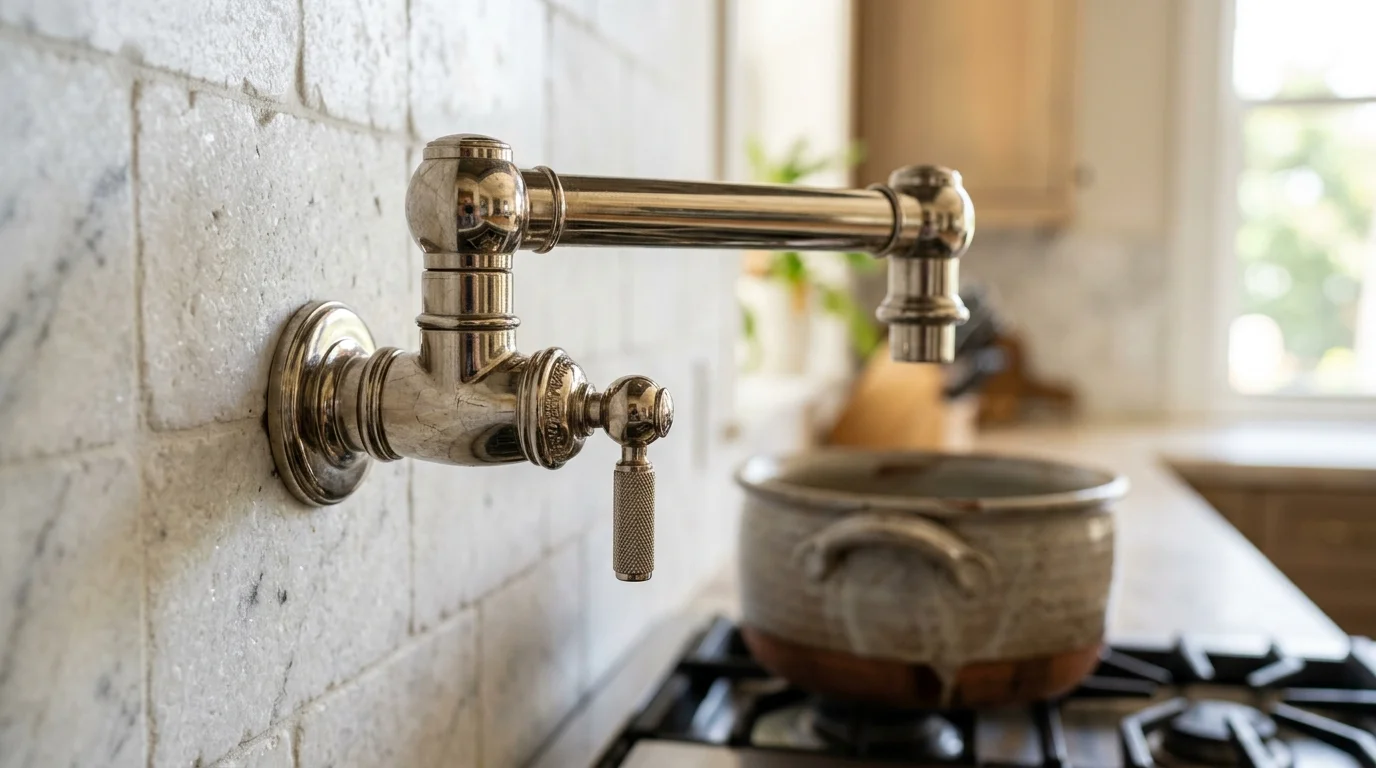
A pot filler is a wall-mounted faucet installed directly above your range or cooktop. It swings out on an articulating arm, usually two joints, so you can position it over a pot, fill it with water, then fold it back flat against the wall when you're done. No carrying a heavy stockpot from the sink to the stove. That's the entire value proposition.
Most pot fillers are cold-water only. That's by design, there's no reason to heat water before it hits a pot that's going straight onto a burner anyway. Some models offer dual-handle setups with a secondary shut-off at the wall and another at the head of the faucet, which is a smart redundancy. If the faucet ever develops a drip, you can shut it off at the wall without hunting down the main supply.
They come in two broad categories: wall-mounted (the standard) and ceiling-mounted. Wall-mounted is almost always the right call. Ceiling-mounted units exist for kitchen islands with cooktops, and they work, but the supply line has to run through the ceiling and the installation cost climbs fast. Stick with wall-mounted unless your cooktop is on an island with no wall behind it.
Finish options have expanded considerably. Matte black, polished chrome, brushed nickel, and unlacquered brass are all common. Brass is having a real moment right now, if you want to see how it plays with cabinetry hardware, our guide on brass cabinet hardware for 2026 shows exactly how that finish reads in South Florida light. The pot filler should match or intentionally contrast your faucet and hardware, don't just pick whatever's on sale.
Placement & Plumbing Requirements
This is where most homeowners get surprised. A pot filler needs a dedicated cold-water supply line run inside the wall, terminating behind the tile or backsplash at the correct height above the cooking surface. The standard rough-in height is 18-24 inches above the cooktop grate. Go too low and the arm won't clear a tall stockpot. Go too high and the reach is awkward. Our crew always measures for the specific pots a homeowner uses before we mark the rough-in location, a 12-quart stockpot sits very differently than a 6-quart Dutch oven.
Here's the key thing to understand about permits and plumbing: the water supply rough-in for a pot filler is plumbing work, which means your general contractor coordinates that portion of the job. If you're adding a pot filler to an existing kitchen where no water line currently exists behind the range wall, your GC will need to run new copper or PEX supply through the wall. Depending on your municipality, Palm Beach County, Boca Raton, Delray Beach, that work may require a plumbing permit, especially if it involves opening walls. Your GC handles that. Our team handles the tile, the cabinetry around it, and the final faucet installation once the rough-in is complete and inspected.
The backsplash situation matters more than people expect. A pot filler sits right in the middle of your backsplash focal wall. If you're doing a full-height backsplash that runs up to the range hood, the escutcheon plate on the faucet needs to land cleanly, ideally centered on a tile or at a grout joint, not splitting a tile awkwardly. We plan this during the design phase. If you're still deciding between backsplash heights, our breakdown of 4-inch vs full-height backsplash is worth reading before you commit.
Wall-mounted pot fillers on exterior walls can be tricky in older South Florida homes where the exterior walls are CMU block. Running a supply line through block isn't impossible, but it adds labor. Interior walls are almost always the easier path. If your range backs up to an exterior wall, tell your GC early, this affects both cost and timeline.
One more thing: always install a dedicated shut-off valve at the wall stub-out, separate from the faucet's own valves. This is non-negotiable. If the faucet leaks at 2am, you want to be able to cut the water supply to that one line without killing water to the whole kitchen.
Pros and Cons
We're going to be straight with you here, because there's a lot of marketing fluff around pot fillers and homeowners deserve an honest take.
The real advantages:
Convenience for serious cooks is genuine. If you make stock regularly, cook pasta for a family of six, or do any kind of large-batch cooking, the ergonomic benefit is real. Carrying a full stockpot from your sink to your range is awkward and can be a safety issue, hot water sloshes, handles strain. The pot filler eliminates that entirely. For homeowners in our 55+ communities in Palm Beach County and Wellington, this is actually one of the more practical kitchen upgrades we recommend, right alongside the features covered in our aging-in-place design guide.
Visual impact is also real. A well-chosen pot filler on a tile backsplash behind a professional-style range looks purposeful and high-end. In a luxury kitchen with a 48-inch range, it reads as a design statement. Buyers notice it. It signals a serious cooking kitchen.
The value question is covered in more depth in our kitchen upgrades that add value in Floridathe short version is that pot fillers don't have a clean ROI number the way countertops or cabinets do, but they contribute to the overall impression of a premium kitchen.
The honest drawbacks:
You still need to carry the pot back to the sink to drain it. This is the one that makes some homeowners feel duped after installation. You fill at the stove. You drain at the sink. If your sink is 15 feet away, you're still walking that heavy pot across the kitchen, just in one direction instead of two. For some people, that's still a win. For others, it feels incomplete.
Cold water only means it's not useful for recipes that need warm water to start. It's also not useful for filling the coffee maker, rinsing vegetables, or anything you'd normally do at the sink. It does exactly one thing. That's fine, but know what you're buying.
Installation cost is a one-time hit, but if you're doing a remodel on a tighter budget, that money might work harder somewhere else. We've had clients who pulled the pot filler from their scope and put it toward better countertop material, a trade-off that made sense for their kitchen.
Maintenance is low but not zero. The articulating joints can develop drips over time. Cartridges need occasional replacement. These are minor issues, but they exist. A touchless faucet at your main sink has similar cartridge maintenance, if you want to compare that style of fixture, our article on touchless kitchen faucet pros and cons covers the territory.
Cost Guide
Here's what pot fillers actually cost in the Palm Beach County market, broken out honestly. The faucet itself is just one piece, the labor and rough-in work drive the total number, especially on a retrofit where no supply line currently exists.
The retrofit number is the one that catches people off guard. If you're adding a pot filler to an existing kitchen with no supply line behind the range wall, you're looking at opening the wall, running pipe, patching drywall, and potentially repatching or retiling the backsplash. That's why we almost always recommend adding a pot filler during a full remodel rather than as a standalone project. When the wall is already open and the backsplash is already being replaced, the incremental cost drops to the faucet itself plus a straightforward rough-in.
For context on how this fits into overall remodel budgets, our kitchen remodel cost guide for Palm Beach County walks through the full picture. A pot filler is a line item, not a budget-breaker on a mid-range or luxury remodel, but potentially harder to justify on a budget refresh.
Brand matters more than most people think at this price point. We've seen sub-$200 pot fillers develop joint drips within two years in South Florida's hard water environment. Spending $350-$600 on a Brizo or Rohl unit buys you significantly better cartridges and a longer warranty. Brizo's pot filler lineup is one we recommend frequently, the articulating mechanism holds up and the finish options are excellent.
South Florida Considerations
A few things about our local market that affect this decision specifically.
Hard water is a real issue across Palm Beach County. Boca Raton, Delray Beach, and much of Wellington run on municipal water with moderately high mineral content. That mineral buildup will affect pot filler aerators, cartridges, and the articulating joints faster than you'd see in a softer-water market. A whole-house water softener or at minimum a point-of-use filter at the rough-in helps. If you're already dealing with hard water effects on your countertops, you know the drill, our guide on the best countertops for Florida kitchens touches on this as it relates to material selection.
The cooking culture here also matters. South Florida kitchens get used for large gatherings, extended family dinners, holiday cooking, entertaining that runs all day. If that describes your household, the pot filler earns its keep faster than it would in a kitchen that sees light daily use. We've installed them in Jupiter homes where the owner makes Cuban black beans in batches for the whole block. That's a use case where the convenience is tangible every single week.
Gas vs. induction is worth considering too. A pot filler makes more intuitive sense over a gas range, the visual connection between professional cooking equipment and a wall-mounted faucet is cohesive. Over an induction cooktop, it still works functionally, but the visual pairing is less natural. Our breakdown of induction vs gas cooktops for Florida homes covers the cooktop decision itself if you're still working through that choice.
HOA and condo considerations come up occasionally. In high-rise condos in Boca Raton or West Palm Beach, plumbing modifications above the slab often require HOA approval and may have restrictions on how and where supply lines can run. Your GC and the building management need to coordinate before any rough-in work begins. For condo-specific remodeling concerns, our condo kitchen remodel HOA guide is a good starting point.
Finally, the style angle. South Florida kitchens trend toward coastal, Mediterranean, and modern tropical aesthetics. A pot filler in matte black works beautifully in a modern or transitional kitchen. Brushed brass reads well in Mediterranean and coastal designs. Polished chrome keeps it clean and timeless. Whatever you choose, it should feel like part of the kitchen's design language, not an afterthought bolted to the wall. Our team always specifies the faucet finish alongside the cabinet hardware and plumbing fixtures so the kitchen reads as a cohesive whole. Per Florida Building Code standards, any new plumbing rough-in in a permitted project must meet current code, your GC will handle that compliance piece so everything is done correctly from the start.