Waterfall Countertop Cost and Ideas: Are They Worth It?
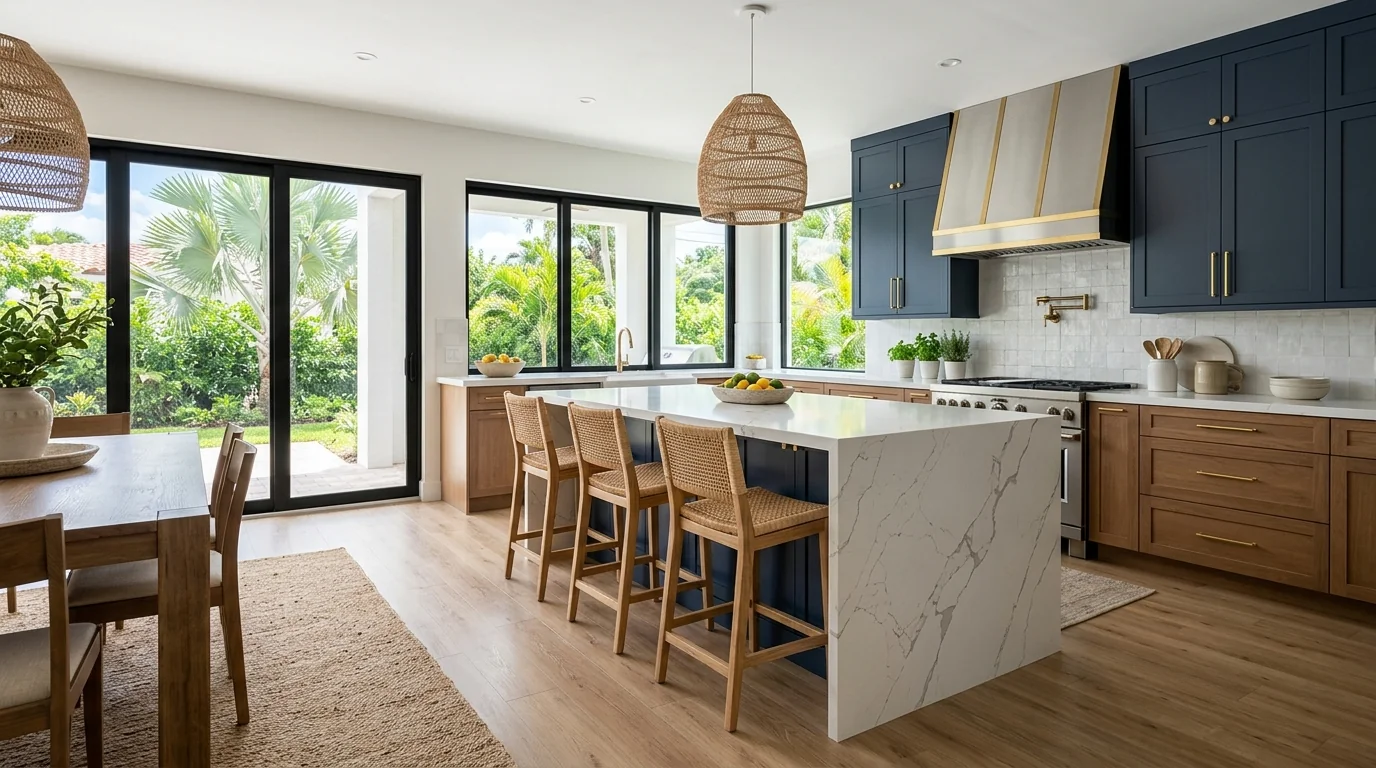
A waterfall countertop is the look you keep seeing on island after island in remodeled Boca Raton and Wellington kitchens, the slab that runs across the top and then turns ninety degrees to pour straight down the side to the floor. It is one of the most requested upgrades our team handles, and it is also one of the most misunderstood when it comes to price. This guide walks through what a waterfall edge really is, which materials hold up best in South Florida, what it costs here, and the honest case for and against doing it.
We've installed waterfall islands in everything from Jupiter waterfront condos to single-family homes in Delray Beach, and the verdict is not the same for every kitchen. Done on the right island with the right slab, it looks custom and lifts the whole room. Done on the wrong one, it is money spent on a side nobody sees. Let's get into where the line is.
What a Waterfall Edge Actually Is
A countertop with a waterfall edge does not just have a thicker lip. The stone wraps the corner and continues vertically down the end of the island or cabinet run, so the surface appears to cascade over the side. Instead of seeing a painted or wood cabinet panel at the end of your island, you see the same stone you see on top, flowing down to the floor.
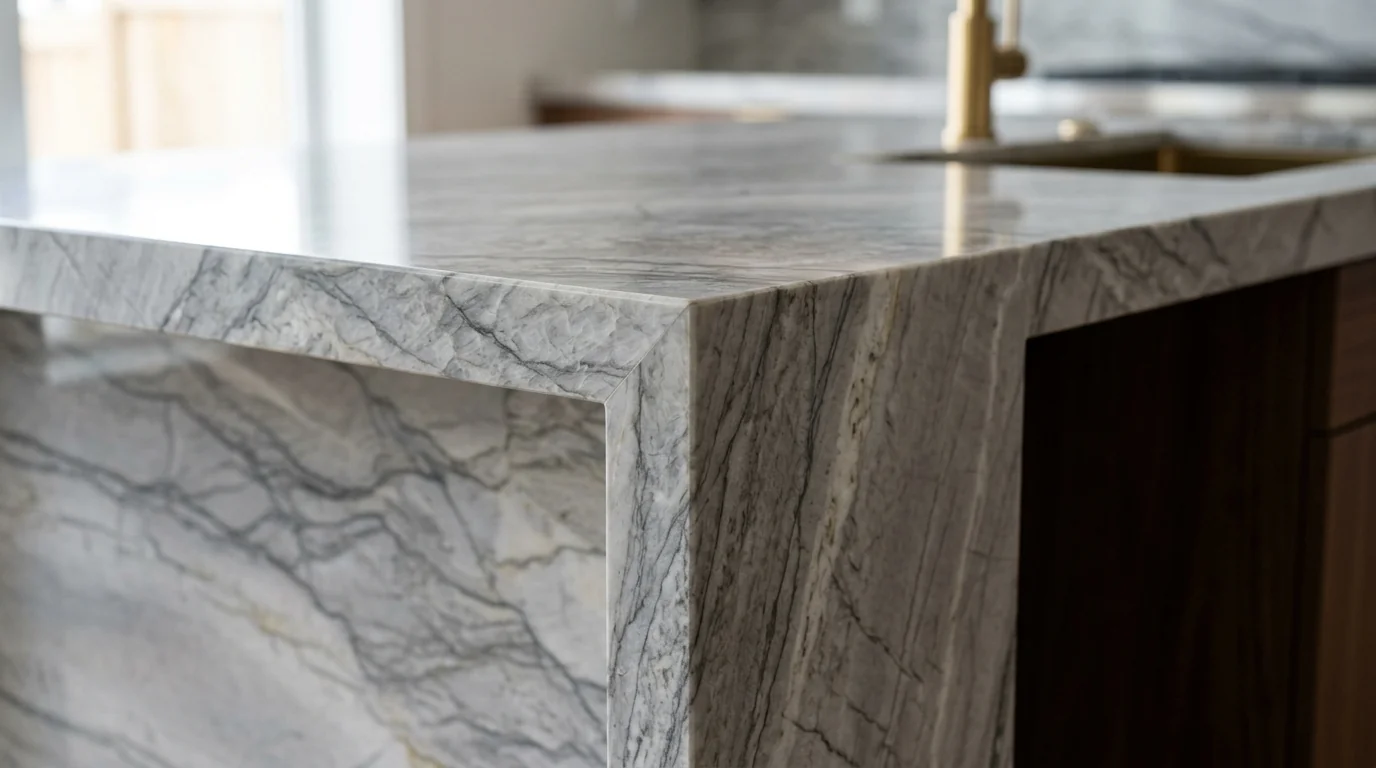
That vertical panel meets the horizontal top at a corner, and how that corner is built is the whole game. The premium method is a mitered seam: both pieces are cut at 45 degrees and joined so the edge reads as one continuous, solid piece of stone with no visible buildup. Cheaper versions use a butt joint, where the vertical panel simply tucks under the lip of the top. A butt joint is faster and uses less material, but the seam shows, and on a natural stone the pattern breaks at the corner instead of flowing.
Waterfall edges show up most on kitchen islands, but our team also runs them on peninsulas, bar tops, and the occasional bathroom vanity. The effect is strongest when the island is open to a living or dining area, because that vertical face becomes a piece of furniture you see from across the room.
Best Materials: Quartz vs Quartzite vs Marble
Material choice drives both the look and the cost of a waterfall, so this is where most decisions get made. The three we recommend most for waterfall kitchen countertops in South Florida are engineered quartz, natural quartzite, and marble. Each behaves differently at that mitered corner.
Quartz is the safe, smart pick for most homeowners. Because it is engineered, the pattern is predictable across the slab, so matching the vertical panel to the top is straightforward and the mitered seam disappears cleanly. It needs no sealing, it ignores the humidity swings we get between the rainy season and winter, and it shrugs off the everyday abuse an island takes. If you want the waterfall look with the least fuss, quartz is where we steer people. Our quartz countertop page covers the brands we stock.
Quartzite is natural stone, harder than granite, with the kind of depth and movement engineered surfaces can only imitate. It is excellent for a waterfall because the veining is real, and a skilled fabricator can make that veining appear to spill over the edge. The tradeoffs: it costs more, it usually wants periodic sealing, and it demands a fabricator who is comfortable cutting and matching a hard, brittle slab. If you love the natural look but want durability, quartzite earns its price. We break down the differences in our guide to quartz vs quartzite countertops.
Marble gives you the most dramatic vein flow of any option. Nothing matches a book-matched marble waterfall where the veining mirrors across the corner. But marble is soft. It scratches, it etches when lemon juice or wine sits on it, and in a working family kitchen it will develop a patina. We install plenty of it for clients who want that European look and accept the aging. If a flawless surface five years out matters more to you, marble is not your waterfall stone. For a side-by-side on all four surfaces, our quartz vs quartzite vs granite vs marble comparison is worth a read.
Granite works too and costs less, but its busier, spotted patterns rarely vein-match as cleanly over an edge, so it is a less common pick for a true waterfall.
Waterfall Countertop Cost in Palm Beach County
Here is the part everyone wants. A waterfall edge is priced as an add-on to your island top, not a separate countertop. You pay for the extra slab the vertical panels eat, plus the mitered seam labor, plus more careful handling and installation. In the Palm Beach County market, a waterfall countertop cost typically lands between $1,500 and $4,500 on top of a standard island, and the material is what moves the number.
Those figures are the waterfall premium on a typical 7 to 9 foot island. The biggest hidden driver is slab yield. A waterfall panel that runs floor to counter is often 36 inches tall, and that stone has to come from the same slab as your top to match. On a large island, vein-matching both the top and two end panels can push you into a second slab, and a second slab can add $800 to $2,500 by itself depending on the material. This is why our team measures and lays out the cut before quoting, not after.
A few adders show up often in our local jobs. Mitered seams cost more than butt joints, usually $150 to $400 per corner. Thick-look waterfalls, where two slabs are laminated to mimic a 4 or 6 centimeter edge, add labor. And if your island sits over a finished floor that has to be protected during a heavy install, that careful handling shows up in the labor line. For the full picture on island pricing, our kitchen remodel cost guide for Palm Beach County puts the waterfall in context with the rest of the budget.
One more local note. Slab availability matters here. We pull from yards in Riviera Beach and the surrounding area, and the dramatic quartzites and marbles move fast. If your heart is set on a specific block-matched slab for the waterfall, reserve it early. Our piece on the best places to buy countertop slabs in Palm Beach County covers where to look.
Design Ideas and Single vs Double Waterfall
The single biggest design decision is one waterfall or two. A single waterfall drops the stone down one end of the island. It works beautifully when the opposite end is occupied by seating overhang, butts against a wall, or faces away from the main sightline. You get the effect where it counts and save on slab.
A double waterfall drops both ends and gives the island a symmetrical, solid-block, furniture-like presence. This is the move for a freestanding island that's open on all sides in an open-concept layout, the kind we build constantly in newer West Palm Beach and Jupiter homes. It costs more, but on the right island it looks like a single carved monolith and it is hard to beat.
Beyond the count, here are the waterfall island ideas that land well with our clients:
- Match the backsplash. Running the same slab up as a full-height backsplash ties the room together and doubles down on a stunning quartzite or marble.
- Go bold on the island, calm on the perimeter. A dramatic veined waterfall island paired with quiet, solid-tone perimeter counters keeps the room from feeling busy.
- Mind the overhang. If you want bar seating, a waterfall end means the seating has to live on the long side, since the dropped end has no knee room. Plan stools before fabrication.
- Light the face. A waterfall panel reads best with good light on it. We often position pendants or under-counter lighting to play up the vertical stone. Our guide to pendant lighting over a kitchen island helps here.
If you are still deciding between an island and a peninsula for your layout, that choice changes whether a waterfall even makes sense, since a peninsula only has one open end. Our peninsula vs island breakdown is the right place to start, and for more on island layouts generally, see our kitchen island ideas.
Pros, Cons, and Whether It's Worth It
Time for the honest part. A waterfall edge is a design feature, not a functional upgrade, so whether it is worth it depends entirely on your kitchen and your priorities.
On the plus side, it protects the cabinet ends. Island ends take a beating from stools, vacuums, and feet, and a stone panel never scuffs or chips the way a painted cabinet side does. It reads as high-end, which matters in listing photos and walkthroughs across our competitive resale market. And it hides the cabinet box entirely, which is a clean look in an open floor plan where that end is on display.
The downsides are real too. It costs more, sometimes a lot more once a second slab enters the picture. It locks you into that layout, since the dropped stone is not something you reposition later. The floor-level corner can be a stubbing point in a tight walkway, so clearances matter. And on soft stone like marble, that vertical face is now exposed to feet and mop buckets.
So is it worth it? Our take: if your island is visible from the living or dining area and you are already buying a nice slab, yes, a waterfall is usually worth it and it is the detail people remember. If your island sits in a closed-off kitchen where almost nobody sees that end, put the money into a better slab grade or your cabinetry instead. We tell clients this in person all the time, because the wrong waterfall is just expensive stone facing a wall.
Fabrication Considerations
A waterfall lives or dies in the fabrication shop, so this is worth understanding before you sign anything. The most important point: the waterfall is planned, not improvised. A good fabricator decides exactly where on the slab each piece comes from so the veining lines up across the mitered corner. That layout has to happen before a single cut is made, and it is the difference between a waterfall that looks carved from one block and one where the pattern jumps at the corner.
Vein-matching is the term for this. On quartzite and marble, the vertical panel is cut from the slab right next to the horizontal top so the veins appear to continue over the edge. On a book-matched approach, the pieces mirror each other across the seam, which can be striking. None of this is possible without extra slab and a fabricator who plans for it, which is part of why natural stone waterfalls cost more.
The mitered seam itself is a craftsmanship checkpoint. A tight, well-polished miter is nearly invisible. A rushed one shows a dark line and sometimes a slight lip you can feel with a fingernail. Ask to see a fabricator's previous waterfall corners in person before committing. The seam at the floor and the seam where the waterfall meets the top are the two spots to inspect.
Support matters as well. That vertical panel and the unsupported overhang where seating sits both need proper substrate and sometimes hidden steel or plywood backing so nothing flexes or cracks over time. In our installs we build the cabinet box and support to carry the stone before it ever arrives. Skipping that step is how waterfalls develop hairline cracks at the corner a year later.
Finally, get the template right. Template day, when the fabricator makes an exact pattern of your island, is when the waterfall geometry gets locked. The panel has to account for the finished floor height, because the stone usually runs to the floor and any flooring change later will leave a gap or force a recut. We coordinate flooring and template timing on every waterfall job for exactly this reason. To see the full range of edge profiles and surfaces we work with, our countertops overview is a good next stop, or reach out for a consultation and our team will lay out the cut with you.