Waterproof Flooring for Kitchens: Best Options for Florida
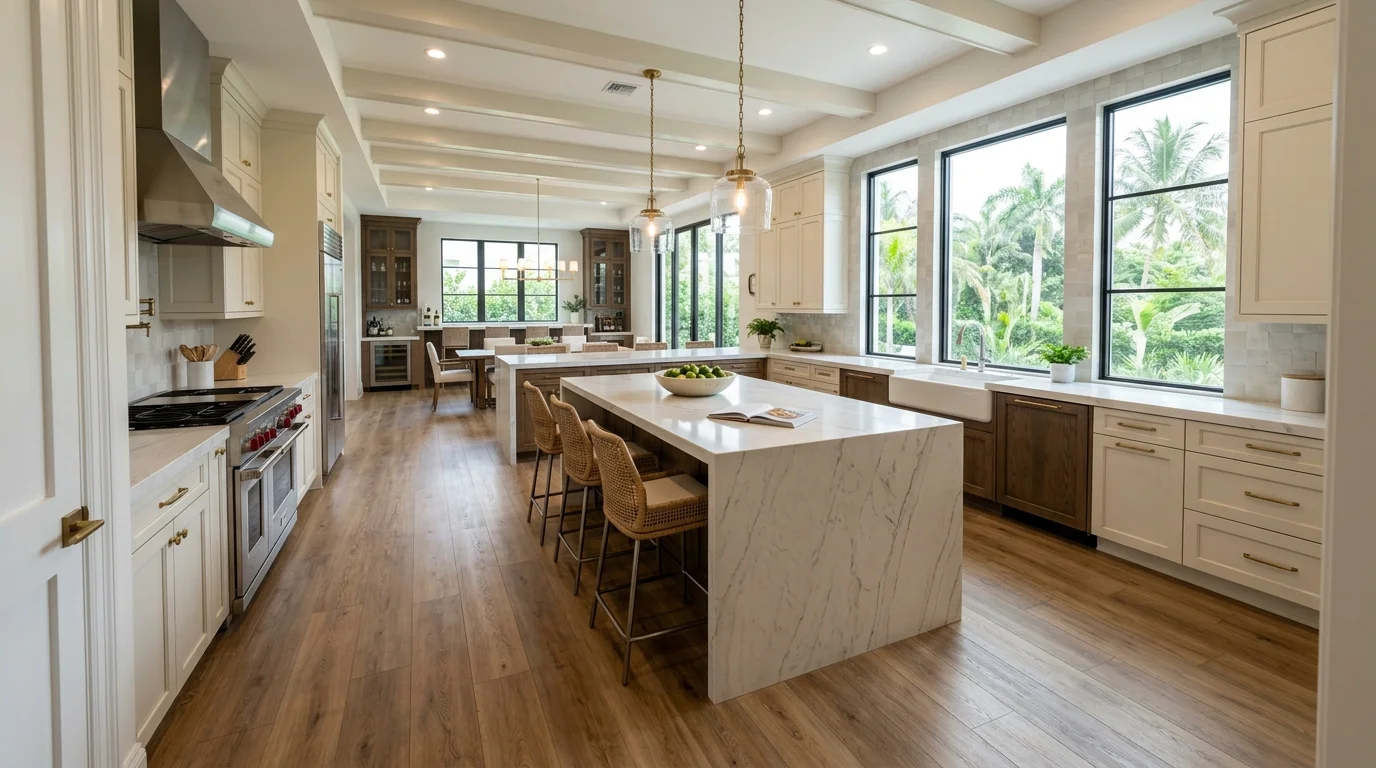
Choosing the right waterproof flooring for your kitchen is one of the most practical decisions you'll make in a South Florida remodel. Between the humidity that never really leaves, the afternoon storms that blow through Boca Raton and Delray Beach, and the occasional appliance leak, your kitchen floor takes a beating that a hardwood or laminate product simply cannot handle long-term. We've installed flooring in hundreds of homes across Palm Beach County, Wellington, and Jupiter, and the difference between a floor specified for this climate and one picked from a national inspiration board is significant. This guide covers the three options we recommend most, real local pricing, and what flood-prone homes need to think about differently.
Why Waterproof Flooring Matters in Florida Kitchens
Florida's average relative humidity sits between 74% and 90% depending on the season. That moisture doesn't just come from rain — it seeps up through slab foundations, rolls in from open doors, and gets trapped under appliances. Standard laminate and engineered hardwood with thin wear layers absorb that moisture over time, swell at the joints, and start lifting within a few years. We've torn out five-year-old floors in Wellington homes that looked like a topographic map.
True waterproof flooring has a 100% impermeable core. Not water-resistant — waterproof. The distinction matters when a refrigerator line fails at 2 a.m. or a dishwasher door gasket gives out. Water-resistant floors buy you time. Waterproof floors survive the event.
Beyond bulk water, there's the issue of grout joints and seams. Any floor with porous grout or poorly sealed seams creates a path for moisture to reach the subfloor. In South Florida, that subfloor is almost always concrete slab, which means you won't get rot — but you will get mold, efflorescence, and tile or plank failure as the adhesive bond breaks down. Specifying the right product and installing it correctly are equally important.
If you want a broader look at how material selection protects your kitchen in this climate, our guide on hurricane-proof kitchen materials for South Florida covers the full picture beyond just flooring.
The Three Best Waterproof Flooring Options
We recommend three products consistently across our Palm Beach County projects: porcelain tile, luxury vinyl plank (LVP), and polished concrete. Each has a clear use case. Here's our honest take on all three.
Porcelain Tile
This is our top recommendation for most Florida kitchen floors. Porcelain has a water absorption rate below 0.5% — essentially zero — and when installed with epoxy or polymer-modified thinset and properly grouted joints, it's about as close to a waterproof surface as you can achieve. It handles the heat of a busy kitchen, it doesn't fade in the sun that pours through those Boca Raton sliding glass doors, and it holds up against dropped cast iron pans.
The one legitimate complaint about porcelain is that it's hard underfoot. If you're on your feet cooking for hours, you'll feel it. A quality anti-fatigue mat solves most of that. The other consideration is grout maintenance: we recommend epoxy grout for kitchen floors. It costs more upfront but it won't stain, doesn't require sealing, and won't crack and harbor mold the way sanded grout can in a humid environment.
Large-format porcelain — 24x24 or 24x48 slabs — is increasingly popular in Palm Beach County kitchens because fewer grout lines means fewer maintenance points and a cleaner look. Our article on kitchen flooring options pros and cons goes deeper on the full range of choices if you want to compare porcelain against other tile types before committing.
For a closer look at how porcelain stacks up against ceramic specifically in our climate, see our breakdown of porcelain vs. ceramic tile for South Florida homes — the logic translates directly to kitchens.
Luxury Vinyl Plank (LVP)
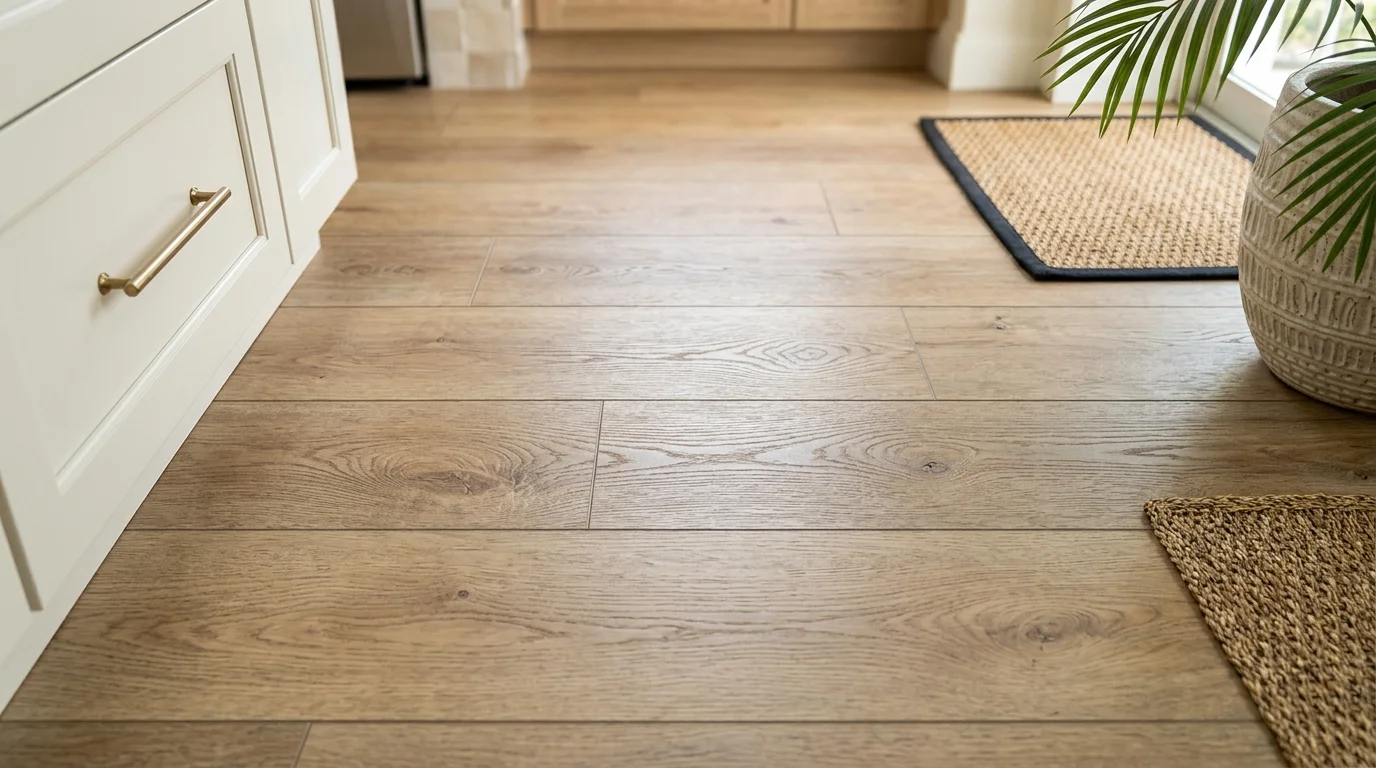
LVP has come a long way. The products available today — particularly 20-mil wear layer, rigid-core SPC (stone plastic composite) planks — are genuinely waterproof, dimensionally stable in the heat, and comfortable underfoot in a way that tile is not. For homeowners who want the warmth of a wood look without the moisture risk, SPC luxury vinyl is the answer.
Not all LVP is equal. We specify rigid-core SPC over WPC (wood plastic composite) for Florida kitchens. WPC cores can still expand and contract more than SPC in extreme heat, and South Florida summers are extreme. Look for products with an attached underlayment and a wear layer of at least 12 mil for residential use — 20 mil if you have kids, dogs, or both. Brands like Shaw Floors and COREtec publish detailed technical specs on their SPC lines that are worth reviewing before you buy.
The one downside: LVP doesn't add the same perceived value as natural tile or stone when it comes time to sell. In the Jupiter and Palm Beach Gardens luxury market, buyers expect hard tile or stone in kitchens. In Delray Beach condos or more budget-conscious Wellington neighborhoods, LVP is perfectly appropriate and performs beautifully. We match the product to the home's price point and the homeowner's goals.
We cover LVP in detail in our guide to luxury vinyl plank for South Florida bathrooms — everything there about moisture performance applies equally to kitchens.
Polished Concrete
Polished concrete is the most misunderstood option on this list. People assume it's industrial or cold-looking. Done well, it can be warm, sophisticated, and completely at home in a coastal Florida kitchen. It's also the only option here that's a single monolithic surface with zero seams and zero grout joints.
The catch: it must be sealed properly and re-sealed on a schedule. Concrete itself is porous. A penetrating sealer plus a topical epoxy or polyurea coating makes it waterproof, but if that coating wears through and isn't maintained, you're back to a porous surface. In a busy kitchen, plan on re-coating every 5–7 years depending on traffic and products used for cleaning.
Polished concrete also requires a GC experienced with the process. If your slab has significant cracking or patching, that will telegraph through the finish — something to assess before committing. It's a great choice for new construction and whole-home renovation projects where the slab condition is known and controlled.
Flood-Prone Homes: What Changes
Parts of Palm Beach County — particularly low-lying areas in West Palm Beach, certain sections of Delray Beach near the intracoastal, and older neighborhoods in Lake Worth — sit in FEMA-designated flood zones. If your home has flooded before, or if you're in an AE or VE flood zone, standard flooring decisions need a second look.
The first thing to understand is that no floor material survives prolonged submersion without some level of remediation. The goal in flood-prone homes isn't to find a floor that will survive a flood intact — it's to find a floor that can be dried out, cleaned, and reinstalled or replaced at the lowest possible cost.
That changes our recommendation. In flood-prone kitchens, we lean toward large-format porcelain tile with epoxy grout. Here's why: after a flood event, tile can be cleaned, disinfected, and if undamaged, re-grouted. The tile itself doesn't absorb water. LVP, even waterproof SPC, can pop up at the joints under flood conditions and may need full replacement — though it usually fares far better than laminate or hardwood. Polished concrete with a proper epoxy coating can also perform well after flooding if the coating is intact, but coating failures are harder to assess and repair post-event.
For flood-zone homes, we also recommend avoiding any floor installation that includes a floating underlayment that traps water. Tile set directly in thinset on slab is the most flood-resilient approach. Keep your grout joints tight, use epoxy grout, and make sure any transition strips are metal, not wood-based.
The FEMA Flood Map Service Center lets you check your specific address's flood zone designation — worth doing before you spec flooring if you're not sure of your zone.
One more thing flood-prone homeowners should consider: elevation. If your finished floor elevation is at or near base flood elevation, your GC should weigh in on whether any floor height modifications make sense during a remodel. That's outside our scope — we handle the design and installation of the flooring surface — but it's a conversation worth having before work begins.
Cost Guide
Here are real Palm Beach County cost ranges for waterproof kitchen flooring, including materials and installation labor. These are current 2025 figures. Costs vary based on kitchen size, floor prep requirements (which add cost on older slabs), and material grade.
Floor prep is the line item that surprises most homeowners. Older Palm Beach County homes — especially those built in the 1970s and 1980s — often have slabs with low spots, adhesive residue from previous flooring, or hairline cracks that need to be addressed before any new floor goes down. Skipping prep to save money creates callbacks and failed installations. We always assess the slab condition before quoting a final number.
If flooring is part of a broader kitchen project, it's worth understanding how it fits into the overall budget. Our kitchen remodel cost guide for Palm Beach County breaks down where flooring typically lands relative to cabinets, countertops, and other line items.
South Florida Considerations
A few things about our market and climate that don't show up in national flooring guides.
Heat matters more than people expect. Floors in South Florida homes with lots of west-facing glass can reach surface temperatures of 90°F or higher on summer afternoons. LVP products with lower heat tolerances — typically anything rated below 140°F — can soften, gap, or cup. Always check the manufacturer's temperature rating before specifying LVP in a kitchen with significant direct sun exposure. SPC products with higher temperature ratings handle this far better than WPC.
Slab-on-grade construction is nearly universal in Palm Beach County. That's actually good news for waterproof flooring — you don't have a wood subfloor that can rot or move. But slabs do have moisture vapor emissions, particularly in older homes without vapor barriers. A simple calcium chloride test before installation tells you what you're dealing with. High vapor emissions require a moisture-mitigating primer before tile setting or LVP installation. Skipping this step is one of the most common reasons floors fail prematurely in South Florida.
HOA and condo rules matter in this market. If you're in a high-rise or gated community in Boca Raton or Delray Beach, your HOA may have restrictions on hard flooring that require specific underlayment for sound transmission — or may prohibit certain flooring types on upper floors entirely. Confirm before you buy materials. Our guide to condo kitchen remodels and HOA rules in Palm Beach County covers this in detail.
Permit requirements depend on scope. Replacing like-for-like flooring on a slab — swapping old tile for new tile, or installing LVP over an existing clean slab — does not require a permit in most Palm Beach County jurisdictions. Permits are required when the project involves moving plumbing, altering electrical, running new gas lines, or opening walls. If your kitchen remodel involves any of those elements, your general contractor handles permitting through the appropriate municipality. We focus on design and installation of the surfaces.
Finally, think about transition zones. Florida kitchens often connect directly to outdoor lanais, screened porches, or pool decks. That transition point is a moisture vulnerability. We recommend the same tile species run from inside to the transition threshold, with a proper waterproof membrane behind the threshold. Don't let a cheap transition strip be the weak point in an otherwise well-spec'd floor.
If you're also rethinking your countertops while updating the floor, our guide on the best countertop materials for Florida's humidity and heat pairs well with this one — the same climate logic applies.
And if you're weighing the full scope of what your kitchen project should include before pulling the trigger, the 30 percent rule in remodeling is a useful framework for making sure your flooring spend makes sense relative to your home's overall value.