Countertop Edge Profiles: Complete Guide for Homeowners
Countertop edge types don't get nearly enough attention during a kitchen remodel. Most homeowners spend weeks picking the slab material, quartz, quartzite, granite, and then spend about thirty seconds on the edge profile. That's backwards. The edge you choose affects how your countertops look, how safe they are for your household, how easy they are to keep clean, and how much you pay per linear foot. At South Florida Kitchen & Bath Design, we work on countertop projects across Palm Beach County, Boca Raton, Delray Beach, Wellington, Jupiter, and edge selection is one of the first conversations we have with clients. Here's everything you need to know before you make that call.
Why Edge Profiles Matter More Than You Think
The edge profile is the finished shape cut into the exposed front face of your countertop slab. It's not decorative trim added after the fact, it's carved directly into the stone or engineered material. That distinction matters because more complex profiles require more labor, more passes on a CNC machine or by hand, and sometimes thicker material to execute properly.
Beyond cost, the edge affects proportion. A thick 3-cm slab with a pencil edge looks completely different from the same slab with a stacked mitered edge. One reads light and minimal. The other reads like a piece of furniture. Neither is wrong, but they send very different signals about the design direction of your kitchen.
Safety is a real factor too. Households with young children or older adults benefit from softer, rounded profiles that don't have a hard corner to catch a hip on. If you're thinking about aging-in-place bathroom design, the same rounded-edge logic applies to your vanity tops.
Maintenance is another consideration nobody mentions until it's too late. Profiles with deep coves or multiple ridges, like an ogee, collect crumbs and soap residue in ways that a flat eased edge never will. If you hate cleaning countertops, that's a legitimate reason to skip the ornate profile.
Finally, edge profiles have to work with the rest of your design. Your cabinet door style, your backsplash, your hardware finish, they all interact. An intricate ogee edge on flat-front European cabinets is a clash. A clean eased edge on a traditional raised-panel kitchen can feel unfinished. We'll get into the pairings that actually work.
Every Countertop Edge Type Explained
Here's a plain-language breakdown of the profiles we install most often across Palm Beach County homes, from the simplest to the most involved.
Eased EdgeThis is a 90-degree square edge with just the top corner slightly softened so it won't chip as easily. It's the default for modern, contemporary, and Japandi-style kitchens. Clean, low-cost, and easy to wipe down. On a thick slab it looks intentional and architectural. On a thin slab it can look unfinished. We recommend it for any kitchen going for a minimal aesthetic.
Pencil Edge (Slightly Rounded)A small radius is applied to the top corner only. More forgiving than a pure eased edge, slightly warmer in feel. Still firmly in the modern camp. Great for busy households where people are constantly brushing against the countertop edge.
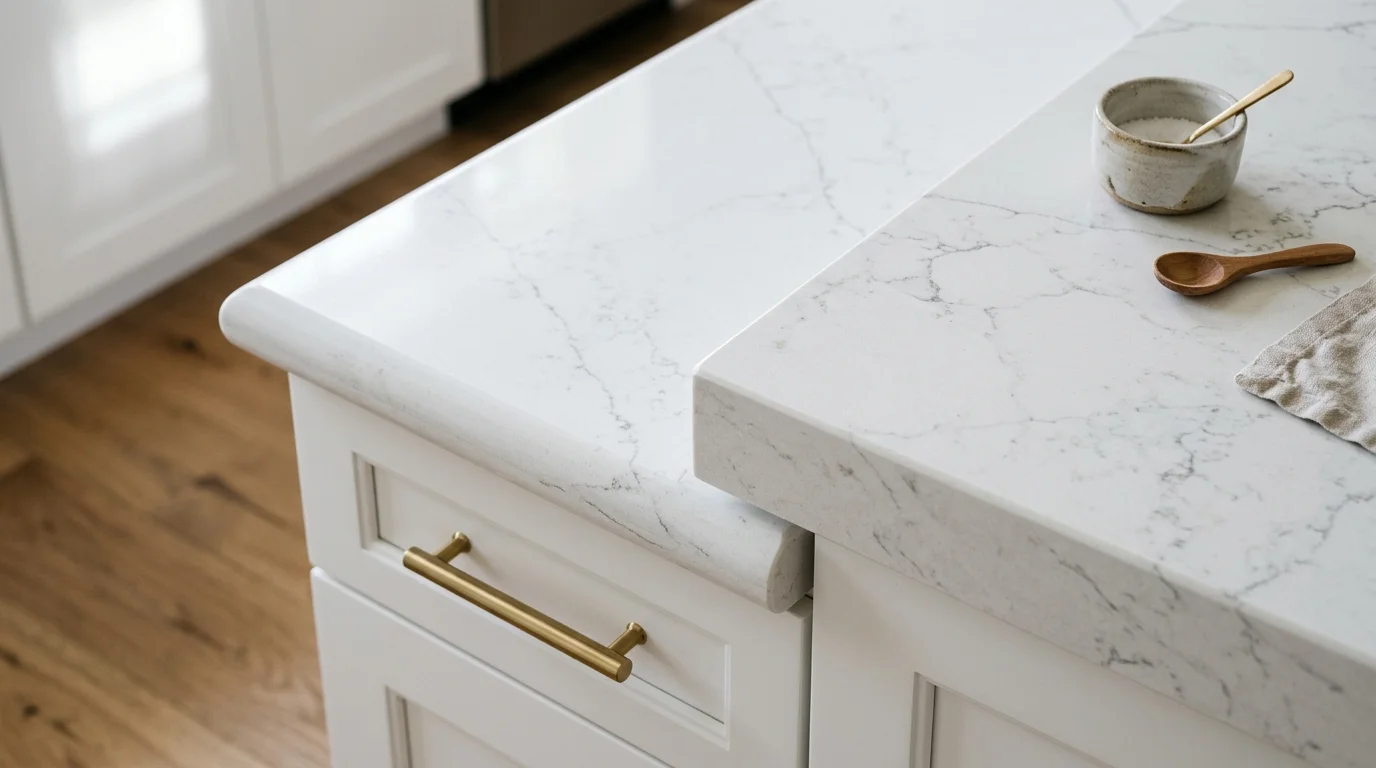
BullnoseThe full top edge is rounded into a half-circle. Both the top and bottom corners curve. This was the standard profile for about two decades in Florida kitchens, you've seen it in almost every 1990s and early-2000s home in Boca Raton and Delray Beach. It's making a comeback in softer, organic design directions, but it still reads as more traditional. Full bullnose is the most chip-resistant profile you can choose, which makes it genuinely practical for busy kitchens. Half-bullnose (only the top is rounded, flat underneath) splits the difference between modern and traditional.
Beveled EdgeA flat angled cut is taken off the top corner at 45 degrees, creating a narrow diagonal face. The result is a crisper, more tailored look than a bullnose with more visual interest than a plain eased edge. Works well with both transitional and contemporary cabinet styles. Not great for stone with strong veining because the bevel interrupts the pattern.
Ogee EdgeThis is the most ornate standard profile. It combines an S-curve with a small cove at the bottom, creating a profile that looks almost like classical architectural molding. It belongs in traditional and Mediterranean kitchens, think raised-panel cabinets, tumbled stone backsplashes, warm wood tones. If your kitchen leans toward a Mediterranean kitchen design, an ogee edge is a natural fit. Keep in mind the grooves trap grease and crumbs, so it requires more attentive cleaning than simpler profiles.
Dupont EdgeA step up from a simple bevel, the Dupont combines a straight face with a pronounced rounded lip at the top and a small cove cut underneath. It's a transitional profile, more decorative than eased, less dramatic than ogee. Popular in Palm Beach County homes that blend traditional cabinet styles with cleaner stone choices like white quartz.
Chiseled or Leathered EdgeThese are texture-forward options where the edge is either hand-chiseled (creating an irregular, rough-hewn look) or given a leathered finish to match a leathered countertop surface. Both work best on natural stone like granite or quartzite. They're niche, but in the right rustic or organic-modern kitchen they look incredible. Labor-intensive to execute well.
Triple Pencil / Triple RadiusThree small routed channels run along the face of the edge, adding subtle visual detail without going full ogee. It's a traditional profile that's less fussy than ogee and pairs well with Shaker cabinets. Some clients choose it when they want a little more than plain but aren't ready to commit to something ornate.
The edge you pick should reinforce your cabinet choice, not fight it. If you're still deciding on cabinets, our breakdown of kitchen cabinet styles for South Florida walks through which door styles pair with which design directions, and that directly informs which edge profile makes sense.
Waterfall and Mitered Edges: The Statement Options
These two profiles deserve their own section because they're in a different category from standard edge work. Both are design statements, both cost significantly more, and both require specific conditions to look right.
Mitered Edge (Thick-Edge Illusion)A mitered edge involves cutting two pieces of stone at 45-degree angles and bonding them together at the front face of the countertop. The result looks like a slab that's 4-6 inches thick even though the material itself is standard 3-cm. It's one of the most popular upgrades we do on kitchen islands right now across Wellington and Jupiter. It adds serious visual weight and makes the island feel like a piece of custom furniture. The joint must be executed with precision, a sloppy miter line shows badly on stone with strong veining. Matching the veining across the miter takes skill and sometimes requires the fabricator to book-match slabs.
Waterfall EdgeA waterfall takes the countertop material and runs it vertically down the side of an island or cabinet end panel, creating a continuous flow of stone from the horizontal surface to the floor. It's the most dramatic countertop edge treatment available. Done right, it looks extraordinary. Done wrong, wrong material, wrong kitchen proportions, wrong cabinet style, it can overwhelm a space. We've written a full piece on waterfall countertop cost and ideas if you want to go deep on this option. Short version: it's worth it in the right kitchen, but it requires more stone and more fabrication time, so budget accordingly.
Both mitered and waterfall edges demand materials with consistent patterning or dramatic veining that photographs well. Busy, small-scale granite patterns don't show the effect the way a clean quartz or a statement quartzite slab does. If you're considering a Taj Mahal quartzite kitchen, the waterfall treatment is almost made for that stone, the soft white-gold movement reads beautifully flowing vertically.
One practical note on waterfall edges: they require precise subfloor and base cabinet alignment. Any unevenness at the floor shows. Your general contractor needs to account for this during cabinet installation. It's also worth confirming with your GC whether the specific scope triggers a permit requirement, that depends on whether walls are being opened or plumbing is being moved, not on the edge profile itself.
Cost Guide
Edge profile pricing in Palm Beach County is quoted per linear foot and added to your base fabrication and installation cost. Here's what to expect from fabricators in our market. These ranges reflect the full edge treatment, not the countertop material cost itself. For full countertop material pricing, see our guides on quartz countertop costs in Palm Beach County and granite countertop costs.
Keep in mind: the linear footage of exposed edge in a typical Palm Beach County kitchen runs roughly 15-30 linear feet once you account for the perimeter and any island. A 20-linear-foot run at a $25 ogee upcharge adds $500 to your project. A waterfall panel is priced differently, it's typically quoted as a flat add-on per panel, not per linear foot, because of the bookmatching and additional material involved.
According to the National Kitchen & Bath Association, countertop selection and detailing consistently ranks among the top five value-drivers in kitchen remodels, which is why getting the edge profile right matters as much as the material choice itself.
These numbers represent what homeowners in our Palm Beach County market actually pay, not national averages that tend to run low. If you're working through the broader budget picture for your kitchen, our kitchen remodel cost guide for Palm Beach County breaks down every line item in detail.
South Florida Considerations
Palm Beach County kitchens have a few specific conditions that influence which edge profiles hold up best over time.
Humidity is the first factor. South Florida's climate, even with air conditioning running constantly, means countertops expand and contract with temperature swings, especially when the kitchen runs hot during cooking. This isn't a reason to avoid any particular edge profile, but it's a reason to use a quality stone sealer on natural stone materials. The edge face is an exposed surface that can absorb moisture just like the top. Our granite countertop sealer guide covers how often to seal and what products actually work in Florida conditions.
Outdoor kitchens are big in this market, and edge profile selection matters more when stone is exposed to direct sun, salt air, and rain. Delray Beach and Jupiter homes with covered lanais frequently extend their indoor countertop material to the outdoor kitchen. For those applications, avoid deep cove profiles like ogee, water pools in the grooves and accelerates deterioration. A clean eased or pencil edge is far more durable outdoors. Check our guide on outdoor kitchen countertops for material recommendations that pair with the right edge choices.
HOA and condo considerations matter here too. Many gated communities in Wellington, Boca Raton, and Palm Beach Gardens have architectural review boards that require design drawings before approval. Edge profiles are typically not flagged by ARBs, but if your countertop project involves moving the sink location or any structural change, permits may be required and your general contractor submits those to the relevant municipality, not your kitchen designer. Our team supplies design drawings and material samples for the package; the GC takes it from there.
The thickness of your slab also interacts with the edge in ways that are more visible in South Florida's bright natural light. Our kitchens get a lot of sun, and that lateral light rakes across the countertop edge and shows every detail, including fabrication imperfections. This is why we're selective about which fabricators we work with. A sloppy miter or an uneven ogee groove shows up immediately in Florida light in ways it might not in a darker northern kitchen. It's worth asking to see finished samples before committing to a complex profile.
Finally, if you're renovating a condo in a high-rise along the coast, weight matters. Some buildings have restrictions on stone weight, particularly for upper floors. Waterfall panels add significant material. Your structural question should go to your building management and GC, but it's something to flag early in the design process so it doesn't derail a decision you've already committed to.
If you're still in the material-selection phase and haven't landed on stone yet, our guide to the best countertop materials for Florida's humidity and heat gives you a clear starting point, and once you know your material, the right edge profile becomes a much easier call.