Aging in Place Bathroom Design for South Florida Seniors
Aging in place bathroom design is one of the most meaningful remodeling categories we work in at South Florida Kitchen & Bath Design. Families across Palm Beach County, from Wellington retirement communities to Boca Raton condos to Jupiter single-family homes, are making the same smart decision: redesign the bathroom now, while it's a renovation project, not an emergency. The cost of proactive planning is a fraction of what reactive renovation costs after a fall or mobility change. And in a market where 55+ communities are everywhere from Delray Beach to Lake Worth, demand for accessible, beautiful bathrooms is only growing.
Why This Matters More Than Most Remodels
The bathroom is statistically the most dangerous room in any home for seniors. The CDC reports that over 235,000 people visit emergency rooms annually due to bathroom-related injuries, with the majority being adults over 65. Wet tile, high tub thresholds, and a lack of support surfaces are the main culprits.
What makes aging in place bathroom design different from a standard remodel isn't that it looks clinical or institutional. Done right, it looks better than the original bathroom. The goal is to anticipate changing mobility needs without sacrificing style, and without turning your home into a hospital wing. Our crew works with homeowners in their 50s, 60s, and 70s who want a bathroom that works for the next 20 years, not just the next 2.
The timing matters too. Designing for accessibility during a full remodel is always cheaper than retrofitting later. Blocking for grab bars when the walls are already open costs almost nothing extra. Coming back after the fact to cut tile, open walls, and re-waterproof? That's a full project.
If you're already planning a bathroom remodel and wondering how to scope it properly, our guide on bathroom remodel costs in Palm Beach County gives you a realistic baseline for what different scopes actually run in this market.
The Features That Actually Make a Difference
Let's get specific. These are the elements our team prioritizes in every aging in place bathroom design project, ranked by impact.
Zero-Entry (Curbless) Showers
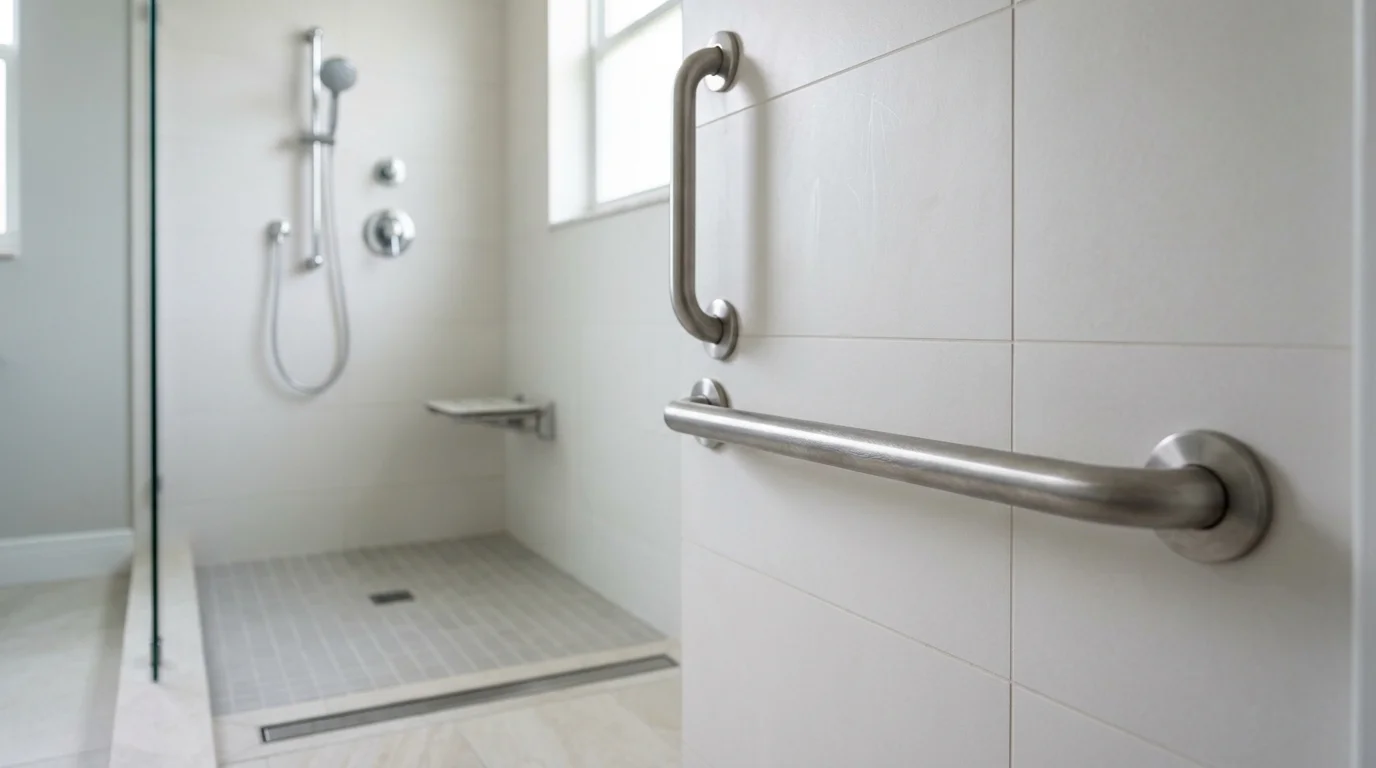
This is the single most impactful change you can make. A curbless shower eliminates the step-over threshold that causes falls. It also accommodates a shower chair or wheelchair without modification. The floor slopes gently toward a linear drain, and when tiled correctly, it looks intentional and modern, not medical. We frequently pair curbless showers with frameless glass enclosures so the space reads as open and spa-like. For design ideas that work well with this format, look at our walk-in shower design ideas for South Florida bathrooms.
Grab Bars
We recommend grab bars at the toilet (both sides when possible), inside the shower on the control wall and the back wall, and at the shower entry. The old chrome-pipe-on-white-tile look is gone. Today's grab bars from manufacturers like Moen's Home Care line or Delta's Assist Series come in brushed nickel, matte black, and champagne bronze, they integrate with your fixture choices so the bathroom feels cohesive. The key is proper blocking. Grab bars need to be anchored into studs or into backer board rated for the load. We block the walls during rough-in so bars can go exactly where they're needed now or in the future.
Comfort Height Toilets
Standard toilets sit at 15 inches. Comfort height (also called ADA height) sits at 17-19 inches, roughly chair height. For anyone with knee or hip issues, this difference is significant. It reduces the effort required to sit and stand, which matters multiple times a day. We recommend pairing a comfort height toilet with a wall-mounted grab bar on the dominant hand side and a freestanding or wall-mounted support rail on the other. Most comfort height toilets cost $200-$600 at the fixture level; your plumber handles the swap.
Handheld Showerheads on Adjustable Slide Bars
A fixed showerhead at 72 inches works fine when you're standing. It doesn't work when you're seated. An adjustable slide bar lets the showerhead sit at the right height for seated bathing and lets a standing user raise it back up. We specify slide bars with a minimum 24-inch adjustment range. Pair this with a pressure-balancing valve so there are no sudden temperature spikes, that's a burn risk, especially for seniors with reduced sensation.
Wider Doorways
Standard bathroom doors are 24-28 inches wide. ADA recommends 32-36 inches clear for wheelchair or walker access. If mobility aids are a current or future possibility, widening the doorway to 32-36 inches during the remodel is the time to do it. This typically involves your general contractor for the framing work; our team handles the finish carpentry and any tile work up to the new threshold.
Vanity Height and Knee Clearance
Standard vanity height is 32-34 inches. Comfort height runs 36 inches, better for standing users. For wheelchair access, the vanity needs to be lower (around 29-30 inches) with open knee clearance underneath. We've designed floating vanities with knee clearance for clients who need that now, and comfort height vanities for clients who are planning ahead. Both can look exceptional, it's a design decision, not a compromise. For sizing guidance, our bathroom vanity sizes and dimensions guide covers the measurements in detail.
Adequate Lighting
Aging eyes need more light. Seniors typically need two to three times more illumination than younger adults for the same visual task. We design layered lighting for aging in place bathrooms: recessed overhead fixtures for general light, a backlit mirror or vanity sconces for task lighting at face height, and a night light circuit or LED toe-kick lighting for safe navigation at night without blinding overhead light. Our bathroom lighting ideas for Palm Beach County remodels goes deeper on layering strategies.
Flooring and Tile: The Non-Negotiable
Slippery tile is the fastest way to undo every other safety improvement in an aging in place bathroom design. Florida homeowners love large-format tile, and we get it, it looks stunning. But in a wet bathroom, especially in a zero-entry shower, slip resistance isn't optional.
The standard to know is the DCOF (Dynamic Coefficient of Friction) rating. The Tile Council of North America recommends a wet DCOF of 0.42 or higher for floor tile in wet areas. We always specify tile at or above that threshold for shower floors and bathroom floors in aging in place projects.
Our recommendations by area:
- Shower floor: 2x2 or 3x3 mosaic tile. More grout lines mean more grip. Porcelain with a matte or textured finish. We steer clients away from polished or glazed finishes on shower floors, period.
- Bathroom floor: 12x24 or 18x18 matte or honed porcelain, or wood-look porcelain with a textured surface. Luxury vinyl plank is an excellent option here, it has inherent texture, is softer underfoot, and is genuinely waterproof, which matters in South Florida humidity.
- Shower walls: Larger format tile is fine here since the walls aren't a slip hazard. This is where you can go bold with pattern or color if you want visual interest.
For a broader look at what works in South Florida bathrooms specifically, our guide on bathroom floor tile ideas for Palm Beach County homes covers material options, sizing, and grout considerations. And if you want to compare porcelain to ceramic specifically for wet areas, our porcelain vs. ceramic tile comparison for South Florida bathrooms breaks down the durability and moisture resistance differences.
One thing we're firm about: waterproofing. A zero-entry shower with no curb means water management depends entirely on the slope of the floor and the integrity of the waterproofing membrane. If the membrane fails, you have a moisture problem inside the walls, and in South Florida, that becomes mold within weeks. Our crew does not cut corners on waterproofing. Every curbless shower we build gets a full schluter or sheet membrane system. Our bathroom waterproofing guide for Florida homes explains why this matters so much in our climate.
Cost Guide: Aging in Place Bathroom Design in Palm Beach County
Costs vary significantly based on scope. A grab bar and comfort height toilet swap is not the same project as a full zero-entry shower conversion with new flooring, lighting, and a floating vanity. Here's how we break it down for clients across Boca Raton, Delray Beach, Wellington, and Jupiter:
A few notes on these numbers: the tub-to-shower conversion range is wide because the framing situation in older homes varies a lot. Some tub surrounds in 1980s and 1990s homes, common in Boca Raton and Delray Beach neighborhoods, have moisture damage behind the original tile that needs remediation before new work starts. That's a cost that shows up during demolition, not before. We always flag this risk upfront so clients aren't surprised. For a broader look at where unexpected costs hide, our article on hidden costs in bathroom remodels is worth reading before you finalize your budget.
South Florida Considerations for Aging in Place Bathrooms
Aging in place bathroom design in South Florida has wrinkles you won't find in national guides. Here's what's specific to our market:
HOA and 55+ Community Rules
Many 55+ communities in Palm Beach County, Century Village, Kings Point, Wynmoor, Pelican Landing in Jupiter, have architectural review processes. Exterior modifications usually require approval, but interior bathroom remodels generally don't, as long as you're not changing the footprint. That said, some condo associations have specific requirements about wet area waterproofing, drain placement, and noise mitigation (impact on the unit below). Always check with your HOA before demolition starts. Our team works regularly in gated and 55+ communities throughout the county and knows what questions to ask. We've written separately about remodeling in 55+ communities in Palm Beach if that applies to you.
When Permits Are Required
Permits for bathroom remodels in Palm Beach County are scope-dependent. A grab bar installation, a toilet swap, new tile over existing substrate, and a vanity replacement typically don't require permits. When permits do come into play: relocating plumbing (moving the drain for a new shower position), changing electrical service or adding circuits, or structural changes like widening a doorway through a load-bearing wall. Your general contractor handles permit pulling and coordinates with the building department for those scopes, that's not our lane. We supply the design drawings and material specs; your GC manages the permit process.
Humidity and Mold Risk
South Florida's humidity means bathroom moisture management is more critical here than almost anywhere in the country. Curbless showers require perfect slope and a reliable waterproofing system, there's no margin for error. We use continuous sheet membranes or liquid-applied systems on every zero-entry shower build. We also recommend exhaust fans rated for the room volume at a minimum of 1 CFM per square foot, and we size up when the bathroom is in a high-humidity corridor of the home. An exhaust fan that runs on a timer (not just a manual switch) is a simple upgrade that dramatically reduces long-term moisture buildup.
Flooring Choices in South Florida's Climate
Luxury vinyl plank is genuinely one of our top recommendations for aging in place bathroom floors in this climate. It's 100% waterproof, softer underfoot than porcelain (which matters for fall impact), inherently textured, and dimensionally stable in high humidity. Porcelain is our second choice, specifically matte or honed finish, never polished. We avoid natural stone in wet bathroom floors for aging in place projects because it requires sealing and can be slippery when wet if not properly specified.
Resale Value
This comes up often in our consultations with clients in Boca Raton and Delray Beach who are thinking about both personal use and eventual resale. The reality: an accessible, well-designed bathroom does not hurt resale value in South Florida's market. In communities where a significant percentage of buyers are 55+, it actively helps. A zero-entry shower with frameless glass reads as a luxury spa feature to most buyers, they may not even register it as an accessibility feature. Grab bars in brushed nickel or matte black look like intentional design choices. Done right, aging in place bathroom design is just good bathroom design.