Custom Kitchen Cabinets Cost in Palm Beach County
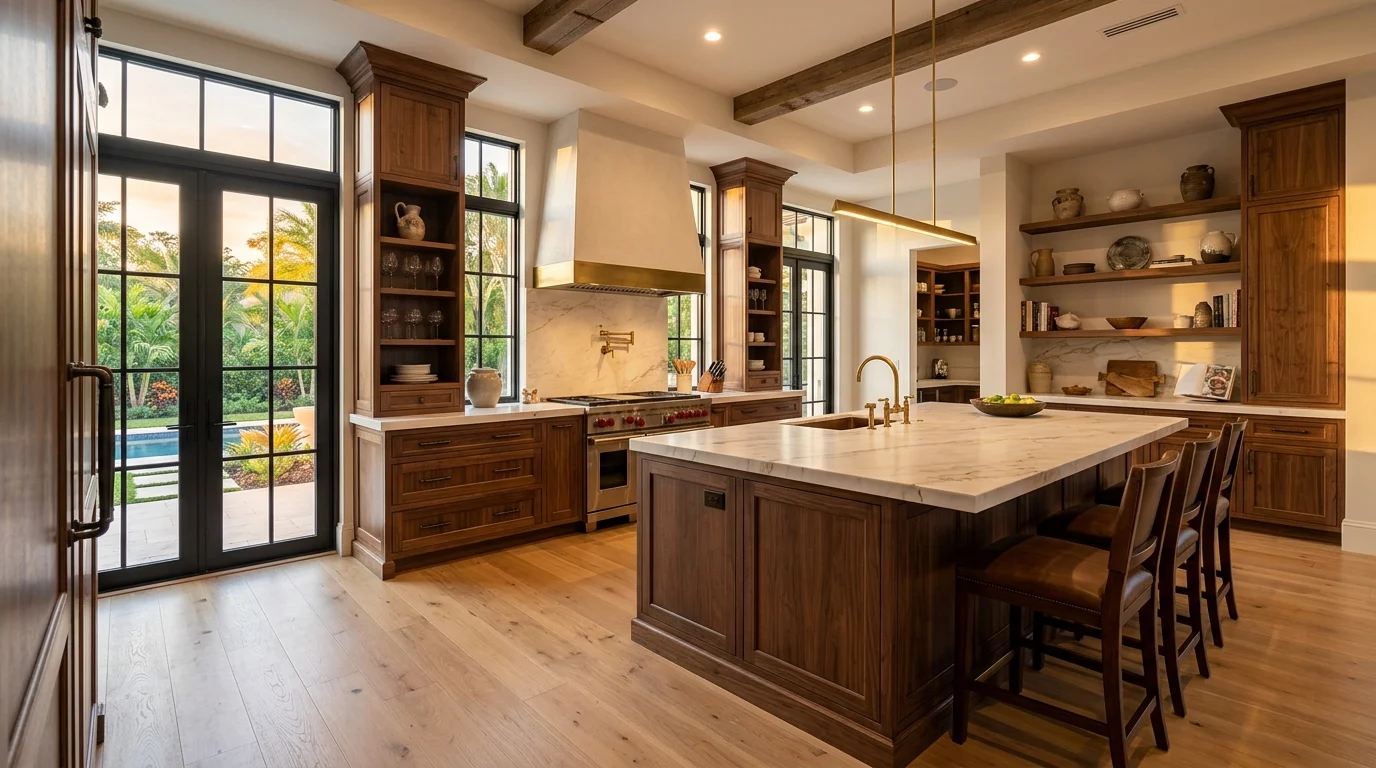
Understanding custom kitchen cabinets cost in Palm Beach County means getting past the vague national numbers you see online. We work with homeowners across Boca Raton, Delray Beach, Wellington, Jupiter, and West Palm Beach every week, and the pricing here reflects our market, higher labor costs than the national average, strong demand for quality materials, and kitchens that genuinely get used hard in the Florida climate. Across all the projects we see, custom cabinetry runs from roughly $500 to $1,500+ per linear foot installed, depending on wood species, finish type, door style, interior hardware, and the overall complexity of the run. That range is wide for a reason. A painted MDF shaker door with soft-close hinges is a very different product than a hand-finished solid maple cabinet with dovetail drawers and full inset doors.
What You Actually Get with Custom Cabinets
Custom cabinets are built specifically for your kitchen, your dimensions, your ceiling height, your quirky corner, your request for an 18-inch spice pull-out exactly where you want it. Nothing is sized to a manufacturer's standard increment. If your wall is 143 inches wide, the cabinets fill 143 inches. No filler strips. No awkward gaps.
That matters more than people realize. In older homes across Delray Beach and Boca Raton, walls are rarely perfectly square. In newer construction in Wellington and Jupiter, homeowners often have high ceilings, 9, 10, even 12 feet, and stock cabinets leave a dead zone above the uppers that collects dust and looks unfinished. Custom cabinets can run floor to ceiling, giving you actual storage and a built-in look that reads as high-end immediately.
The construction standard also changes. True custom cabinetry from a reputable shop uses solid wood face frames or full frameless construction with ¾-inch plywood boxes, not particleboard. Dovetail drawer boxes instead of stapled MDF. Soft-close undermount drawer slides rated for 100,000+ cycles. You can read more about how construction style affects performance in our guide to frameless vs framed cabinets.
And because the cabinets are built to order, you can spec interior upgrades that semi-custom and stock lines can't always match: pull-out trash drawers, deep pots-and-pans drawers, dedicated spice storage, built-in knife blocks, custom plate racks, rollout shelves inside base cabinets. The interior of the cabinet is where you actually live day to day, and custom gets that right.
Custom vs Semi-Custom vs Stock
Most homeowners come in thinking there are two options: cheap or expensive. The reality is a three-tier system, and knowing where the lines are helps you spend money where it matters.
Stock cabinets are pre-built in fixed sizes, typically 3-inch width increments, and come off a warehouse shelf. Home Depot, Lowe's, IKEA. They work fine for basic layouts in rental units or very budget-constrained refreshes. Box construction is usually particleboard. Finish options are limited. Lead times are short because they're already built. Expect to pay $80-$200 per linear foot installed for stock, including basic hardware and a simple layout. If you're curious how the big-box stores stack up against local options, we broke that down in our guide to buying kitchen cabinets in Palm Beach County.
Semi-custom cabinets are the middle ground. They're manufactured in standard increments but offer significantly more options: a wider range of door styles, finishes, wood species, and interior accessories. Brands like Kraftmaid, Aristokraft, and Wellborn sit in this category. You get more flexibility than stock without the full lead time and price of true custom. Installed cost in Palm Beach County runs $200-$500 per linear foot, depending on the line and the options you select.
True custom cabinets are built to your exact specifications by a cabinet shop. Lead times are typically 6-12 weeks from signed drawings. The per-linear-foot installed cost starts around $450-$500 for painted MDF construction and climbs to $900-$1,500+ for solid hardwood, specialty finishes, or full inset door construction. For a detailed breakdown of how these two upper tiers compare on fit, finish, and long-term value, see our article on semi-custom vs custom cabinets.
Our opinion: for most Palm Beach County kitchens in the $35,000-$75,000 remodel range, semi-custom from a quality line hits the sweet spot. For high-end homes, move-in-forever situations, or non-standard layouts, true custom pays for itself. We rarely recommend stock for anything beyond a condo refresh.
What Drives the Cost Up (or Down)
When homeowners see a quote and wonder why two shops came back with different numbers, the answer is almost always one of these variables.
Wood species and box material. Painted MDF cabinet doors look great and hold paint well, they're a legitimate choice. But the box itself should still be ¾-inch plywood, not MDF or particleboard. In Florida humidity, particleboard boxes swell, delaminate, and fail at the joints. We've torn out plenty of them. Solid wood species, maple, alder, cherry, white oak, each carry a different price point, with white oak and cherry commanding a premium right now due to supply and demand. Our guide to natural wood kitchen cabinets in South Florida covers which species hold up best in our climate.
Door style. A flat-front slab door costs less to manufacture than a shaker, which costs less than a detailed raised-panel or beaded-inset profile. If budget is a concern, flat-front or slim shaker is where we'd steer you, they photograph beautifully and are extremely popular in South Florida right now. The comparison between the two most popular styles is covered in our flat-front vs shaker cabinets article.
Finish type. Stain versus paint changes the process significantly. Staining requires more prep, sanding between coats, and a clear topcoat. Certain painted finishes, especially dark colors like navy or forest green, require more coats and careful quality control to avoid lap marks. Two-tone kitchens (uppers in one color, lowers in another) are popular right now but add labor. Whatever finish you land on, the durability difference between a professional spray finish and a brush-applied paint is significant in a working kitchen.
Soft-close hardware. Every cabinet we specify includes soft-close hinges and undermount drawer slides as standard. It's not an upgrade anymore, it's a baseline expectation. The difference in long-term feel between a cheap European hinge and a quality Blum or Grass hinge is noticeable after two years of daily use. This isn't the place to cut cost.
Interior accessories. Rollout shelves, pull-out trash drawers, drawer organizers, peg inserts, knife blocks, these are add-ons that accumulate fast. A well-organized kitchen is worth every dollar, but plan for $200-$600 per specialty interior accessory on top of the base cabinet price.
Number of upper cabinets vs lowers. Base cabinets are more expensive than wall cabinets because they carry more structural load and typically include drawer stacks. A kitchen heavy on base storage will cost more per linear foot than one with mostly uppers.
Tall cabinets and pantry units. Floor-to-ceiling pantry cabinets and oven towers are priced separately from standard uppers and lowers. A single 84-inch tall pantry unit in custom construction runs $800-$2,500 depending on interior configuration.
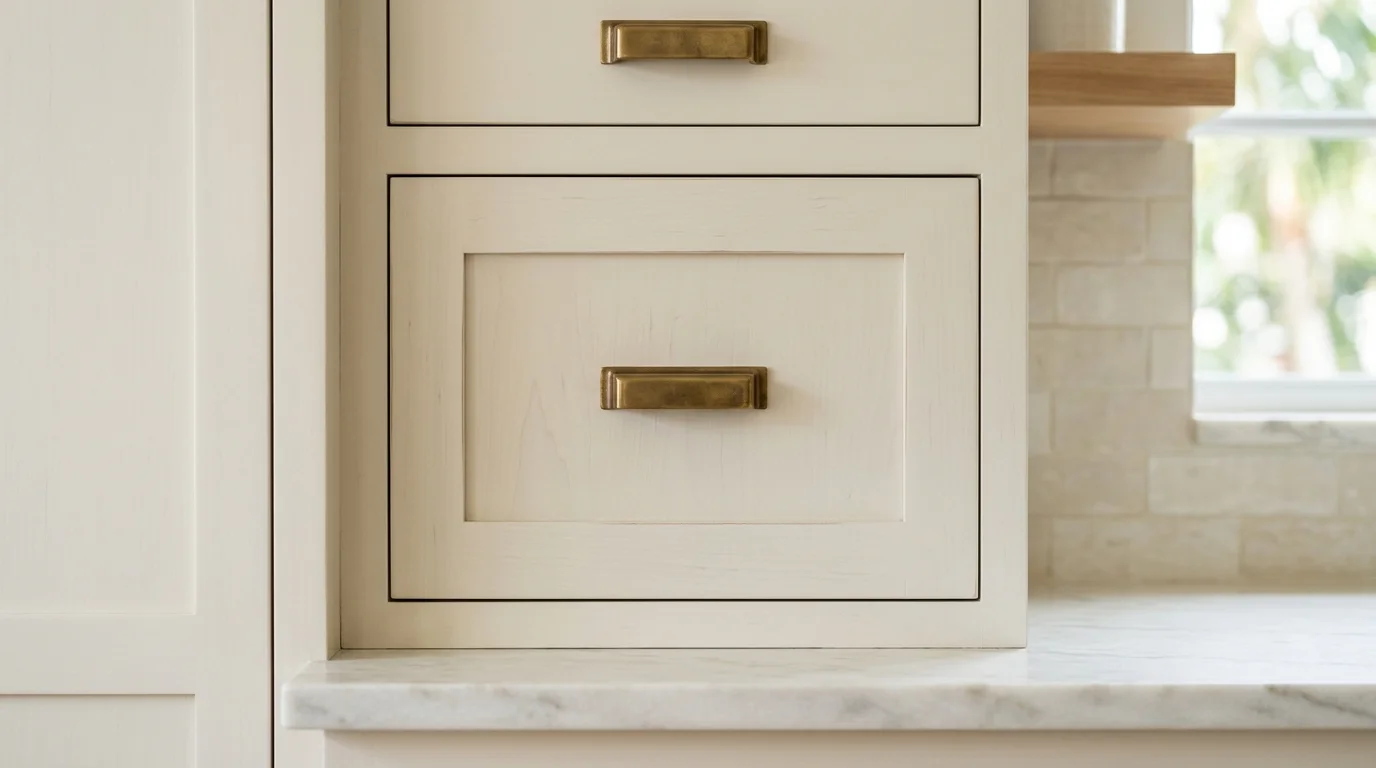
Cost Guide: Palm Beach County Price Ranges
These numbers reflect installed pricing, cabinets plus hardware plus our crew's installation labor. They do not include countertops, appliances, plumbing, electrical, or tile. If you want to see how cabinet cost fits into overall project budgets, the Palm Beach County kitchen remodel cost guide lays that out in detail.
According to NAHB remodeling data, cabinetry and hardware typically represent 29-35% of a full kitchen remodel budget, which lines up with what we see on local projects.
Keep in mind that 20 linear feet is a rough average for a mid-size kitchen in Palm Beach County. Smaller galley kitchens in Boca Raton condos might be 14-16 linear feet. Larger kitchens in Wellington or Jupiter with an island can run 30+ linear feet once you count all runs. The kitchen cabinet dimensions guide is a good starting point if you want to calculate your own linear footage before meeting with a designer.
One more thing worth saying: cabinet cost alone doesn't tell you whether the remodel makes financial sense. The 30 percent rule in remodeling is a useful benchmark for keeping your total investment proportional to your home's value, worth understanding before you finalize a scope.
South Florida Considerations
Florida's humidity and heat create real demands that don't show up in national cabinet buying guides. A few things we see repeatedly on local projects:
Plywood boxes are non-negotiable here. Particleboard and MDF box construction absorbs moisture. In a Palm Beach County kitchen that sees daily humidity swings, that translates to swelling, drawer misalignment, and eventually structural failure at the joint. Every quote we write specifies plywood box construction. If a competitor's quote comes in significantly lower, ask what the box material is. That's usually where they're cutting.
Finish durability matters more in a working kitchen. Painted cabinets look beautiful and are enormously popular right now, white, sage green, navy, two-tone combinations. But the finish system has to be right. We recommend a conversion varnish or catalyzed lacquer topcoat over raw primer for painted kitchens. It's harder, more resistant to grease and cleaning products, and holds up to South Florida's heavy-use kitchen environments. The article on best paint for kitchen cabinets in Palm Beach County goes deeper on this if you're weighing finish options.
Cabinet door warping is a real risk. Solid wood panels in large door sizes can warp in humidity if they're not properly constructed with floating panels and appropriate wood movement gaps. We've seen it on doors installed by other shops. If someone quotes you solid-wood flat-panel doors at suspiciously low prices, ask about their construction method. MDF center panels in painted doors actually perform better than solid wood in humid conditions because MDF is dimensionally stable.
HOA and gated community considerations. Many homeowners in Wellington, Boca Raton, and the barrier island communities have architectural review requirements before beginning a remodel. Cabinet replacement that doesn't touch plumbing, electrical, or walls generally does not require a building permit, but your HOA may still want to see design drawings before you start. When scope does expand, relocating the sink, adding an island with a new circuit, moving a dishwasher, your general contractor will handle the permitting process with Palm Beach County. Our kitchen remodel permit guide explains what triggers permit requirements and what doesn't.
55+ communities across Palm Beach County have their own set of considerations, accessibility, drawer height, pull-out storage at lower levels, and sometimes HOA restrictions on contractor hours and elevator use for material delivery. These are all solvable, but they need to be on the table at the design stage, not discovered on demo day.
Finally: lead times matter here. Custom cabinets from a quality shop run 6-12 weeks in production. If you're targeting a specific move-in date or want the kitchen done before the holidays, work backward from that date when you start the design conversation. Rushing custom cabinetry rarely ends well.