How Kitchen Cabinet Boxes Are Built: What Actually Matters
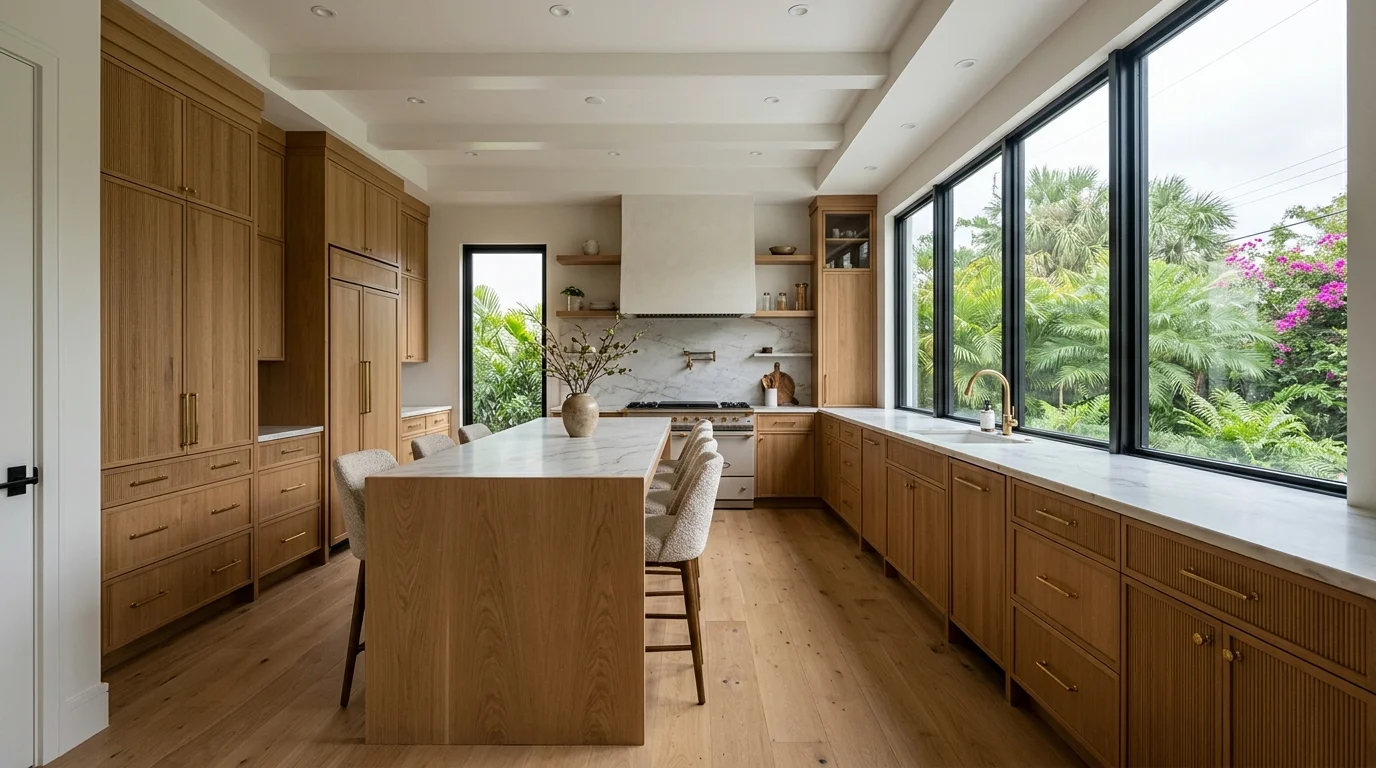
Understanding how kitchen cabinets are made is the single most useful thing a homeowner can do before spending money on a remodel. Doors and finishes are what you see in the showroom. The box, the carcass, the actual structural shell, is what determines whether your cabinets last 10 years or 30. We see this play out constantly across Palm Beach County, from Boca Raton condos to Wellington custom homes to older neighborhoods in Delray Beach and Jupiter. Homeowners pick a gorgeous door style, never ask about the box, and end up with swollen shelves and broken drawer slides three years later. This guide breaks down exactly what goes into a cabinet box, what the differences mean in practice, and what we recommend for Florida kitchens specifically.
Why Box Construction Matters
The cabinet box is what holds weight. It supports your countertop, your dishes, your small appliances. It takes the stress every time a drawer gets yanked open or a door gets slammed. And in South Florida, it absorbs humidity day after day, year after year. A weak box fails quietly, drawers start sticking, shelves sag in the middle, corner joints open up. By the time you notice, the damage is done.
Most homeowners spend their budget decisions on door style and finish. That is understandable. Doors are visible. But the box is where quality lives, and it is where corners get cut on lower-cost cabinets. The door style you pick is largely aesthetic. The box construction is structural.
We tell every client the same thing: pick a door style you love, but make sure the box behind it is built right. If you are comparing quotes and one is significantly cheaper, the box is almost always where that savings is coming from. If you want to dig deeper into how framing style changes the whole equation, our guide on frameless vs. framed cabinets covers that comparison in detail.
Box Materials: Plywood vs. MDF vs. Particleboard
There are three primary materials used to build cabinet boxes: plywood, MDF (medium-density fiberboard), and particleboard. Each has a different performance profile, and each tells you something about what you are buying.
Plywood is the material we recommend for cabinet boxes in Florida, full stop. It is made from cross-laminated wood veneers, which gives it dimensional stability and screw-holding strength that the other two cannot match. When humidity rises and falls, and it does, constantly, in South Florida, plywood handles the movement. It resists swelling. Screws driven into plywood stay put. If a shelf ever needs to be repositioned, the holes hold. Plywood boxes typically run 1/2-inch or 3/4-inch thick on sides and shelves, with a thinner back panel dadoed into the sides rather than just stapled on.
MDF is dense, heavy, and very smooth, it takes paint exceptionally well, which is why it is commonly used for door faces and painted cabinet boxes in mid-range lines. As a box material, MDF is more susceptible to moisture than plywood. It swells when it gets wet and does not recover well. Screw-holding strength is lower, especially at the edges. It is not our first choice for a Florida kitchen box, but it is not disqualifying either if the cabinet is well-sealed and the kitchen is climate-controlled, which most are. We see plenty of painted cabinet lines using MDF boxes that perform fine for 10-15 years in conditioned space.
Particleboard is the material found in entry-level stock cabinets and most big-box store offerings. It is inexpensive and heavy, and it fails faster than either of the other two options in humid environments. Screws strip out. Shelves sag under moderate loads. The back panel is often stapled on rather than dadoed, which means the box can rack under stress. We are not saying particleboard cabinets cannot work, they can, for a budget refresh where the homeowner understands the trade-off. But they are not what we specify for projects where longevity matters.
For a deeper dive into how these materials compare across all cabinet types, including doors and face frames, our article on MDF vs. plywood vs. solid wood cabinets goes into the full picture.
One other detail worth knowing: how the bottom panel of the box is attached matters as much as the material. A dadoed-in bottom, meaning it sits in a routed groove in the sides, is structurally sound. A bottom that is just glued and stapled to the underside of the sides is not. Ask about it when you are comparing cabinets. Most sales reps will know the answer.
Framed vs. Frameless Cabinet Boxes
Beyond the material, the structural design of the box itself comes in two formats: face-frame (framed) and frameless, sometimes called full-access or European-style.
A face-frame cabinet has a solid wood frame, typically solid maple or poplar, glued and sometimes doweled to the front edge of the box. That frame typically runs 1-1/2 inches wide on the sides and includes a center stile between adjacent doors. The frame adds rigidity to the box and gives you a place to attach door hinges and align doors. Traditional American cabinet manufacturers have built this way for decades. The trade-off is that the face frame eats into the interior opening, so you lose some usable width, typically 1 to 1-1/2 inches per side, compared to a frameless box of the same exterior dimensions.
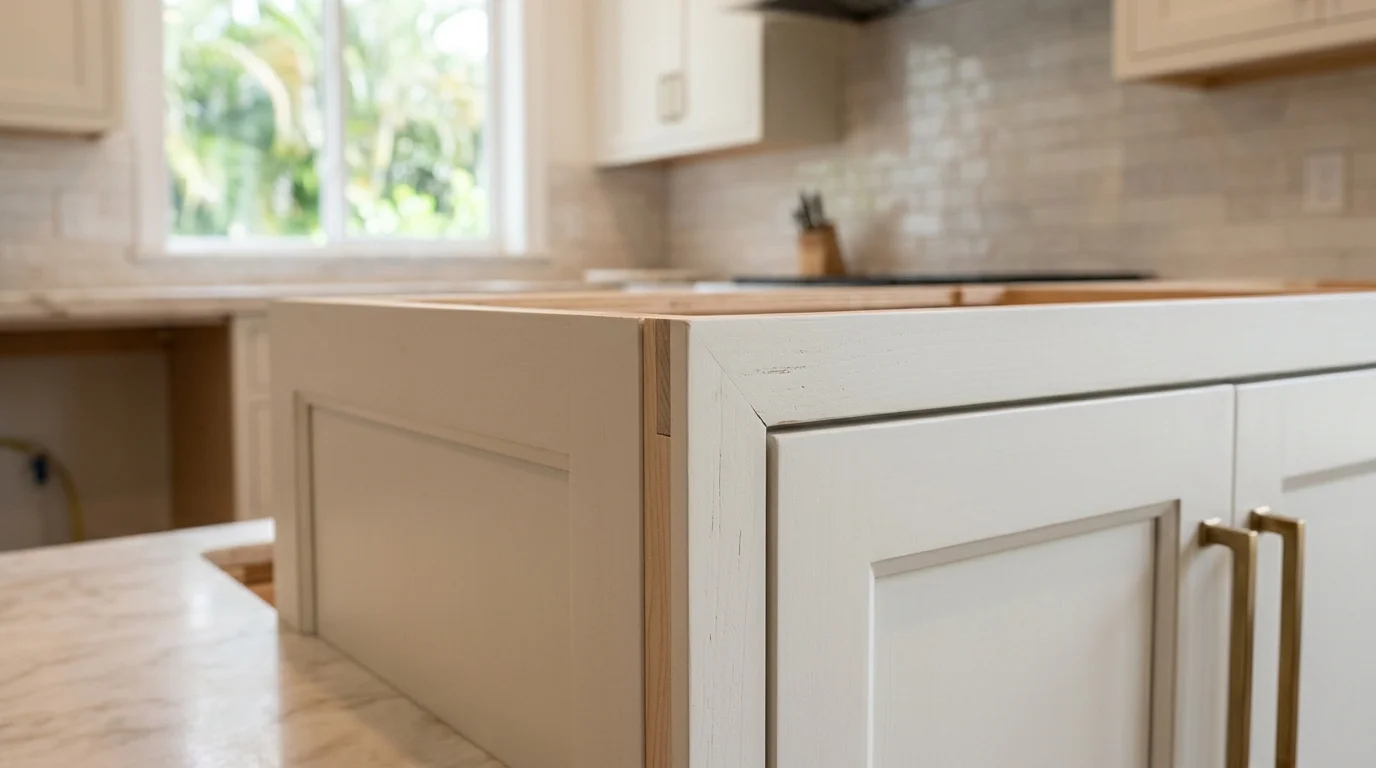
A frameless cabinet has no face frame. The box sides are the finished front edge. Doors and drawers are attached directly to the box using European-style cup hinges mounted inside the box. The full width of the interior is accessible, which is why the term full-access gets used. For drawers especially, this matters, you can fit a wider pot or pan into a frameless base cabinet than a face-frame of the same width. Frameless construction requires thicker, more precisely manufactured box sides, since there is no frame to compensate for imperfections. Higher-end frameless boxes run 3/4-inch plywood sides with a finished interior surface.
We see both styles across Palm Beach County. Frameless tends to dominate in contemporary and transitional kitchens. Face-frame is common in traditional and Shaker-style kitchens throughout areas like Wellington and Jupiter where that look is popular. Construction quality can be excellent in both formats, the material and joinery matter more than the framing style itself. If you are still working through door style decisions, our breakdown of flat front vs. Shaker cabinets in South Florida is worth reading alongside this guide.
One structural point worth making on frameless boxes: the hinge plate attaches directly to the side panel, so the panel needs to hold screws reliably. Frameless particleboard boxes have a real weakness here. Plywood or high-density fiberboard frameless boxes do not have that problem.
Drawer Box Construction
Drawers fail more than any other part of a cabinet. They cycle hundreds of times a year. The bottom gets loaded with weight. The joints get stressed every time a drawer is pushed in with too much force. This is where you can tell a quality cabinet line from a cheap one faster than anywhere else.
There are two main types of drawer box construction: dovetail and doweled or stapled.
Dovetail drawer boxes are the benchmark. The interlocking dovetail joint, cut at the corners of the drawer box sides, is mechanically locked. It does not rely on glue alone or on fasteners that can back out over time. Under repeated stress, a dovetail joint gets tighter. It is not a marketing gimmick. It is genuinely the strongest wood joint for a box under tension. Most mid-range and all custom cabinet lines use dovetail drawer boxes as standard. The boxes themselves are typically solid wood, often solid maple or birch, not plywood or MDF.
Doweled or stapled drawer boxes are found in entry-level stock cabinets. The corners are butted together and held with dowels, screws, or staples and glue. Under normal use they hold fine. Under hard use, a kitchen with kids, heavy pots in base drawers, a household that does not baby its cabinets, they can fail within a few years. The bottom panel on lower-quality drawer boxes is often 1/8-inch hardboard stapled into a groove. On better boxes, it is 1/2-inch plywood dadoed in.
The drawer slide matters just as much as the box. Undermount soft-close slides from manufacturers like Blum or Grass are the industry standard for mid-range and above. They support the drawer from underneath, hide from view when the drawer is open, and allow the drawer face to float independently for adjustment. Side-mount slides work, but they are visible, have less weight capacity, and do not offer the same smooth action. If a cabinet quote does not specify undermount slides, ask. The answer tells you a lot about the overall spec of the line.
Our guide on soft-close cabinet drawers covers the mechanics and what it costs to add them to existing cabinets if you are working with an older kitchen.
Cabinet Quality and Cost Guide
Here is how cabinet box quality typically maps to price in the Palm Beach County market. These ranges reflect what homeowners pay for the cabinets themselves, not installation, countertops, or other finish work. For full remodel budgeting, our Palm Beach County kitchen remodel cost guide covers the whole picture.
The jump from entry-level to semi-custom is where you get the biggest improvement in box quality per dollar spent. Going from particleboard with stapled drawers to plywood with dovetail construction is meaningful. The jump from semi-custom to full custom is more about fit, finish options, and storage customization than a dramatic difference in basic box durability.
For homeowners comparing RTA (ready-to-assemble) options against local dealers, our breakdown of RTA vs. custom cabinetry for Palm Beach County kitchens walks through where the real trade-offs are.
South Florida Considerations
Florida's climate changes the cabinet equation in ways that matter. Humidity in Palm Beach County runs high from June through October. Even in air-conditioned homes, kitchens near the coast, think Boca Raton, Juno Beach, Delray Beach oceanside, see more ambient moisture than kitchens 20 miles inland. That moisture works on box materials constantly.
Particleboard is particularly vulnerable. The resin binders that hold particleboard together weaken over time with repeated moisture exposure. A particleboard shelf under a kitchen sink, where minor leaks and condensation are common, can swell and fail within a few years. We have seen it happen on cabinets that were barely five years old. Plywood boxes hold up significantly better because the cross-laminated veneer structure handles moisture cycling without delaminating the way particleboard does.
Cabinet interiors matter here too. A finished interior, melamine or thermofoil coating on the inside surfaces, seals the substrate and slows moisture absorption. An unfinished interior exposes the raw material. On plywood that is less critical. On particleboard or MDF, an unfinished interior in a humid kitchen is a liability.
For base cabinets specifically, the toe kick area and the bottom of the box deserve attention. Boxes that sit directly on a concrete slab with no moisture barrier between the slab and the cabinet bottom are asking for trouble. A properly installed kitchen will have the cabinets elevated on a toe kick platform with a moisture barrier below. This is basic installation practice, but it is worth confirming before work starts. The Florida Building Code sets standards for moisture protection in occupied spaces, and any well-executed installation should account for it.
We also see homeowners in Wellington, Royal Palm Beach, and western Palm Beach County neighborhoods dealing with harder water, which can affect finishes and hardware more than the box itself, but it is worth noting when specifying any metal interior hardware like slide components.
One more consideration specific to South Florida: many kitchens in this market are in older homes from the 1970s, 1980s, and 1990s where the original cabinet layout was not particularly efficient and the boxes were often particleboard from the start. If you are remodeling one of those kitchens and you find the existing boxes in poor condition, that is normal and expected. Our article on remodeling a 1980s Florida kitchen covers what to expect when you open up those walls and cabinets.
When it comes to what to look for in the cabinet lines we carry and recommend, construction standards from manufacturers like Fabuwood publish their specs, plywood box construction, dovetail drawers, Blum undermount slides, so you can verify exactly what you are getting before you sign anything. That transparency is what we look for in the lines we work with.
Understanding box construction also shapes decisions about storage upgrades. Pull-out shelves, drawer organizers, and built-in spice racks all depend on the box being solid enough to support the hardware. A plywood box with proper dado joinery handles that load. A particleboard box with a stapled back panel often cannot. If storage upgrades are part of your plan, make sure the box spec supports them before you commit to the cabinet line. Our guide on kitchen pantry design ideas shows how the right cabinet construction enables better storage systems throughout.