Soft-Close Cabinet Drawers: How to Add Them
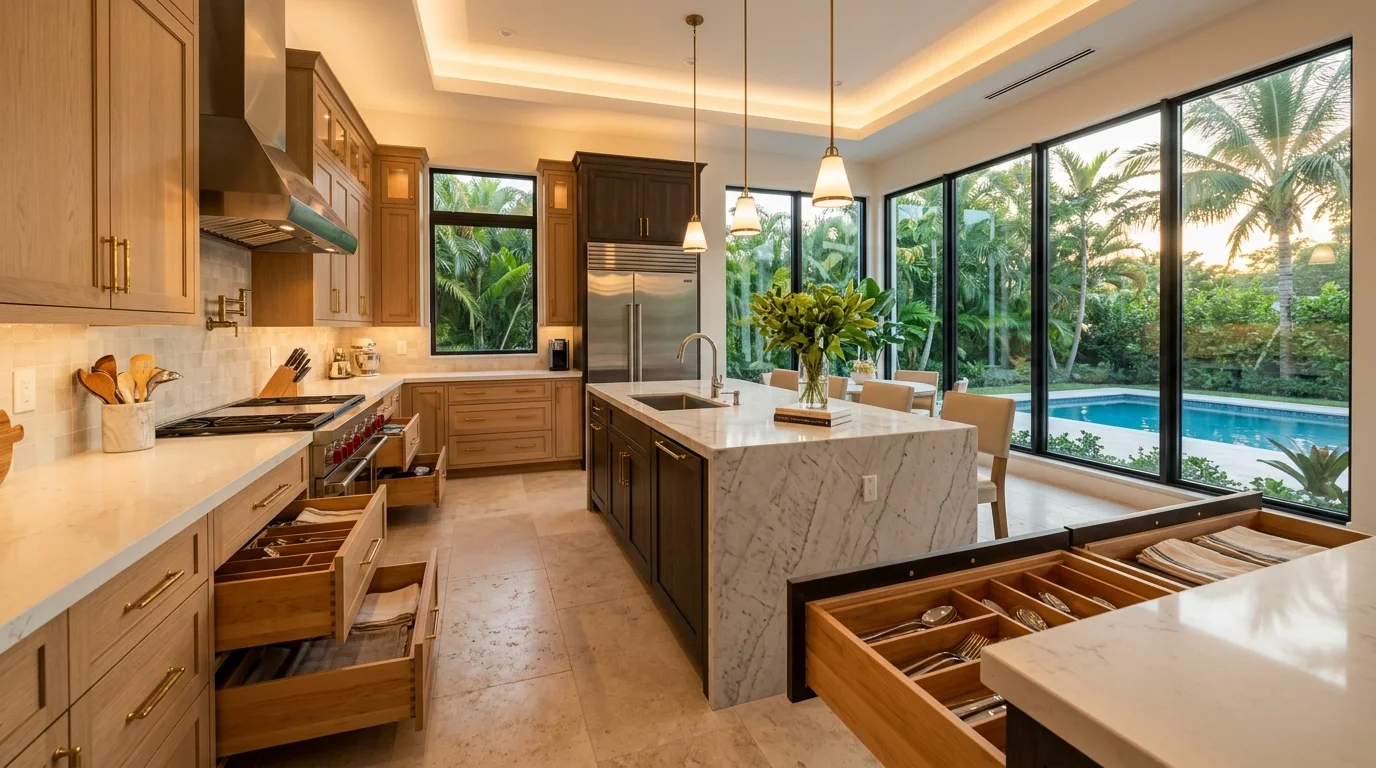
Soft close cabinet drawers are one of the simplest upgrades a homeowner can make, and one of the most satisfying. No more slamming. No more kids rattling the whole cabinet bank every time they grab a snack. The mechanism is quiet, controlled, and once you live with it, you won't go back. If you're retrofitting existing drawers or speccing new hardware for a full cabinet install, this guide covers exactly how soft-close works, which approach makes sense for your situation, and what it'll cost here in Palm Beach County.
How Soft-Close Actually Works
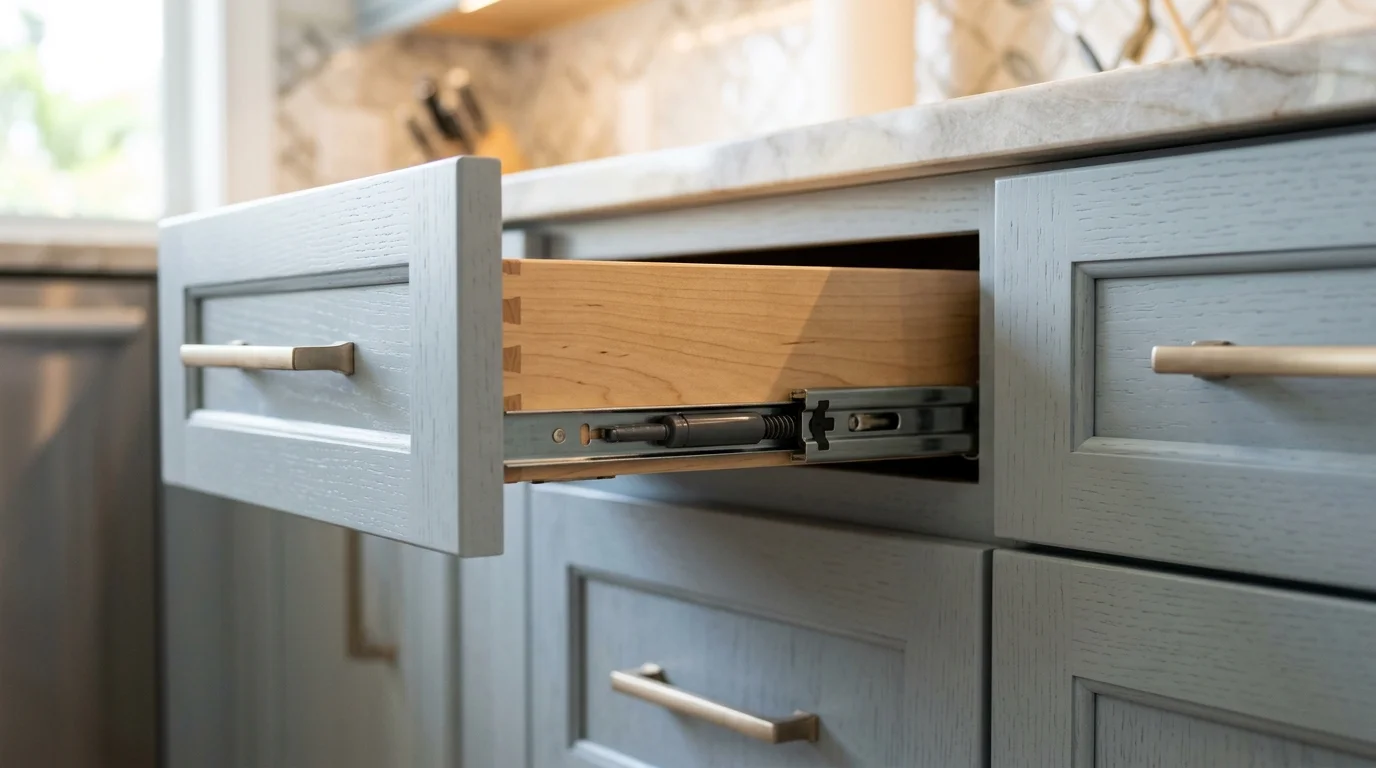
The technology behind soft-close is simpler than most people expect. Inside the drawer slide, or attached as a separate dampener, sits a small hydraulic or pneumatic cylinder. When the drawer reaches about two inches from fully closed, that cylinder engages and controls the deceleration. The drawer eases in rather than slamming.
There are two ways this gets built into a drawer system. The first is an integrated soft-close slide, where the dampener is built directly into the slide mechanism itself. Brands like Blum make some of the best, their Tandem and Legrabox lines are what we spec on our full cabinet installations because the action is consistent year after year. The second approach uses add-on dampeners that clip or screw onto an existing slide. These retrofit kits let you keep your current drawer boxes and simply add the soft-close function.
Door hinges follow the same logic, separate topic, but worth knowing. Soft-close hinges for cabinet doors work on a similar hydraulic principle. We're focused on drawers here, but if you're already pulling hardware out, it's worth addressing both at once.
One thing homeowners get wrong: they assume soft-close means slow-close. It doesn't. The drawer moves freely at normal speed, the dampener only kicks in at that last inch or two. A well-tuned soft-close slide feels effortless, not sluggish.
Retrofit Kits vs. New Hardware
This is where you need to make a decision before buying anything. The right path depends on the condition of your current slides and how much you want to spend.
Retrofit dampener clips are the budget move. These small plastic or metal clips attach to the inside rear of the cabinet box and catch the drawer as it closes. They run $3-$8 per drawer and take about ten minutes each to install. The catch: they work best on drawers that already close smoothly. If your slides are worn, bent, or misaligned, adding a dampener clip won't fix the underlying problem, it'll just slow down the final slam.
Replacing the full slide with a new soft-close slide is the better long-term solution. You're pulling out the old hardware anyway, so you can inspect the drawer box, fix any racking, and install a quality undermount or side-mount slide with integrated soft-close. Blum Tandem undermount slides are our preference for face-frame and frameless cabinets alike. KV (Knape & Vogt) and Grass are solid alternatives at a slightly lower price point. Expect to spend $15-$40 per drawer on quality soft-close slides.
When does full replacement make sense versus a retrofit clip? Our rule of thumb: if the cabinet is more than fifteen years old, the slides are side-mount epoxy-coated steel, and there's any wobble or drag when you open and close, replace the slides. If the cabinets are five years old or newer with decent ball-bearing slides that just lack the soft-close function, retrofit clips do the job fine.
If you're considering a broader cabinet refresh, not just hardware but doors, boxes, or finish, take a look at our breakdown of cabinet refacing vs. full replacement for Palm Beach County kitchens before committing to a direction. Sometimes adding soft-close is the gateway decision that leads to a smarter, larger upgrade.
Step-by-Step Installation Guide
This covers replacing full drawer slides with new soft-close undermount slides, the approach we recommend for lasting results. If you're just adding retrofit clips, skip to Step 3.
What you'll need: Replacement soft-close slides (measure your existing slides for length, 18", 21", or 24" are most common), a cordless drill, #2 Phillips bit, small flathead screwdriver, tape measure, pencil, and a small level.
Step 1: Remove the drawer. Most modern drawers lift straight out once fully extended. Older side-mount slides usually have a release lever or tab on each side that you press simultaneously while pulling the drawer forward. Set the drawer box on a flat surface.
Step 2: Remove the old slides. The cabinet-side rails are screwed to the inside walls of the cabinet box. Back out the screws, typically three to five per rail, and pull the rails free. Note the mounting height. Take a photo before you remove anything.
Step 3: Install the cabinet-side rails for the new slides. For undermount slides, the rail mounts to the bottom of the cabinet interior. Position it flush with the front of the cabinet face frame (or front rail for frameless) and level side-to-side. Mark your pilot holes with a pencil, pre-drill to avoid splitting, and fasten. Repeat on the other side. Check that both rails are at the same height, a quarter-inch difference will cause the drawer to rack.
Step 4: Attach the drawer-side components. Undermount systems clip or screw to the bottom of the drawer box. Follow the manufacturer's template, Blum ships a paper template with each slide that makes placement straightforward. The rear bracket typically snaps into a notch; the front clip hooks over the drawer face rail.
Step 5: Hang the drawer. Slide the drawer onto the cabinet rails. Most undermount systems have a lever or button release at the front that locks the drawer box onto the rail. Push down until you hear or feel it click.
Step 6: Adjust. Open and close the drawer several times. Quality undermount slides have three-dimensional adjustment, height, side-to-side, and front-to-back, via small hex screws or cam adjusters at the front clip. Get the drawer face parallel to the cabinet front before calling it done. This step is where patience pays off.
Step 7 (retrofit clips only): If you're adding dampener clips to existing slides, position the clip at the rear interior of the cabinet box, centered on the slide path. Press or screw it in place per the kit instructions. Close the drawer slowly to confirm the clip engages before the drawer fully closes. Adjust forward or back as needed.
One thing to flag for anyone doing a full kitchen cabinet install or dealing with hardware across the whole kitchen: the way you spec your hardware matters as much as the soft-close mechanism. Our kitchen cabinet hardware guide for Palm Beach County covers pull sizing, finish selection, and placement in depth, worth reading before you order anything.
Cost Guide
Here's what soft-close cabinet drawer upgrades actually cost in Palm Beach County, if you're DIYing it or having our team handle it as part of a larger project.
A few things to keep in mind on pricing. Labor costs in Boca Raton, Delray Beach, and Wellington are consistent, it's mostly travel and the number of drawers that moves the needle. Jupiter and areas further north in Palm Beach County can add a modest travel surcharge depending on the scope. If soft-close installation is part of a larger cabinet project, new doors, refacing, or a full kitchen, the per-drawer cost drops because the setup time is already absorbed into the larger job.
We include soft-close slides as standard on every drawer in our cabinet installations. It's not an upsell. Drawers that slam are drawers that fail faster, and we'd rather build it right from the start. If you're curious how hardware choices fit into a bigger kitchen budget, our kitchen remodel cost guide for Palm Beach County lays out where dollars actually go.
South Florida Considerations
Humidity is the factor most guides ignore, and it's the one that matters most in Palm Beach County. South Florida averages 70-75% relative humidity for much of the year. That moisture affects wood drawer boxes, MDF components, and even the plastic dampener clips in retrofit kits.
Wooden drawer boxes swell in high humidity. A drawer that closed perfectly in January may drag or rack in August. If you're adding soft-close slides to existing drawers, check the fit in summer conditions before you finalize your adjustment. A drawer that's slightly tight in July needs a different adjustment than one that fits perfectly in the dry season.
For that reason, we strongly prefer undermount slides with full-extension and metal drawer boxes, or at minimum, plywood construction, over MDF drawer boxes in South Florida kitchens. Blum's Legrabox line uses a metal drawer frame that doesn't swell at all. It's more expensive, but in our climate it's the right call for anything near a sink, dishwasher, or under a window where humidity gets trapped.
The dampener oil in hydraulic soft-close mechanisms can also be affected by temperature extremes. South Florida doesn't get cold enough for this to be an issue in air-conditioned kitchens, but if you're doing an outdoor kitchen or a utility area that isn't climate controlled, think a garage cabinet or a covered lanai kitchen, look for slides rated for wider temperature ranges. Some of the cheaper no-name slides sold online use dampener fluid that thins out in heat and produces inconsistent closing action.
Cabinets in coastal areas, particularly homes within a mile or two of the Intracoastal or ocean in Boca Raton, Delray Beach, or Jupiter, should use slides with corrosion-resistant plating. Salt air gets into everything. Blum's nickel-plated and zinc-coated slides hold up significantly better than standard epoxy-coated steel in those environments.
Warped cabinet doors are another South Florida reality. If a door is warped, the drawer below it may not close evenly even with perfect slides. We cover that issue separately in our guide to fixing warped cabinet doors in Florida's humid climateworth checking if you're seeing gaps or uneven reveals alongside sticky drawers.
One more thing: soft-close drawer retrofits don't require permits. There's no structural work, no plumbing, no electrical. You don't need to notify your HOA in most cases either, check your CC&Rs if you're in a gated community, but a hardware swap inside an existing cabinet is almost never a governed modification. If you're in a condo, the same applies: this is interior finish work that doesn't touch shared systems. Our condo kitchen remodel and HOA guide goes deeper on what does and doesn't need approval in Palm Beach County condos.
If this retrofit is sparking a bigger conversation about your cabinets, style, finish, or whether it's time to replace rather than repair, take a look at the best kitchen cabinet styles for South Florida homes for a sense of what's working well in this market right now. And if you're weighing hardware finish choices alongside the slide upgrade, our post on brass cabinet hardware trends for 2026 covers what pairs well with the most popular South Florida cabinet colors.