Shaker Style Cabinets: The Complete Guide
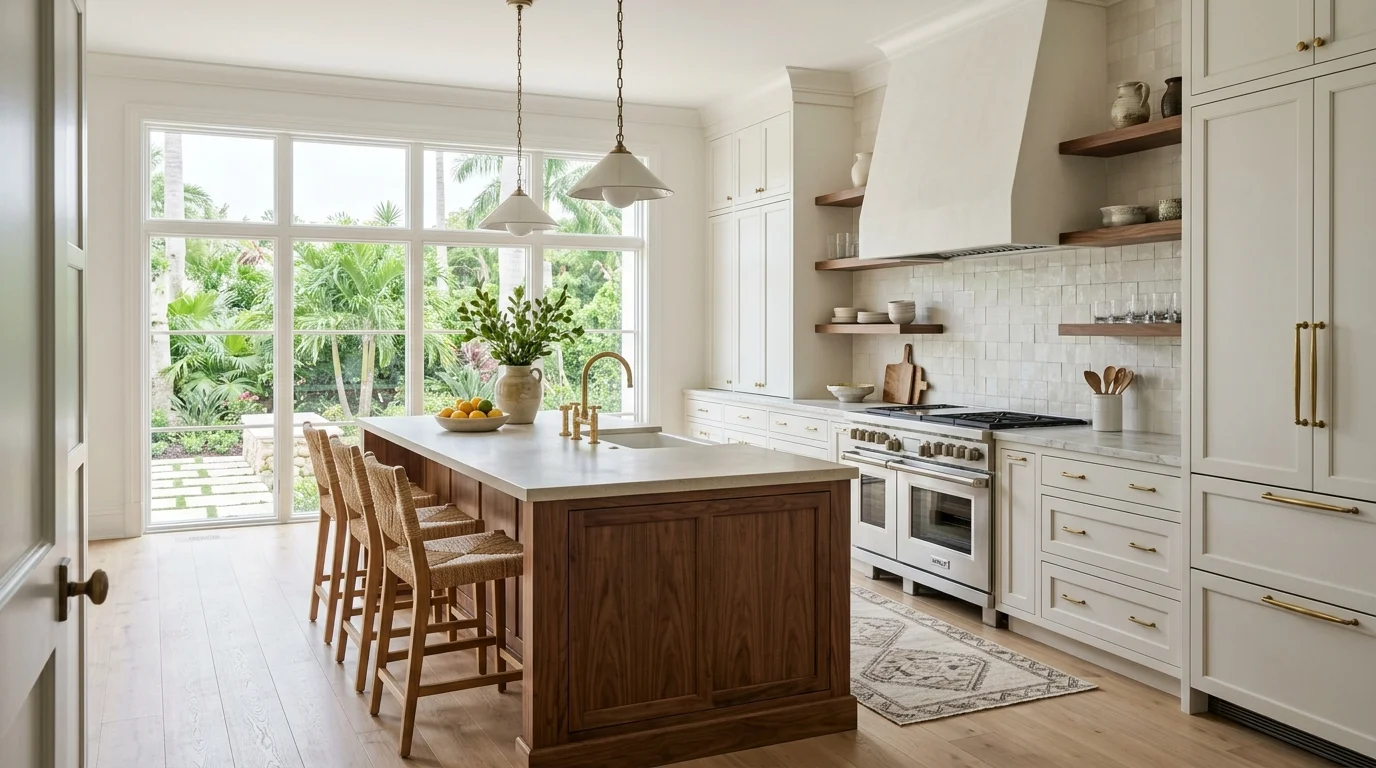
Shaker style cabinets are the most requested door style we see in Palm Beach County kitchens, and for good reason. The five-piece recessed-panel door hits a sweet spot between traditional and contemporary that suits almost every home aesthetic we work in, from transitional waterfront properties in Jupiter to coastal modern condos in Boca Raton. If you're doing a full gut renovation or just replacing cabinet doors, understanding exactly what shaker means, and where the real decisions lie, will save you money and keep you from making choices you'll regret in three years.
What Defines a Shaker Cabinet Door
The shaker door is a five-piece construction: two vertical stiles, two horizontal rails, and a flat center panel. That's it. The design comes from 18th-century Shaker craftsmen who believed in function over ornament, and the door's clean geometry is precisely why it has outlasted every decorative trend of the last century.
What separates a quality shaker door from a budget one is the joinery and the wood species. A true shaker door uses mortise-and-tenon or dowel joinery at the corners, the stiles and rails lock together mechanically before any glue is applied. Cheaper versions route a groove and float the panel in MDF or thin plywood, which can telegraph movement over time. In Florida's humidity swings, that difference matters more than it does in a climate-controlled Midwest home.
The center panel on a shaker door is flat and sits recessed slightly from the face frame. That shadow line, typically 3/16" to 1/4" deep, is what gives the door its depth without being ornate. Compare that to a raised-panel door (which has a beveled or shaped profile around the panel) or a flat-front slab door (no frame at all). Shaker sits exactly in the middle of that spectrum, which is why it pairs naturally with both traditional crown molding and minimalist hardware.
One variation worth knowing: the slim shaker, sometimes called a thin-rail shaker, uses narrower stiles and rails, often 1.5" instead of the standard 2.5", for a more streamlined look. We've written a full breakdown of that option at Slim Shaker Cabinets: The 2026 Kitchen Trend Explained if you want to compare the two profiles side by side.
Door material choices for shaker construction in our market:
- Maple: The standard for painted shaker doors. Tight grain absorbs paint evenly. Most semi-custom lines use maple for painted finishes.
- Alder: Slightly softer than maple, takes paint well, costs less. Good option for budget-conscious projects.
- Oak: Grain shows through paint, which some clients love for texture. Rift-cut white oak is having a major moment in 2026, natural, not painted.
- MDF center panel with solid wood frame: The most stable option for painted shaker doors in humid climates. MDF doesn't expand and contract like solid wood, so painted surfaces stay crack-free longer.
Our recommendation: for any painted shaker door in South Florida, specify a solid wood frame with an MDF center panel. It's the industry standard for a reason. Doors that warp or crack because of a solid-panel construction in coastal humidity are a headache we see regularly when clients come to us after buying from big-box stores without asking the right questions. Our guide on how to fix a warped cabinet door gets into the specifics if you're dealing with an existing issue.
Framed vs Frameless Shaker Cabinets
This is where most homeowners get confused, because they think shaker is a construction method rather than a door style. Shaker refers only to the door profile. The cabinet box behind it can be either framed (also called face-frame) or frameless (full-access or European-style). Both can use a shaker door.
Here's the practical difference:
A framed cabinet has a 1.5" solid wood face frame glued and stapled to the front of the box. The door hinges onto that frame. You lose about 1" of interior access on each side, but the frame adds rigidity and gives you a traditional look at the door reveals. This is the dominant construction in American semi-custom cabinetry.
A frameless cabinet has no face frame, the door hinges directly onto the box with a concealed European hinge. Full interior access. Cleaner look at the seams. More storage per linear foot. The shaker door on a frameless box will have a slightly different reveal pattern, doors sit nearly flush with each other with very small gaps, which reads as more contemporary.
In South Florida transitional kitchens, we see both. Clients in Wellington or Delray Beach who want a more traditional feel usually choose framed construction. Clients in newer Boca Raton builds or modern waterfront homes tend to go frameless for that cleaner line. Neither is wrong. The choice should be driven by your overall design direction, not a cost calculation, the price difference between framed and frameless at the same quality tier is modest.
For a full side-by-side comparison with photos and specs, read our article on frameless vs framed cabinets. And if you're weighing shaker against a flat-front slab for a more modern look, we cover that directly in Flat Front vs Shaker Cabinets South Florida.
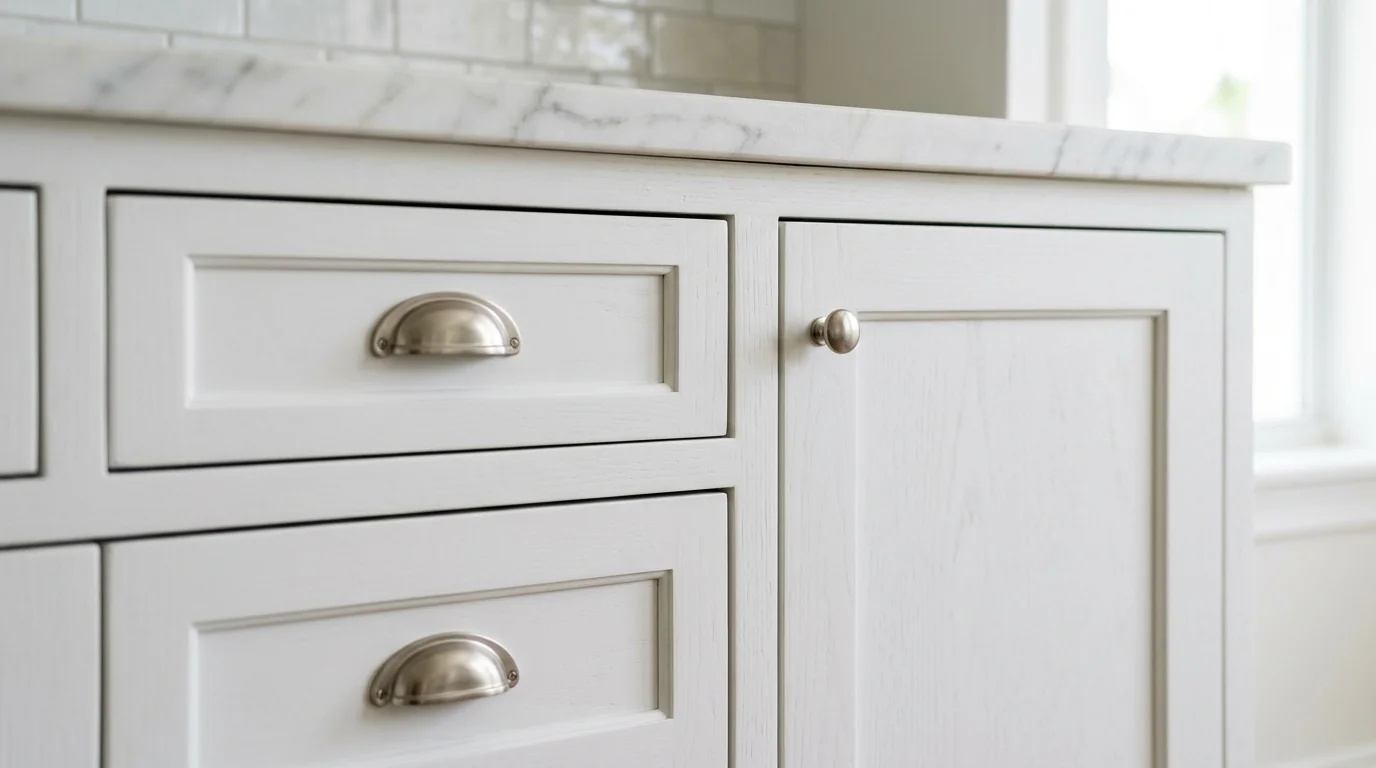
One more construction variable: inset vs overlay. Overlay doors (full overlay or partial overlay) sit on top of the face frame. Inset doors sit flush inside the frame opening, a more refined, furniture-like look that costs significantly more because the tolerances are tight and the installation is slower. Inset shaker cabinets in a Palm Beach County kitchen are beautiful. They're also the most expensive way to build a kitchen. If budget is a factor, full-overlay shaker gives you 90% of the look at a fraction of the premium.
Colors and Finishes That Work in Florida
Shaker doors accept paint and stain equally well, which is one of their biggest advantages. The flat center panel doesn't fight color the way a raised-panel door does.
White remains the single most popular choice in our market. It reads clean, reflects natural light, and works with every countertop material from quartz to quartzite to leathered granite. If you're on the fence, white is almost never wrong. We wrote an entire piece on white shaker cabinets with quartz countertops in Palm Beach County that gets into specific pairing recommendations.
Beyond white, here's what we're seeing in active projects across Palm Beach County right now:
- Warm whites and off-whites: Benjamin Moore White Dove, Chantilly Lace, and Swiss Coffee. These read white in photos but have warmth in real light, which suits Florida's golden afternoon sun better than a stark cool white.
- Sage green: Consistently the top color request after white. Works with brass hardware, natural stone, and unlacquered fixtures. See our full take on sage green kitchen cabinets for specific Benjamin Moore and Sherwin-Williams codes.
- Navy blue: Strong on perimeter cabinets or islands. It grounds the kitchen and pairs well with white quartz or Carrara-look surfaces.
- Two-tone combinations: White uppers with a colored lower, navy, sage, soft black, or warm gray. This is the most popular approach in transitional South Florida kitchens right now because it breaks up the visual mass without committing fully to a bold color.
- Natural wood stains: Rift-cut white oak and natural maple stains on shaker doors are gaining ground fast. The shaker profile works beautifully in natural wood because the clean lines let the grain be the feature.
Colors we'd steer most clients away from: Cool gray shaker cabinets had their moment between 2014 and 2020. They're not going to look dated immediately, but if resale is a concern in the next five to seven years, a warm neutral or natural wood will serve you better. The National Association of Home Builders consistently tracks neutral and warm-toned kitchens as top performers in buyer satisfaction, which tracks with what we see in Palm Beach County resale conversations.
Hardware is where shaker cabinets really come alive. The flat door face is a canvas, it doesn't dictate hardware style the way a more ornate door would. Simple cup pulls, bar pulls, and bin pulls all look intentional on a shaker door. Brass is dominant right now and we expect it to stay relevant well into the decade. We covered the full hardware picture in Brass Cabinet Hardware: the 2026 Finish.
Cost Guide: Shaker Style Cabinets in Palm Beach County
Cabinet costs in our market vary widely based on construction quality, finish, and if you're doing a full kitchen, an island only, or a bath vanity. These are real numbers from projects we've completed in Boca Raton, Delray Beach, Wellington, Jupiter, and surrounding Palm Beach County communities, not national averages pulled from a cost-aggregator site.
A few things that move these numbers: Box material (plywood vs particleboard), finish type (painted vs thermofoil vs stained), dovetail vs stapled drawer boxes, and soft-close hardware throughout. At the mid-range tier, we spec plywood boxes, soft-close hinges and drawer glides, and dovetailed drawer construction as a baseline. At the budget tier, some of those features come as upgrades.
For a complete view of what a kitchen remodel costs at each tier in our market, the Kitchen Remodel Cost Palm Beach County guide breaks down every line item. And if you're wondering whether your overall remodel budget makes sense relative to your home's value, the 30 Percent Rule in Remodeling is a useful framework before you commit.
South Florida Considerations for Shaker Cabinets
Our climate creates specific demands that homeowners in cooler, drier markets don't deal with. Here's what matters when you're buying shaker cabinets in Palm Beach County.
Humidity cycling is the biggest factor. South Florida kitchens swing between air-conditioned interiors and humid ambient air whenever doors open. Wood moves. Paint can crack at poorly constructed joints. This is why we push MDF center panels for painted shaker doors and why we're skeptical of all-solid-wood painted doors at entry-level price points. The Florida Building Code doesn't regulate cabinet material directly, but the humidity exposure standards it sets for interior materials tell you something about what this climate demands.
Coastal salt air is a secondary concern for homes within a mile of the water, particularly in Jupiter Inlet Colony, Manalapan, and oceanfront Delray Beach condos. Salt accelerates hardware corrosion. If you're in a coastal property, specify stainless steel, solid brass, or PVD-coated hardware over zinc alloy. The finish will last years longer.
Shaker cabinets suit the dominant design directions in our market better than almost any other door style. Transitional coastal, the single most popular aesthetic from Wellington to Boca Raton, pairs white or off-white shaker with natural stone counters, warm wood accents, and large-format tile floors. The shaker door's clean geometry doesn't compete with any of those elements. It lets the countertop, the backsplash, and the hardware tell the story.
For coastal-themed kitchens specifically, the combination of shaker cabinets with a textured or handmade-look backsplash tile is extremely effective. Our Coastal Kitchen Design Ideas for South Florida Homes article has specific tile and color pairings that work in this climate and aesthetic.
One more practical note: if your project involves relocating the sink, adding a dishwasher where none existed, moving gas lines, or opening walls to change the layout, those scopes will require permits in Palm Beach County, and that work falls under your general contractor's scope, not ours. A straight cabinet-and-counter replacement on an existing layout typically does not require a permit. Ask your GC early so you're not surprised mid-project.