Inset vs Overlay Cabinets: Which Is Best?
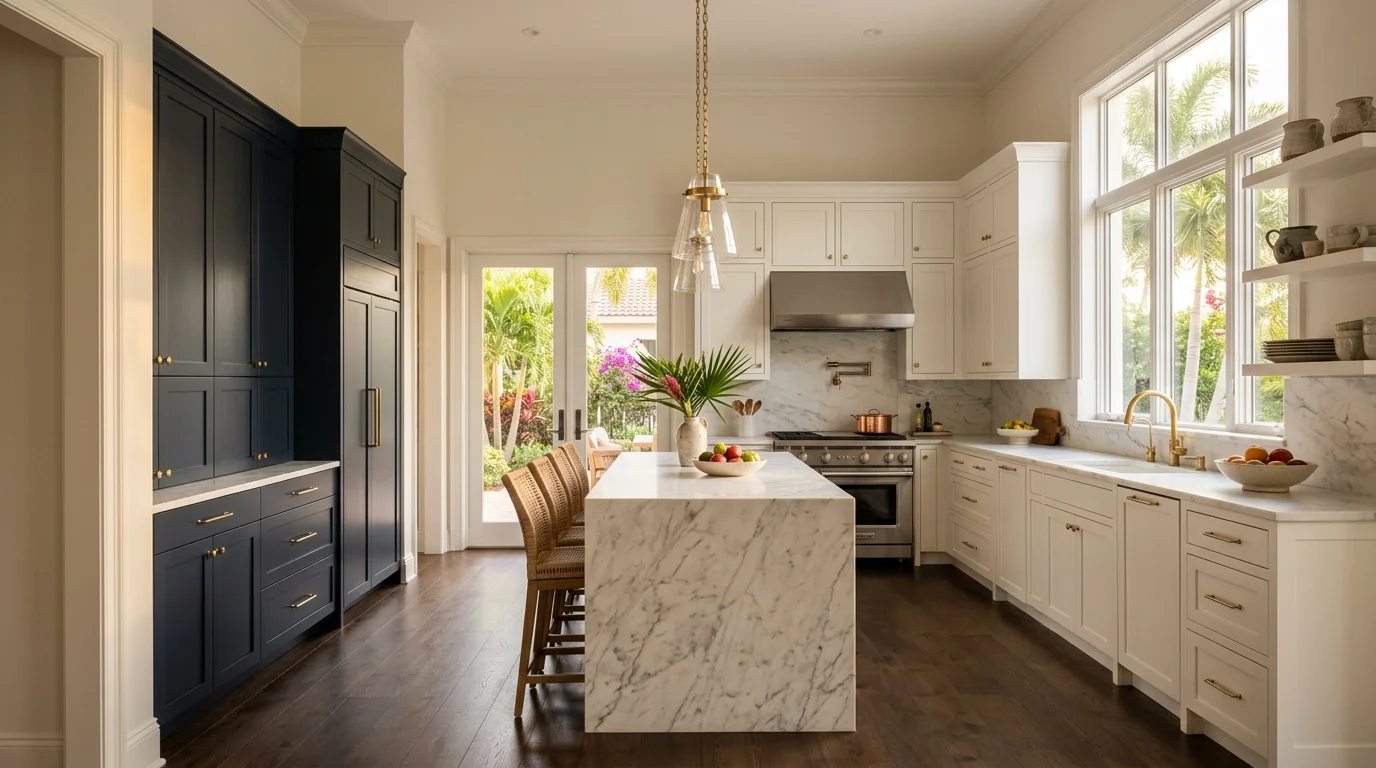
When homeowners in Boca Raton, Delray Beach, and Wellington start planning a kitchen remodel, the inset vs overlay cabinets question comes up almost every time. It sounds like a minor detail. It isn't. That single choice affects your budget, your door style options, how the kitchen photographs, and how the cabinets hold up in South Florida's humidity over the next 20 years. We've installed both styles across Palm Beach County for years, and we have clear opinions on when each one makes sense.
What's the Actual Difference?
The difference comes down to one thing: where the cabinet door sits relative to the face frame.
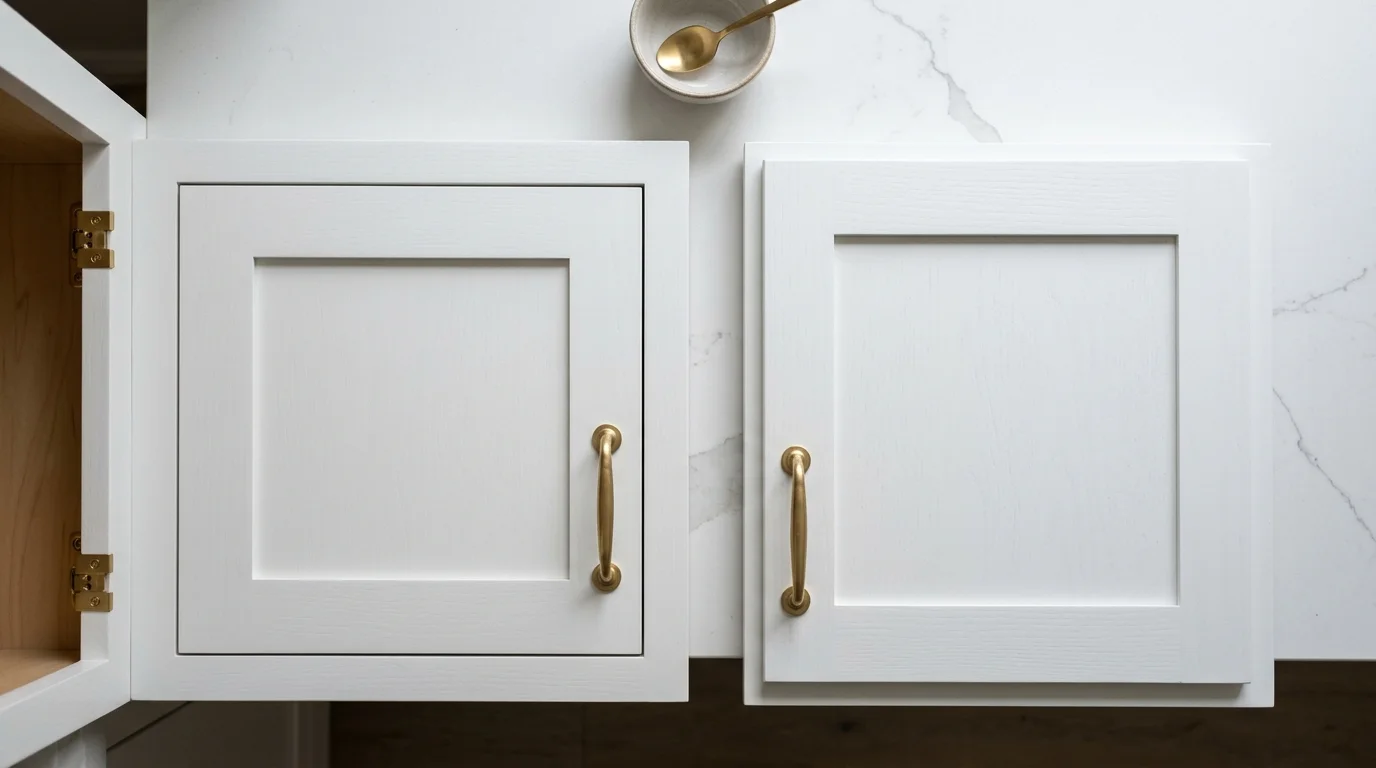
With overlay cabinets, the door sits on top of the face frame, it overlays it. You can see varying amounts of the frame depending on whether you go full or partial overlay. With inset cabinets, the door sits inside the face frame, flush with the front of the cabinet box. When the door is closed, the frame is fully visible around all four edges of the door.
That flush, frame-exposed look is what makes inset cabinets so distinctive. It's a more traditional, furniture-grade aesthetic, think classic New England cabinetry, Colonial Revival kitchens, or high-end British kitchen design. Every door and drawer has to be machined to tighter tolerances, hinges are typically concealed or semi-concealed, and the whole assembly requires more precise installation. That's exactly why inset costs more and why not every cabinet shop can execute it well.
Overlay cabinets, particularly full overlay, dominate contemporary and transitional kitchen design right now. When you see a flat-front or shaker door in a modern kitchen with almost no visible frame between doors, that's full overlay. The doors and drawers nearly touch each other, which gives a cleaner, more European-influenced look.
Both styles are available in framed cabinet construction. Inset is always framed by definition. Overlay can be framed or frameless, and frameless is its own category worth understanding before you make a decision. If you want to go deeper on that distinction, our guide on frameless vs framed cabinets covers the structural differences in detail.
Full Overlay vs Partial Overlay
Within overlay cabinets, you have two options: full overlay and partial overlay (also called standard overlay or traditional overlay). This matters more than most homeowners realize when they're pricing out a kitchen.
Partial overlay leaves a significant reveal of the face frame, typically 1.25" to 1.5" on each side of the door. You can clearly see the cabinet frame between every door and drawer. This was the standard in American kitchens for decades, and it still shows up in builder-grade and budget remodels. It's not a bad look, it's actually quite at home in cottage, farmhouse, and certain traditional styles. The bigger benefit is cost: partial overlay doors are often the least expensive option because tolerances are forgiving and standard hinges work fine.
Full overlay leaves only a 1/8" to 3/16" reveal of the face frame, so the doors and drawers appear nearly edge-to-edge. This is the dominant style in contemporary, transitional, and coastal modern kitchens right now. If you've been browsing Instagram or Houzz and love that clean, clean cabinet look, full overlay is what you're seeing. It runs more than partial overlay but significantly less than inset.
Here's our general guidance: if you want a traditional or transitional kitchen with visible frame character and you have the budget, choose inset. If you want a clean, current look without the inset price tag, full overlay is the move. Partial overlay makes sense for budget-conscious projects or specific cottage and farmhouse styles where the exposed frame reads as intentional rather than dated.
Whatever door style you land on, hardware selection plays a big role in how the finished kitchen reads. Take a look at our cabinet hardware guide for Palm Beach Countyit covers pull sizing, knob placement, and finish pairings that work with each door style.
Look, Style & What Works in South Florida
South Florida kitchens don't follow a single design formula, but there are clear patterns across the markets we serve, and those patterns should inform your door style choice.
In Jupiter and the northern Palm Beach County corridor, we see a lot of coastal transitional design: white or soft-toned shaker doors, natural stone or quartz counters, casual but refined. Full overlay shaker is the workhorse here. It's versatile enough to read as relaxed coastal or pulled-together traditional depending on the hardware and countertop you pair with it. If you're considering an all-white kitchen in this style, full overlay shaker is almost always the right call, it keeps the look light and uncluttered without the premium cost of inset.
In Boca Raton and Delray Beach, especially in luxury single-family homes and gated communities, inset cabinets are much more common. Homeowners there are often investing $70,000-$100,000+ in a full kitchen transformation, and inset detailing signals quality the moment you walk in the room. Paired with custom paint colors, unlacquered brass hardware, or integrated appliances, inset doors make a kitchen feel like a designed space rather than an assembled one.
Wellington leans toward a more relaxed, ranch-influenced aesthetic, large kitchens, practical layouts, warmer wood tones. Here we see full overlay in both painted and stained finishes, often on framed maple or oak boxes. Inset shows up in the higher-end custom builds but isn't the default expectation the way it is in parts of Boca.
One style note worth making: inset cabinets work especially well with detailed crown molding and furniture-style toe kicks. The craftsmanship commitment carries through the whole design. If you're going inset but skipping the finishing details, you're leaving value on the table.
Full overlay pairs naturally with flat-panel doors and minimal hardware, or with slim shaker profiles that keep the frame lines tight. Two-tone layouts, where base cabinets are one color and uppers are another, are easier to execute in full overlay because the reduced frame exposure keeps color transitions clean. For ideas on how Palm Beach County homeowners are handling color right now, our 2026 kitchen cabinet trends roundup is worth reading before you finalize your design.
Durability-wise, both styles perform well when built from quality materials. The argument that inset is less durable because of tighter tolerances is mostly a concern with cheap construction, if the cabinet box isn't square and stable, inset doors will stick, rack, and frustrate you. With quality framed construction, the tolerance isn't a problem. That said, inset doors are slightly more prone to showing seasonal wood movement in extremely humid environments, which is relevant in South Florida. We address that in the considerations section below.
One more thing: don't confuse door style with cabinet quality tier. You can get inset doors on stock cabinets (they exist), and you can get poor-quality overlay doors on semi-custom lines. The door style is a design and budget decision, it doesn't automatically tell you anything about box construction, drawer system quality, or finish durability. Always look at those specs independently. Our guide on the best kitchen cabinet styles for South Florida goes into construction quality in more detail.
Cost Guide
Here's where the rubber meets the road. Inset cabinets cost more, that's just the truth. The question is how much more, and whether the visual payoff justifies it for your project. The ranges below reflect what we see in the Palm Beach County market for cabinet supply and installation. These are cabinet-only figures; countertops, backsplash, and appliances are separate line items.
Keep in mind that cabinet cost depends heavily on if you're going stock, semi-custom, or fully custom. Inset is rarely available in true stock programs, you're almost always in semi-custom or custom territory, which raises the floor significantly. For a full breakdown of what drives cabinet pricing, the RTA vs custom cabinets comparison covers the decision well.
A few things to understand about these numbers. First, the spread within each tier is wide because kitchen size, number of cabinets, wood species, and finish all move the needle significantly. A 10-foot galley in a Delray Beach condo and a 400-square-foot kitchen in a Wellington estate are both "kitchens" but they're entirely different projects. Second, inset doors require more labor time to fit, adjust, and install, plan on that adding 15-25% to installation cost compared to the same cabinet line in full overlay. Third, semi-custom inset programs from manufacturers like KraftMaid exist and are a legitimate middle ground if you want the inset look without full custom pricing, but the options are narrower.
The cost premium for inset is real, but so is the resale value signal it sends in high-end Palm Beach County markets. If you're wondering whether the cabinet upgrade makes financial sense for your home's value tier, the 30% rule in remodeling is a useful framework before you commit.
South Florida Considerations
Living in Palm Beach County means your cabinets deal with things that kitchens in drier climates never face. Humidity, salt air in coastal communities, and the constant cycling of AC systems all affect wood movement, and wood movement is the central concern with inset cabinets specifically.
Inset doors work on tighter tolerances than overlay doors. That's what gives them their refined look. The typical gap between an inset door and the face frame is 3/32" to 1/8" on each side. When wood absorbs moisture and expands, which happens even with finished cabinets during South Florida's wet season, that gap closes. Doors can stick, drag, or feel stiff. When the AC kicks into high gear and relative humidity drops, the wood contracts and the gap may widen slightly. This is normal behavior, but it's more noticeable with inset than with overlay, where there's no precision gap to maintain.
Our recommendation for inset cabinets in South Florida: specify paint-grade MDF doors rather than solid wood doors wherever possible, or go with a high-quality engineered wood core with stable veneer faces. MDF moves significantly less than solid wood across humidity cycles. It also holds paint better over time, relevant because painted finishes dominate inset cabinet design. Solid wood inset doors in coastal environments are beautiful, but they require the homeowner to understand and accept seasonal movement as part of the deal.
For overlay cabinets, wood movement is less of a concern because the door has clearance room. Full overlay in painted MDF or thermofoil holds up well in our climate. If you're going with a stained wood finish on full overlay doors, choose a species with lower movement coefficients, hard maple and cherry outperform oak and hickory in humidity-variable environments.
One more South Florida-specific note: if your kitchen is near the coast, think east Boca Raton, Delray Beach barrier island, or Jupiter Inlet Colony, salt air accelerates finish degradation on exposed hardware and cabinet exteriors. Powder-coated hinges hold up better than plated options for inset cabinets where the hinge is more visible. For overlay and frameless systems with concealed European hinges, this is less of a concern because the hinge mechanism stays protected inside the cabinet.
Finally, if your project involves moving the sink location, adding a kitchen island with plumbing, or relocating a gas line for a cooktop, those scopes trigger permit requirements in Palm Beach County. Cabinet and countertop replacements that don't touch plumbing, electrical service panels, or structural walls typically don't require permits. Your general contractor handles permit applications and coordinates with the building department; that's outside our scope as the cabinet and finish installer. For a clear explanation of when permits apply, the Palm Beach County kitchen remodel permit guide is the right starting point.