Under Cabinet Lighting for Your Kitchen: Complete Guide
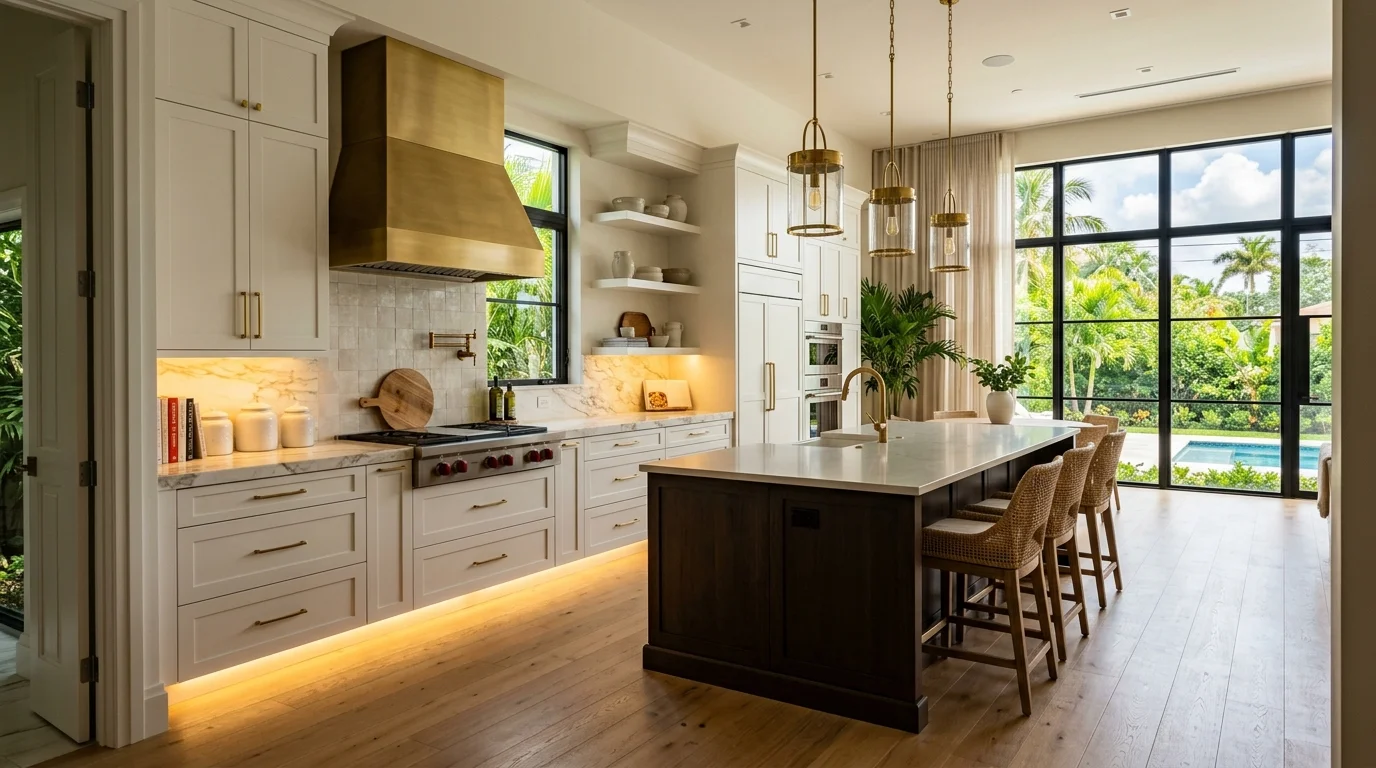
Under cabinet lighting for your kitchen is one of those upgrades that costs relatively little but changes how the space looks and functions more than almost anything else at the same price point. It puts task light exactly where you need it, on the countertop, instead of casting shadows from overhead cans. In Palm Beach County kitchens, where bright natural light competes with artificial lighting during the day and disappears fast at night, getting under cabinet lighting right makes a real difference. If you're doing a full remodel or just refreshing your finishes, this guide covers every decision you'll face: fixture types, color temperature, dimmability, wiring, and what it actually costs in the Boca Raton, Delray Beach, Wellington, and Jupiter markets.
Why Under Cabinet Lighting Actually Matters
Most kitchens in South Florida are lit with recessed cans in the ceiling. That's fine for general ambient light, but the moment you stand at the counter to chop vegetables or read a recipe, your own body blocks the light from above. You end up working in your own shadow. Under cabinet lighting solves that completely.
Beyond function, the visual effect is significant. A strip of warm light running beneath your uppers grazes the backsplash and countertop, adding depth and making the whole kitchen feel more finished. It's the difference between a kitchen that looks good in photos and one that looks good at 7pm on a Tuesday when you're actually cooking.
We've installed under cabinet lighting in kitchens across Palm Beach County, everything from narrow galley layouts in Delray Beach condos to large open-plan kitchens in Wellington and Jupiter, and the reaction from homeowners is consistent: they wish they'd done it sooner. It pairs especially well with a full-height tile backsplash because the grazing light picks up the texture and movement in the tile. If you're weighing backsplash options, our 4-inch vs full-height backsplash guide walks through how that decision plays into the overall lighting design.
It also adds real value. Buyers notice it. It reads as a premium detail, especially in the mid-range and luxury kitchen categories where buyers in Boca Raton and Jupiter expect a polished, complete package.
LED Strips, Puck Lights & Light Bars Compared
There are three main fixture categories for under cabinet lighting. Each has a real use case. Here's our honest take on all three.
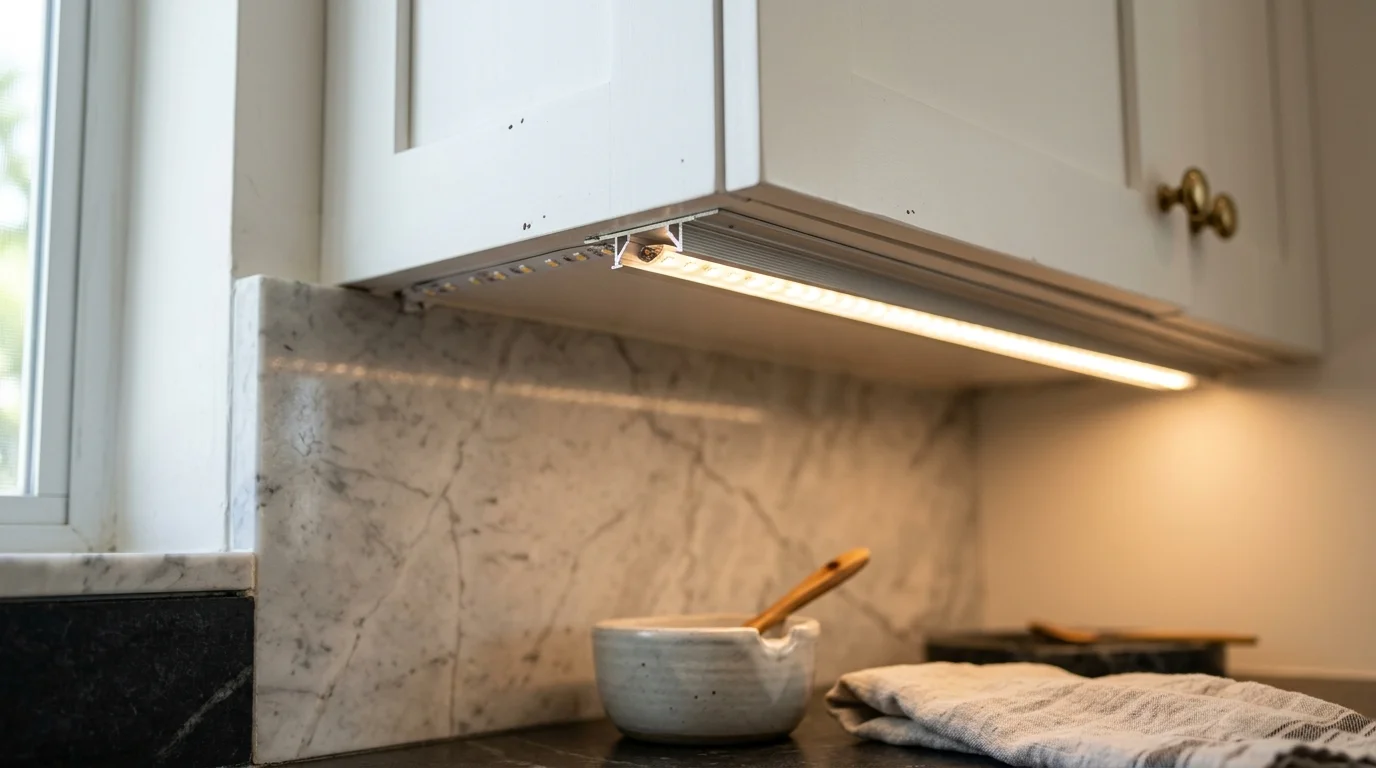
LED Strip Lights are the most popular option we install today, and for good reason. A continuous LED tape runs the full length of the cabinet and delivers consistent, even light across the entire countertop with no hot spots or dark gaps. Modern LED strips, specifically those with a high CRI (Color Rendering Index) of 90 or above, make food, stone countertops, and tile look accurate and rich. The strips themselves are thin enough to hide completely behind the cabinet's front rail. You won't see the source, just the glow. We recommend going with a quality product from a reputable manufacturer. The U.S. Department of Energy's LED lighting resource is a solid starting point for understanding efficiency ratings if you want to compare products before specifying.
The one drawback with strips: the quality range is enormous. Cheap strips from no-name suppliers fade in color, flicker with certain dimmers, or have inconsistent output within six months. Spend money here. It's not a place to cut corners.
Puck Lights are circular disc fixtures spaced at intervals under the cabinet. They were the standard for a long time and still show up in a lot of older Palm Beach County kitchens. The problem is the light pattern, each puck creates a circle of bright light with dark spots between them. On a plain white countertop that's tolerable. On a detailed stone or quartz surface, the scalloping effect looks cheap and distracting. We generally steer clients away from puck lights for new installations unless the cabinet run is very short and even spacing isn't an issue. If you're replacing existing puck lights as part of a cabinet refresh, it's worth upgrading to strip lights or a continuous light bar at the same time.
Light Bars are a middle ground, a rigid linear fixture in aluminum housing, usually available in lengths from 12 to 48 inches. They produce clean, even output and are easier to install than a flexible strip because they're plug-and-play in many configurations. The downside is that on a long cabinet run, you're linking multiple bars end-to-end, and the joints can create a faint dark spot. For runs under 36 inches, a single cabinet section in a smaller kitchen, a light bar is a clean, practical choice. For longer continuous runs, we prefer LED strip.
One more consideration: hardwired versus plug-in. Plug-in fixtures are faster to install and don't require electrical work, but the cords are visible unless you run them through the cabinet interior to a hidden outlet. Hardwired fixtures look cleaner and are a better long-term solution for a finished kitchen. Any new electrical circuits or outlet additions inside the cabinet are your general contractor's scope, not something our team handles directly, but we coordinate closely with the GC on placement and timing so the lighting rough-in happens before the cabinets go in.
Color Temperature: Getting It Right
This is where most homeowners make their biggest mistake. They pick a fixture without thinking about color temperature, and then wonder why the kitchen looks off. Color temperature is measured in Kelvin (K). The lower the number, the warmer and more amber the light. The higher the number, the cooler and bluer it gets.
Here's a simple breakdown for kitchen applications:
- 2700K, 3000K: Warm white. Looks great in traditional, coastal, and transitional kitchens. Flattering on wood tones, cream cabinets, and warm stone countertops. This is our most common recommendation for South Florida homes because it complements the natural light palette here.
- 3500K: Neutral white. A good middle ground if your recessed cans are also at 3500K and you want everything to feel cohesive.
- 4000K: Cool white. Works in very modern or contemporary kitchens, flat-front cabinets, white-on-white schemes, concrete or industrial looks. If you're going this route, make sure your ceiling lighting matches.
- 5000K+: Daylight. We don't recommend this for residential under cabinet lighting in kitchens. It's clinical and unflattering on most materials.
The key rule: match or closely align your under cabinet lighting color temperature with your recessed ceiling lights. A 2700K strip under the cabinets paired with 4000K recessed cans creates a jarring mismatch that's hard to ignore once you see it. If you're planning recessed lighting at the same time, our recessed lighting layout guide for kitchens covers how to coordinate both layers properly.
CRI matters as much as Kelvin. A CRI of 90 or above is what you want for a kitchen. Lower CRI lights make your countertops look dull and your food look unappetizing. It's a spec that's easy to verify, any quality fixture will list it.
If you have a white kitchen, color temperature becomes even more critical. Warm 2700K light on bright white cabinets creates a beautiful cream tone that feels luxurious. Cool 4000K on white cabinets can look sterile. Our all-white kitchen design guide for South Florida goes deeper on how lighting affects the overall palette.
Dimmability and Smart Controls
Under cabinet lighting you can't dim is under cabinet lighting you'll eventually hate. At full brightness during dinner prep it's perfect. At 10pm when you want a glass of water, full blast task lighting is uncomfortable. Dimmability is not optional in our opinion, it's a baseline requirement.
The complication is compatibility. LED strips and dimmers have to be matched correctly. A standard incandescent dimmer on an LED strip will flicker, buzz, or not dim smoothly through the full range. You need a dimmer that's specifically rated for LED loads and ideally matched to your specific driver or transformer. This is a detail your electrician and your fixture supplier both need to know about before anything gets installed.
For most Palm Beach County homeowners, a simple wall-mounted LED-compatible dimmer is enough. It's reliable, easy to use, and keeps costs down. If you're doing a larger remodel and already investing in smart home technology, integrating under cabinet lighting into a system like Lutron Caseta or a similar platform gives you scene control, scheduling, and app operation. That's worth it if the infrastructure is going in anyway. If it's not, the smart system adds cost without proportional benefit for most households.
One practical note on placement: think about where the dimmer switch lives relative to the counter. We've seen layouts where the only switch controlling the under cabinet lights is across the kitchen, which defeats the purpose. Ideally the control is within arm's reach of the main prep area. Plan this before the electrical rough-in, not after.
If you're pairing under cabinet lighting with island pendants, it's worth reading our pendant lighting over kitchen island guidecoordinating the two circuits and their dimmers so they work together is part of a well-planned lighting design.
Smart kitchen technology is moving fast. If you're curious what else is worth integrating during a remodel, our smart kitchen technology guide for 2026 covers what actually gets used versus what sounds good in a showroom.
Cost Guide
Costs for under cabinet lighting in Palm Beach County vary by fixture type, run length, and whether the installation is hardwired or plug-in. Below are real ranges we see on our projects, not national averages pulled from a survey. These reflect material and installation labor in the Boca Raton, Delray Beach, Wellington, and Jupiter markets.
Permit note: under cabinet lighting that's plug-in and connects to an existing outlet typically doesn't require a permit. Hardwired installations that add new circuits or extend electrical service may require one depending on scope, that determination is your GC's call, not ours. Your general contractor will advise based on the specific work involved.
Under cabinet lighting is one of the better value-per-dollar upgrades in a kitchen refresh. Even at the high end of the range, it's a small line item relative to a full remodel. If you're trying to understand where this fits in the overall budget, our kitchen remodel cost guide for Palm Beach County breaks down every major scope with current local pricing.
South Florida Considerations
A few things about Palm Beach County kitchens make under cabinet lighting decisions slightly different than they'd be in other markets.
First, heat and humidity. South Florida's climate is tough on electronics. Cheap LED drivers and bargain-brand strips don't hold up well when kitchen humidity cycles daily and ambient temps run higher than a home in the Northeast. Spend on quality fixtures with good thermal management. The drivers, the power supply components, are where failures happen first. A quality driver from a reputable manufacturer has a real operational life in this climate; a no-name driver from an overseas supplier might not.
Second, natural light interaction. In Boca Raton and Jupiter waterfront homes especially, kitchens often get intense direct light for part of the day and then shift dramatically in the evening. Under cabinet lighting at 2700K reads completely differently at noon versus 8pm. This is actually an argument for dimming capability, you'll use it more here than in a darker Northern kitchen.
Third, HOA and condo considerations. If you're in a managed community in Palm Beach County, and many of our clients in Delray Beach and Wellington are, any new electrical work tied to the under cabinet lighting is subject to HOA rules and potentially requires building department involvement depending on the scope. Your GC handles the permit side of that. Our role is the cabinet and finish work. For clients navigating a condo remodel specifically, our condo kitchen remodel and HOA guide is worth reading before you start planning.
Fourth, backsplash material matters more than most homeowners realize when it comes to under cabinet lighting. A glossy subway tile will reflect the light strip and can create a bright, almost neon streak if the fixture is too bright or positioned wrong. A matte or textured tile handles the grazing light beautifully. If you're choosing your backsplash tile at the same time, our kitchen backsplash ideas guide for Palm Beach County covers material and finish choices with this in mind.
Finally, if you're doing a full remodel and not just a lighting update, under cabinet lighting needs to be specified before the cabinets go in, not after. The strip channel, wire routing, and driver location all have to be planned during cabinet design and installation. Retrofitting after the cabinets are in place is possible but messier and more expensive. Plan it early, execute it right.