Kitchen Lighting Ideas: The Complete Guide for South Florida Homes
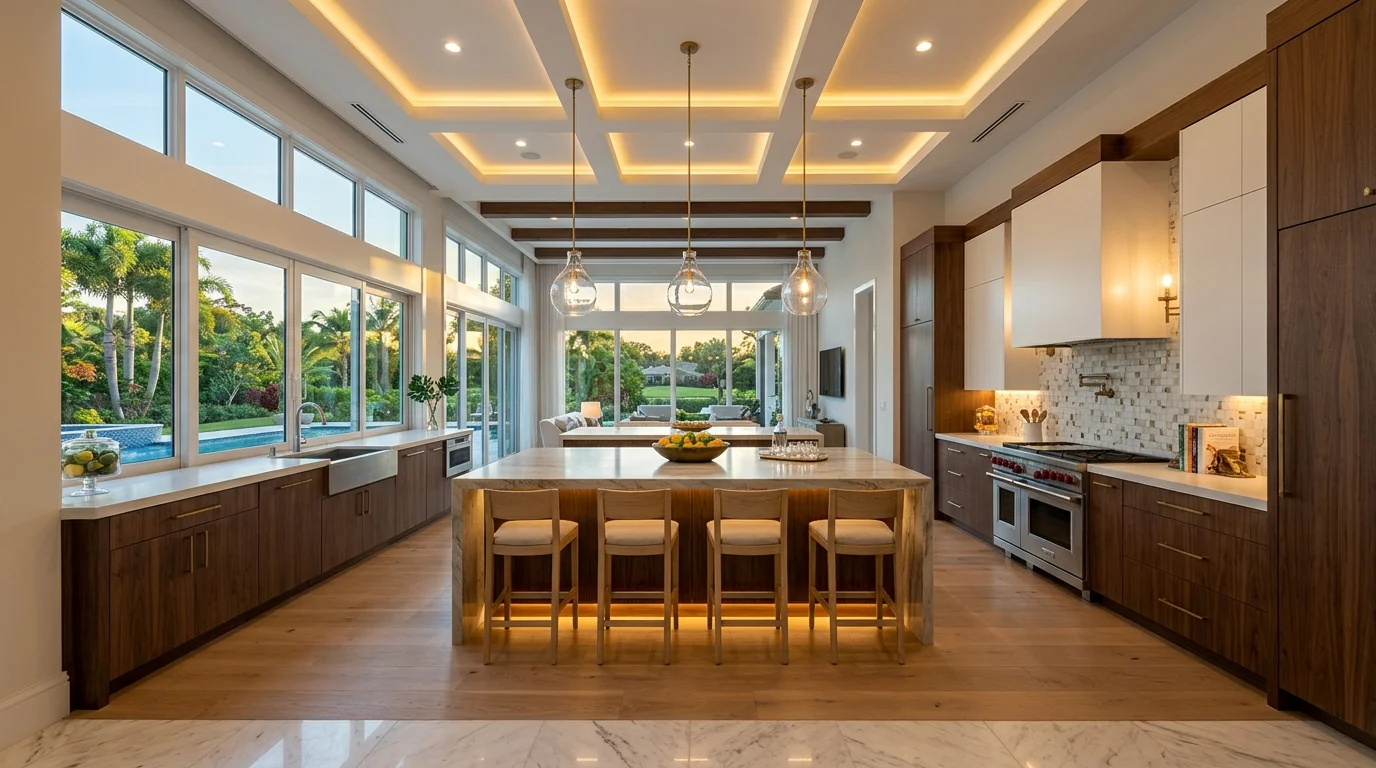
Kitchen lighting ideas get talked about less than countertops and cabinets, but they affect how your kitchen actually feels more than almost any other decision. Bad lighting makes a $60,000 remodel look cheap. Great lighting makes a modest refresh look polished. At South Florida Kitchen & Bath Design, we design lighting plans for kitchens across Palm Beach County, from Boca Raton condos to Wellington single-family homes, and the same principle applies every time: you need layers, not just fixtures. This guide covers everything, from recessed layout to pendant sizing to what it all costs here in South Florida.
Why Kitchen Lighting Deserves Its Own Plan
Most homeowners pick a few can lights, add a chandelier over the island, and call it done. Then they wonder why the kitchen still feels dark at 7 p.m. The problem is almost always a single-layer lighting plan, meaning everything is on the same switch, at the same height, doing the same job. That approach flattens the space and creates glare on countertops while leaving corners and cabinet interiors in shadow.
A proper lighting plan treats the kitchen like a stage with multiple zones. You have cooking areas that need bright, focused task light. You have the island or peninsula where people gather, and that spot benefits from warmer, more ambient pendants. You have upper cabinets or a range hood surround where accent lighting adds visual depth. Each zone has a job. Each zone needs its own control.
We recommend putting every lighting layer on a separate dimmer circuit. This is the single highest-return lighting upgrade you can make, and it costs almost nothing compared to the fixtures themselves. Dimmers let you run the kitchen at full blast for meal prep and dial it back to 30 percent for a casual dinner. Your general contractor handles the electrical rough-in; our team coordinates the fixture placement and cabinet-integrated lighting during the design phase so everything lines up correctly before a single wire gets run.
One more thing worth saying plainly: lighting is not a category to value-engineer at the end of a remodel. We have seen homeowners spend $45,000 on cabinetry and countertops and then cut the lighting budget to $800 in recessed cans. The result never looks right. Budget for lighting from the start, the same way you budget for hardware or tile.
The Three Layers Every Kitchen Needs
The industry standard framework is ambient, task, and accent lighting. These terms get thrown around loosely, so here is what they actually mean in a kitchen context.
Ambient lighting is your general fill light. Recessed cans on a grid pattern are the most common source in South Florida homes, and they work well when laid out correctly. The mistake most people make is spacing them too far apart. A proper recessed layout for a kitchen puts fixtures on 4-foot centers or closer, angled toward countertops, not straight down at the floor. Our dedicated guide on recessed lighting layout for your kitchen remodel walks through the exact spacing math and how to account for ceiling height, which matters more than most people realize.
Task lighting is direct, focused light right where you work. Under-cabinet lighting is the gold standard here. A strip of LED tape or a row of puck lights mounted to the underside of your upper cabinets throws light directly onto the countertop surface with no shadows from your body blocking overhead fixtures. This is the lighting upgrade our team recommends to every homeowner who spends serious money on countertops, because it is the only way to actually see the stone you paid for. For a deep dive, our complete guide to under-cabinet lighting covers hardwired versus plug-in options, LED tape versus puck lights, and color temperature selection.
Accent lighting adds visual interest and depth. This category includes interior cabinet lighting behind glass-front doors, toe-kick LEDs at floor level, and strip lighting above upper cabinets that washes the ceiling. These touches are optional, but they are what separate a kitchen that looks designed from one that just looks renovated. If you have glass-front cabinets, interior lighting is not optional; without it, those cabinets look like dark boxes at night.
The right approach is to plan all three layers simultaneously, not sequentially. Deciding where the island pendants go after the recessed layout is already planned leads to conflicts. We see this constantly on projects where the homeowner sourced lighting separately from the kitchen design. Everything needs to be coordinated on the same plan from day one.
Fixture Types: What Works Where
South Florida kitchens tend toward open layouts with high ceilings, and the fixture choices that work here are not always the same ones that photograph well in a New England farmhouse kitchen. Here is our honest take on each fixture type.
Recessed downlights (can lights) are the workhorses of any kitchen lighting plan. We specify 4-inch aperture LED recessed fixtures almost exclusively now. They are slim, they produce enough output for a kitchen, and the retrofit versions make it easier for your GC to add or reposition them without major ceiling work. Avoid 6-inch cans in kitchens with 9-foot or lower ceilings; they look oversized and create hot spots. On high ceilings, 6-inch works fine.
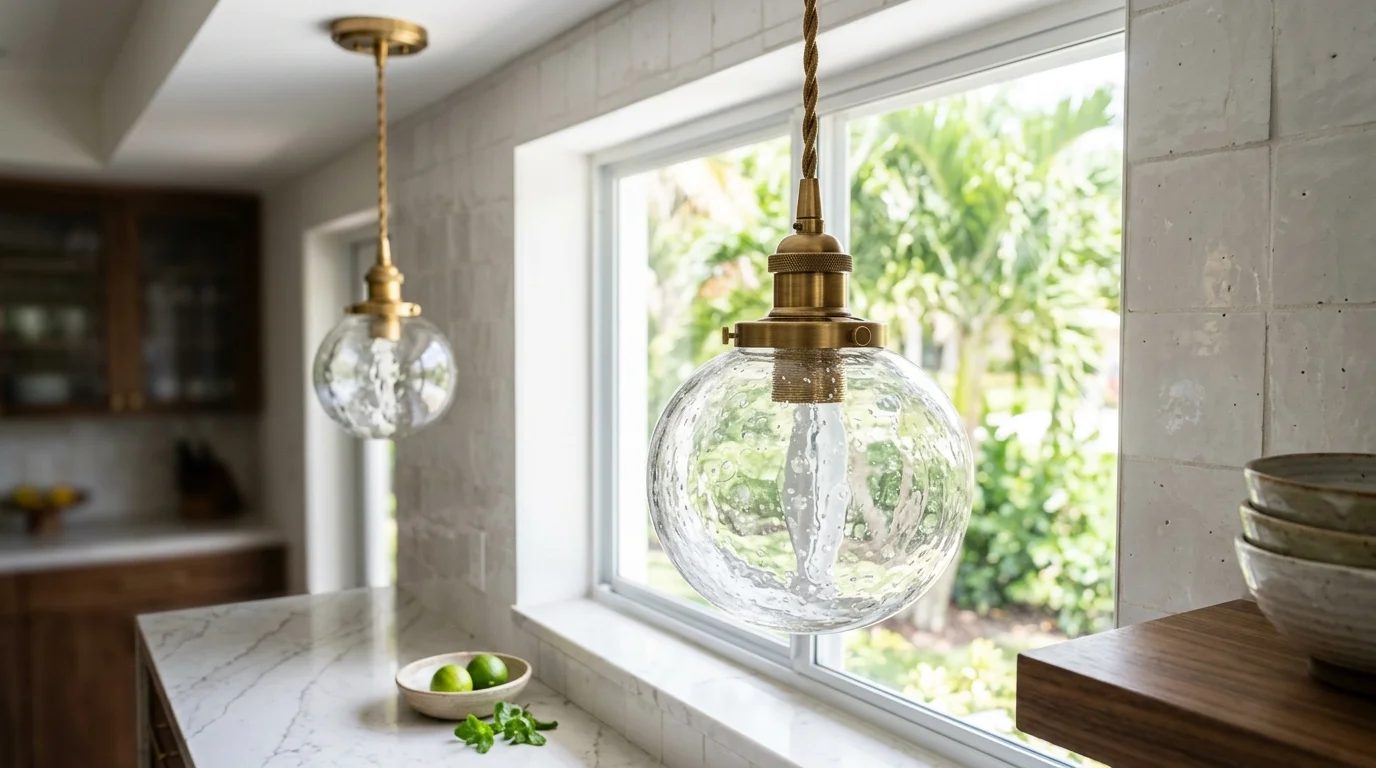
Pendant lights over the island are the most visible design decision in most kitchens. Size matters enormously here. A pendant that looks perfect in a showroom can look undersized when it is actually hanging over a 4-foot island in your home. The general rule our team uses: pendant diameter in inches should be roughly one-third of island length in inches. Two pendants over a 48-inch island means each pendant should be around 14-16 inches in diameter. For full sizing guidance and style direction, see our post on pendant lighting over a kitchen island.
Under-cabinet lighting is where we see the biggest quality gap between budget and mid-range installations. Plug-in puck lights from a big-box store look fine for a few months, then you start noticing the uneven light pools and the cords taped along the cabinet bottom. Hardwired LED strip lighting, installed during the remodel before the upper cabinets go in, delivers a uniform wash of light with no visible hardware. If your remodel schedule allows it, hardwired is always the right call.
Semi-flush and flush-mount ceiling fixtures work in smaller kitchens without islands. They are also a good solution for kitchens with 8-foot ceilings where pendants would feel too low. The problem is most homeowners pick fixtures that are too small. A 10-inch flush mount in a 150-square-foot kitchen looks like a nightlight. Size up.
Range hood lighting deserves mention because it is often overlooked as a task lighting source. Most range hoods include built-in LED task lights that illuminate the cooktop directly. This is actually excellent task lighting for cooking. Do not skip it or cover it up with a bulky surround. Our range hood buying guide covers what to look for when those integrated lights are part of the spec.
Color temperature is the variable that most homeowners get wrong. The South Florida kitchen that looks warm and inviting in a showroom often ends up feeling clinical at home because someone specified 5000K (daylight) bulbs throughout. We recommend 2700K-3000K for most kitchen applications. It reads as warm white, works well with wood tones and natural stone, and looks more like natural Florida light than the cool blue end of the spectrum. The exception is task lighting directly over a prep area, where 3500K gives slightly better color rendering for seeing food clearly.
Kitchen Lighting Cost Guide
These are real Palm Beach County numbers, not national averages. Electrical labor rates here run higher than the national mean, and fixture costs vary widely based on brand and specification. Your general contractor handles all electrical rough-in and permitting when scope triggers it; the fixture and placement costs below reflect what homeowners typically spend on the fixtures themselves plus installation labor from their GC.
Note: lighting changes that involve adding new circuits, upgrading panel capacity, or running new wiring through finished walls will require permits from Palm Beach County. Simple fixture swaps on existing circuits typically do not. Your GC will advise based on scope.
Fixture quality is where costs swing most. A set of two island pendants from a big-box store might cost $180 total. The same two pendants from Visual Comfort or Rejuvenation run $600-$1,800. Both hang from the same ceiling, but they do not look the same. For a kitchen where you are spending $35,000 or more on cabinetry and countertops, skimping on pendant quality is a mistake you will notice every day. For guidance on keeping the overall project in a healthy range relative to your home's value, the 30 percent rule in remodeling is a useful benchmark.
Smart lighting controls are worth serious consideration. Lutron Caseta dimmers are what our team specifies most often because they are reliable, compatible with most LED fixtures, and integrate with Alexa, Google Home, and Apple HomeKit without requiring a full smart home hub. The ability to set lighting scenes, so that a "cooking" scene runs recessed cans at 100 percent and under-cabinet at 80 percent, while a "dinner" scene drops everything to 40 percent, is genuinely useful in daily life, not just a tech novelty.
South Florida Considerations
Kitchen lighting design in Palm Beach County has a few specific factors that do not always come up in national design guides.
Natural light is abundant, and that changes the equation. A kitchen in Delray Beach or Jupiter with east or south-facing windows gets intense direct sun for several hours a day. In those kitchens, the artificial lighting plan needs to work well even when competing with bright Florida daylight. High-output LED recessed fixtures matter more here than in a dark Northern kitchen. Conversely, kitchens in condos along the Intracoastal in Boca Raton often have west-facing windows that get blinding afternoon glare, and the task lighting needs to compensate during morning hours when the west side is in relative shadow.
Humidity affects fixture selection. If your kitchen is adjacent to an outdoor lanai or you run the kitchen window open regularly, choose fixtures with sealed housings. Moisture and open electrical fixtures are a bad combination in South Florida's climate. This is especially true for any lighting installed in an outdoor kitchen or covered lanai extension.
HOA and ARB reviews in gated communities. Many Wellington and Palm Beach Gardens communities require architectural review for remodel projects. Our team supplies design drawings and material samples that your GC can include in any required HOA or ARB submission package. We do not submit those packages ourselves, but we make sure our drawings are detailed enough that whoever does submit has everything they need.
Older homes need extra planning. A lot of the kitchens we work on in Delray Beach and Boca Raton were built in the 1980s and early 1990s with minimal electrical infrastructure. Single 15-amp circuits serving an entire kitchen were common. If your remodel involves adding multiple new lighting zones plus under-cabinet hardwired strips, your GC may need to add dedicated circuits. That is a scope conversation to have early. See our post on remodeling a 1980s Florida kitchen for a broader look at what those projects typically uncover.
Cabinet style affects lighting choices. This is something we think about from the very beginning of a design. Dark kitchen cabinets absorb ambient light, so you need more of it. If a homeowner is going with navy blue or charcoal lowers, we specify higher-output recessed fixtures and make sure the under-cabinet lighting is hardwired and continuous rather than spotty puck lights. Dark kitchen cabinets can look spectacular in South Florida light, but only when the lighting plan accounts for the absorption factor. On the flip side, an all-white kitchen reflects light aggressively, and you can sometimes use slightly lower-output fixtures without the space feeling dim.
Energy codes in Florida. The Florida Building Code Energy Conservation section requires that a certain percentage of installed luminaires in a kitchen meet high-efficacy standards. In practice, this means LED throughout, which is what we specify anyway. Incandescent and halogen fixtures are effectively off the table for new kitchen installations in Florida. This is not a burden; modern LED fixtures have improved dramatically in color quality over the past five years, and there is no reason to use anything else.
If you are pairing a new lighting plan with a broader kitchen refresh, the timing of lighting decisions matters relative to cabinet and countertop installation. Under-cabinet lighting needs to be roughed in before uppers are installed. Pendant junction boxes need to be in the ceiling before drywall closes. We walk through this sequencing in detail as part of our design process, but if you want the full picture of how a remodel phases together, our kitchen remodel order of operations guide is worth reading before you start scheduling trades.