Glass-Front Cabinet Ideas: Clear, Seeded & Fluted Glass for South Florida Kitchens
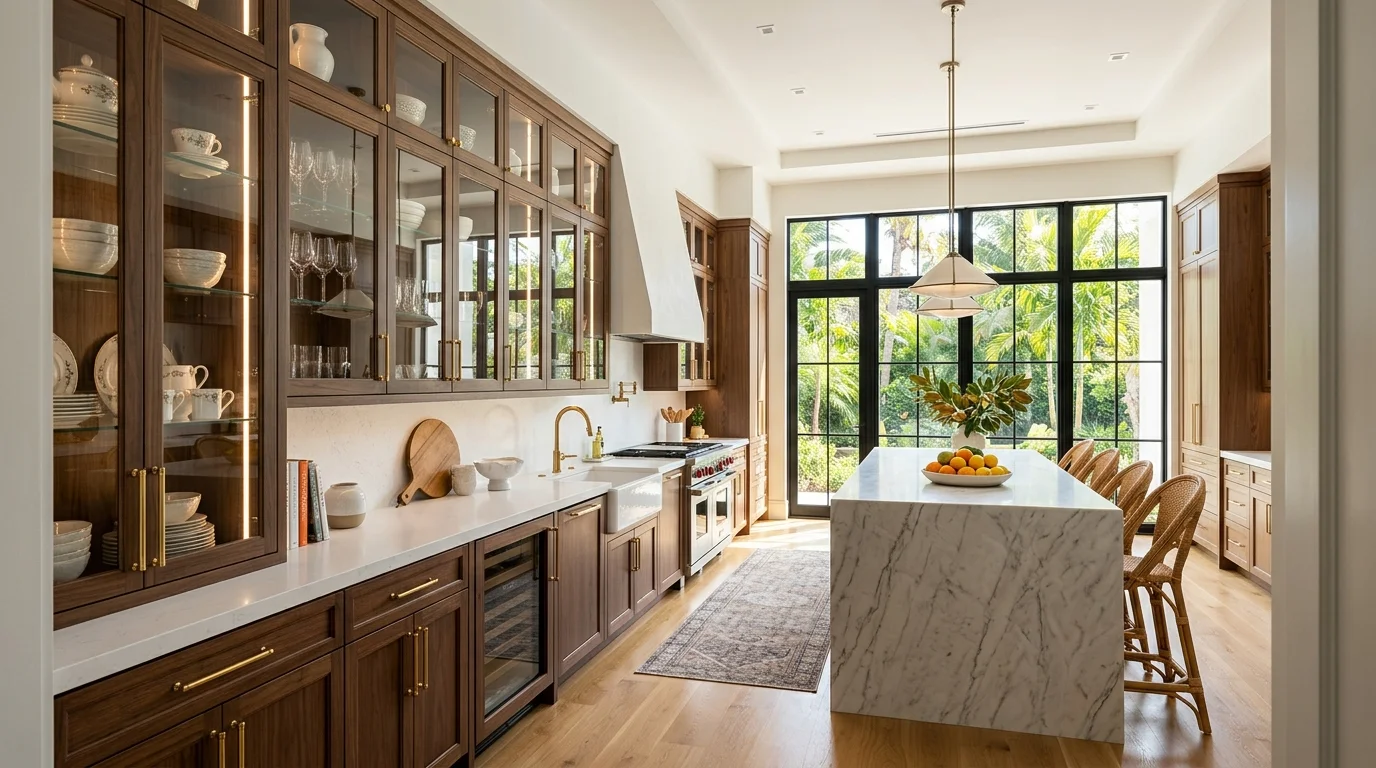
Glass front cabinets are one of the most requested upgrades we see from homeowners in Palm Beach County, Boca Raton, Delray Beach, Wellington, and Jupiter. They break up a wall of solid doors, add depth to a kitchen, and let you show off the things worth showing. Done right, glass front cabinets feel intentional and custom. Done wrong, they turn into a display case for clutter. Our team has installed them on everything from modest galley kitchens in Boynton Beach condos to sprawling coastal kitchens in waterfront homes in Jupiter Inlet Colony. This guide covers the three main glass types, how to pair them with different cabinet styles, what they actually cost in our market, and the details that separate a polished result from a regrettable one.
Why Glass-Front Cabinets Work in South Florida
South Florida interiors live and die by natural light. Our homes get a lot of it, and glass front cabinets take full advantage. When afternoon sun hits a kitchen in Delray Beach, clear or lightly textured glass panels bounce that light around in a way solid doors simply cannot. The kitchen feels bigger. The upper cabinets feel less heavy. That matters especially in homes with lower nine-foot ceilings, which are common in communities built through the 1990s and 2000s across Palm Beach County.
There is a practical angle too. Clients who cook regularly tell us they love grabbing a glass or a bowl without opening three wrong doors first. When your everyday items are visible, the kitchen runs more efficiently. That said, glass front cabinets demand a level of organization most people do not naturally maintain. Our honest advice: plan which cabinets will have glass before the project starts, and only put glass on the cabinets where you are willing to keep things neat. Two or three glass-front uppers flanking a range or a window is a far better strategy than glassing out every upper in the kitchen.
Glass front cabinets also pair exceptionally well with the under-cabinet and interior cabinet lighting that has become a standard part of mid-range and luxury kitchen packages. Putting a small LED puck or strip light inside a glass-front cabinet makes the whole run glow at night. That detail alone elevates a kitchen from functional to genuinely beautiful.
Clear, Seeded, and Fluted Glass: Which One Is Right for You?
The glass type is the single most important design decision here. It determines how much you see, how much texture the door carries, and how formal or casual the kitchen feels. We work with three types almost exclusively, and each one has a distinct personality.
Clear glass is exactly what it sounds like. Full transparency. You see everything behind the door. This works beautifully when your shelves are styled deliberately, with matching dishware, a row of uniform glasses, or a curated collection of serving pieces. Clear glass reads as classic and refined. It is the right call for transitional kitchens, traditional kitchens, and any space where you want that furniture-like cabinet look. It pairs naturally with shaker-style cabinet doors, which have enough visual weight in the frame to balance the openness of the glass. The downside is zero forgiveness for disorder. One mismatched mug and the whole cabinet looks chaotic.
Seeded glass has tiny air bubbles trapped inside the pane, creating a soft, antique texture that slightly blurs what is behind it. You get a sense of what is on the shelf without a perfectly clear view. This is our recommendation for homeowners who love the look of glass front cabinets but are realistic about how organized their cabinets actually stay. Seeded glass is also the best fit for Mediterranean, Old Florida, and farmhouse kitchens. It has warmth and character that plain clear glass does not. If you are working on a Mediterranean-style kitchen, seeded glass on the uppers is almost always on our short list.
Fluted glass (also called reeded glass) is the trendy option right now, and for good reason. The vertical ridges catch light differently depending on the angle, creating a dynamic, almost decorative surface. Fluted glass provides meaningful privacy. You can see color and shape behind the door, but not detail. That makes it the most forgiving of the three for everyday use. It also has a strong modern and transitional design sensibility. We are putting fluted glass into kitchens across the range, from flat-front frameless cabinets in contemporary Boca Raton homes to more traditional framed cabinets in Wellington equestrian properties. The texture reads as a design feature in its own right, not just a functional choice.
A fourth option worth mentioning is wire glass or antique mirror, which we use occasionally in butler's pantries and bar areas. Antique mirror as a cabinet insert gives a very high-end, collected look that works especially well in butler's pantry designs where the cabinet is more of a display feature than a daily-use storage unit.
One practical note on glass thickness: cabinet door inserts should be a minimum of 3/16-inch tempered glass for safety. Standard clear glass at that thickness is fine. Seeded and fluted glass in decorative patterns typically runs slightly thicker, around 1/4 inch, which adds cost but also feels more substantial. Florida Building Code requires tempered or safety glass in certain locations, so if your GC is pulling a permit for a broader kitchen renovation, make sure the glass spec is documented in the drawings.
Design Ideas and Cabinet Pairings
Glass front cabinets are not a one-size-fits-all detail. The way you use them should be driven by your overall cabinet style, your kitchen layout, and what you actually want to display. Here are the pairings and approaches we find ourselves recommending most often in Palm Beach County kitchens.
Flanking the range hood. Two glass-front uppers on either side of the range hood is the most classic placement. It creates symmetry, frames the focal wall, and keeps the display area contained. This layout works in virtually every kitchen style. If you have a 36-inch or 48-inch range with a prominent hood, this arrangement ties the whole wall together. Clear or seeded glass both work here depending on your style.
Corner accent cabinets. A single glass-front corner cabinet at the end of a run draws the eye and breaks up what could be a monotonous stretch of solid doors. This is a good option for homeowners who want the look without committing to a full glass treatment. One well-placed glass door does more visual work than you might expect.
Full upper run in glass. Some clients, particularly those with coastal or transitional kitchens in Boca Raton or Palm Beach Gardens, want all of their upper cabinets in glass. This works when the interior of every cabinet is thoughtfully organized and the lighting inside is designed to complement the display. We recommend fluted glass for this approach because it adds privacy and texture without the kitchen feeling like a store display. Pair with interior LED strips for best results.
Two-tone cabinet pairings. Glass front cabinets take on a completely different personality depending on whether the cabinet body is painted or stained. On white uppers, clear glass reads as bright and open. On navy blue or dark-painted uppers, glass inserts create a dramatic contrast, especially with interior lighting. The dark interior behind fluted glass is one of the best looks available in kitchen design right now. We see it constantly in higher-end Wellington and Jupiter projects.
Open shelving alternative. Some clients come to us wanting open shelving but worrying about dust and grease accumulation on their dishes, which is a legitimate concern in kitchens that see real cooking. Glass front cabinets give you the visual openness of shelving with the protection of a door. It is a practical compromise that we recommend over true open shelving for most active kitchens. If you are weighing the two, read our take on open shelving pros and cons before deciding.
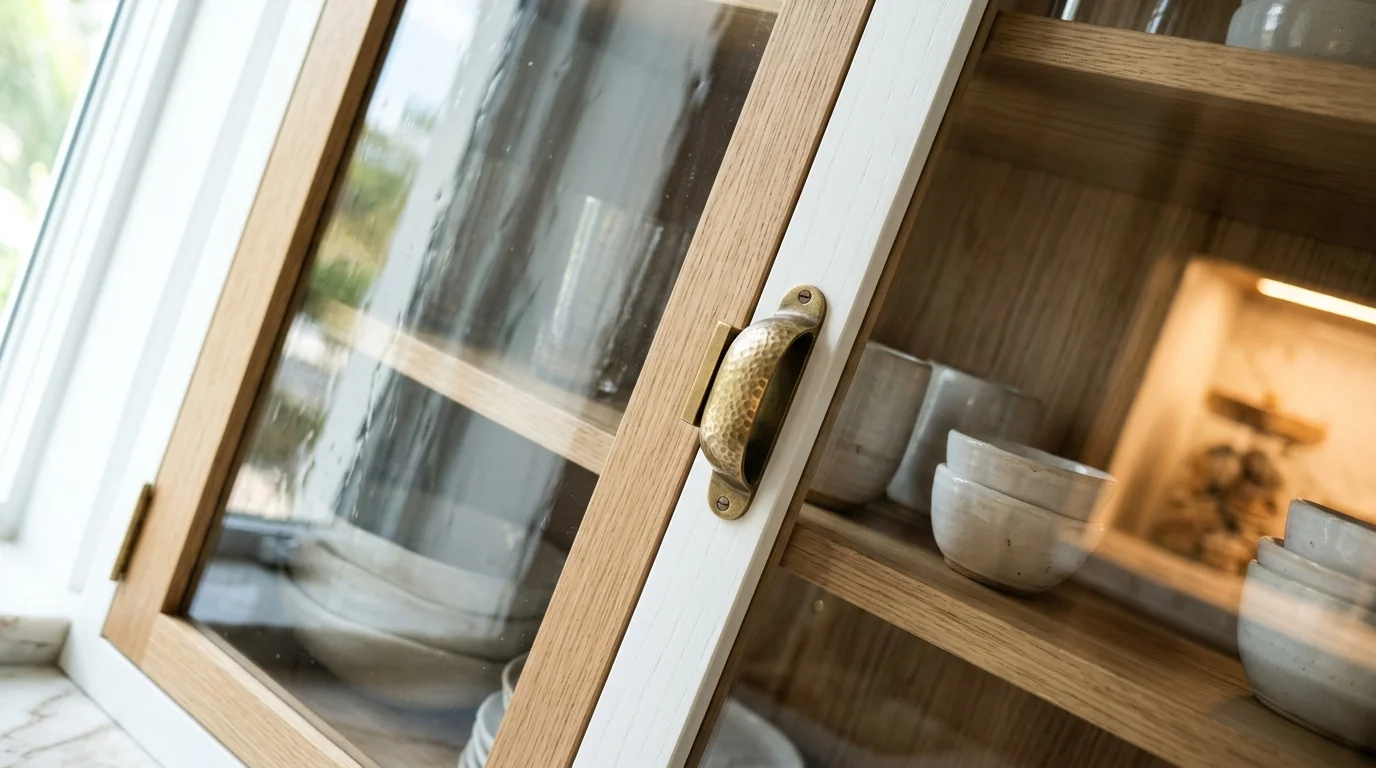
Hardware pairings. Glass front doors need hardware that complements the frame without competing with the glass. We lean toward simple bar pulls or cup pulls in brass or unlacquered finishes for most traditional applications, and minimal flat pulls or finger pulls for modern frameless cabinets with fluted glass. The hardware should feel like a natural extension of the door, not a statement piece. If you are still working through hardware decisions, our complete cabinet hardware guide walks through the full process.
Cost Guide
Glass front cabinet costs in Palm Beach County depend on whether you are retrofitting existing doors, ordering new cabinet doors with glass inserts, or specifying glass-front doors as part of a full cabinet order. The ranges below reflect our current pricing in this market. They are not national averages.
If you are adding glass front doors as part of a broader kitchen cabinet project, the per-door premium above the cost of a solid door is typically $100-$250 depending on the glass type and cabinet line. For full kitchen remodel cost context specific to your area, see our guides on kitchen remodel costs in Boca Raton and kitchen remodel costs in Delray Beach.
Worth noting: a glass-front cabinet door swap without plumbing, electrical, or wall changes typically does not require a permit. Permits become scope-dependent when a broader kitchen renovation involves moving sinks, relocating appliances, or changing electrical circuits. Your GC can advise on what applies to your specific project.
South Florida Considerations
A few things come up repeatedly when we spec glass front cabinets in Palm Beach County that you would not necessarily encounter in a drier climate.
Humidity and the cabinet interior. South Florida humidity is real. Upper cabinets near a range or dishwasher can trap moisture, and dishes that go away slightly damp can develop mildew smell over time. This is not unique to glass front cabinets, but it is more visible when the interior is exposed. Make sure your kitchen has adequate ventilation, and consider a range hood that vents to the exterior rather than recirculating. If you are upgrading your range hood as part of a remodel, that is a conversation worth having with your GC early.
Salt air near the coast. Homes within a mile or two of the ocean in Jupiter, Juno Beach, or Boca Raton's barrier island deal with salt air that accelerates corrosion on metal hardware and can fog certain glass coatings over time. Standard tempered clear glass holds up fine. Where you need to be careful is with any mirrored or metallic-backed glass inserts. Standard antique mirror uses silver backing, which can degrade with salt air exposure over years. We recommend clients in coastal homes ask specifically about marine-grade or protected backing on any mirrored inserts.
Hurricane shutters and impact windows. Kitchens in communities with accordion shutters or roll-down panels are a non-issue. But some older homes in Palm Beach County use removable panel shutters that are stored in the garage. Glass front cabinet doors are no more hurricane-vulnerable than a regular window, and since they are interior to the home, they are protected by whatever exterior impact protection your home has. This is not a reason to avoid glass front cabinets. It is just worth understanding that your exterior protection strategy, not your cabinet glass, is what matters during a storm.
HOA and condo considerations. If you are in a condo or a gated community in Palm Beach County, your HOA or building board may have design review requirements. Most cabinet changes that stay within the existing footprint do not trigger review, but if your project involves any structural or mechanical changes, your GC should confirm with the association. We have worked on plenty of condo kitchen remodels subject to HOA rules and can help you prepare the documentation the association typically needs from our end.
Style fit with your home. Palm Beach County has tremendous architectural diversity. A fluted glass door that looks perfect in a contemporary Boca Raton home may feel out of place in a Mediterranean Revival home in Mizner Park-adjacent neighborhoods, where seeded or leaded glass would read as more authentic. We always look at the overall home architecture before recommending a glass type. If you are working through a broader style direction, our piece on the best kitchen cabinet styles for South Florida is a good starting point. For specifics on the current cabinet trends shaping what we are building right now, see our 2026 kitchen cabinet trends guide.
Glass front cabinets are a detail that rewards planning. The glass type, the cabinet style, the interior organization, and the lighting all have to work together. Our team has been speccing and installing these across Palm Beach County for years, and we are happy to walk through the options with you during a free estimate. NAHB remodeling data consistently shows kitchen cabinet upgrades among the highest-ROI interior improvements, and glass front doors are one of the most visible ways to add perceived value without a full cabinet replacement.