Laminate vs Quartz Countertops: Which Is Worth It?
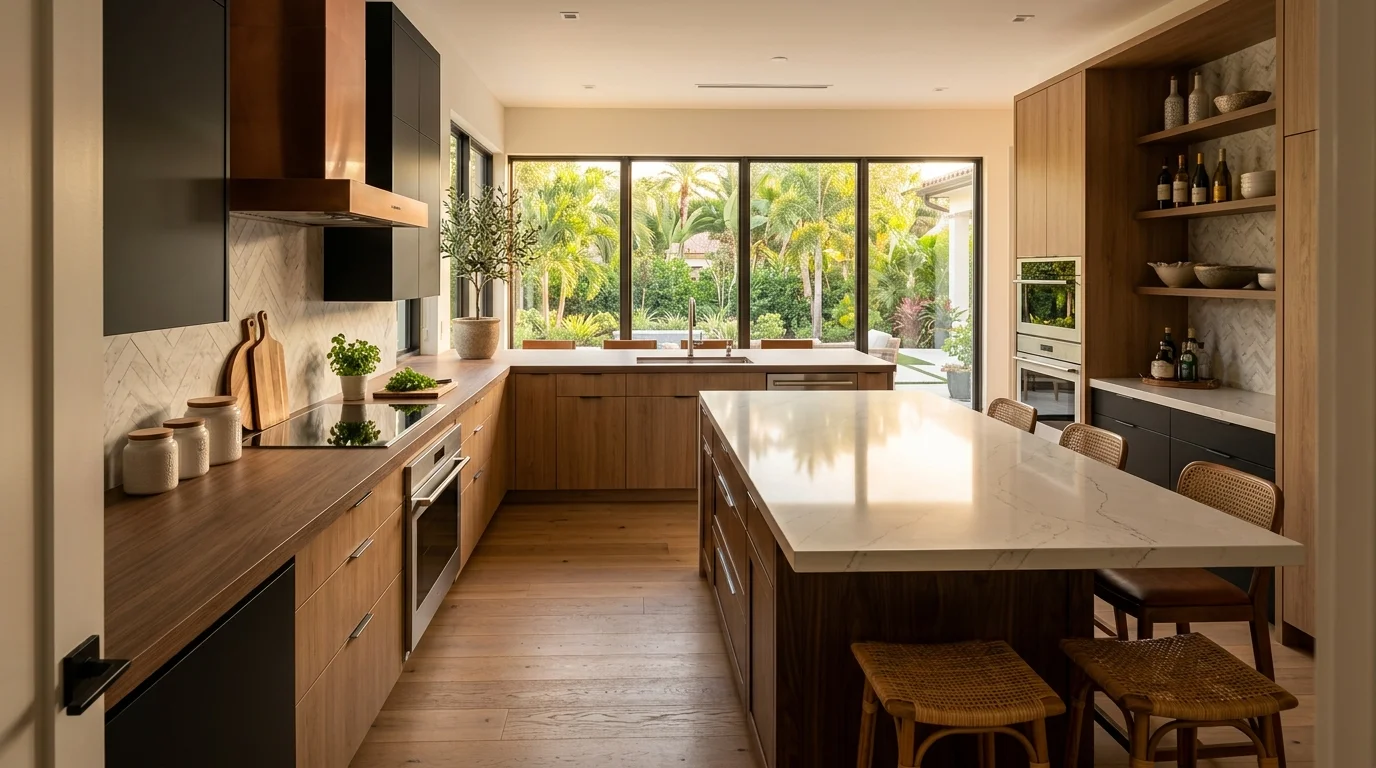
The laminate vs quartz countertops debate comes up in nearly every budget conversation we have with homeowners across Palm Beach County. Laminate has gotten dramatically better over the last decade. Quartz remains the dominant choice in mid-range to luxury kitchens from Boca Raton to Jupiter. Neither answer is automatic, the right pick depends on your budget, how hard you cook, and what the next buyer of your home will expect. Here is how we break it down for our clients.
The Real Difference Between These Two Materials
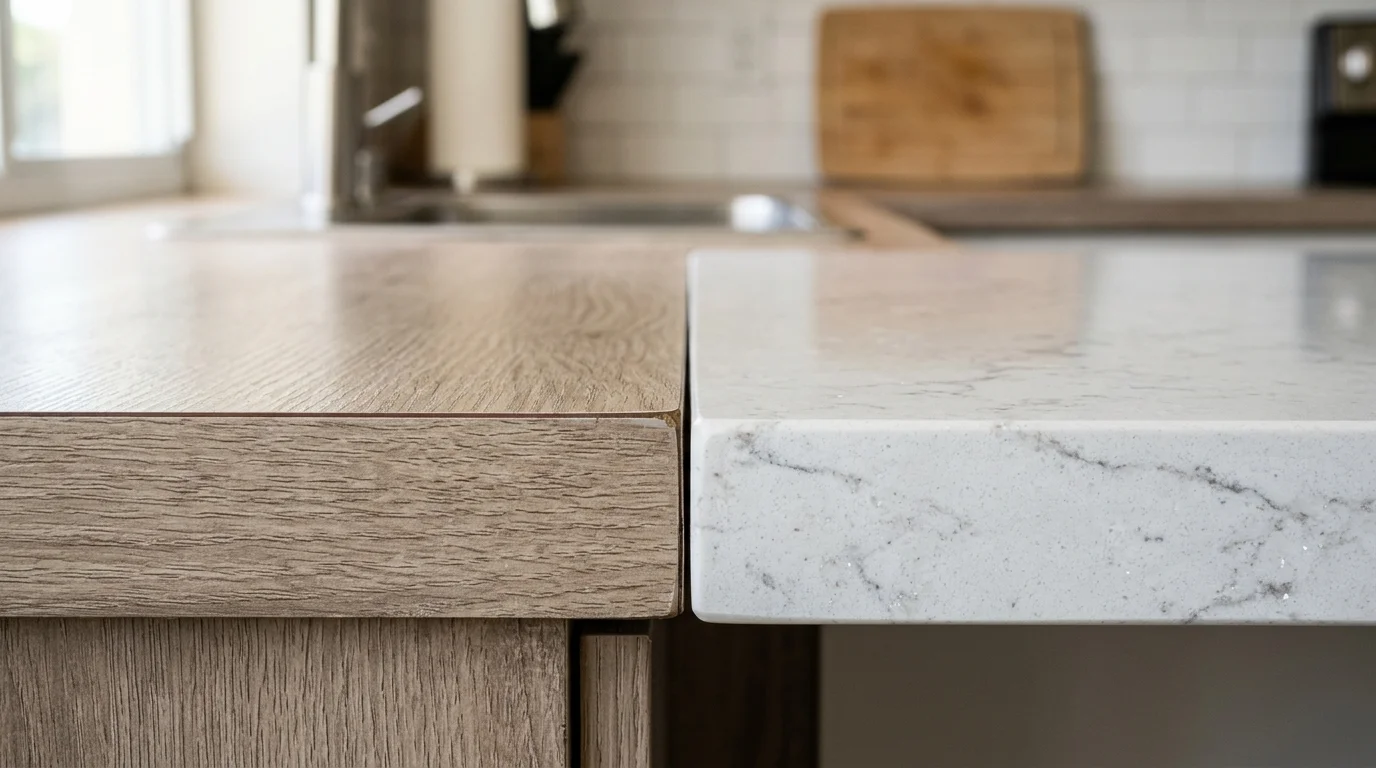
Laminate countertops are made from layers of kraft paper and resin pressed together under high heat, then bonded to a particleboard or MDF core. The top surface is a photographic print protected by a clear wear layer. Modern high-definition laminate from brands like Wilsonart can mimic marble, granite, and concrete convincingly enough to fool a casual glance. But it is still a printed surface. Touch it at the seams, or look at the edges, and the illusion breaks.
Quartz countertops are engineered stone: roughly 90-94% crushed quartz aggregate bound with polymer resins. The result is a non-porous slab that holds up to spills, heat, and everyday abuse without sealing. If you want to understand what makes quartz different from its natural-stone cousins, our breakdown of quartz countertop pros and cons covers the full picture.
The core distinction: laminate is a surface coating. Quartz is a structural material. That difference matters every single day you use your kitchen.
Cost Comparison
Material cost is where laminate wins, and it is not close. Installed laminate countertops in the Palm Beach County market typically run $15-$35 per square foot installed, depending on the edge treatment and brand. That means a standard 40-square-foot kitchen counter comes in at $600-$1,400 installed. That is hard to argue with on a tight budget.
Quartz starts higher and climbs fast. Entry-level quartz from Silestone, MSI, or similar brands installed in the same 40-square-foot kitchen runs $75-$110 per square foot, call it $3,000-$4,400 for basic material and installation. Mid-tier brands with more complex movement or patterning push $110-$150 per square foot installed. Premium quartz with custom edges and waterfall details can exceed $200 per square foot once you factor in fabrication. For a full picture of local pricing, see our quartz countertops cost guide for Palm Beach County.
So the price gap is real. On a cabinet-and-counter refresh without layout changes, choosing laminate over entry quartz can save you $2,500-$4,000 in a typical kitchen. That money can fund better cabinets, new hardware, or a proper backsplash. We have seen clients in Delray Beach use exactly that approach to stretch a $15,000 kitchen refresh into something that looks genuinely sharp.
What you give up is long-term value. Laminate does not hold up as long, and it does not carry the same weight with buyers when you sell.
Durability and Maintenance
This is where the gap gets serious. Laminate scratches. Set a pan down too hard, drag a cast iron skillet across it, and you will see evidence. It cannot be resanded or refinished the way butcher block can. Once the wear layer is compromised, moisture gets under it and the core swells. In South Florida, where humidity never truly lets up, a compromised laminate surface near a sink can delaminate within a year or two. Quartz does not have this problem. Its non-porous surface resists moisture, bacteria, and staining without any sealing required.
Quartz is not indestructible. It can chip at corners if hit hard. Prolonged direct heat from a hot pan can damage the resin binders, so a trivet is still a smart habit. And quartz will fade with direct UV exposure, which matters in Florida where sunlit kitchens are common. But day-to-day? Quartz holds up better with less effort.
Laminate maintenance is straightforward: wipe it down, avoid abrasive scrubbers, and never let standing water sit at seams. The problem is not the daily cleaning, it is what happens after a hard year of use. Scratches accumulate. Seams open. The surface that looked clean and modern starts to look worn in ways that are impossible to reverse short of replacement.
If you want a deeper read on keeping quartz in top shape, our guide on how to remove stains from quartz countertops walks through exactly what works and what damages the surface.
Cost Guide
Below are typical installed cost ranges we see in the Palm Beach County market in 2025-2026. These reflect a standard kitchen with approximately 40 square feet of countertop area. Edge profiles, cutouts, and material upgrades move the number. For a full-scope kitchen remodel, countertops are one piece of a larger budget, our kitchen remodel cost guide for Palm Beach County breaks down every line item.
One note on permits: a straight countertop swap, laminate out, quartz in, same sink location, does not require a permit in Palm Beach County. Permits come into play when you are relocating the sink or dishwasher, running new electrical circuits, or opening walls. Your general contractor handles that scope if it applies to your project.
South Florida Considerations
The Florida climate puts countertop materials through conditions that most national comparisons ignore. Humidity in Wellington and Boca Raton during summer sits at 80-90% for weeks at a stretch. Air conditioning cycles on and off constantly, which creates condensation on surfaces near exterior walls. Laminate with any seam near a sink, dishwasher, or exterior wall is vulnerable to that moisture cycling. We have pulled out laminate tops in homes throughout Delray Beach and Jupiter that were only five to seven years old but had already delaminated at the dishwasher seam. Quartz does not absorb moisture, so this failure mode does not apply.
UV exposure is the flip side. Direct sun through unshaded kitchen windows, common in east- or west-facing Florida kitchens, can yellow or fade quartz over time, particularly lighter-colored slabs with high resin content. Laminate is not immune either, but the effect shows differently. If your kitchen gets hard direct sun for hours daily, talk to our team about quartz brands that use UV-stabilized resins, or consider window treatments as part of the overall design plan.
Resale value is the factor that tips most of our Palm Beach County clients toward quartz. Buyers in this market expect quartz in a renovated kitchen. It has become the baseline at the $400,000 and above price point that covers most of Boca Raton, Delray Beach, and Wellington. Listing a recently remodeled kitchen with laminate countertops is not a dealbreaker, but it will come up in negotiation. According to data tracked by the Remodeling Magazine Cost vs. Value Report, midrange and upscale kitchen remodels consistently show stronger resale returns than budget refreshes, and countertop material is one of the most visible signals buyers use to categorize a kitchen.
Our honest take: if you are staying in the home for ten or more years and budget is genuinely tight, high-definition laminate done well beats cheap quartz every time. A well-executed $18,000 kitchen refresh with quality laminate, solid cabinet boxes, and a great tile backsplash looks better and lasts longer than a rushed $25,000 remodel with entry quartz and cutting corners elsewhere. If you are selling in the next three to five years, quartz is the smarter investment, especially in the price brackets that dominate Palm Beach County's resale market.
For anyone weighing how countertop choice fits into the bigger picture of renovation ROI, our article on the 30 percent rule in remodeling gives useful context on how much to spend relative to your home's value. And if you are comparing quartz against other stone options, our full comparison of quartz vs quartzite vs granite vs marble lays out every material side by side.
One more consideration specific to our market: gated communities and HOAs in Palm Beach County sometimes have architectural review requirements for exterior-visible changes, but countertop material is an interior decision and almost never subject to HOA approval. If you are in a condo with shared walls or stacked floors, confirm with your building's rules on any work that involves running water lines, but a counter swap on an existing layout is typically unrestricted. See our guide to condo kitchen remodels and HOA rules in Palm Beach County for more on that process.