Statement Range Hoods: Plaster, Wood & Metal for South Florida Kitchens
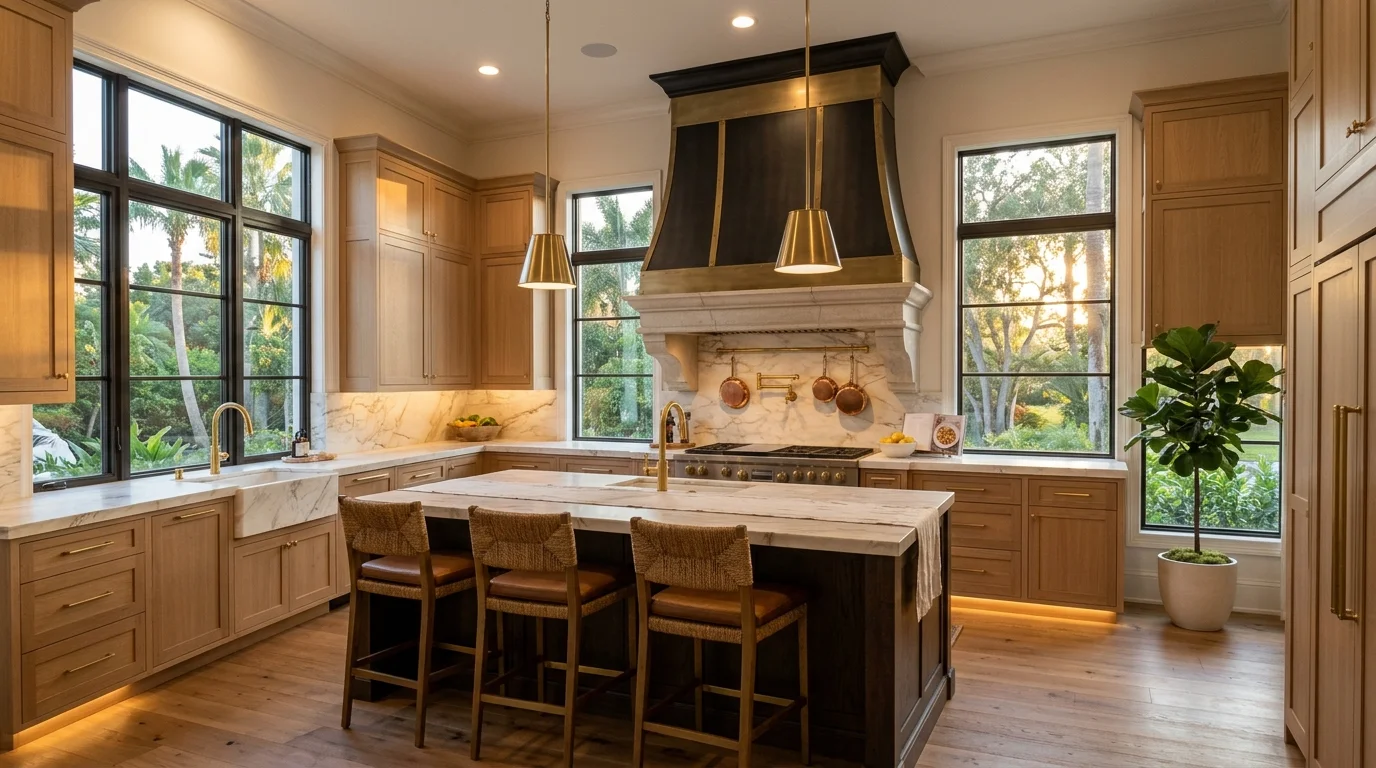
A statement range hood is the single piece in a kitchen remodel that gets noticed first. Before the countertops, before the cabinet color, before the backsplash tile. When homeowners across Palm Beach County, Boca Raton, Delray Beach, Wellington, and Jupiter ask us what upgrade will transform their kitchen from nice to unforgettable, our answer is almost always the same: build a hood that earns its place on that wall. Plaster hoods, wood hoods, and hand-finished metal focal hoods each create a completely different atmosphere. This guide breaks down how each style works, what it actually costs in our market, and how to choose the right one for your home.
Why the Hood Is the Kitchen's Focal Point
Most kitchens in South Florida were built with builder-grade stainless inserts or basic under-cabinet ventilation. Functional, sure. But they disappear into the wall instead of anchoring the room. A well-designed statement range hood does the opposite. It gives the kitchen a vertical axis, draws the eye upward, and creates the kind of intentional design that makes a space feel custom rather than assembled from a catalog.
Ventilation performance matters too. The hood enclosure is separate from the blower insert inside it, and the two decisions should not get tangled together. You choose the aesthetic form of the hood surround and pair it with the right blower for your cooktop's BTU output. We focus on the cabinet and finish carpentry side of that equation. For the blower spec and any ductwork changes, your general contractor and appliance supplier will coordinate that scope.
The hood also solves a layout problem that trips up a lot of remodels. When you go to eliminate upper cabinets on the cooking wall, you need something to fill that vertical space. A plaster chimney, a wood beam surround, or a dramatic metal canopy does that job better than any run of wall cabinets ever could.
One more thing worth saying: the hood sets the style for everything around it. It tells you what the backsplash should do, what the cabinet hardware should feel like, and whether you need a pot filler. Get the hood right and the rest of the cooking wall almost designs itself. For a full picture of how ventilation fits into the overall appliance layout, our range hood buying guide covers CFM ratings, ducting requirements, and insert options in detail.
Plaster Range Hoods
Plaster hoods are the most requested style we see in Palm Beach County right now. They show up in Mediterranean revival homes in Boca Raton, in transitional coastal kitchens in Jupiter, and increasingly in new construction throughout Wellington. The appeal is obvious: a plaster hood looks like it was built into the house rather than added to it. The smooth, monolithic form feels architectural rather than decorative.
Construction starts with a wood or metal subframe built by our finish carpenters, which gets covered in cement board and then coated by a plaster artisan. The finished surface can be smooth and refined, hand-troweled with subtle texture, or given a Venetian plaster treatment with depth and sheen. Color is painted or tinted directly into the finish coat, so you are not limited to white. Warm greiges, soft sage tones, and even deep charcoal plaster hoods are showing up in high-end kitchens across the county.
Plaster hoods pair particularly well with painted Shaker cabinetry and natural stone countertops. We also love them in Mediterranean-style kitchens where arched details and corbels can be built directly into the form. The plaster artisan can add decorative moldings, curved bases, and carved accents that simply are not possible with sheet metal.
One honest downside: plaster is not forgiving of a home that moves. South Florida's clay soils and humidity swings can cause hairline cracking over time, especially in older homes. This is typically cosmetic and easy to touch up, but it is worth knowing going in. We always recommend a flexible acrylic-modified plaster coat over traditional gypsum plaster for this reason.
Budget for the subframe, cement board, plaster labor, and paint. A basic plaster hood surround in our market runs $3,500-$6,500 installed. Add Venetian plaster finishing, decorative corbels, or arch detail work and that number moves to $7,000-$12,000 or more depending on complexity.
Wood Range Hoods
Wood range hood surrounds bring warmth and organic texture to a kitchen in a way no other material matches. They work best in modern farmhouse kitchens, Japandi-influenced spaces, and coastal designs where natural material is a core part of the palette. The key is treating the wood hood as furniture, not as millwork. It should look like something a skilled craftsman built, not like a cabinet box tipped on its side.
Our team builds wood hoods from a range of species. White oak is the most requested right now. Its open grain reads beautifully at scale, and the rift-cut or quarter-sawn versions used in white oak cabinetry can be matched in the hood surround for a cohesive cooking wall. Walnut creates a richer, moodier statement. Painted poplar or maple works for clients who want the form without visible grain. Reclaimed wood is a popular request but adds lead time and cost for sourcing material with consistent thickness and no structural defects.
Wood hood surrounds can be flat paneled, beadboard paneled, or clad in tongue-and-groove planks. We can add chunky corbels, crown molding details, open shelving flanking the hood, or a painted accent color on the hood body while keeping the surrounding cabinets a different finish. The two-tone approach is one of our favorite moves in a large kitchen because it creates visual weight exactly where you want it.
Moisture and heat are legitimate concerns with a wood hood in South Florida. The hood surround never touches the actual flame or burner, but it does sit above a heat source. Proper ventilation through the blower insert manages ambient heat. The bigger concern here is humidity. Solid wood will move seasonally. We build wood hood boxes with plywood substrates and use species-appropriate finishes to minimize this. For kitchens running full A/C year-round, this is rarely a problem. For open-concept spaces that get humid air from an outdoor area, we have that conversation with the homeowner up front.
Installed cost for a custom wood hood surround runs $4,000-$9,000 for most residential projects. High-end custom work in walnut or reclaimed material with decorative shelving integrated into the design can reach $12,000-$15,000.
Metal Focal Hoods
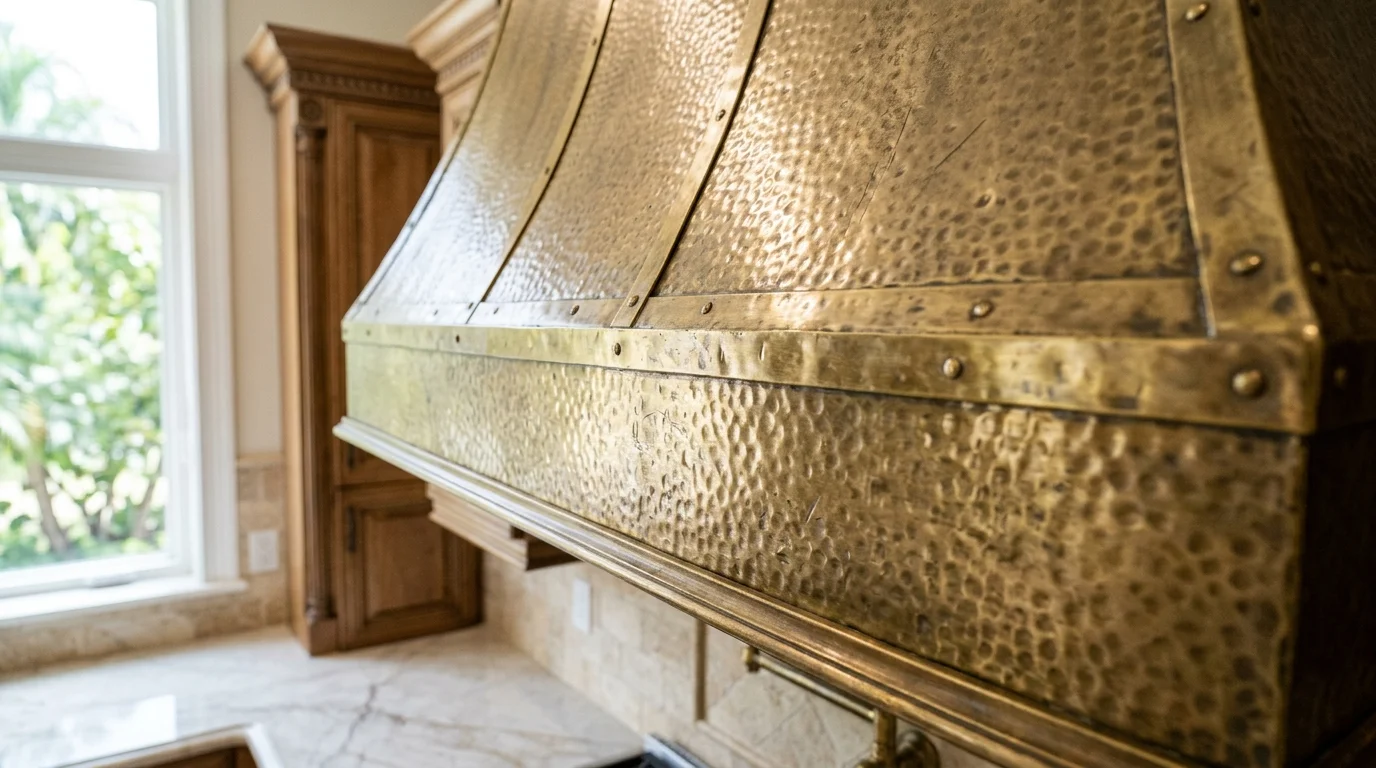
Metal hoods are the most polarizing of the three styles, and that is exactly why we like them. A well-executed metal focal hood in copper, blackened steel, brass, or zinc commands attention. It does not ask for it. It just takes it. Done right, a metal hood in a South Florida kitchen looks like something that belongs in a Boca Raton waterfront estate or a Wellington equestrian property where the design brief was to build something that lasts decades, not just trends.
Copper is the classic choice. Hand-hammered copper hoods age into a patina that becomes more beautiful over time, shifting from bright penny to warm amber to deep brown. They suit Mediterranean kitchens, rustic farmhouse spaces, and even transitional designs where the copper picks up warm metal finishes in the hardware and fixtures. We recommend pairing copper hoods with unlacquered brass or oil-rubbed bronze hardware so the warm metal tones read as intentional. Our guide on mixing metals in the kitchen goes deep on how to do this without the room feeling like a hardware store.
Blackened steel and matte black metal hoods suit modern and industrial kitchens. They pair with flat-front cabinetry, concrete or dark stone countertops, and minimal hardware. The scale matters enormously with metal hoods. A flat sheet-metal pyramid looks cheap at any price point. A hood with dimensional form, riveted seams, and a finished flue that runs to the ceiling reads as a custom piece.
Zinc and stainless hoods occupy a cleaner, more contemporary space. Zinc patinas naturally to a soft silver-gray that suits coastal and Scandinavian-influenced kitchens. Commercial-grade stainless hoods work in true chef's kitchens where the design intent is industrial and uncompromising.
Metal hood pricing varies more than the other categories because fabrication is entirely custom. A locally fabricated copper or blackened steel hood surround runs $5,000-$14,000 depending on size, gauge, finish, and whether decorative hammering or hand-forming is involved. Import metal hoods from specialty manufacturers can run $3,000-$8,000 for semi-custom shapes, though lead times are longer and local customization is limited.
For kitchens where the hood is meant to be a true art object, some clients commission metal hoods from artisan fabricators who work in custom shapes, embedded tile accents, and mixed-material combinations. These projects start at $10,000 for the hood alone and go up from there. The investment makes sense when the rest of the kitchen is built to that standard. If you want to understand how this fits into overall kitchen investment, our breakdown of kitchen remodel costs in Palm Beach County gives full context on where hood budget fits relative to cabinets and countertops.
Cost Guide
These ranges reflect what homeowners in Palm Beach County, Boca Raton, Delray Beach, Wellington, and Jupiter are actually paying in our market. They cover the hood surround and finish carpentry installation only. The blower insert, ductwork modifications, and any associated electrical work are separate line items handled by your GC and appliance supplier. For a broader look at how hood spend fits into full project budgets, see the Boca Raton kitchen remodel cost guide.
Permits are scope-dependent. A hood surround replacement on an existing duct chase typically does not require a permit. If your GC needs to extend or reroute ductwork, cut through walls, or add electrical circuits, your GC will determine what is required under the Florida Building Code.
South Florida Considerations
Building a statement range hood in South Florida is not identical to building one in Atlanta or Chicago. The climate, the architecture, and the homeowner association landscape all shape decisions in ways that matter.
Humidity is the dominant material concern. Plaster needs a flexible finish coat. Wood needs a moisture-resistant substrate and a quality topcoat. Metal hoods in copper or steel will develop patina faster in coastal environments, which is either beautiful or problematic depending on the finish you chose. For homes within a mile or two of the ocean in Jupiter or Juno Beach, we lean toward copper (which patinas gracefully), zinc (which stabilizes quickly), or plaster (which is inorganic and unaffected by salt air). We steer clients away from raw steel that is not properly sealed or lacquered in those environments.
Many of the homes we work in across Palm Beach County are in gated communities with architectural review boards. Exterior changes to rooflines for ductwork may trigger an ARB review. Interior kitchen changes typically do not, but if your remodel involves cutting a new duct penetration through the roof or an exterior wall, your GC should check the community's approval requirements before work begins. We supply design drawings and material samples for those packages when needed. Your GC submits them.
Style alignment matters here too. South Florida architecture is diverse. The same kitchen hood that looks perfect in a Mediterranean revival home in Boca Raton's Royal Palm Yacht and Country Club neighborhood will look jarring in a clean-lined modern townhouse in Delray Beach's Atlantic Avenue corridor. Plaster hoods fit the Mediterranean and Old Florida vernacular perfectly. Wood hoods suit coastal casual and modern farmhouse builds. Metal hoods cross style lines most easily, particularly in transitional and contemporary kitchens where the drama of the material is the point.
The kitchen lighting design around your hood matters as much as the hood itself. We almost always recommend under-hood lighting integrated into the blower surround and accent lighting above the hood chimney where it meets the ceiling. In kitchens with high ceilings common to Wellington and North Palm Beach homes, that upper chimney section can be three feet tall or more. Lighting that section properly transforms the hood from a daytime feature to an evening focal point.
One last note: the backsplash behind and below the hood is a design decision that should be made in direct relationship to the hood material. A plaster hood over a slab backsplash in matching stone creates a cohesive wall of material. A copper hood over a Zellige tile field creates beautiful contrast. A wood hood over a simple subway tile lets the wood do all the work. We cover these pairings in depth in our guide on kitchen backsplash ideas for Palm Beach County homes. Getting the hood and backsplash designed together is always better than selecting them separately and hoping they harmonize.