White Oak Kitchen Cabinets: 2026 Trend Guide
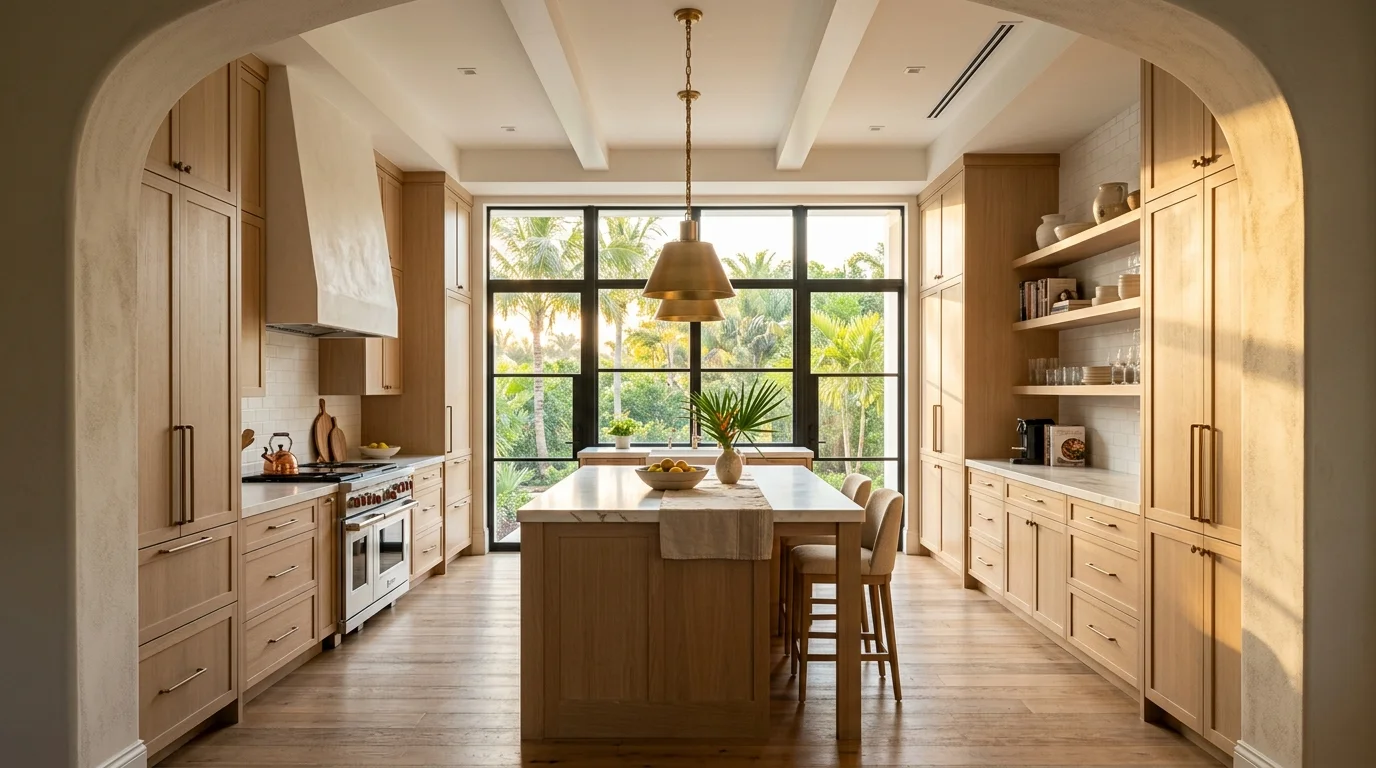
White oak kitchen cabinets are everywhere heading into 2026, and in Palm Beach County, they make more sense than almost anywhere else in the country. The warm, straight grain of white oak catches South Florida's natural light differently than painted cabinets do. It reads rich in morning sun, calm at midday, and almost amber-toned in the evening when the windows are glowing. We've been specifying white oak cabinets for clients across Boca Raton, Delray Beach, Wellington, and Jupiter for the past several years, and demand has accelerated sharply. This guide covers everything you need to know: cuts, finishes, countertop pairings, hardware, real local costs, and how white oak holds up in Florida's humidity.
Why White Oak Is Dominating 2026
The all-white kitchen had its moment. A long one. But homeowners are tired of sterile. They want warmth without going dark, texture without going rustic, and natural materials without high maintenance. White oak hits all three marks.
Unlike red oak, which has a pinkish undertone and a swirling grain that reads as dated, white oak has a cooler, more linear grain with subtle golden and gray undertones. It sits comfortably in both modern and transitional kitchens. You can pair it with sleek flat-front doors and get a Japandi-influenced look. Put it in a slim shaker door profile and it leans transitional coastal. The wood does the heavy lifting either way.
From a design standpoint, white oak is the answer to the question homeowners kept asking us in 2023 and 2024: "How do I get away from all-white without committing to a dark cabinet?" If that's where you are, white oak is your answer. Our article on kitchen cabinet trends for 2026 names warm wood tones as the defining shift of the year, and white oak is leading that shift.
It's also worth noting that white oak works particularly well at the current scale of Palm Beach County kitchens. The large open-concept layouts common in newer construction in Wellington and Jupiter give white oak room to breathe. In tighter galley kitchens in older Delray Beach or Boca condo buildings, a lighter white oak stain keeps things from feeling closed in.
One more thing: white oak is durable. It has a Janka hardness rating of 1,360, harder than cherry and most species used in cabinetry. That matters for face frames and door edges that take daily abuse.
Rift-Sawn vs. Quarter-Sawn: Which Cut to Choose
The cut of the lumber matters more with white oak than with almost any other species, because white oak has prominent medullary rays, those distinctive fleck patterns that show up differently depending on how the log is milled. Get this decision right and your cabinets look intentional and tailored. Get it wrong and the grain can read as busy or inconsistent.
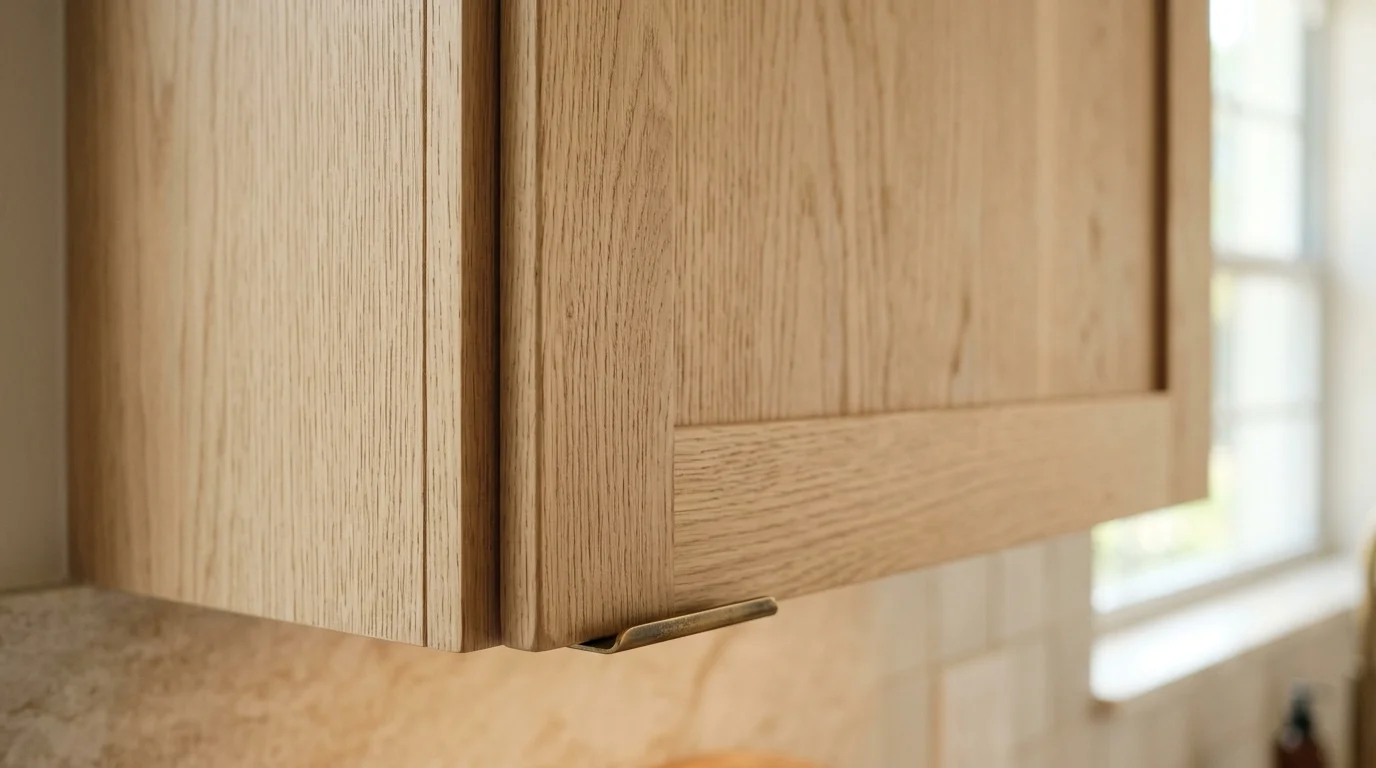
Rift-sawn white oak is our top recommendation for most kitchen projects. The log is cut at roughly 30-60 degrees from the growth rings, which produces a very straight, consistent grain with minimal ray fleck. The result is clean, linear, and modern. It pairs naturally with flat-front and slim shaker door styles. If you're going for a contemporary or Japandi look, rift-sawn is the only cut worth specifying.
Quarter-sawn white oak is cut closer to 90 degrees from the growth rings, which maximizes the medullary ray fleck. You get those silver, almost iridescent streaks running perpendicular to the grain. It's beautiful, and it reads more traditional or craftsman. If your kitchen leans transitional or you're working with a more classic architecture in Boca Raton or Palm Beach, quarter-sawn gives you richness that rift-sawn doesn't.
Flat-sawn white oak, the most common and least expensive cut, has a cathedral grain pattern that we generally steer clients away from in cabinetry. It can look fine in some applications, but the grain variation is harder to control across a full set of kitchen doors, and the consistency you get with rift or quarter is worth the premium.
Fabuwood recently released a rift-cut white oak option in their 2026 line that we've been excited to specify. Our detailed breakdown of the Fabuwood Natural Oak rift-cut white oak cabinets covers the construction specs and finish options if you want to go deeper on that product specifically.
For door styles, flat-front (slab) and slim shaker are our go-to pairings with white oak in 2026. The minimal profile lets the wood grain be the design element. Traditional raised-panel doors compete with the grain and usually lose. If you want to understand the style tradeoffs in more depth, our comparison of flat-front vs. shaker cabinets in South Florida lays it out clearly.
Best Countertop Pairings for White Oak Cabinets
White oak cabinets give you unusual flexibility with countertops because the wood's undertones shift depending on the finish. A natural, unsealed-looking white oak leans warm gold. A wire-brushed or cerused finish pulls out gray. That means the countertop pairing depends heavily on what finish you choose for the wood.
Here's how we think about it:
White oak with warm finish + white or soft-veined quartz. This is the most popular combination we're doing right now in Palm Beach County. The quartz surface is clean and low-maintenance, the veining gives visual movement, and the warm oak base stops the whole kitchen from feeling cold. Think Calacatta-style quartz with gold veining, not stark white. The gold in the veins pulls from the oak and ties the whole palette together. For maintenance peace of mind, our article on the best countertops for Florida kitchens explains why quartz holds up better than marble in our climate.
White oak with gray or cerused finish + leathered quartzite or honed marble. If you've gone gray on the wood, you can lean into natural stone without the pairing feeling too warm. Taj Mahal quartzite is a strong choice, creamy background, minimal veining, and it doesn't compete with the linear oak grain. Honed Carrara marble works similarly but requires more maintenance discipline.
White oak with any finish + Dekton or sintered stone. This is the pairing for clients who want the organic look of wood cabinets but have absolutely zero tolerance for countertop maintenance. Sintered surfaces are essentially indestructible and look increasingly convincing in stone-look formats. The slightly cooler, more industrial character of sintered stone actually contrasts nicely with warm oak.
What we steer people away from: dark granite paired with warm white oak. The combination can work but it requires careful vein color selection, and most of the black and dark brown granites on the market read heavy against white oak's lighter character. If you're drawn to stone, natural quartz or quartzite almost always gives a better result.
Also worth noting: the backsplash decision becomes much easier when you have white oak cabinets. The wood itself is already doing textural work, so a simple slab backsplash in the same material as your countertop reads cohesive and sophisticated. For 2026 backsplash directions that work alongside wood tones, our guide to countertop design trends for 2026 covers slab backsplash execution in detail.
Hardware & Finish Choices That Work
Hardware on white oak cabinets is not a neutral decision. The wrong metal finish will fight the wood. The right one makes the whole kitchen feel intentional.
Brushed brass is our top recommendation. White oak has warm, golden undertones, brushed brass echoes that warmth without being matchy. Long bar pulls on drawers, simple cup pulls on lower cabinets, and minimal knobs (or no knobs, with push-to-open on uppers) is the combination we're specifying most in 2026. It's refined without being precious. Our full breakdown of brass cabinet hardware trends for 2026 goes deep on finish grades and which profiles age best.
Unlacquered brass is a stronger, more editorial choice. It will patina over time, which some clients love and some hate. Know your client before specifying it. Matte black is a contrasting option that works when you want to push the design toward contemporary, the tension between warm wood and cool black hardware creates visual interest. Satin nickel and chrome tend to flatten against white oak. We rarely recommend them for this wood.
For cabinet finishes, white oak is almost always left natural or lightly stained rather than painted. That's the whole point of the material. A light wire-brush texture is the most popular surface treatment we're seeing, it adds depth, makes the grain more readable, and helps the wood resist minor surface scuffs. A natural oil or matte lacquer finish preserves the raw look while protecting the wood from moisture absorption.
If you're building a two-tone kitchen, white oak uppers paired with a painted or different-finish lower, the combination of oak upper cabinets with a sage green or navy lower bank is one of the strongest looks in South Florida right now. Our guide to two-tone kitchen cabinets covers the pairing logic and proportions that work best.
Cost Guide
White oak cabinets cost more than painted MDF or thermofoil, you're paying for solid wood construction, premium veneer matching, and a finish that requires more hand work. That said, there's a meaningful range depending on whether you go semi-custom or full custom, and if you're refreshing an existing layout or doing a complete gut remodel. Here's how the numbers look in the Palm Beach County market heading into 2026.
These figures reflect cabinet and countertop costs as installed by our team. They do not include plumbing relocation, electrical upgrades, flooring, or appliances, which your general contractor would scope separately. Permits are only required when the project involves moving plumbing, running new gas lines, changing electrical service capacity, or opening walls, a cabinet-and-counter refresh on an existing footprint typically does not require a permit.
For a broader picture of where your kitchen budget should go across all categories, the kitchen remodel cost guide for Palm Beach County covers the full scope of expenses you'll want to plan for. And if you're trying to understand how much of your home's value you should reasonably put into a remodel, the 30 percent rule in remodeling is a useful reality check before you commit to a budget.
South Florida Considerations
White oak performs well in Florida, but it's not bulletproof. Wood and humidity have a relationship, and in Palm Beach County, that relationship needs to be managed carefully.
The first thing to understand is that solid wood cabinets will move slightly with seasonal humidity swings. In South Florida, those swings aren't as dramatic as they are in the Northeast, but we do have a wet season and a dry season, and air conditioning keeps interiors drier than the outside air. That moisture differential creates minor expansion and contraction in wood cabinet doors. Rift-sawn and quarter-sawn white oak are actually more dimensionally stable than flat-sawn because of the way the grain is oriented relative to the growth rings. That's another reason we prefer those cuts beyond just aesthetics.
Proper finishing is non-negotiable here. White oak cabinets in South Florida should have a sealed finish, either a catalyzed lacquer, conversion varnish, or high-quality penetrating oil, that limits moisture absorption at the surface. A wire-brushed texture is beautiful, but the micro-grooves it creates need to be sealed or they'll collect grease and moisture. We always confirm finish specs with the cabinet manufacturer before installation.
For clients near the water in coastal Boca Raton or Jupiter Inlet Colony, salt air is a real factor. It's less damaging to the wood itself than to hardware. Specify marine-grade or PVD-coated hardware finishes if you're within a half-mile of the coast. Standard brushed brass will tarnish faster in salt-air environments.
White oak also responds well to South Florida's natural light, which is the strongest argument for it here. Painted white cabinets can look flat and slightly yellow under intense direct sun. White oak gets more interesting. The grain becomes more readable, the finish depth is more visible, and the warmth of the wood complements rather than competes with bright Florida interiors. Homes in Wellington and Delray Beach with large east- or west-facing kitchen windows are exactly where white oak shines best.
One practical note on cabinet sourcing: the lead time on rift-sawn and quarter-sawn white oak cabinets is longer than painted or standard stained options. If you're working toward a specific move-in date or a seasonal deadline, plan for 8-14 weeks on semi-custom and 12-20 weeks on full custom. That timeline means your countertop slab selection needs to happen early, ideally before cabinets are even ordered, so the two arrive within the same installation window. We walk clients through the sequencing at the design stage to avoid delays. The kitchen remodel order of operations guide is a useful reference for understanding how cabinet delivery fits into the full project timeline.
For those in HOA-governed communities in Palm Beach County, especially in gated developments in Wellington or Boca West, confirm whether your association requires design approval before ordering cabinets. Some HOAs require submittal of finish samples and floor plan drawings. Your general contractor handles any building permit submittals; we supply the design drawings and finish samples your GC needs for that process. More detail on navigating HOA requirements is in our article on remodeling a kitchen in a Palm Beach County gated community.
Finally, if you want to understand how white oak cabinets compare to the full range of natural wood options available in the South Florida market, the natural wood kitchen cabinets guide for South Florida covers the species comparison and which woods hold up best in our climate long-term.
According to the NAHB Remodeling Market Index, kitchen remodeling remains one of the strongest categories of home improvement spending, and natural wood cabinetry is consistently among the top selections driving mid-range and luxury project budgets upward. That aligns with exactly what we're seeing on the ground in Palm Beach County.