Mixed Metals in the Kitchen: How to Combine Finishes Tastefully
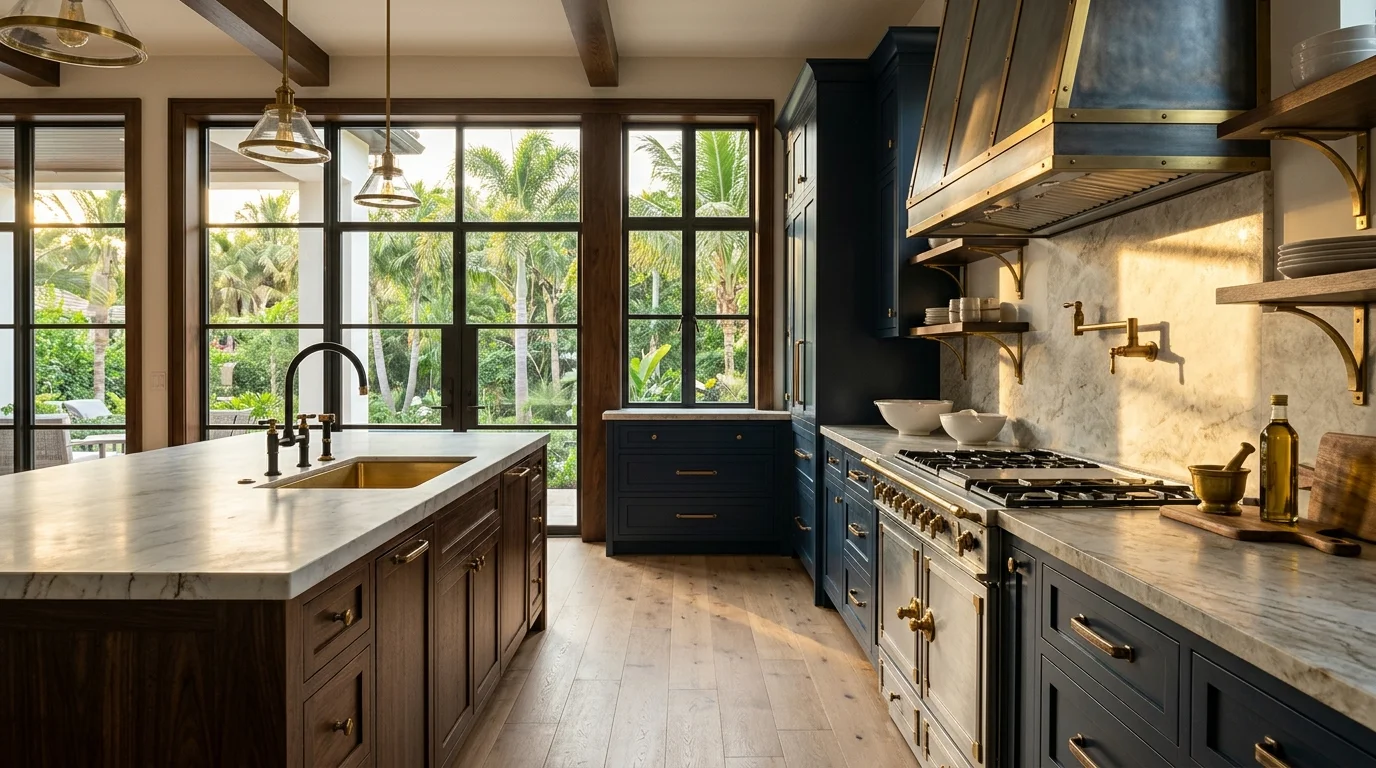
Mixing metals in kitchen design is one of the most searched topics we get from homeowners in Palm Beach County, and it makes sense. Chrome faucets, brushed gold hardware, matte black pendants, the choices are everywhere right now. Done right, combining finishes adds depth, personality, and a layered quality that all-matching metal looks simply cannot achieve. Done wrong, it looks like you bought whatever was on sale. Our team has designed kitchens across Boca Raton, Delray Beach, Wellington, and Jupiter, and we have strong opinions on how this should be handled. This guide breaks down everything you need to know.
Why Mixing Metals Works
The design world largely abandoned the "everything must match" rule about fifteen years ago. Interior designers started letting gold and chrome coexist. Then brass came back. Now matte black is everywhere. The result is kitchens that feel collected and intentional rather than like a catalog page.
There is a practical reason mixing metals works in kitchens specifically: different elements serve different functions. Your faucet, your cabinet hardware, your light fixtures, and your appliances all live in different visual zones. They do not have to be the same finish any more than your furniture needs to be the same wood stain throughout the room.
The key is intentionality. Random mixing reads as an accident. Deliberate mixing reads as design. The difference comes down to a few rules our team applies on every project.
If you are still choosing your cabinet style and hardware together, our guide on how to choose kitchen cabinet hardware is a smart starting point before you think about which finishes to combine.
The Rules for Mixing Metal Finishes
We tell every client the same thing: pick a dominant finish, a secondary finish, and stop there. Three metals can work, but only if one is clearly dominant and one plays a very minor accent role. Four metals almost never works unless you have a very large, very complex kitchen with distinct zones.
Rule 1: One finish does the heavy lifting. This is usually your cabinet hardware, since hardware appears on every door and drawer. It is the most repeated element in the kitchen, which makes it the natural dominant. If you choose brushed brass pulls for 20 cabinet doors, brass is your dominant finish. Everything else plays supporting roles.
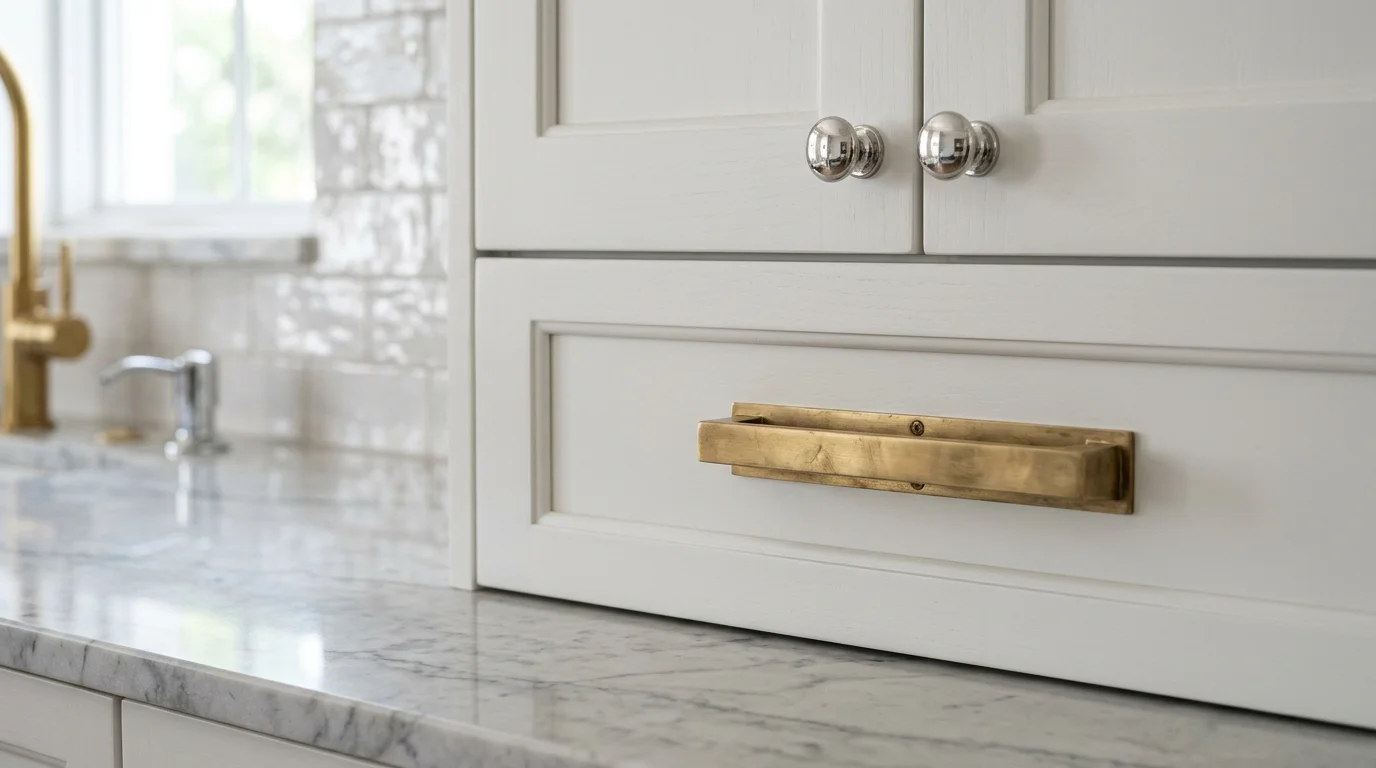
Rule 2: The secondary finish should contrast, not clash. Contrast means the two finishes are visually distinct enough to look intentional. Brushed brass and matte black contrast well. Brushed brass and polished gold do not, they are too similar in hue to read as a choice rather than a mistake. Polished nickel and chrome are another common trap. They look almost identical in photos but slightly different in person, which creates a confused look.
Rule 3: Connect your metals through undertone. Warm metals, brass, gold, unlacquered bronze, copper, group naturally. Cool metals, brushed nickel, polished chrome, stainless, pewter, group naturally. You can absolutely mix warm and cool, but anchor the combination in your overall palette. A warm-toned kitchen with cream cabinets and warm wood accents can carry brass hardware with a matte black faucet because matte black reads as a neutral. That same faucet in a cool, all-white kitchen with polished chrome fixtures would fight harder for attention.
Rule 4: Distribute both finishes intentionally. Do not cluster all your secondary metal in one corner. If matte black is your secondary finish, it should appear in at least two or three distinct locations, maybe the faucet, the range hood strapping, and the pendant lights. This distribution is what makes the combination feel designed rather than random.
Pairing knobs and pulls is a related challenge. We wrote a detailed breakdown on how to mix knobs and pulls on kitchen cabinets if you want to go deeper on hardware strategy specifically.
Best Metal Finish Combinations
Not all pairings are equal. These are the combinations our team reaches for most often, and why they work.
Brushed Brass + Matte Black. This is the combination of the moment and for good reason. Warm brass hardware with matte black fixtures creates high contrast without aggression. The matte surface on both finishes keeps the look grounded. We see this constantly in Delray Beach new builds and in Wellington renovations where clients want something contemporary but not cold.
Unlacquered Brass + Stainless Steel. Unlacquered brass patinas over time, which gives it an organic, lived-in quality. Paired with stainless appliances, which are the default in most kitchens anyway, this combination feels both timeless and relaxed. The key is accepting that the brass will change. If you want it to stay shiny and consistent, choose a lacquered or PVD-coated version instead.
Polished Nickel + Matte Black. Polished nickel is warmer and softer than chrome but still reads as a cool, clean finish. Against matte black, it creates a classic contrast that works well in transitional kitchens. This pairing shows up a lot in Boca Raton kitchen remodels where clients want something elevated but not trendy.
Brushed Nickel + Warm Bronze. A subtler combination. The two finishes are closer in tone, which creates a cohesive look with just enough variation to avoid looking monotonous. This works especially well in kitchen designs that lean Mediterranean or warm-traditional, styles that are common throughout Palm Beach County.
Matte Black + Brushed Gold. Similar to the brass-and-black pairing but with a brighter, more polished gold. The contrast is dramatic. Use this in kitchens where you want a statement. Dark cabinets, dramatic stone countertops, and this hardware combination can produce a genuinely striking result. We recommend it cautiously, it is not for kitchens where the goal is calm and quiet.
If you are designing around brass cabinet hardware, we have a full deep-dive on why brass is having its biggest moment yet and how to pick the right tone for your kitchen.
Where to Use Each Finish
Knowing which metals to pair is half the battle. Knowing where each one should live in the kitchen is the other half. Here is how our team thinks about placement.
Cabinet hardware is your dominant finish, full stop. It is the most repeated element. Make a decision here first and build everything else around it. If you choose brushed brass pulls, you have already established your dominant warm metal. Now decide whether your secondary finish is cool or whether you want to stay in the warm family with a contrasting texture.
Faucet and sink fixtures are the most visible plumbing elements in the kitchen. This is a logical place for your secondary finish. A brushed brass hardware kitchen with a matte black faucet is a classic execution. The faucet is prominent enough to register as intentional without overpowering the hardware.
Pendant lights over the island are another prime location for the secondary finish. NAHB research consistently shows that lighting is among the highest-impact design elements for buyers and homeowners alike. Getting the finish right on your pendants matters. We recommend that pendants match either the dominant or secondary finish, not introduce a third. For more on sizing and placement, our guide on pendant lighting over a kitchen island covers everything you need to know.
Range hood is a large, eye-level element. It can carry either finish effectively. A stainless range hood in a brass-and-black kitchen reads as a neutral because stainless is so expected. A matte black range hood in the same kitchen makes a bolder statement. A brass-trimmed custom hood would go full warm-metal. All three can work, the choice depends on how much you want the hood to be a focal point.
Appliances are mostly stainless by default and most clients do not change that. Stainless is a cool neutral that plays well with both warm and cool secondary finishes. If you are considering panel-ready appliances, you can effectively remove appliances from the metal equation entirely by hiding them behind cabinet panels, a move that can simplify your finish decisions considerably.
Under-cabinet lighting hardware and interior cabinet lighting are often overlooked. The trim rings and cover plates on recessed under-cabinet lights come in multiple finishes. This is a small detail but it matters in a kitchen where everything else has been carefully considered. Match these to your dominant finish when possible.
Pot filler if you have one, should match your faucet finish. Having the faucet in matte black and the pot filler in polished chrome introduces a third metal that serves no design purpose. Keep these two in the same finish.
Two-tone kitchen designs, where the island and perimeter cabinets are different colors, are a natural opportunity for mixed metals too. The island hardware can differ from the perimeter hardware as long as the finishes still follow the dominant-secondary logic. Our article on two-tone kitchen cabinets covers this in detail if you are considering that direction.
One more placement tip: do not mix metals on the same fixture. A faucet with a brass body and a chrome handle looks like a mistake. Each individual fixture should be one finish. The mixing happens across the room, not within a single piece.
South Florida Considerations
Palm Beach County has specific conditions that affect finish selection beyond aesthetics. Our team has seen enough corroded hardware and tarnished fixtures to have real opinions here.
Salt air and humidity are real threats. Homes near the water in Jupiter, Juno Beach, or coastal Boca Raton see accelerated oxidation on metal finishes. PVD-coated finishes, physical vapor deposition, are significantly more durable than standard plating in these environments. If you are set on brass, choose PVD brass over lacquered brass. It resists scratches, cleaning products, and salt air far better. Florida Building Commission standards set baseline requirements for materials in coastal zones, but hardware selection goes beyond code, it is about longevity and keeping your investment looking good for years.
Natural light amplifies finish differences. South Florida kitchens get intense sun through large windows and sliding glass doors. That light makes finish differences more apparent. Polished finishes will catch and reflect direct sunlight aggressively. Brushed and matte finishes diffuse light more gently. In kitchens with strong southern or western exposure, we generally lean toward brushed and matte finishes for a more comfortable daily experience.
HOA and ARB restrictions in gated communities. If you live in a gated community in Wellington, Palm Beach Gardens, or similar, be aware that exterior-visible elements may have restrictions. Interior kitchen hardware typically falls outside HOA scope, but if your remodel involves anything visible from the street or affects shared walls in a condo, your general contractor should verify requirements before the project begins.
Resale considerations. Palm Beach County buyers tend to respond well to warm-toned kitchens. All-chrome, all-stainless kitchens read as dated to many buyers in this market. A well-executed brass-and-matte-black or brushed nickel-and-warm-bronze combination photographs beautifully and appeals to the buyer demographic that dominates Palm Beach County real estate. If resale value is part of your thinking, our article on kitchen upgrades that add the most value to Florida homes is worth reading alongside this one.
What about all-white or light kitchens? These are extremely common throughout Palm Beach County, the coastal, bright, airy aesthetic dominates. Mixed metals work beautifully in all-white kitchens because the neutral backdrop lets both finishes register clearly without competing with cabinet color. Brass hardware and a matte black faucet against white shaker cabinets and white quartz countertops is one of our most requested combinations. If you are designing an all-white kitchen, our guide on all-white kitchen design in South Florida covers the full picture including how to keep the look from feeling flat.