Countertop Seams: What to Expect

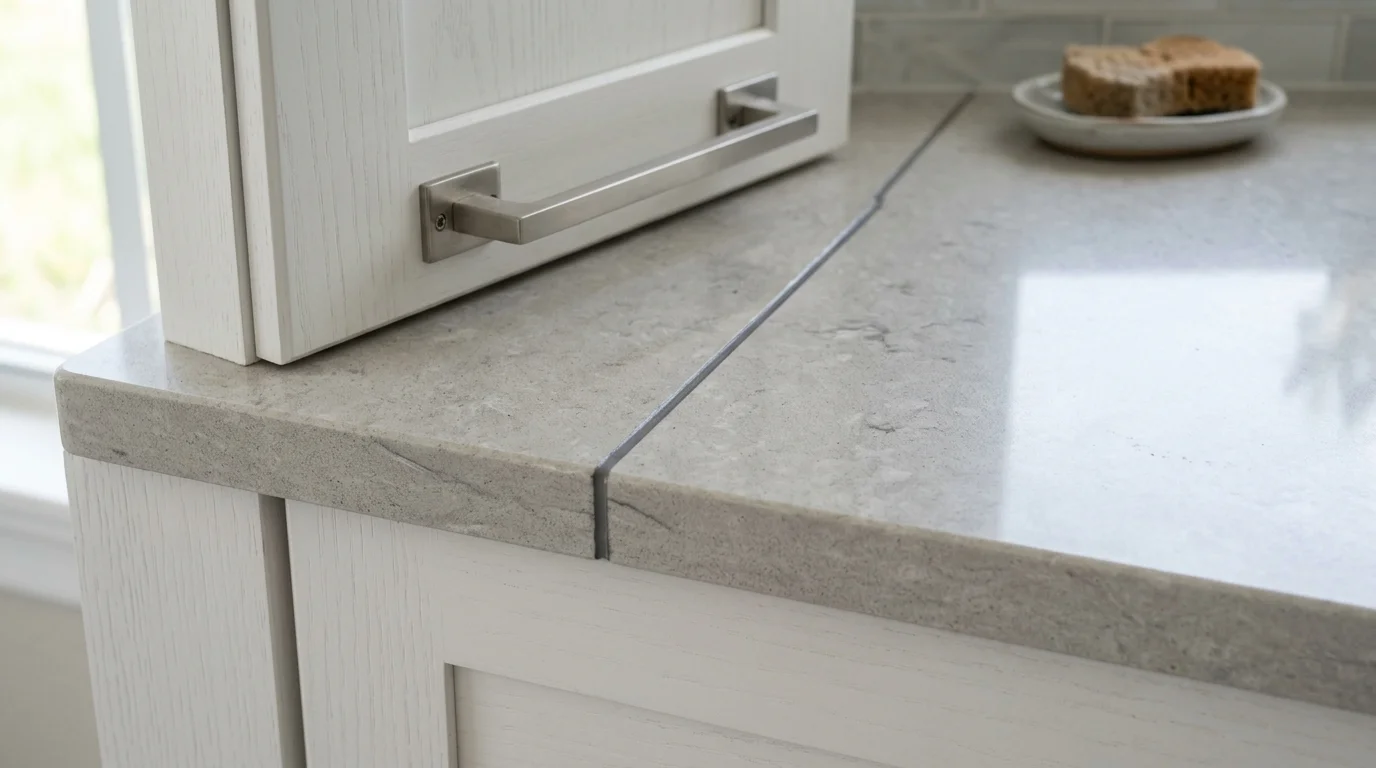
Countertop seams are one of the most misunderstood parts of any kitchen remodel. Homeowners across Palm Beach County see a gorgeous slab at the fabricator's yard, picture it running the full length of their kitchen, and then get surprised when the installer talks about a seam near the sink. It is not a flaw. It is physics. Stone and engineered quartz slabs come in fixed dimensions, kitchens are rarely a single straight run, and no fabricator on earth can violate the laws of material science. Understanding where countertop seams land, why they land there, and how a skilled fabricator handles them will save you a lot of stress on installation day.
Why Seams Exist
Natural stone slabs typically come in sizes ranging from about 55 inches by 110 inches up to roughly 65 inches by 130 inches for jumbo slabs, depending on the quarry and material. Engineered quartz manufacturers like Cambria and Silestone offer similar sheet dimensions. Those are the physical limits of what a fabricator has to work with.
The average Palm Beach County kitchen has perimeter countertops that run 15, 20, sometimes 30 linear feet when you add up the L-shape, the return wall, and the island. A single slab will not cover all of that. Period. Seams are the fabricator's way of joining two pieces cleanly so the surface functions as one continuous work area. The goal is not to eliminate every seam. The goal is to place each seam where it is least visible and least structurally vulnerable, and then execute the join so tightly that you have to look hard to find it.
Even on a short straight run, a seam may be required simply because the total length of the counter exceeds what one slab can cover. On an L-shaped layout, the corner transition almost always needs a seam. On a kitchen with a peninsula, expect at least two seams total across the full countertop package.
Where Seams Are Placed
Good fabricators follow a consistent logic when deciding seam placement. The seam should land away from the cook's primary work zone whenever possible. It should never sit directly over a cabinet base without support underneath. It should avoid corners, because an unsupported corner seam is a crack waiting to happen. And it should stay out of the highest-traffic zones, like right in front of the main prep area.
The most common placement for a kitchen seam is next to the sink cutout. That might sound counterintuitive at first, but the logic is solid. The sink cutout already breaks up the slab in that zone, so the seam reads as a natural transition rather than a random line across an open field of stone. The cutout also creates shorter, more manageable pieces that are safer to template, fabricate, and transport without cracking.
On L-shaped and U-shaped kitchens, the inside corner is another common seam location. The corner is typically hidden by the cook standing in front of it, and it sits over the corner cabinet below, which provides continuous support. For islands, seams are placed based purely on slab dimensions relative to island length, usually closer to one end than the center so they stay out of the main sightline from the dining or living area.
Where you almost never want a seam: spanning an open dishwasher or refrigerator cavity without support below, running across the front edge of an island where guests sit, or cutting through a dramatic book-matched vein pattern. A skilled fabricator will flag those situations during templating and propose alternatives. If yours does not bring it up, ask directly.
For more on what the full installation process looks like from template to final polish, read our guide on what to expect on countertop installation day.
Seams by Material
Not all materials show seams equally. This is probably the single most important thing to understand before you pick your surface.
Quartz is the most forgiving material when it comes to seams. Because it is engineered with a consistent, repeating pattern, the fabricator can match the two pieces at the seam so closely that the line almost disappears. On solid-color and subtle-veined quartz, a tight seam filled with color-matched epoxy is genuinely hard to spot from a normal standing distance. That is one reason we recommend quartz to most of our Palm Beach County clients who are worried about seam visibility. For a full breakdown of quartz as a surface, see our article on quartz countertops pros and cons.
Granite is more complex. Because every granite slab has a unique mineral pattern, the fabricator needs to orient the two pieces so the seam does not create a jarring break in the visual flow. On heavily patterned granites, a seam may be obvious no matter how well it is executed. On more uniform granites, like Absolute Black or Colonial White, seams can blend very well. The stone's finish also matters. A polished surface catches light and makes seam lines more visible. A honed or leathered finish scatters light and tends to make seams less noticeable.
Marble and quartzite are the hardest materials to seam invisibly. The bold, organic veining that makes these stones beautiful is also what makes matching across a seam genuinely difficult. Book-matching, where the fabricator flips adjacent pieces like an open book so the veins mirror each other, can turn a seam into a design feature rather than an eyesore. But book-matching requires ordering more material and takes more fabrication time, which adds cost. If you are drawn to dramatic quartzite like Taj Mahal or Calacatta Gold, talk through seam strategy before you fall in love with a specific slab layout.
Porcelain slabs have become increasingly popular in South Florida, and they can be fabricated in large formats that reduce seam frequency. However, porcelain is brittle compared to natural stone, and seams in porcelain require careful epoxy selection and edge preparation to avoid chipping during the join. A fabricator who mainly works in stone but rarely does porcelain may not have that experience dialed in yet.
Laminate and butcher block both seam differently again. Laminate seams are typically more visible because the substrate color shows at the edge. Butcher block seams are glued wood-to-wood and, when done well, read more like a natural wood grain line than a fabrication joint.
How Fabricators Minimize Seams
The first tool a fabricator uses to minimize visible seams is careful templating. Our crews template every kitchen digitally using CNC-compatible software that maps the exact layout of the space. That template tells the fabricator exactly how to cut each piece from the slab to minimize waste and seam count. Poor templating leads to unnecessary seams, bad seam placement, or pieces that do not fit and have to be recut.
The second tool is slab selection. When you are shopping for stone, you are not just choosing a color. You are choosing a specific slab, and a fabricator who knows what they are doing will help you look at that slab in the context of your kitchen layout. They will mark out where the seam will fall on the actual slab surface so you can see exactly how the pattern will transition. If the seam lands in the middle of a dramatic vein, they can shift the layout to move the seam to a calmer part of the pattern. This step gets skipped more than it should. Push for it.
The third tool is epoxy color-matching. A quality fabricator mixes epoxy tinted to match the dominant background color of the stone at each specific seam. They do not use a generic off-white filler. The epoxy is pressed in, allowed to cure, and then ground flush and polished to match the surrounding surface finish. When this step is executed correctly, the seam line is measured in millimeters, not the width of a pencil line.
Rodding is another technique used on longer spans and over sink cutouts. A fabricator will rout channels into the underside of the stone near a seam and embed steel or fiberglass rods across the joint. Those rods keep the two pieces aligned over time and prevent differential movement as the substrate shifts slightly with South Florida's heat and humidity cycles. Rodding adds time and cost, but on spans over 60 inches or on any seam near a sink cutout, it is worth it.
Finally, edge profile selection affects how seams read at the front edge of the counter. A simple straight edge or eased edge shows the seam line cleanly. An ogee or stacked profile creates more surface geometry at the edge, which can actually make the seam harder to locate by eye. This is not a primary reason to choose a specific edge, but it is worth knowing. For a full look at edge options, our countertop edge profiles guide for Palm Beach County covers every profile we regularly install.
One thing homeowners sometimes ask about is whether a slab backsplash can be cut from the same slab as the countertop so the veining lines up vertically. The answer is yes, and when it works, it looks spectacular. But it requires ordering a larger slab, and the seam between the counter surface and the backsplash panel needs to be handled carefully at the inside corner. This waterfall-style mitered corner is a skilled cut. Not every fabricator offers it at a standard price point. If this look interests you, check out our piece on countertop design trends for 2026 where we cover slab backsplashes in detail.
Cost Guide
Seam-related costs are usually bundled into your overall countertop fabrication and installation quote rather than itemized separately. That said, certain seam-related choices do add to the total. Here is how the Palm Beach County market breaks down as of 2025-2026, based on what we see our clients spending at South Florida Kitchen and Bath Design.
These numbers reflect Palm Beach County market pricing. If a fabricator quotes you significantly below these ranges, ask whether seams and sink cutouts are extra. Sometimes they are, and the quote-to-invoice gap catches homeowners off guard. For a broader view of what countertop installation costs in this market, our countertop installation cost guide for Palm Beach County has current pricing across materials and kitchen sizes.
South Florida Considerations
Kitchens in Boca Raton, Delray Beach, Wellington, and Jupiter have a few characteristics that affect seam planning differently than a kitchen in, say, a Midwest suburb.
First, open-concept layouts are extremely common here. Removing a wall between the kitchen and the living area is practically a default move in South Florida remodels. That means long island runs and extended peninsula countertops, which means more seams. A 96-inch island is common. A 120-inch run is not unusual in a waterfront home. Plan for at least one seam on any island over 90 inches, and two on anything approaching 10 feet.
Second, our humidity and temperature swings affect the substrate beneath stone countertops. Plywood subtops expand and contract with moisture. If the subtop is not properly supported and the seam crosses a weak point, you can get differential movement that opens the seam slightly over time. This is rare with a properly rodded seam, but it is more of a risk here than in a dry climate. Make sure your fabricator is rodding any seam that spans a gap in cabinet support, including over dishwashers and pullout trash drawers.
Third, outdoor kitchens are enormously popular across Palm Beach County. Seams in outdoor countertop applications need to be handled with exterior-grade epoxy that can handle direct sun, rain, and the temperature swings we get in Florida summers. Porcelain and dekton handle outdoor seams better than natural granite because they are non-porous and do not absorb moisture at the seam joint. If you are planning an outdoor kitchen, the seam material selection matters as much as the stone selection. See our article on outdoor kitchen countertops for Florida for a full breakdown of which surfaces hold up best.
Fourth, many homes in HOA communities and gated communities in Wellington and north Palm Beach County have architectural review processes. Countertop material selections sometimes need to be documented as part of a design package. That rarely affects seam placement, but it does mean you want your material specs locked in before fabrication begins, because changing slabs mid-project to satisfy HOA requirements can mean restarting the seam plan from scratch.
One more thing specific to South Florida: the resale market here is active and buyers are sharp. A poorly executed seam on an otherwise beautiful kitchen does get noticed during showings. It is not a deal-breaker, but it is the kind of detail that shows up in buyer inspection reports and gives negotiating leverage. A quality fabricator who takes the time to color-match epoxy and rod the seams properly protects your investment, not just your daily cooking experience. For context on how countertop quality affects home value in this market, our piece on kitchen upgrades that add the most value in Florida homes is worth reading before you finalize your material choice.
The Florida Building Code does not regulate countertop seam placement specifically, but your general contractor should be aware of any permit requirements that apply when the broader remodel involves moving plumbing or electrical, since those permits affect the construction sequence and can influence when countertop templating and installation are scheduled.
At South Florida Kitchen and Bath Design, our crews template before anything is set in stone, no pun intended. We review the seam plan with every client before the slab is cut, because once that diamond blade runs, there is no going back. The conversation takes fifteen minutes. It prevents a lot of regret.