What to Expect on Countertop Installation Day
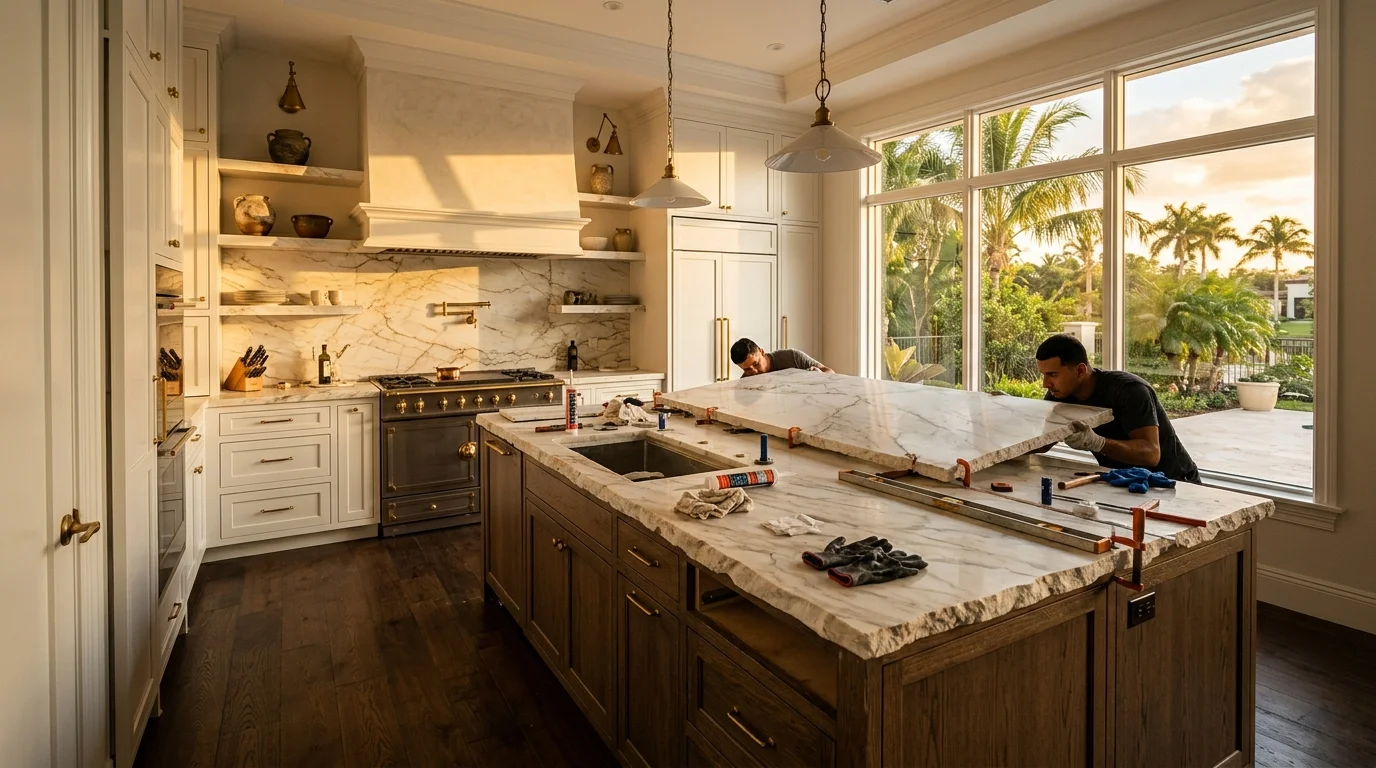
The countertop installation process has more moving parts than most homeowners expect. It is not just showing up with a slab and setting it down. There are measurements, fabrication, curing, sealing, and a handful of decisions that have to happen in the right order. Get one step wrong and you are looking at seams in the wrong place, cutouts that do not line up with your sink, or a gap along the wall that caulk alone cannot save. We have installed countertops across Palm Beach County, from Wellington ranches to high-rise condos in Boca Raton, and the homeowners who have the smoothest experience are the ones who understood the process before the crew showed up. This guide walks you through every stage, start to finish.
Before Installation Day: What Happens First
Countertop installation starts well before any slab enters your home. The sequence matters. Cabinets must be installed and fully leveled before templating can happen. If you template over cabinets that are still shifting or unlevel, those measurements transfer directly to the stone. A slab cut to a crooked cabinet line is a slab that never fits perfectly.
Your appliances should also be on-site or confirmed before templating. Sink dimensions, cooktop cutout sizes, and faucet hole positions all get captured during the template visit. If you have not decided on your sink yet, now is the time. We consistently recommend undermount sinks over drop-in for stone countertops because they are easier to clean and look cleaner against the material. If you are still weighing options, our guide to undermount vs drop-in sinks lays out the real differences so you can decide before templating day arrives.
Clear the countertops of everything. That means appliances, dish racks, decorative items, anything sitting on the existing surface. Pull items out of the sink cabinet below the sink location. Our crew needs access to the underside of that cabinet for the sink mounting hardware. If you have a garbage disposal, it will be disconnected and reinstalled by your plumber as part of the project scope, SFKB handles the countertop and cutout; your GC or plumber handles the plumbing reconnections.
One more thing to sort out before templating: your edge profile. The fabricator needs this confirmed so the CNC machine programs the right cut. If you are still deciding, check out the options in our countertop edge profiles guide for Palm Beach County. Eased and mitered edges are the most popular right now. Ogee is having a moment in more traditional Mediterranean-style homes here in South Florida, but we lean toward cleaner profiles for most modern kitchens.
Precise Templating: The Step That Defines Everything
Precise templating is the single most important step in the entire countertop installation process. Every cut the fabricator makes at the shop is based on what gets captured during this visit. A sloppy template means a sloppy installation, and stone is not forgiving. You cannot shave a quarter inch off a granite slab at your house.
Our templating crew uses rigid template material to trace the exact footprint of your cabinet layout. Every wall angle gets captured, including corners that look square but are not. Florida homes, especially older construction in Delray Beach and the barrier island communities of Jupiter, routinely have walls that are off by a few degrees. It shows up as a gap between countertop and backsplash if nobody catches it at templating.
Here is what gets documented during a precise template visit:
- Full perimeter of each counter run
- Sink cutout location, size, and orientation
- Cooktop or range cutout if applicable
- Faucet hole positions and quantity
- Overhang dimensions at islands and peninsulas
- Seam placement (planned and confirmed with homeowner)
- Edge profile confirmed in writing
- Wall angle variations noted and compensated for
Seam placement is a conversation, not a surprise. We always talk through seam locations with homeowners before the slab gets cut. On longer runs, seams are unavoidable. The goal is to position them where they are least visible and structurally sound. On natural stone like quartzite or granite, a good fabricator will also consider the veining pattern to make seams read as cleanly as possible. If you are using a heavily veined material like Taj Mahal quartzite, seam matching matters even more.
Plan for the template visit to take 45 minutes to an hour and a half depending on the size and complexity of your layout. Islands, L-shaped runs, and anything with multiple cutouts take longer. Do not rush this step. It is worth every minute.
Fabrication and Lead Time
Once the template leaves your house, it goes to the fabrication shop. The CNC machine programs the cuts, the fabricators cut and finish the edges, and the slab gets polished to your chosen finish. This is not a same-day operation.
Typical lead times in the Palm Beach County market run 7 to 14 business days from templating to installation. That number can stretch to 3 weeks or more during busy season, which here in South Florida runs October through March when snowbirds are back and remodel activity spikes. If you are working on a tighter timeline, discuss that with your team before committing to a slab so you know what to expect.
Quartz products from manufacturers like Cambria are engineered slabs and tend to have more consistent lead times than natural stone because the material is more uniform. Natural stone fabrication can take a little longer because the fabricator has to work around natural fissures and veining to position cuts correctly.
During this window, make sure your kitchen sink plumbing is ready to be disconnected on installation day. Your plumber should be scheduled to come back after installation to reconnect supply lines and the drain. Do not assume the countertop crew handles plumbing. They do not. That coordination falls to you or your general contractor.
This is also a good time to finalize your backsplash plan if you have not already. Countertop installation typically happens before backsplash tile, so locking in your tile choice now means no gaps in your schedule. Our kitchen backsplash ideas for Palm Beach County homes is a solid starting point if you are still deciding.
Installation Day: Hour by Hour
Installation day moves fast when the preparation has been done right. Here is a realistic breakdown of what to expect.
Morning arrival, 8 to 9 a.m. The crew arrives with the fabricated slabs loaded in a padded vehicle. Slabs are heavy. A standard 3cm quartz slab for a 25-square-foot countertop run can weigh 400 to 600 pounds. The crew will need a clear path from your driveway or parking area to the kitchen. Move vehicles, remove obstacles, and make sure any pets are secured away from the work area.
Old countertop removal, 9 to 10 a.m. If you have existing countertops, they come out first. Laminate counters come out quickly. Tile-on-drywall is messier and takes longer. Old granite or stone requires more manpower and more time. The crew will disconnect the sink if plumbing has already been shut off by your plumber. Dust happens. Close interior doors to rooms you want to protect.
Dry fit and wall adjustment, 10 to 11 a.m. The new slabs go in dry first, meaning no adhesive yet. The crew checks the fit against every wall, confirms overhang dimensions, and looks for any gaps. This is where that precise templating pays off. Minimal adjustment is needed on a well-templated job. On a poorly templated job, this phase can become a serious problem.
Adhesive and setting, 11 a.m. to noon. Slabs are set using epoxy or silicone adhesive depending on the substrate and material. Seams get aligned and clamped while the adhesive cures. Do not rush this. If a seam is clamped wrong, it shows forever.
Sink cutout and final fitting, noon to 1 p.m. If the sink cutout was not pre-cut at the shop, it gets cut on-site. Most fabricators pre-cut in the shop for cleaner results, but on-site cutting happens when measurements needed to be confirmed against the actual sink at install. Noise is significant during this phase. Wet saws and angle grinders are loud.
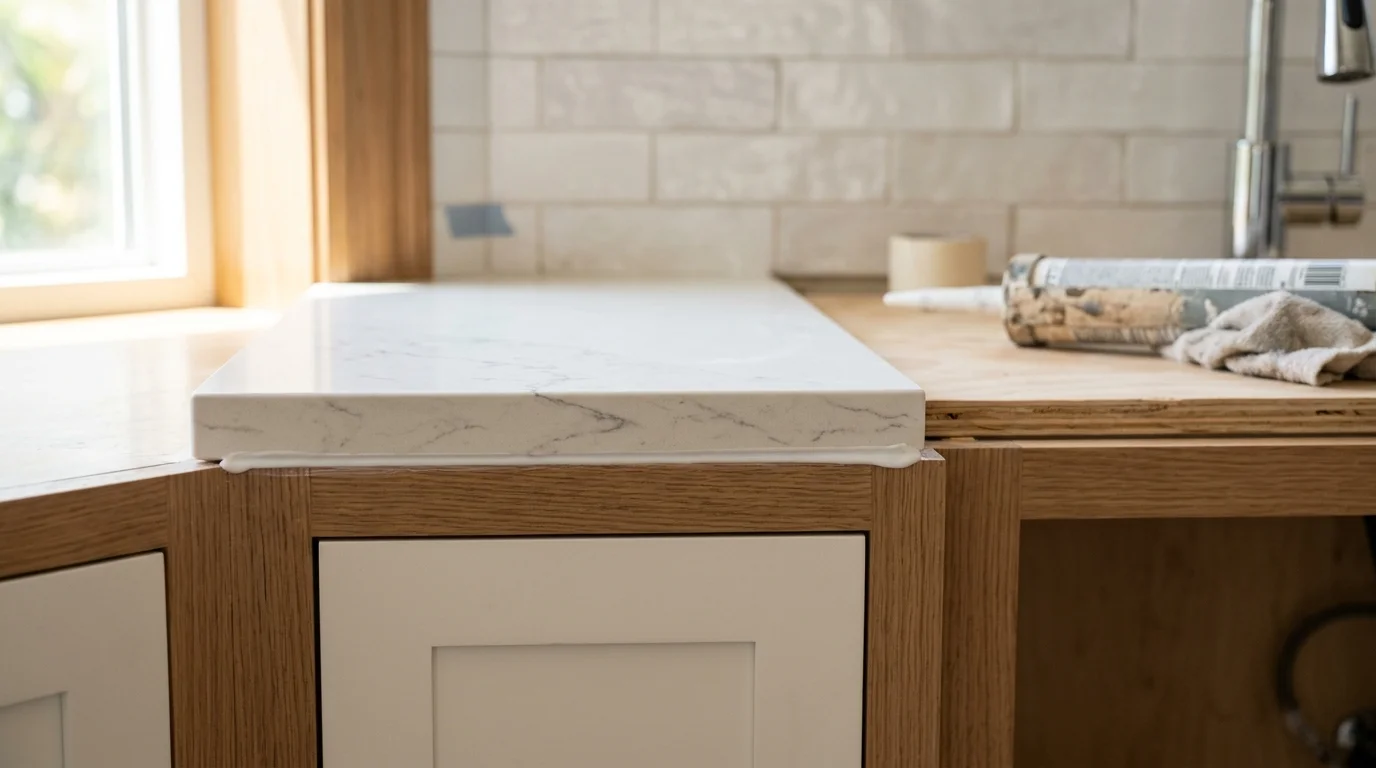
Caulking and cleanup, 1 to 2 p.m. Once everything is set and the adhesive has cured, the crew caulks the joint between the countertop and wall. Color-matched caulk is standard. This joint is intentional. Stone and drywall expand and contract at different rates, especially in Florida heat, and a rigid grout joint there will crack. Caulk moves with the material.
Sealing, 2 to 3 p.m. Natural stone surfaces like granite and quartzite get sealed before the crew leaves. Quartz does not require sealing at installation because it is non-porous by nature. If you want to understand whether your specific material needs ongoing sealing, our article on whether quartz countertops need sealing covers the full picture.
Total installation time for a standard kitchen with one sink run and an island typically runs 4 to 6 hours. Larger kitchens with complex layouts, waterfall islands, or multiple cutouts can take a full 8-hour day. Plan to be home. You should be available to approve the dry fit and seam placement before adhesive goes down.
One thing worth noting about overhang: if you have seating at an island or peninsula, the crew will confirm overhang dimensions against what was templated. Standard seating overhang is 12 inches for counter-height and 15 inches for bar-height. If you have questions about what works for your layout, our countertop overhang guide walks through the numbers.
Countertop Installation Cost Guide
Countertop costs in Palm Beach County are driven by material, linear footage, edge complexity, and the number of cutouts. The ranges below reflect what homeowners across Boca Raton, Wellington, Delray Beach, and Jupiter are actually paying in the current market, not national averages.
Material choice is the biggest lever on cost. For a deeper breakdown of what specific materials cost in this market, our countertop installation cost guide for Palm Beach County gives you line-by-line numbers. And if you are weighing two of the most popular options side by side, our quartz vs granite comparison cuts through the noise on durability, maintenance, and value.
South Florida Considerations
Installing countertops here is not identical to installing them in Atlanta or Phoenix. A few things are specific to Palm Beach County that homeowners should know going in.
Heat and humidity affect adhesive cure times. On days when the humidity is sitting above 80 percent, which is most of summer in Delray Beach and West Palm Beach, some adhesives take longer to fully cure. A good fabrication crew accounts for this. Do not run the dishwasher or put any load-bearing stress on a freshly set countertop for at least 24 hours after installation, longer in peak humidity.
Caulk color matters more here than in drier climates because mold loves warm, humid joints. Ask the crew to use a mold-resistant silicone caulk at the backsplash joint, especially around the sink. It is a small detail that prevents a problem that is extremely common in South Florida kitchens.
If your home is in a gated community or a condominium building in Boca Raton or Jupiter, there may be HOA or building management requirements around delivery hours, freight elevator reservations, and material staging. Work this out before installation day. A crew that shows up to find a freight elevator unavailable for three hours loses half the day. Our article on condo kitchen remodels and HOA requirements in Palm Beach County covers what you need to know about working within those constraints.
Natural stone sealing is more important here than in northern climates. The combination of heat, humidity, and kitchen moisture means porous materials like granite and quartzite wick up spills faster. Make sure the crew seals natural stone the day of installation, and plan to reseal annually. Our granite countertop sealer guide tells you exactly which products work and how often to apply them.
Permits are generally not required for a straight countertop swap when the layout stays the same, the sink stays in its existing location, and no walls are opened. If your project involves relocating the sink, your general contractor should confirm permit requirements with Palm Beach County Building Division before work starts. You can review current building department guidance at Palm Beach County Planning, Zoning and Building.
Finally, think about what comes after the countertop. Backsplash tile is typically the next trade. If you are going with a full-height slab backsplash in the same material as the counter, that gets templated and fabricated at the same time as the countertop. If you are tiling, the tile crew comes in after countertop installation is complete and cured. Getting this sequence right keeps the project on schedule and prevents the tile crew from having nothing to work against. Our piece on 4-inch vs full-height backsplash options is worth a read if you have not nailed down that decision yet.