Quartz vs Granite Countertops: Which Is Better?
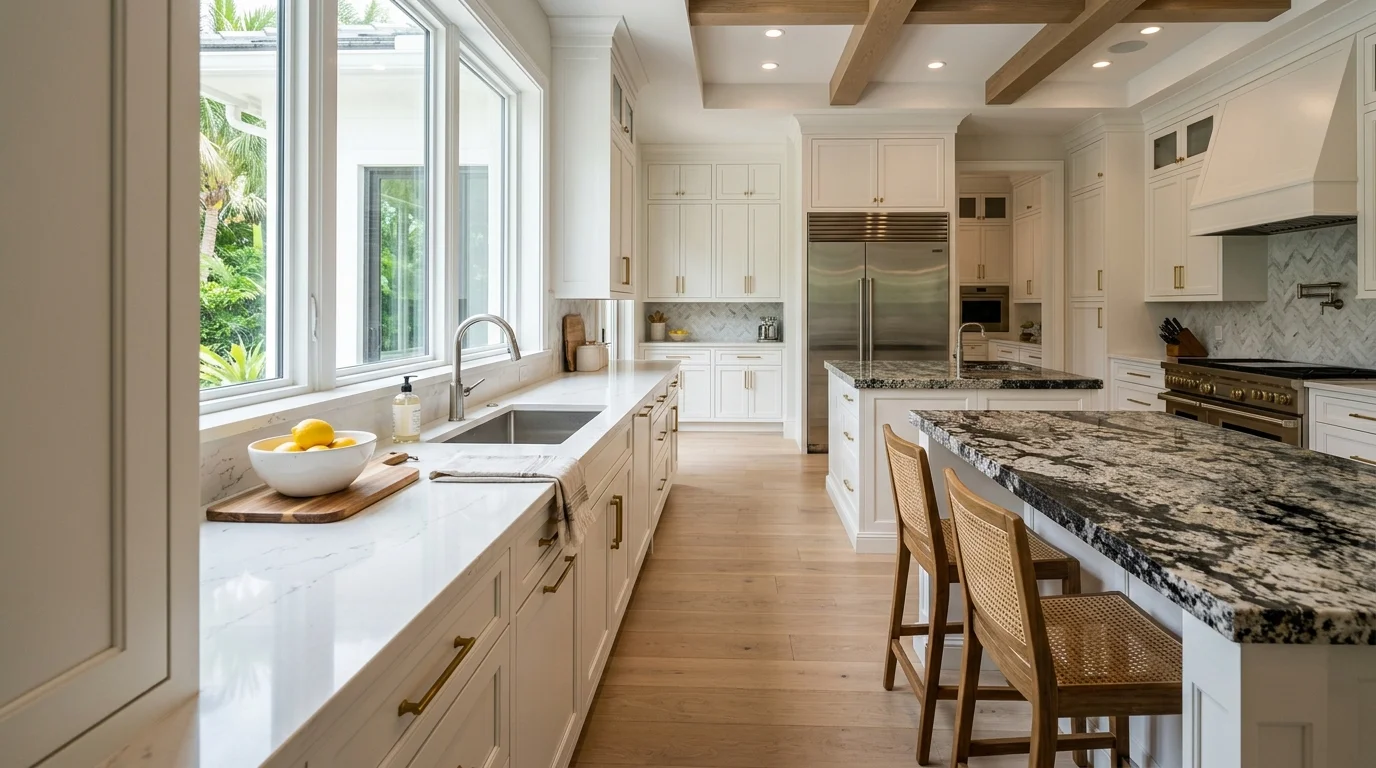
The quartz vs granite countertops debate is one we have every single week with homeowners in Boca Raton, Delray Beach, Wellington, and Jupiter. Both are strong, both look great, and both can absolutely work in a South Florida kitchen. But they are not the same material, they do not behave the same way, and the right choice depends on how you actually use your kitchen. We have installed hundreds of slabs of each across Palm Beach County, and our opinion is clear: most homeowners are better served by quartz, with specific situations where granite wins. Here is the full breakdown.
The Real Difference Between Quartz and Granite
Granite is a natural stone quarried from the earth. Every slab is unique, the mineral composition, veining, and color variation are completely natural. That unpredictability is part of the appeal. No two kitchens in Wellington will have the exact same slab.
Quartz countertops are engineered. Manufacturers bind roughly 90-95% crushed quartz crystals with polymer resins and pigments to create a consistent, controlled product. Brands like Cambria and Silestone run their material through tight manufacturing tolerances, which means the slab you see in the showroom looks almost identical to what gets installed in your kitchen.
That single difference, natural vs. engineered, drives nearly every downstream distinction between the two materials. Porosity, sealing requirements, heat performance, consistency of appearance: they all trace back to how each material is made. Before you decide, it helps to understand what you are actually comparing, not just the names.
If you want to go deeper into the full stone-material comparison, our guide on quartz vs quartzite vs granite vs marble breaks down all four options side by side.
Durability, Sealing & Maintenance
This is where quartz wins for most households. Engineered quartz is non-porous. Bacteria, mold spores, and moisture cannot penetrate the surface because there is no surface to penetrate, the resin fills every microscopic gap. That matters a lot in South Florida, where kitchens run humid year-round.
Granite is porous. Full stop. A freshly polished granite slab looks impenetrable, but liquids, red wine, citrus juice, cooking oil, will eventually work their way in if the surface is not properly sealed. Most granite needs sealing every 1-3 years depending on the stone density and finish. Some exotic granites need it annually. Our guide on granite countertop sealing explains exactly how to test and reseal your stone correctly.
Quartz requires no sealing. Ever. Wipe it down with warm soapy water and you are done. For busy families in Boca Raton or Delray Beach with kids, pets, and heavy cooking traffic, that maintenance difference alone can tip the decision.
Scratch resistance is roughly comparable between the two, both sit at around a 7 on the Mohs hardness scale. Neither should be used as a cutting board, and we always remind homeowners: if you are cutting directly on your countertop, you are shortening its life regardless of material. Our separate article on whether you can cut on quartz countertops covers exactly why that habit is a problem.
Staining is another story. Quartz resists staining significantly better than granite because of that non-porous resin surface. If you do get something stuck on quartz, the fix is usually straightforward. Granite stains are a different challenge, turmeric, cooking oil, and red wine can penetrate an under-sealed slab and leave permanent discoloration. If you already have granite and are dealing with a stain, read our guide on how to remove stains from granite countertops before you panic.
Heat Resistance & Appearance
Here is where granite has a real, meaningful advantage: heat resistance. Natural granite can handle a hot pan directly off the stove. The stone formed under intense geological heat, a 400°F cast iron skillet is not going to faze it.
Quartz cannot say the same. The polymer resin that makes quartz non-porous is also its Achilles heel. Sustained heat above roughly 300°F can discolor, crack, or warp the resin. We have seen this happen in Jupiter and Wellington kitchens where homeowners put a hot pot directly on quartz without a trivet. Manufacturers void warranties for thermal damage. Always use a trivet or hot pad on quartz, no exceptions.
If you cook with intense, direct heat regularly and you cannot be trusted to grab a trivet every single time, granite is the smarter call.
On appearance, this comes down to personal preference, but here is our honest take. Granite's natural variation is beautiful and genuinely unique. The downside is that variation can be hard to predict across multiple slabs. A large kitchen in Boca Raton that needs three or four slabs of granite will show some variation between them, and matching backsplash tile becomes a more complex design puzzle.
Quartz offers consistency. If you want a clean, controlled look, especially popular in all-white kitchen designs throughout South Florida, quartz delivers that reliably. The engineered marble-look quartz slabs available today are genuinely stunning, and several of them are indistinguishable from real Calacatta marble at normal viewing distance.
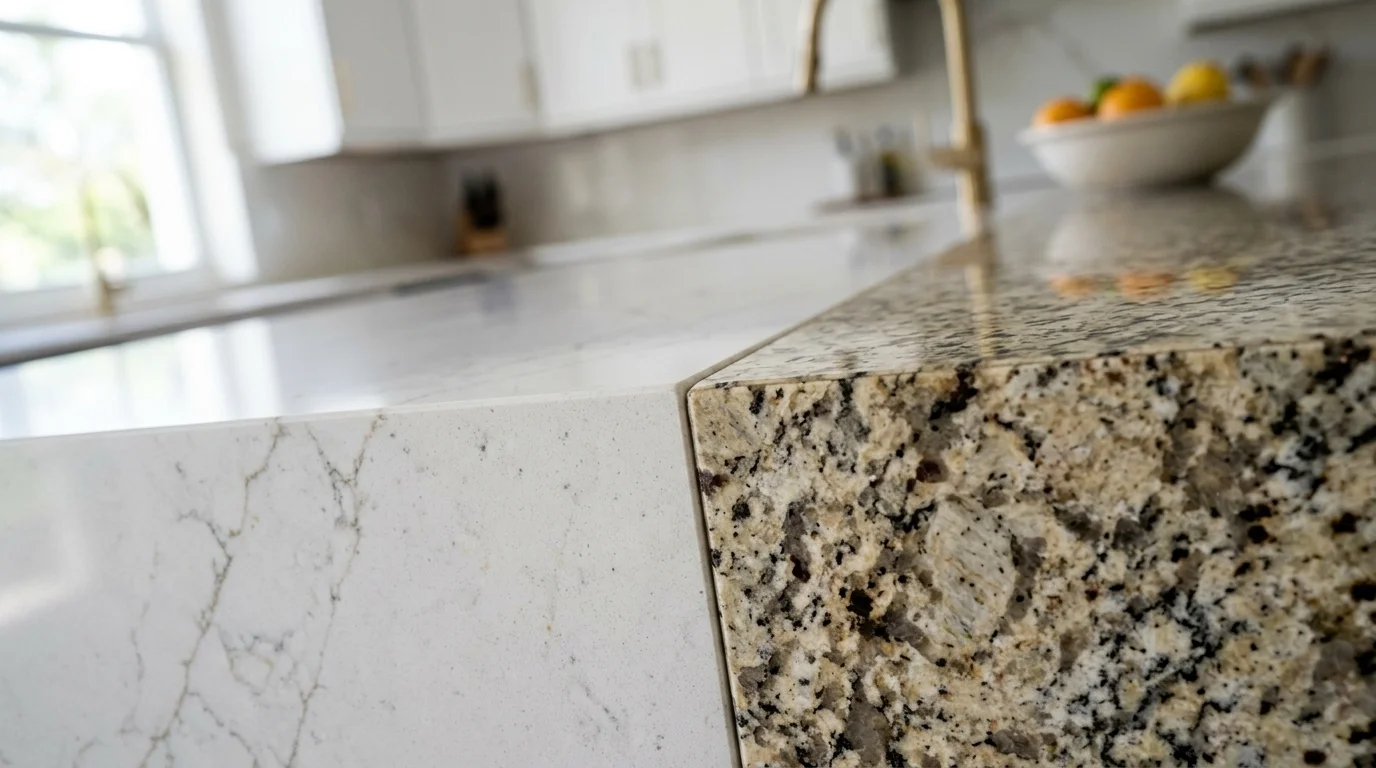
Quartz also dominates when it comes to waterfall edges and slab backsplashes. The consistent patterning means a waterfall countertop in quartz will have continuous veining that wraps the corner cleanly. With natural granite, matching a waterfall seam requires careful slab selection and mitering, and it is harder and more expensive to achieve a clean result.
Cost Guide: Quartz vs Granite in Palm Beach County
Pricing in Palm Beach County reflects our local market, material costs, fabrication, and installation all factor in. These ranges cover supply and installation. Countertop removal and disposal, if needed, adds $200-$500 depending on scope. For a full breakdown of what quartz countertops cost locally, see our dedicated quartz countertops cost guide for Palm Beach County. Granite pricing is covered in our granite countertops cost guide.
A few things worth noting: entry-level granite is genuinely cheaper than entry-level quartz. If budget is the primary driver, builder-grade granite at $55-$75/sq ft installed is hard to beat on raw cost. But once you move into mid-range and above, the pricing between the two materials is very competitive. Exotic granite with complex veining, think Blue Bahia or Lemurian Blue, can actually cost more than premium quartz brands.
Edge profiles add cost regardless of material. A simple eased or beveled edge is typically included. Ogee, waterfall, and mitered edges add $15-$40 per linear foot. Our guide on countertop edge profiles in Palm Beach County covers the full range of options and pricing.
South Florida Considerations
Living in Palm Beach County means your kitchen operates in a genuinely harsh environment. High humidity, salt air if you are near the coast, aggressive UV from year-round sun, and the daily heat load of a South Florida summer, these conditions affect countertop performance in ways that national buying guides never mention.
Humidity is the big one. Granite's porosity means moisture absorption is a real concern in humid kitchens. If a granite countertop is not sealed properly and moisture works its way in, you can get darkening around the sink, edges, or any area where water pools. Quartz does not have this problem. The resin surface is impervious to ambient humidity, which is why our team tends to recommend quartz more often in coastal Boca Raton and Delray Beach homes where salt-air humidity is polished year-round.
UV exposure is another factor almost nobody talks about. Natural granite has no UV sensitivity, the stone's color is mineral-based and stable in sunlight. Quartz resins, however, can yellow or fade with prolonged direct UV exposure. Quartz manufacturers are clear about this: quartz is not recommended for outdoor applications. If your kitchen has significant skylights or a south-facing window wall that floods the counters with direct sunlight for hours each day, some quartz colors may shift over time. This is rarely a problem in a typical kitchen, but outdoor kitchen countertops should absolutely not be quartz. See our guide on outdoor kitchen countertops for materials that actually hold up outside in Florida.
For kitchens in gated communities, HOA-governed condos, or historic districts in Delray Beach, your countertop selection sometimes needs to align with design standards or architectural review. If your project involves a full layout change that requires your general contractor to pull permits, say, relocating the sink or adding a kitchen island with new plumbing rough-in, your GC handles that process. The countertop material selection is entirely separate from permitting scope, which is typically triggered by structural or MEP work, not by a countertop swap. If you are wondering how permits work for kitchen projects specifically, the kitchen remodel permit guide for Palm Beach County has the details.
Our recommendation for most South Florida homeowners: go with quartz. The maintenance simplicity, humidity resistance, and design consistency make it the right call for the majority of kitchens we work on in Boca Raton, Wellington, Jupiter, and Delray Beach. Choose granite when you want the uniqueness of natural stone, you cook with intense direct heat regularly, or the specific exotic slab you fell in love with simply does not exist in quartz form. Both materials, installed correctly with quality fabrication, will last decades in a South Florida home.