Honed vs Polished Countertops: Which Finish Is Right for You?
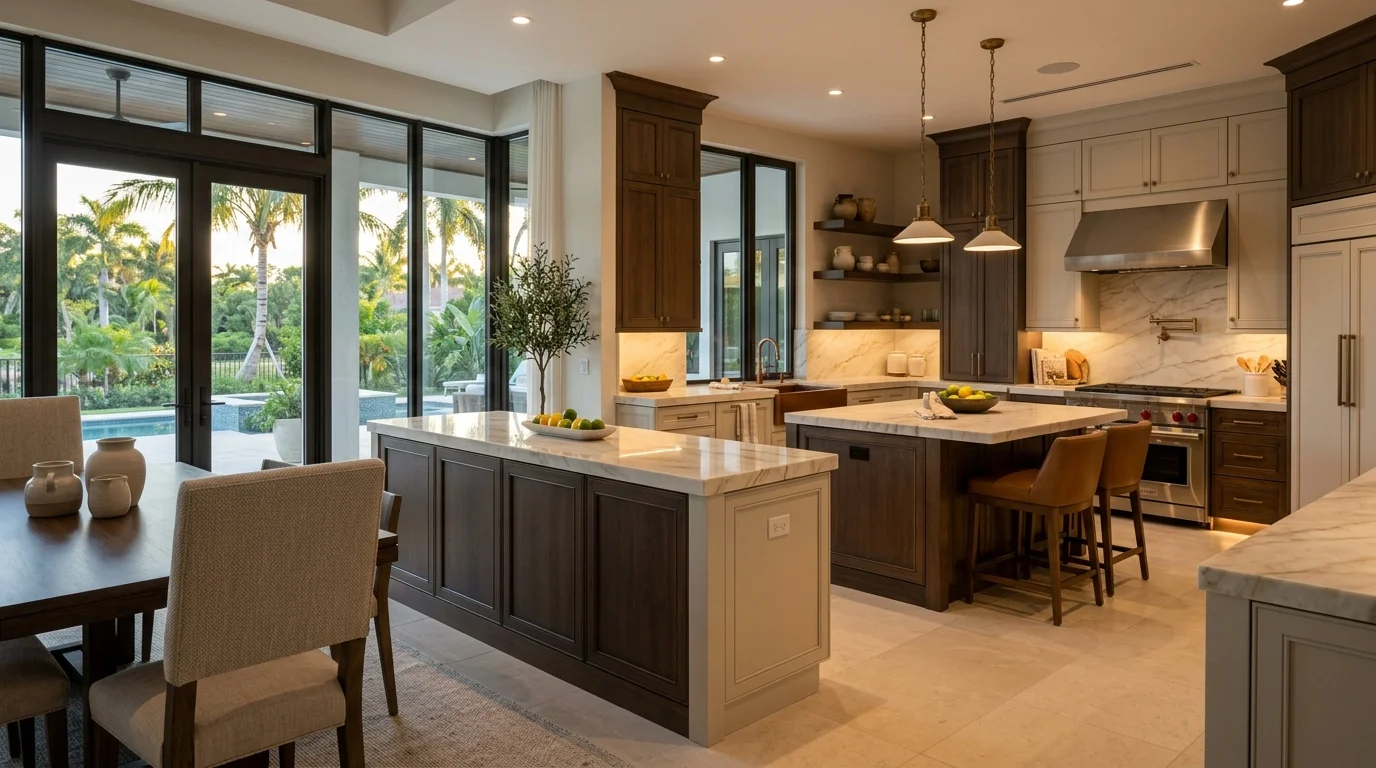
The honed vs polished countertops debate comes up in almost every design conversation we have with homeowners across Palm Beach County, and it matters more than most people expect. The finish you choose affects how your countertop looks, how it wears, how you clean it, and whether it will still look sharp five years from now in a South Florida kitchen where sunlight is relentless and humidity never quits. This guide covers granite, quartzite, and marble because those are the natural stones where the finish decision is real and consequential. With quartz, the finish is largely factory-set and the stakes are different.
What the Finish Actually Means
A polished finish is achieved by grinding the stone surface through progressively finer abrasives until the crystalline structure reflects light like a mirror. That process closes up the pores slightly and produces the glossy look most people picture when they think "granite countertop." Polished stone shows color depth and veining at maximum intensity. The contrast is sharp, the surface feels glassy, and the shine is immediately obvious from across the room.
A honed finish stops the grinding process earlier, typically at a 400- to 800-grit stage depending on the stone. The result is a flat, matte surface without the mirror reflection. Honed stone still feels smooth, but it diffuses light rather than bouncing it back. Colors read softer. Veining reads more organic. The whole effect feels quieter.
There is also a third finish, leathered or brushed, that uses diamond-tipped brushes to create a subtle texture. It sits between honed and polished and is especially popular on darker granites. We won't go deep on leathered here, but it's worth knowing it exists when you're at the slab yard.
The finish is applied at the fabrication stage, before installation. If you fall in love with a slab in polished form, you can request the fabricator re-finish it as honed, but not all fabricators offer that for every stone, and it adds cost and lead time. When you're sourcing stone, ask the yard what finishes are available before you commit. Our article on the best places to buy countertop slabs in Palm Beach County can help you find yards that carry a real selection of both.
Granite: Honed vs Polished
Granite is the stone where polished finishes have the longest track record, and for good reason. Granite's crystalline mineral structure, feldspar, quartz, mica, produces a genuine mirror-bright polish that flatters the color range. Polished granite on a kitchen island in a Boca Raton home catches the overhead lighting and makes a statement. It's the classic look, and it holds up well.
The practical upside of polished granite is that the denser surface is slightly more resistant to staining than honed. Water beads more readily. Acidic spills, citrus, wine, tomato, have a little less opportunity to penetrate before you wipe them up. You still need to seal polished granite; just because it's shiny doesn't mean it's impermeable. Our granite countertop sealer guide covers the right products and how often to apply them in Florida's climate.
Honed granite has grown significantly in popularity over the last few years. The matte look reads more contemporary and pairs naturally with flat-front cabinetry, unlacquered brass hardware, and the warmer palettes we're seeing in 2026. The downside is real: honed granite is more porous than its polished equivalent, which means it needs sealing more frequently and it's more forgiving of your eyes but less forgiving of your cooking habits. Oil in particular can darken honed granite if it sits. That's not a dealbreaker, it's just something you need to know going in.
Our recommendation for granite: if your kitchen gets hard daily use, a family cooking real meals, kids doing homework at the island, go polished. It's more practical. If you're doing a lower-traffic kitchen, a butler's pantry, or a bar area where the aesthetic is the priority, honed granite looks genuinely beautiful and the maintenance tradeoff is manageable.
Quartzite: Honed vs Polished
Quartzite is the stone where we have the strongest opinions, because homeowners regularly confuse it with marble and get burned by the maintenance expectations. Quartzite is a metamorphic stone, harder than marble, and it takes a polish extremely well. Polished quartzite, especially white and soft-gray varieties like Taj Mahal or White Macaubas, has a luminous quality that looks more refined than most granites. The veining is natural and dramatic without the fragility of marble.
Polished quartzite is our go-to recommendation when someone wants a marble look with better real-world performance. It still needs sealing. Quartzite does need to be sealed, and some softer varieties need it done annually in high-use kitchens. But polished quartzite holds up to South Florida cooking far better than marble in the same finish.
Honed quartzite is absolutely gorgeous, soft, almost chalky on the surface, with an understated elegance that photographs beautifully. The problem is the same one that applies to honed granite, multiplied. Quartzite in a honed finish is more absorbent than polished, and because many quartzite varieties already have softer or denser mineral zones within the same slab, the staining risk is real. Oil and red wine are the main culprits. If you go honed quartzite, you commit to a strict sealing schedule and you commit to immediate cleanup of anything acidic or fatty. Some homeowners are perfectly fine with that. Others are not.
For Delray Beach and Jupiter kitchens where we see a lot of indoor-outdoor cooking and entertaining, we lean toward polished quartzite for the main perimeter and reserve honed finishes for lower-traffic surfaces like a built-in bar top or a laundry room counter where the look matters and the abuse level is lower.
If you want to go deeper on the stone itself before choosing a finish, our comparison of quartz vs quartzite countertops breaks down the material differences clearly.
Marble: Honed vs Polished
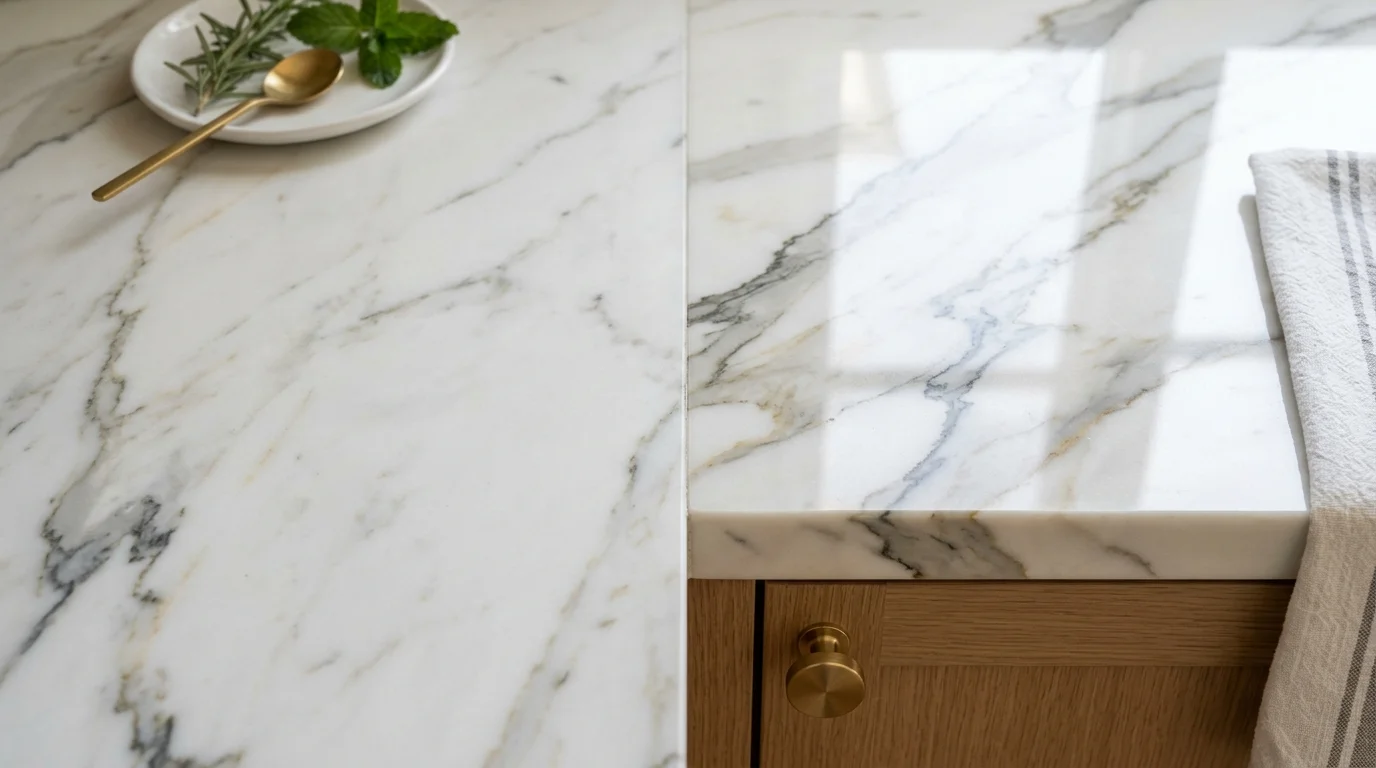
Marble is where the finish debate gets the most charged, and where our opinion is most definitive. For kitchen countertops in active South Florida homes, we recommend honed marble over polished marble. Here's why.
Polished marble etches. Etching is a chemical reaction, not a stain, where acidic substances like lemon juice, vinegar, wine, or even some dish soaps dissolve the calcium carbonate on the surface and leave a dull mark where the polish used to be. On polished marble, those etch marks are brutally visible because they interrupt the mirror surface. You see them at every angle under any light. On honed marble, the surface is already matte. Etching still occurs, but the marks blend into the existing texture. You often can't see them unless you're looking for them at an oblique angle. That difference is enormous in a kitchen.
The tradeoff is that honed marble stains more readily than polished because it's more porous. But here's our actual opinion: a faint oil stain that blends into the patina of honed marble reads as character. A cluster of etch rings on polished Calacatta reads as neglect, even if it isn't. Homeowners who want polished marble in a working kitchen often end up frustrated within the first year.
Honed marble in a bathroom is a different calculation entirely. Bathrooms see less acid exposure, and honed marble on a vanity or a tub deck is an excellent choice, durable enough for the use case, beautiful, and easier to maintain than the same stone in a kitchen. See our notes on marble countertop pros and cons for Florida kitchens for a fuller picture of what you're signing up for regardless of finish.
For homeowners who love the marble look but want none of the maintenance drama, we point them toward high-quality marble-look porcelain or Calacatta quartz, which comes in both polished and matte finishes from the factory and etches from nothing because it isn't calcium-based stone.
The Marble Institute of America has published detailed technical guides on etching, sealing protocols, and finish comparisons across natural stone types, worth bookmarking if you're going deep on this decision.
Cost Guide
The finish itself, honed vs polished, adds a modest cost premium in most cases. If a polished slab is the baseline, honed typically adds $5-$15 per square foot in fabrication costs because it requires a re-finishing pass. That said, some stone varieties are simply priced higher in certain finishes depending on availability and demand at the local yard level. Here are realistic ranges for Palm Beach County based on what we see in the market, supply chain considered as of 2025.
These are supply-and-install figures covering the slab, fabrication, edge profile, and installation. They do not include demolition of existing countertops, plumbing reconnections (handled by your GC), or structural changes.
For a full breakdown of what countertop installation costs across different materials in this market, see our guide to countertop installation costs in Palm Beach County. Edge profile choice also affects fabrication pricing, eased and beveled edges are standard; waterfall or ogee profiles cost more. Our countertop edge profiles guide for Palm Beach County covers what's available and what each costs.
South Florida Considerations
A few things about this market specifically that influence the finish decision in ways national guides won't tell you.
Sunlight is the big one. South Florida homes, especially in Wellington, Jupiter, and coastal Boca Raton, often have large windows, sliders, and open floor plans that flood kitchens with direct sun for hours a day. Polished countertops can produce significant glare in these conditions. We have seen Calacatta marble in a polished finish reflect afternoon sun so intensely that the homeowner couldn't comfortably work at the island. Honed finishes diffuse that light instead of bouncing it. In a high-light South Florida kitchen, honed often looks more sophisticated even setting aside the maintenance argument.
Humidity matters too, but not in the way you might think. Florida's year-round humidity doesn't directly attack stone surfaces, but it does mean your kitchen sees more airborne moisture and more condensation from cold glasses, ice, and drinks on the counter. Stone that isn't properly sealed, regardless of finish, will absorb that moisture over time. Honed stone needs more frequent sealing precisely because it's more porous. We recommend sealing honed natural stone at least once a year in Florida kitchens, twice if the surface gets heavy use. Use an impregnating penetrating sealer, not a topical coating.
HOA and condo considerations also come up in Palm Beach County. If you're in a managed condo building in Delray Beach or Boca, weight limits on upper floors can be a real constraint. Natural stone slabs run heavy, typically 18-22 lbs per square foot depending on thickness. This applies regardless of finish. If you're working through an HOA approval process, the finish is rarely what they care about, it's the slab weight and the plumbing work your GC needs to schedule. Your general contractor handles the permit and HOA coordination; we supply the design drawings and material specs to support that process.
Finally, resale value. In the Palm Beach County market, natural stone countertops in either finish read as premium and support strong resale. Polished stone photographs better for listing photos, the reflection reads as "luxury" in real estate images even if it's harder to live with daily. Honed stone looks more muted in photos but appeals strongly to buyers who've owned polished stone before and know the maintenance reality. Neither finish is wrong from a resale standpoint; it's more about who your eventual buyer is.
If you're trying to make sense of where countertop upgrades fit into the overall value equation for your home, our breakdown of which kitchen upgrades add the most value in Florida puts stone selection in context. And if you're still deciding between stone types altogether before settling on a finish, our guide to the best countertops for Florida kitchens covers the full material landscape including performance in heat and humidity.
The Florida Building Commission sets baseline standards for residential construction, but countertop finish selection is a design and performance decision, not a code issue. Your choice of honed vs polished won't affect permit requirements, which for countertop-only replacements on an existing layout typically aren't required at all.