Countertop Thickness Guide: 2cm vs 3cm Explained
Countertop thickness is one of those decisions homeowners in Palm Beach County rarely think about until they are standing in a stone yard staring at two slabs that look nearly identical, except one is noticeably heavier and costs more. Understanding countertop thickness 2cm vs 3cm before you buy saves you from overspending on stone you don't need, or underspending and ending up with a slab that sags, chips, or just looks cheap. Our team works on countertop projects from Boca Raton to Jupiter every week, and this is one of the most common questions we field during consultations. Here is exactly what the difference means and how to choose right for your specific project.
What the Numbers Actually Mean
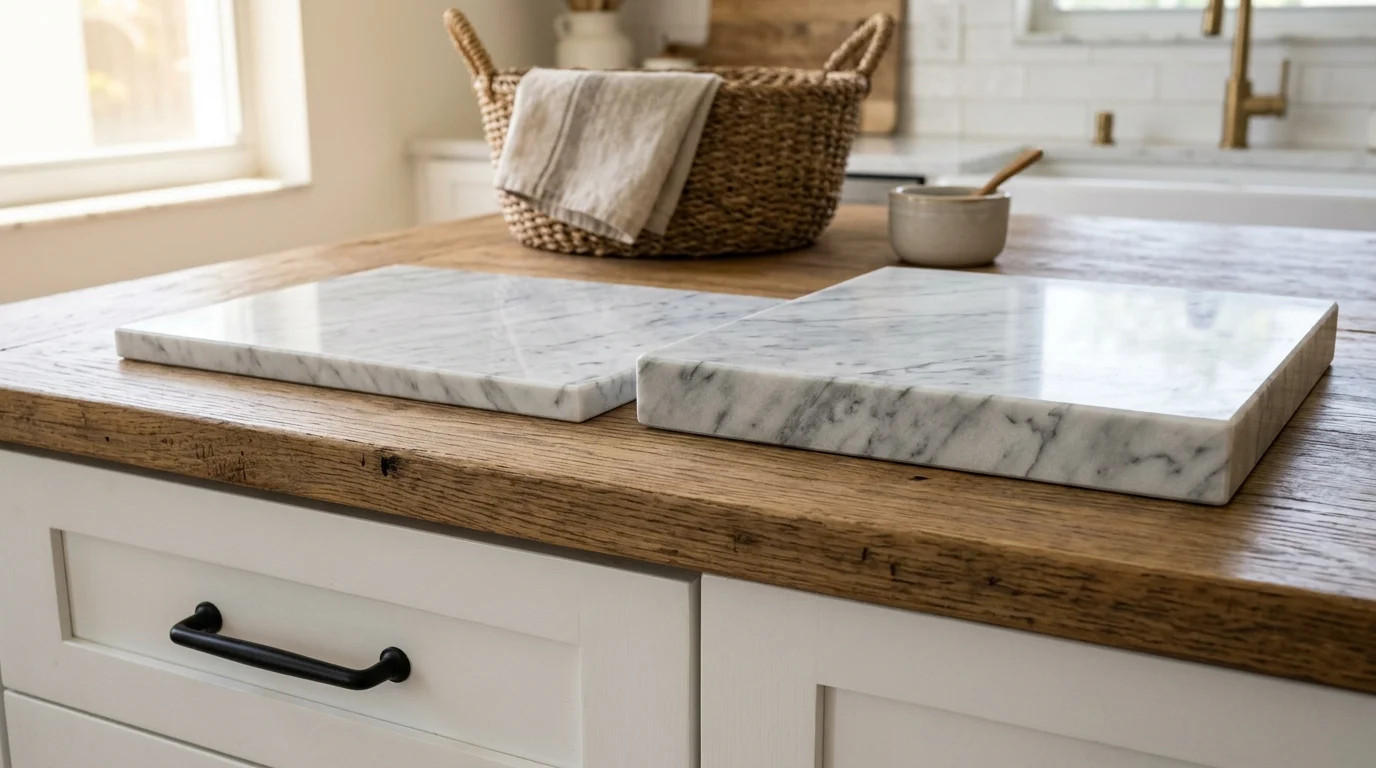
Countertop slabs are sold in two standard thicknesses: 2cm (roughly 3/4 inch) and 3cm (roughly 1-1/4 inch). That extra half-centimeter sounds small. In real life, it has real consequences for structural integrity, edge options, support requirements, and price.
Both thicknesses are cut from the same quarried or engineered material. The difference is how much material is left after the slab is processed. A 3cm slab is a true solid piece. A 2cm slab is thinner and, when used on horizontal surfaces with unsupported spans, typically requires a plywood substrate underneath to prevent flex and cracking.
Most natural stones, granite, marble, quartzite, are available in both. Engineered quartz is available in both, though some manufacturers have shifted heavily toward 3cm as their standard offering. Porcelain slabs are almost always 12mm or 20mm (closer to the 2cm range), which is an entirely different structural story we cover separately in our guide to porcelain countertops.
The Marble Institute of America publishes fabrication and installation standards that address slab thickness requirements for various span lengths. The short version: longer unsupported spans demand more thickness or more substrate support. That is not just an aesthetic rule, it is a structural one.
2cm Countertops: When They Work
2cm stone is not inferior material. It is the right choice in specific situations, and the wrong choice in others.
Where 2cm works well: vertical applications like waterfall sides, furniture-style cabinet ends, tub decks where the stone is fully supported, and bathroom vanity tops where spans are short. It is also the standard for some tile and slab backsplash applications where weight on upper cabinets is a concern.
Where 2cm gets tricky: kitchen countertops with spans longer than about 18 inches without full plywood underlayment. If you are using 2cm stone on a standard kitchen counter, your fabricator will almost always laminate a plywood base underneath it. That adds cost and adds height to your counter, which can throw off your cabinet-to-counter alignment if your cabinets were not spec'd for the adjusted thickness.
2cm also limits your edge profile options. Eased, beveled, and pencil edges are achievable. But dramatic ogee, waterfall, or thick stacked profiles? Those require more material or mitering to pull off convincingly. Our guide to countertop edge profiles breaks down the full range of options and which profiles work at which thickness.
On price, 2cm stone used to be meaningfully cheaper. In the Palm Beach County market today, the gap is smaller than most people expect. The plywood substrate labor cost often offsets the material savings. For most kitchen projects, the math does not favor 2cm the way it once did.
3cm Countertops: Why We Usually Recommend Them
Our team recommends 3cm for the vast majority of kitchen countertop installations. Here is why.
First, structural integrity. A 3cm slab does not need a plywood substrate in most standard kitchen applications. It sits directly on the cabinet carcass and handles typical overhang spans up to about 12 inches without additional support. Beyond 12 inches, like a breakfast bar or island overhang, corbels or hidden steel brackets are still needed, but that is true at any thickness.
Second, edge profiles. 3cm opens up the full library of edge options: eased, beveled, ogee, waterfall, dupont, mitered stacks. If you have a strong opinion about your edge profile, and many homeowners do once they see the options in person, 3cm gives you the full menu. See how different edges are trending in South Florida right now in our 2026 countertop design trends guide.
Third, perceived quality. A 3cm edge simply looks more substantial. On a kitchen island or peninsula, that extra mass reads as high-end. Walk into any luxury kitchen in Wellington or Palm Beach Gardens and the countertops are almost certainly 3cm.
The honest downside of 3cm: weight. It is roughly 50% heavier than 2cm of the same stone. That matters for upper cabinet installations, for slab backsplashes, and for any vertical applications. It also matters for transport and fabrication, and that weight factors into your installation quote.
One more thing. If you are comparing engineered quartz options specifically, check the manufacturer's warranty fine print. Some brands void their warranty if 3cm quartz is installed without proper substrate on long unsupported spans. Others are fine with direct cabinet support. Know which category your slab falls into before the fabricator shows up. Our breakdown of quartz countertop pros and cons gets into warranty details worth reviewing before you commit to a material.
Mitered Edges: Getting a Thick Look from Thin Stone
Here is where things get interesting. A mitered edge is the technique that lets 2cm stone look like 3cm, or lets 3cm stone look like 6cm. It is one of the most valuable tricks in countertop fabrication, and not enough homeowners know it exists until they ask why one quote is significantly higher than another.
The way it works: the fabricator cuts a strip of the same slab material and joins it to the underside of the countertop edge at a 45-degree angle. Done well, the seam is nearly invisible from the front. The result is an edge that appears to be a single thick slab. Done poorly, the miter seam is obvious, the color match is off, and it looks like exactly what it is, a glue-up.
This is why fabricator skill matters enormously with mitered edges. The miter joint requires precise cutting, proper adhesive, and a clean polish across the seam. Color-matched epoxy and experience with book-matching the stone pattern are non-negotiable for a result that actually looks right. Our crew sources fabrication partners who specialize in this work because a bad miter on a $4,000 quartz island top is an expensive mistake.
When does a mitered edge make financial sense? Two situations. First, when you want a waterfall island with thick drama but are working with a 2cm slab that cost significantly less per square foot. The miter gives you the visual without the full material cost. Second, when you are using a 3cm slab and want an even thicker profile, say a 4cm or 5cm apparent thickness, on an island for maximum visual impact. Double-stacked or triple-stacked mitered edges are increasingly popular in high-end Boca Raton and Delray Beach kitchen renovations. For a deeper look at how waterfall countertops are priced and designed, check out our waterfall countertop cost and ideas guide.
One caveat: mitered edges on bookmatched stone require enough slab material to cut matching strips. If you are tight on slab square footage, a miter can be a problem. Plan your material order with your fabricator before committing to the edge treatment.
Mitered edges also add fabrication time and cost. Budget an additional $150-$400 per linear foot for a mitered waterfall or island edge compared to a standard eased edge on the same material. The number swings based on the stone, the profile complexity, and whether bookmatching is involved.
Cost Guide
These are Palm Beach County market prices reflecting actual fabrication and installation costs our clients see, not national averages. Prices assume standard kitchen countertop installation on existing cabinet layout. Material costs vary by stone selection.
These ranges are starting points. Factors that push costs up include exotic stone with complex veining that requires bookmatching, non-standard sink cutouts, cooktop cutouts with radius corners, and unusual overhangs requiring custom bracket work. Get itemized quotes and know what you are comparing. Our guide to countertop installation cost in Palm Beach County goes deeper on what each line item should look like.
South Florida Considerations
Palm Beach County has a few specific conditions that make certain countertop decisions more or less practical than they would be in other parts of the country.
Heat and UV exposure matter. If you have a kitchen with west-facing windows in Delray Beach or a screened lanai kitchen in Jupiter, certain countertop materials degrade faster with sustained UV exposure. This is less about thickness and more about material choice, but thicker slabs of natural stone do hold up better to thermal expansion and contraction than thinner ones. Our guide to the best countertop materials for Florida's humidity and heat covers material durability in detail.
Outdoor kitchens are a big part of the South Florida lifestyle. For outdoor applications in Wellington, Boca Raton, or anywhere along the coast, 3cm is the only practical choice. 2cm outdoors invites cracking from direct sun exposure and temperature swings. Porcelain slabs at 20mm are the exception, but even those require experienced fabrication to handle the brittleness at cut edges.
HOA and ARB requirements in gated communities throughout Palm Beach County sometimes specify design parameters for kitchen renovations visible through windows or from shared spaces. If you live in a community with architectural review, your general contractor handles the submission of design drawings and material samples to the review board. Our team supplies the detailed design drawings and finish samples that your GC needs for that package.
Countertop thickness questions often come up as part of a broader kitchen remodel conversation, and if you are weighing how much to spend overall, our kitchen remodel cost guide for Palm Beach County puts countertop spend in context with cabinets, appliances, and labor.
One more thing worth saying plainly: the countertop decisions you make now affect resale. In markets like Boca Raton, Delray Beach, and Wellington, buyers notice countertop quality. 3cm stone with a well-executed edge profile reads as a finished, considered kitchen. 2cm with a builder-grade profile reads as a cost cut, even if the material is technically the same stone. If you are remodeling before selling or are thinking about long-term value, invest in the thickness and edge treatment that photographs well and holds up to scrutiny during a showing.