Green Kitchen Cabinets: 2026 Color Ideas for South Florida Homes
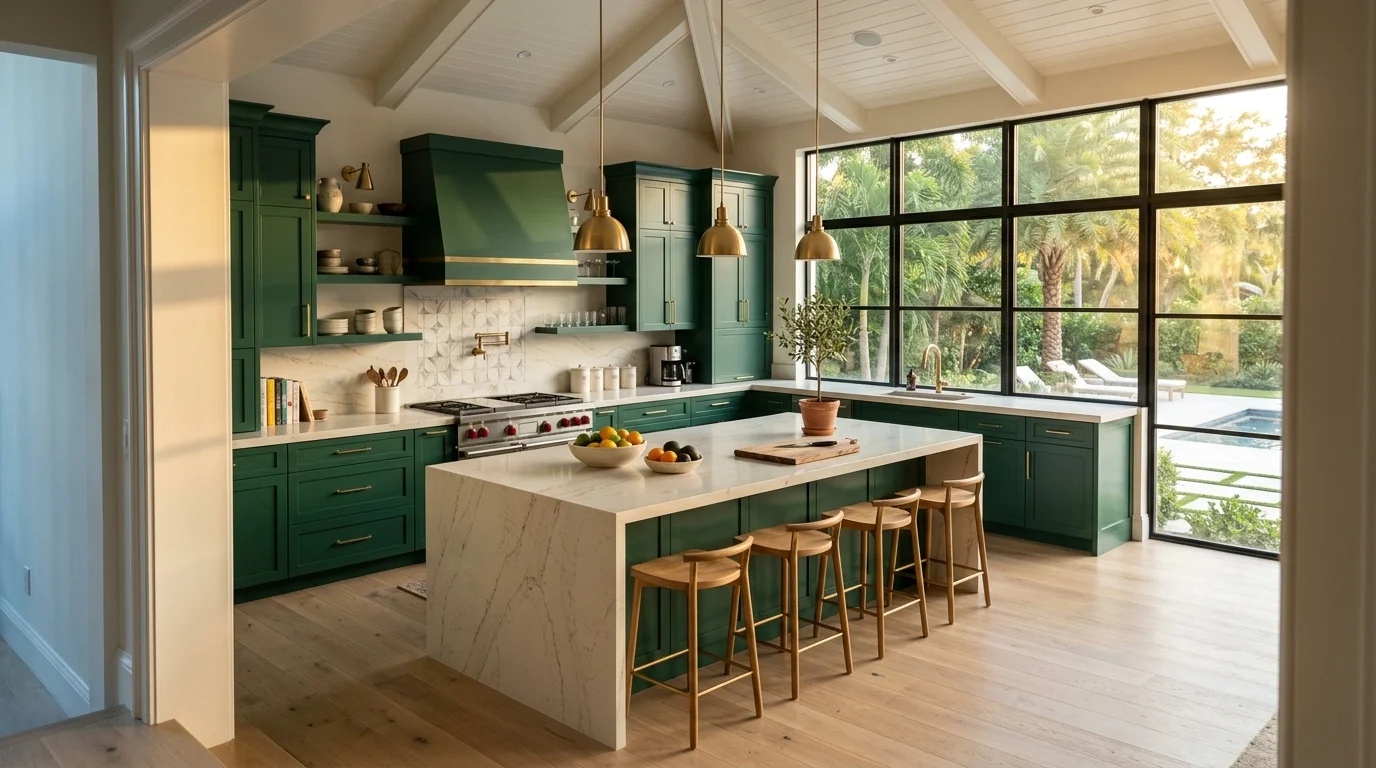
Green kitchen cabinets have moved from a trend to a legitimate long-term choice, and for 2026, the color is everywhere from Jupiter waterfront kitchens to Boca Raton estate homes. We're seeing it across every price point: a soft sage on a modest condo refresh, a moody forest green on a full custom build, an earthy olive on a farmhouse-style layout in Wellington. The range is wide, and that's the point. Green is not one thing. The shade you pick changes everything, how the space feels, what countertops work, whether brass hardware reads elegant or costume-y. This guide breaks down the full green spectrum, how each shade performs in South Florida's particular light, and what our team recommends for pairings that actually hold up after the novelty wears off.
Why Green Cabinets Are Dominating 2026
The shift away from all-white kitchens has been building for years. If you've been watching kitchen color trends for 2026, you already know warm neutrals and earthy tones are pulling homeowners away from the sterile all-white look that dominated for over a decade. Green sits at the intersection of two things buyers want right now: connection to nature and a color that actually photographs well in the bright, open-plan kitchens common throughout Palm Beach County.
Green cabinets also age gracefully. White shows every scuff and finger smudge under Florida's harsh sun. Navy goes dark fast in kitchens without natural light. Green, especially mid-value shades, hides minor wear while still reading as intentional and designed. That matters when you're in a market like Delray Beach or Boca Raton where resale value is always in the back of your mind.
We also recommend green to clients who are nervous about committing to color. It feels grounded. It doesn't feel aggressive the way a true red or bright yellow does. And paired with the right countertop, it can look just as timeless as a classic white kitchen, with far more personality.
One practical note: if you're considering a full repaint versus new cabinet boxes, read through our comparison of painted vs. stained kitchen cabinets before deciding. For most green tones, painted finish is the only realistic option, stain doesn't yield a true green. That means the quality of your paint, primer, and door material matters a lot in a humid climate like ours.
The Green Spectrum: From Sage to Forest
Not all greens behave the same way, especially in Florida's light. Here's how we break down the main families and where each works best.
Sage green is the most versatile and the most forgiving. It reads almost neutral in bright rooms, picks up gray undertones in overcast light, and leans warmer when paired with wood or brass. For Palm Beach County homes with lots of natural light, think east-west facing kitchens in Wellington or Jupiter, sage is the green that looks effortless all day long. It's soft enough that it won't compete with a busy backsplash or bold countertop veining. Our sage green kitchen cabinets guide goes deeper into specific shades and paint recommendations if that's the direction you're leaning.
Olive and eucalyptus fall in the middle of the spectrum, more yellow-brown undertones than sage, less saturated than forest. These work exceptionally well in Mediterranean-style homes common in Boca Raton and Palm Beach. They feel earthy and warm without being heavy. Pair olive with raw wood, leathered stone, and matte black hardware and you get a kitchen that feels like it belongs in a Tuscan farmhouse, which is exactly the look a lot of our clients in gated communities are chasing.
Hunter and deep forest green are the bold choices. These are saturated, dark, and dramatic. They work best in large kitchens with high ceilings and significant natural light, or in a kitchen where the green is used selectively (lower cabinets only, or an island). In a small, south-facing kitchen with limited windows, deep forest can read almost black by afternoon. We're not saying avoid it. We're saying know your light before you commit.
Dusty or muted blue-greenssometimes called celadon or soft teal, sit on the cooler side. These work beautifully in coastal-style kitchens near the water. They pair naturally with white or off-white uppers, natural rattan, and linen textures. If you're in a home closer to the Intracoastal in Delray Beach or South Palm Beach, this palette feels native to the environment.
One brand worth looking at for consistent, durable painted finishes across the green spectrum is Fabuwood Cabinetry, which offers several painted green options as part of their semi-custom lines. We work with their product regularly and have seen how their painted finishes hold up in Florida humidity over time.
What to Pair With Green Cabinets
The cabinet color is the starting point. What you put next to it determines whether the whole kitchen works. Here's what our team reaches for most often when designing around green cabinetry.
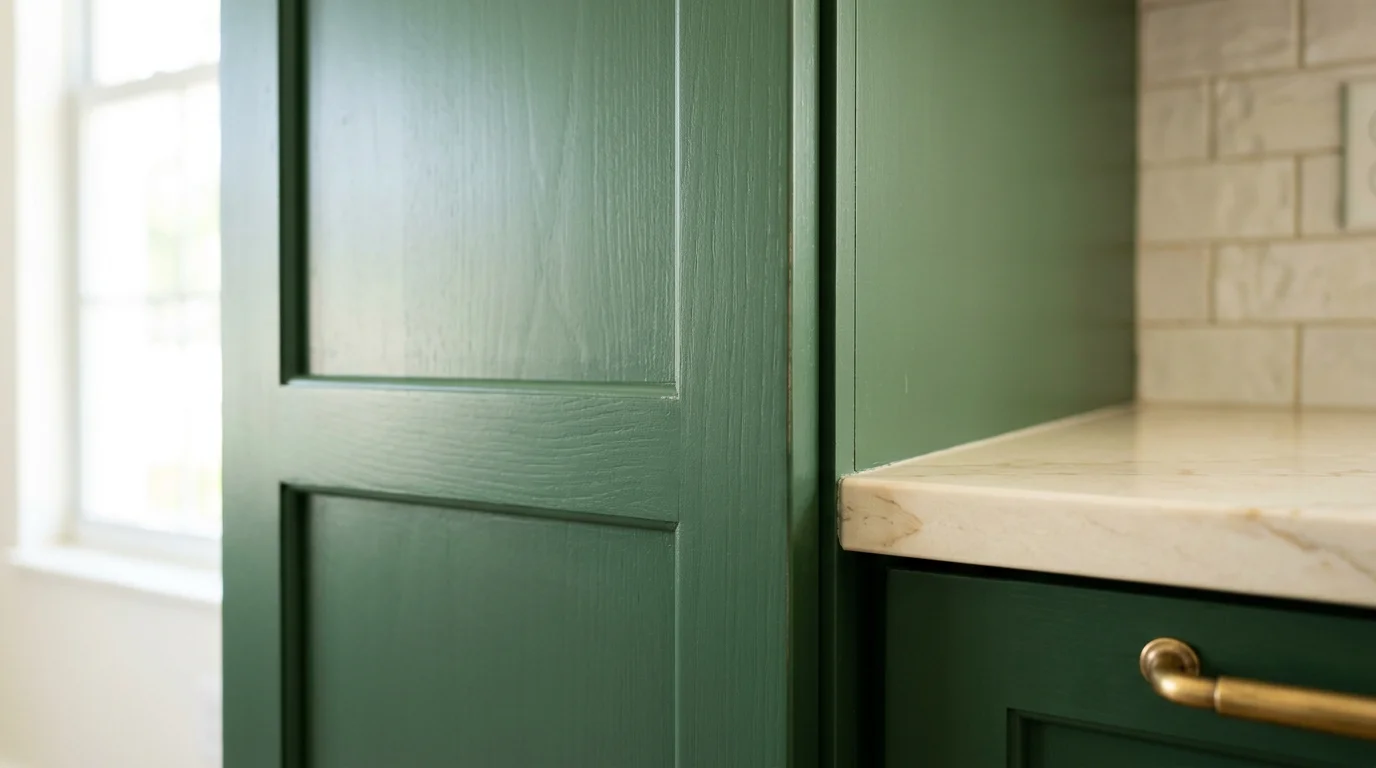
Brass hardware is the pairing we recommend above almost everything else for green cabinets. Warm-toned brass, particularly unlacquered or satin finishes, pulls out the yellow undertones in most greens and gives the kitchen an organic, lived-in quality that polished chrome or matte black just can't match. We've covered why this finish is having such a strong moment in our brass cabinet hardware guide, but the short version is this: brass doesn't fight green, it completes it. Matte black is a close second for forest green specifically, that high-contrast look reads modern and sharp.
Countertops: White and cream quartzites are our top recommendation for green cabinets. Taj Mahal quartzite, Calacatta Laza, and similar warm-white stones let the green read fully without competing. If you want something more budget-friendly, a white or cream quartz with soft veining does the same job. For olive or eucalyptus cabinets, a leathered granite or soapstone in a charcoal tone works beautifully, that earthy-meets-earthy combination feels intentional and grounded.
Avoid cool gray countertops with most greens. The undertones fight each other unless you're deliberately going for a contemporary blue-green palette. Even then, you need warm wood floors or warm lighting to keep the kitchen from reading cold.
Backsplash: Green cabinets pair well with backsplashes that add texture rather than compete on color. Zellige tile in cream, off-white, or warm ivory is one of our favorites right now, the handmade variation in the surface catches light in a way that makes a solid-color cabinet look anything but flat. A full-height slab backsplash in the same stone as your countertop is another strong move, and one we're specifying on a lot of projects in Jupiter and Palm Beach Gardens. If you're still deciding on backsplash height, our breakdown of 4-inch vs. full-height backsplash options will help you weigh the two approaches.
Wood accents: Natural wood is green's best friend. Rift-cut white oak open shelving above green lowers, a wood-wrapped island, or warm hardwood floors all give the kitchen the organic, layered quality that makes green cabinets feel designed rather than trendy. Avoid orange-toned wood (old-school oak stain, for example), it clashes. Stick to lighter, cooler-toned woods or a walnut with gray undertones.
Two-Tone Cabinet Ideas Using Green
Two-tone kitchens are one of the smartest ways to use green without overwhelming a space. Done right, the color creates a visual anchor while the second tone keeps things airy. Done wrong, it looks like a design accident. Here's what actually works.
The most common configuration we install: green lowers, white or off-white uppers. The uppers keep the room bright, which matters in South Florida where kitchens are often the heart of an open-plan living space. The green lowers read as intentional color without making the ceiling feel lower. This works especially well in sage and eucalyptus, colors that are subtle enough that the transition between upper and lower doesn't feel jarring.
Another option we love: a green island against white perimeter cabinets. The island becomes a furniture piece, a statement that gives the kitchen personality without boxing the space in. This is a strong choice for larger kitchens in Wellington or Boca Raton where the island is a natural focal point. Deep forest green or hunter green on an island reads particularly well because the darker tone grounds the whole room.
A less common but increasingly popular choice: green upper cabinets only, with natural wood or warm white lowers. This inverts the typical configuration and works well in kitchens with high ceilings and clerestory windows. The green sits at eye level and above, which feels bold but not heavy because the lower cabinets stay light.
For more inspiration and specific palm beach examples, our two-tone kitchen cabinet ideas article covers 15 combinations including several green-forward layouts.
One thing to avoid: three or more distinct tones in a small kitchen. Green island, blue uppers, white lowers sounds interesting in theory. In a 150-square-foot galley kitchen in a Delray Beach condo, it reads chaotic. Pick two tones and commit.
Cost Guide
Green cabinets don't carry a premium on their own, the cost difference is in the door style, box construction, and finish quality. Here's what to expect for painted green cabinetry across different tiers in the Palm Beach County market. These ranges reflect a full kitchen, cabinets, countertops, and installation, not just the cabinet boxes alone.
The biggest variable in a green cabinet project is the door style. A flat-front slab door in a painted green finish shows every imperfection, the paint application has to be perfect. Shaker doors are more forgiving because the reveal lines draw the eye away from minor surface variation. If you're budget-conscious, shaker in a painted green finish consistently delivers better value than a flat-front at the same price point. Our flat-front vs. shaker cabinet comparison breaks this down in more detail.
One more cost consideration: a full kitchen project that involves relocating the sink, moving appliances, or changing the layout will require a general contractor and likely permits, depending on scope. Those costs are separate from the cabinetry and countertop work our team handles. If you're staying in the same footprint, which is the case for most green cabinet refreshes, the scope stays clean and the timeline stays short.
South Florida Considerations
Florida light is not like light anywhere else in the country. The sun angle, the intensity, and the way it bounces off pools, water, and light-colored exterior materials all affect how a paint color reads indoors. This matters more for green than almost any other color family because green is so sensitive to undertone shifts.
Our general rule: test your green in your actual kitchen at multiple times of day before ordering cabinets. A sage that looks perfect in a showroom under LED lighting can look gray-green and washed out in a south-facing Palm Beach kitchen at noon. The same color can look warm and beautiful in the same kitchen at 4pm when the western light comes in. Get a sample door, most cabinet lines will provide one, and live with it for a week.
North-facing kitchens (common in older Boca Raton homes where the front door faces north) tend to receive cooler, more diffuse light. In these spaces, warm-toned greens like olive and eucalyptus perform better than blue-greens, which can look muddy without direct sunlight to activate them. South-facing kitchens with intense direct sun can handle deeper, more saturated greens, forest and hunter, because the light intensity keeps them from reading dark and oppressive.
Humidity also plays a role in finish longevity. Painted cabinet doors in Florida are exposed to more moisture cycling than anywhere in the mainland US. We recommend a moisture-resistant primer coat under any painted green finish, and we look for cabinet lines that apply their paint in a controlled factory environment rather than on-site. Field-painted cabinets in South Florida's humidity can blister, peel, or crack within a few years if the prep and product aren't right. This is one area where cutting costs on cabinet quality genuinely hurts you long-term.
For clients in HOA-governed communities, which covers a huge portion of Jupiter, Wellington, and Boca Raton, green cabinets are an interior decision and generally don't require board approval unless you're making structural changes visible from common areas. If your project involves layout changes that touch plumbing or electrical, your general contractor will need to pull permits through Palm Beach County's building department. You can check scope-specific permit requirements at Palm Beach County Building Division.
Finally, think about your long-term flexibility. Green is bold enough that it can feel dated if the specific shade goes out of fashion, though we'd argue that sage and muted olive are sitting in the same category as navy: colors that cycle back rather than disappear. If resale is a concern in the next three to five years, a two-tone approach with green on the island only gives you a kitchen that reads current without betting the whole design on a single color. For a broader look at which kitchen upgrades actually move the needle on value, our guide on kitchen upgrades that add the most value in Florida homes is worth reading before you finalize your scope.