Two-Tone Kitchen Cabinets: 15 Florida Ideas
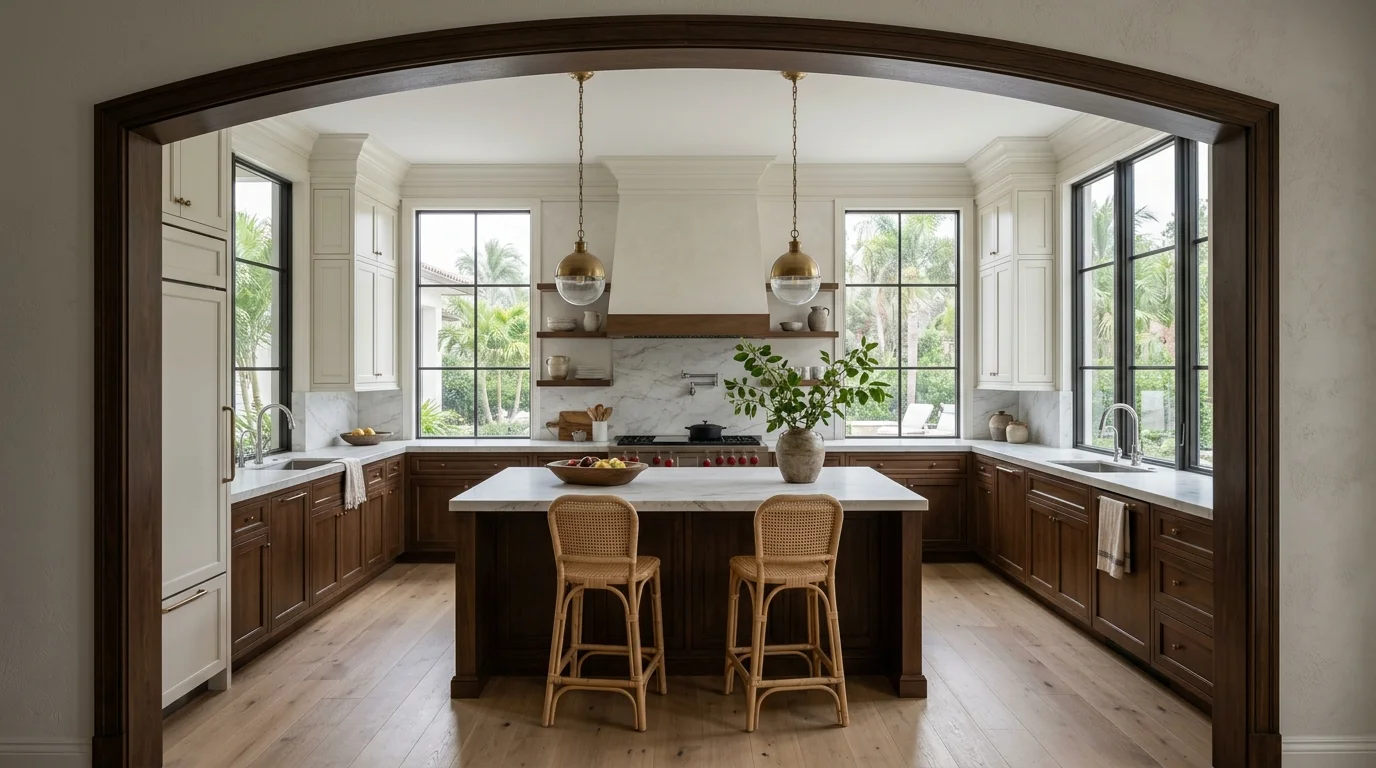
Two tone kitchen cabinets have moved well past trend status in South Florida. At this point, they're just good design. The idea is simple: pair two different cabinet colors, usually a lighter upper and a deeper lower, or a bold island against neutral perimeter, to add depth without the commitment of going all-dark. In homes across Palm Beach County, Boca Raton, Delray Beach, Wellington, and Jupiter, we see this approach work again and again because Florida light is unlike any other. The way afternoon sun floods through impact glass changes how color reads, and two-tone done right plays directly into that. Here's everything you need to know before picking your palette.
Why Two-Tone Works in Florida Light
Florida light is intense and warm, especially in south-facing kitchens. A single paint color reads completely differently here than it does in a showroom photo taken in a northern state studio. Pure whites can blow out. Dark navy can look almost black at midday, then surprisingly rich at dusk. Two-tone cabinetry uses that dynamic light to your advantage, you're essentially anchoring the bottom of the room with weight and letting the upper cabinets breathe.
Our team has worked in hundreds of kitchens across Palm Beach County and the pattern is consistent: homeowners who go all-white often come back years later wanting contrast. Homeowners who jump straight to all-dark sometimes feel the room closes in during daytime. Two-tone splits the difference. You get the airiness of lighter uppers and the grounded, intentional look of colored lowers or a statement island.
Florida's architectural styles also favor it. Mediterranean homes in Boca and Delray handle warm earthy tones beautifully. The coastal ranches in Jupiter and Wellington's equestrian estates respond well to cooler blue-green palettes. Modern condos in West Palm want clean contrast, think flat-front uppers in matte white against warm wood-tone lowers. The style adapts; the principle stays the same.
One more thing worth saying: two-tone is also a smart budget move. Painting or finishing only your lower cabinets in a premium color costs less than doing the whole kitchen. If you're working within a set budget, check our thoughts on the 30 percent rule in remodelingit helps you figure out how much of your home's value makes sense to put into the kitchen before you start spec'ing colors.
Upper vs Lower: How to Split the Color
The most common two-tone configuration is lighter uppers, darker or more colorful lowers. This works because it mirrors how we naturally perceive a room, lighter above the horizon line, anchored below. It also hides scuffs and wear better on the lower cabinets, which take more abuse from feet, dogs, kids, and everyday cooking.
That said, the reverse approach, bold uppers, neutral lowers, can work in tall-ceilinged kitchens where you want the upper zone to carry visual weight. We see this occasionally in open-concept homes in Delray Beach where the kitchen flows into a two-story living room. The bold upper cabinet color helps define the kitchen zone without a physical wall.
A third option: tone-on-tone. This means using two shades of the same color family rather than contrasting hues. Warm white uppers with a greige or taupe lower. Light sage uppers with a deeper forest green lower. This is the subtlest version of two-tone and honestly one of the most elegant. It reads as sophisticated rather than bold, which suits the more formal kitchens we design in gated communities across Palm Beach County.
What to avoid: splitting colors at an arbitrary point. The transition line should always follow cabinet structure, typically the countertop line separates upper from lower, or a visible shelf line separates perimeter from island. Never split a single cabinet between two colors. It looks like a mistake, not a decision.
Hardware plays a big role in tying both tones together. A single metal finish, brushed brass, matte black, or satin nickel, running consistently across all cabinets creates cohesion when the colors themselves are diverging. If you're unsure how to handle hardware selection in a two-tone kitchen, our kitchen cabinet hardware guide for Palm Beach County breaks down how to match metal to cabinet color and countertop tone.
15 Two-Tone Color Combos for Florida Kitchens
These are the combinations we actually recommend to clients, not a recycled list from design blogs photographed in Minnesota. Florida light, Florida humidity, Florida lifestyle. Here's what works.
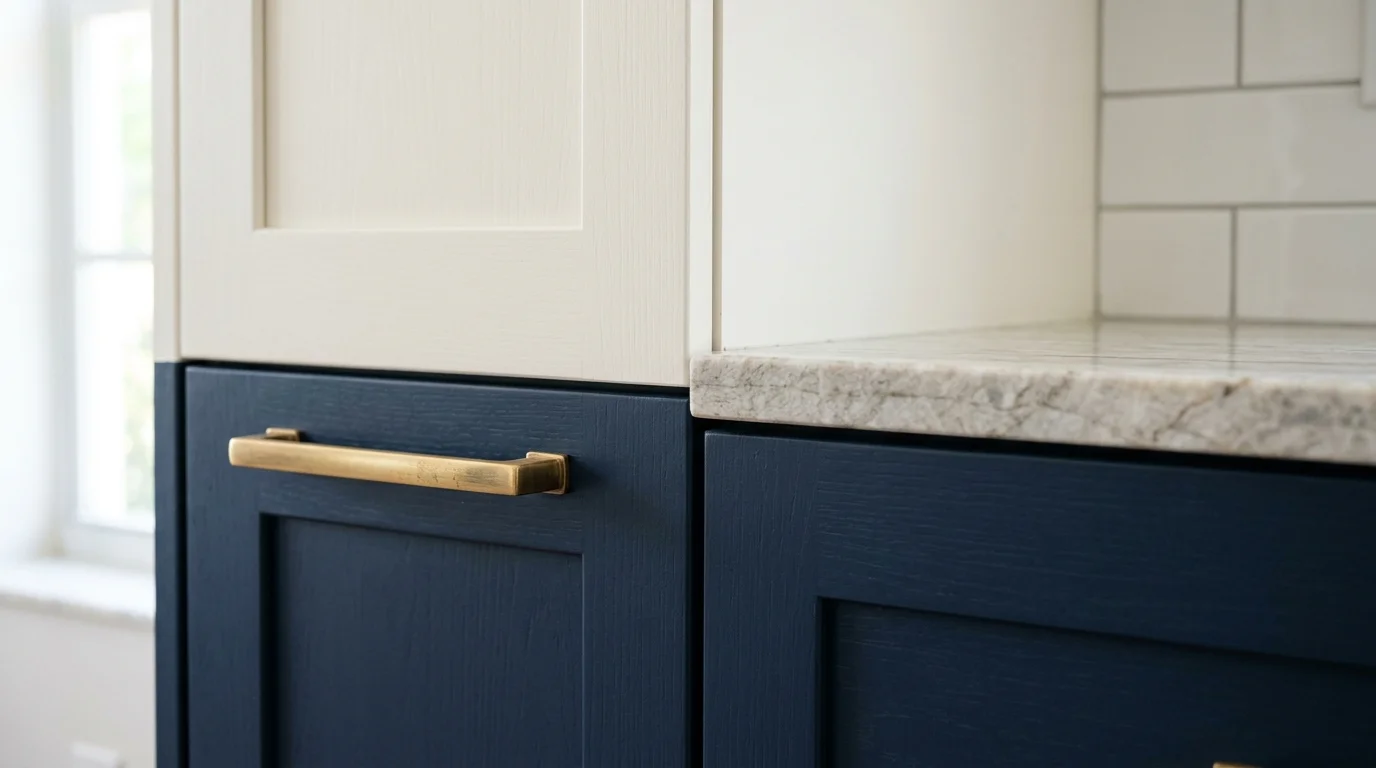
1. White Uppers + Navy Lowers. The most requested combo we get. Clean, nautical without being costume-y, and it photographs beautifully. Navy lowers pair naturally with white quartz or Calacatta marble-look countertops. Works in Jupiter coastal homes and Boca new construction alike. If you want to go deeper on navy as a solo choice, our navy blue kitchen cabinets guide has more detail on finishes and hardware pairings.
2. Soft White Uppers + Sage Green Lowers. Sage is having a long moment and it earns it. In Florida's natural light, sage greens read warmer and more golden than they do up north. Pair with unlacquered brass hardware and a creamy quartz counter and you've got something timeless. We see this a lot in Delray Beach bungalow renovations.
3. Greige Uppers + Forest Green Lowers. Tone-on-tone approach using the warm/cool split within a neutral family. The greige upper keeps things from going too dark; the forest green lower adds drama. Works extremely well in larger kitchens where you need the lower run to hold visual weight across a long span.
4. White Uppers + Warm Wood Lowers. Wood-tone lower cabinets, rift oak, walnut, white oak, against painted white uppers is one of the strongest combinations for Florida's transitional and coastal modern aesthetic. The wood warms up what could otherwise be a cold white kitchen. This pairs naturally with a waterfall quartz or quartzite island. See our guide to natural wood kitchen cabinets in South Florida for species recommendations that hold up in humidity.
5. Pale Blue Uppers + White Lowers. Reverse of the typical formula. A soft coastal blue on uppers against crisp white lowers feels fresh and beachy without being too literal. This works best in open-plan kitchens facing a pool or water view, which is common throughout Wellington and Jupiter Farms.
6. White Uppers + Charcoal Lowers. High contrast. Strong graphic quality. This is the choice when a homeowner wants a modern kitchen that leans contemporary without going full-dark. Charcoal lowers hold up better to fingerprints than true black and read as more sophisticated in person.
7. Cream Uppers + Terracotta or Clay Lowers. A Mediterranean palette that feels entirely at home in the Spanish-style homes throughout Boca Raton and Mizner Park-adjacent neighborhoods. Terracotta lowers with a tumbled travertine or warm beige quartz countertop is cohesive and unmistakably South Florida.
8. Warm White Uppers + Dusty Blue Lowers. Softer than navy, less cool than sky blue. Dusty or slate blue reads as a neutral in most lighting conditions, making this one of the most versatile two-tone combinations. It works in traditional, transitional, and coastal kitchens without fighting the architecture.
9. Linen Uppers + Deep Walnut Lowers. Linen or off-white paired with a dark walnut stain is rich and warm. This reads as luxury without the price tag of custom cabinetry when you use a quality semi-custom line. The warm undertones in both tones make this combo feel intentional rather than contrasted.
10. White Uppers + Olive Green Lowers. Olive is earthier than sage and sits closer to yellow-green. In Florida afternoon light it can glow. This is a polarizing choice, some clients love it immediately, some take time to warm up. Our honest take: in the right kitchen with the right countertop (a creamy white quartz or a leathered quartzite), olive lowers are stunning.
11. Light Gray Uppers + Navy Lowers. A cooler, more urbane take on the classic white-and-navy. Light gray uppers feel more contemporary than white and pair well with a white or veined gray countertop. This combination suits condo kitchens in West Palm Beach where the architecture is more modern.
12. White Uppers + Black Lowers. The starkest contrast option. Done right, with the right countertop, the right hardware, and enough natural light, this is dramatic and clean. Done wrong, it feels dated fast. We recommend this only in kitchens with substantial natural light and a countertop that bridges the two, like a white quartz with subtle veining.
13. Soft Yellow Uppers + White Lowers. Not a bold yellow. A muted, warm butter or cream-yellow on uppers with crisp white lowers feels cheerful and retro in the best way. This is a great option for a kitchen renovation in a 1950s or 1960s Palm Beach County ranch home where you want to honor the era without going kitschy.
14. White Uppers + Moody Blue-Green Lowers. Think teal-adjacent, a deep blue-green like Benjamin Moore Van Deusen Blue or Sherwin-Williams Dragonfly. These tones feel like the ocean at depth and work brilliantly in coastal kitchens. Pair with unlacquered brass hardware and a white marble-look countertop for maximum impact.
15. Natural Wood Uppers + Painted Lowers. The reverse of combo #4. Natural wood grain on upper cabinets above a painted lower, usually a dark green, navy, or charcoal, is an emerging direction we're seeing more of in 2025 and 2026. It's unexpected enough to feel fresh, grounded enough to feel intentional. This pairs well with the wood-stone design philosophy covered in our guide to mixing wood and stone in Palm Beach kitchen remodels.
Using the Island as Your Accent Piece
The kitchen island is arguably the best canvas for two-tone design in a Florida kitchen. You can keep your perimeter cabinets completely neutral, white, greige, or a warm wood, and let the island carry all the color. This approach is lower commitment than painting half your perimeter run and it often makes more visual sense because the island is already a standalone element.
Island accent colors that perform particularly well in Florida light: navy, forest green, charcoal, deep sage, and warm walnut tones. What they all share is enough depth to read as intentional against a lighter perimeter. Pale colors on an island tend to disappear, you lose the contrast that makes the whole concept work.
Size matters. A small island, under 4 feet long, can handle a bold color without overwhelming the room. A large island running 7-8 feet needs a slightly more restrained tone or you risk the accent becoming the entire room. Our kitchen island ideas guide for South Florida homes covers size, configuration, and material decisions that affect how an island reads within the full kitchen.
Counter material on the island is another lever. A contrasting countertop on the island, say, a butcher block top on a white-counter perimeter, or a waterfall quartzite island against standard quartz perimeters, doubles the two-tone effect. You're layering color and material simultaneously. It's a more complex design decision but it pays off in kitchens where the island is the focal point of an open floor plan.
Hardware on the island can also differ from the perimeter, slightly. Same metal finish, different style. Pulls on the perimeter, knobs on the island doors. Or oversized bar pulls on the island against standard pulls on the perimeter. This is a detail-level decision that improves the whole design. For a full framework on mixing hardware without it looking random, see our post on how to mix knobs and pulls on kitchen cabinets.
Cost Guide
Two-tone cabinetry isn't inherently more expensive than single-tone, but a few factors can add cost. Custom paint colors require additional finishing steps. If you're choosing a two-tone combination that involves a factory-finished color on lowers and a painted finish on uppers, you may be drawing from two different product lines. Here's how the numbers typically break out for Palm Beach County projects in 2025-2026.
For context on overall project budgeting, our kitchen remodel cost guide for Palm Beach County covers the full scope of what goes into a kitchen budget beyond cabinetry alone.
Permits for a two-tone cabinet project are typically not required, a cabinet replacement or refresh on an existing layout without moving plumbing, gas lines, or electrical service generally doesn't trigger a permit in Palm Beach County municipalities. If your remodel involves relocating the sink, adding an island with plumbing, or changing your electrical panel capacity, those scopes are handled by your general contractor who will determine permit requirements. The Florida Building Commission sets statewide minimums, but local jurisdictions like Boca Raton, Delray Beach, and Wellington each have their own thresholds, your GC will navigate that.
South Florida Considerations
Florida's climate throws a few variables at cabinetry that don't come up in northern markets. Humidity is the main one. Paint finishes on cabinets need to be durable enough to resist moisture infiltration, especially on lower cabinets near dishwashers and sinks. We recommend a catalyzed lacquer or conversion varnish finish over standard latex paint for any cabinet door that will live in a South Florida kitchen. Benjamin Moore Advance and similar alkyd-hybrid paints are a step up from standard latex, but a professional conversion varnish applied in a controlled shop environment is the best option for longevity.
This becomes even more important with two-tone because you're likely using a paint finish on at least one cabinet color. Factory-finished cabinets in a manufacturer's standard palette are already cured and sealed. Custom paint colors matched in the field or applied on-site are more vulnerable if done improperly. Our guide to the best paint for kitchen cabinets in Palm Beach County covers product specifications in detail.
UV exposure is the second factor. South Florida kitchens get serious sun, especially east- and south-facing kitchens. Some painted cabinet colors, particularly blues, greens, and deep saturated tones, can shift over time with UV exposure. Lighter tones may yellow. Choosing a paint or finish with UV inhibitors is worth the small added cost, especially for the pricier custom colors in a two-tone scheme.
Wood movement is the third variable. Florida humidity fluctuates enough seasonally that solid wood cabinet doors can warp or shift if the product isn't properly engineered or acclimated. MDF core doors with a painted finish are actually more dimensionally stable than solid wood in humid climates, something that surprises a lot of homeowners. If you've ever dealt with a cabinet door that doesn't close right after a summer of heavy humidity, our post on how to fix a warped cabinet door in humid Florida is worth reading before your next installation.
HOA and ARB considerations affect a meaningful number of our projects in Palm Beach County, particularly in gated communities in Wellington, Palm Beach Gardens, and the barrier island municipalities. If you're in a deed-restricted community, exterior-facing elements of your kitchen remodel, specifically anything visible through windows from the street, can technically fall under review. It's uncommon for interior cabinet colors to trigger an ARB review, but if your remodel involves window changes or exterior-visible modifications, your GC handles the submission package. We supply design drawings and material samples; the GC and homeowner submit to the HOA.
Finally, if you're planning a two-tone kitchen as part of a pre-sale update, the combinations that perform best with buyers in this market are the most universally appealing ones: white or soft white uppers with navy, sage, or warm wood lowers. Polarizing choices, bold terracotta, deep moody blues, high-contrast black-and-white, can narrow your buyer pool. Check our thinking on which kitchen upgrades add the most value to a Florida home if resale is part of your calculation.