Marble Countertops Pros and Cons for Florida Kitchens
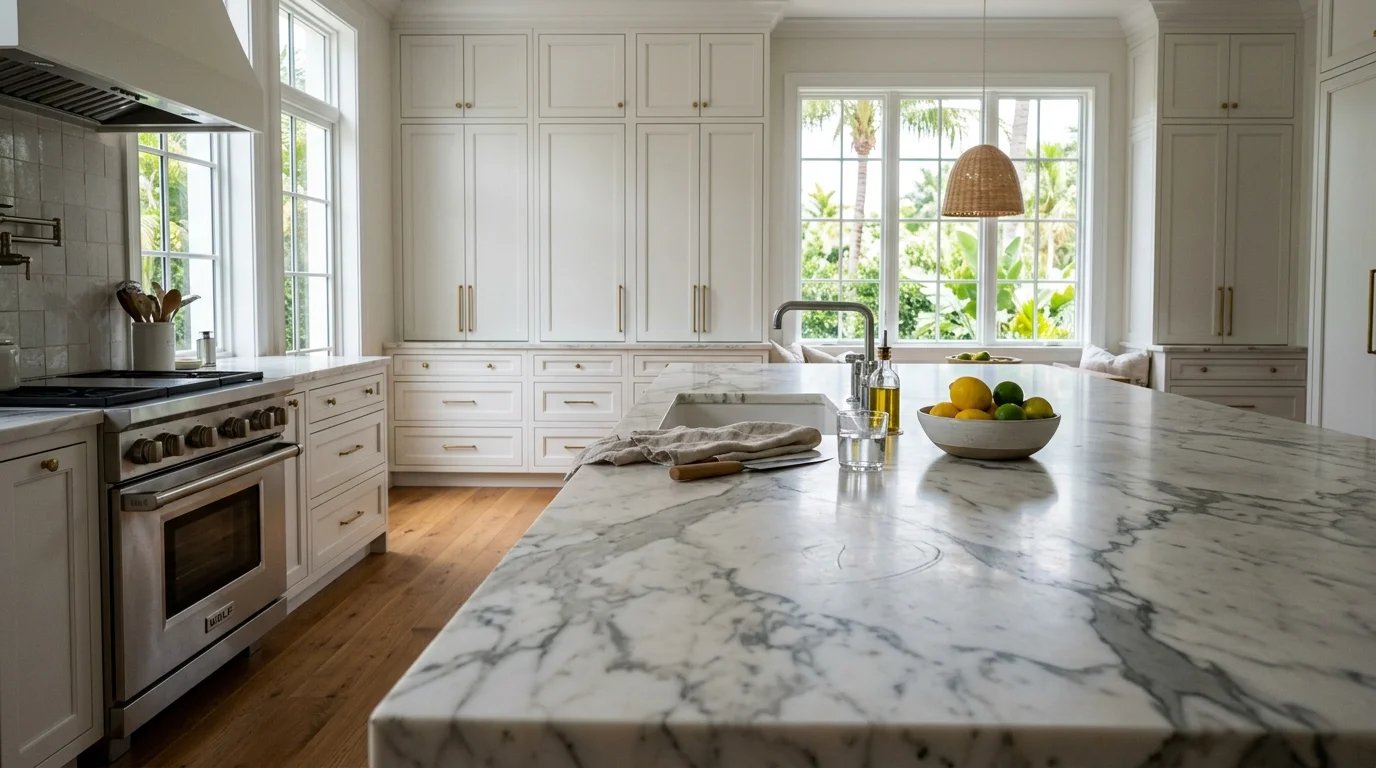
Marble countertops pros and cons come up in almost every kitchen design conversation we have with homeowners across Palm Beach County, Boca Raton, Delray Beach, Wellington, and Jupiter. And for good reason, marble is one of the most beautiful natural stones you can put in a kitchen, and also one of the most demanding. Before you fall in love with a slab at the stone yard, you need to understand exactly what you're getting into. We work with marble regularly, and our honest take is this: it's the right choice for some homeowners and the wrong choice for others. This guide will help you figure out which one you are.
What Makes Marble Different From Other Stone
Marble is a metamorphic rock formed when limestone is subjected to extreme heat and pressure. That process creates the dramatic veining and soft color variation that makes it so desirable. But the same chemistry that produces those veins, primarily calcium carbonate, is exactly what makes marble vulnerable in a kitchen environment.
Granite is igneous rock. Quartzite is metamorphic too, but it's made of recrystallized quartz grains, which are much harder. Marble sits lower on the Mohs hardness scale, typically around 3-4, compared to granite at 6-7. That difference matters when you're sliding cast iron pans, setting down acidic drinks, or cutting citrus at the counter.
There are dozens of marble varieties, Carrara, Calacatta, Statuario, Emperador, Nero Marquina, and they don't all behave the same. Darker marbles tend to show water marks more than light ones. Denser slabs etch less noticeably on honed finishes. Comparing marble to quartz, quartzite, and granite side by side helps put the differences in perspective if you're still deciding on stone type.
The bottom line on what marble is: it's a premium, living material that changes over time. Some homeowners love that. Others regret it every time they see a ring on the counter.
The Real Pros of Marble Countertops
Let's start with why people choose marble in the first place, because the appeal is legitimate, not just aesthetic.
Unmatched visual depth. No engineered surface fully replicates marble's translucent quality. Light passes slightly into the surface rather than bouncing off the top, which is what gives marble that luminous, almost glowing look. Porcelain and quartz have gotten remarkably close, but if you put them side by side with a real Calacatta slab, the difference is still visible. In South Florida homes with strong natural light, marble handles that light beautifully.
Stays cool. Florida kitchens run warm. Marble stays naturally cool to the touch, which makes it excellent for baking. Pastry bakers and serious home cooks genuinely appreciate a cool marble surface for rolling dough. It's one practical advantage that gets overlooked in the pros-and-cons debates.
Each slab is one of a kind. When you select a marble slab from a stone yard, that exact pattern won't be replicated anywhere else. For homeowners who want a truly custom look, that matters. If you're visiting slab yards in Palm Beach County and you see a Calacatta Gold slab with dramatic gold veining that speaks to your design vision, you won't find that exact piece again. Knowing where to buy countertop slabs in Palm Beach County helps you find the best selection.
Works in honed finishes. A polished marble surface shows etching clearly. A honed (matte) surface hides etching much better because the finish is already flat, so the chemical dullness blends in. Many of our clients in Boca Raton and Jupiter opt for honed Carrara specifically because they want the marble look with reduced maintenance anxiety. The trade-off is that honed marble stains a bit more easily than polished, so sealing becomes more critical.
Adds resale value in the right price tier. In high-end Palm Beach County homes, think $1.5M+ properties in Wellington equestrian estates or oceanfront Delray Beach, marble is expected. Buyers at that price point know what they're looking at and will discount a kitchen that has substitute materials. If your home's price point supports it, real marble communicates quality that alternatives can't fully replicate.
Longevity. Properly maintained marble countertops last decades. The Parthenon is made of marble. With the right sealer and reasonable care, your kitchen countertops will outlast the cabinets, the appliances, and probably your interest in the current layout.
The Real Cons of Marble Countertops in Florida
This is where we're going to be direct with you, because marble's downsides are real and they matter more in a Florida kitchen than in, say, a New England farmhouse that gets used on weekends.
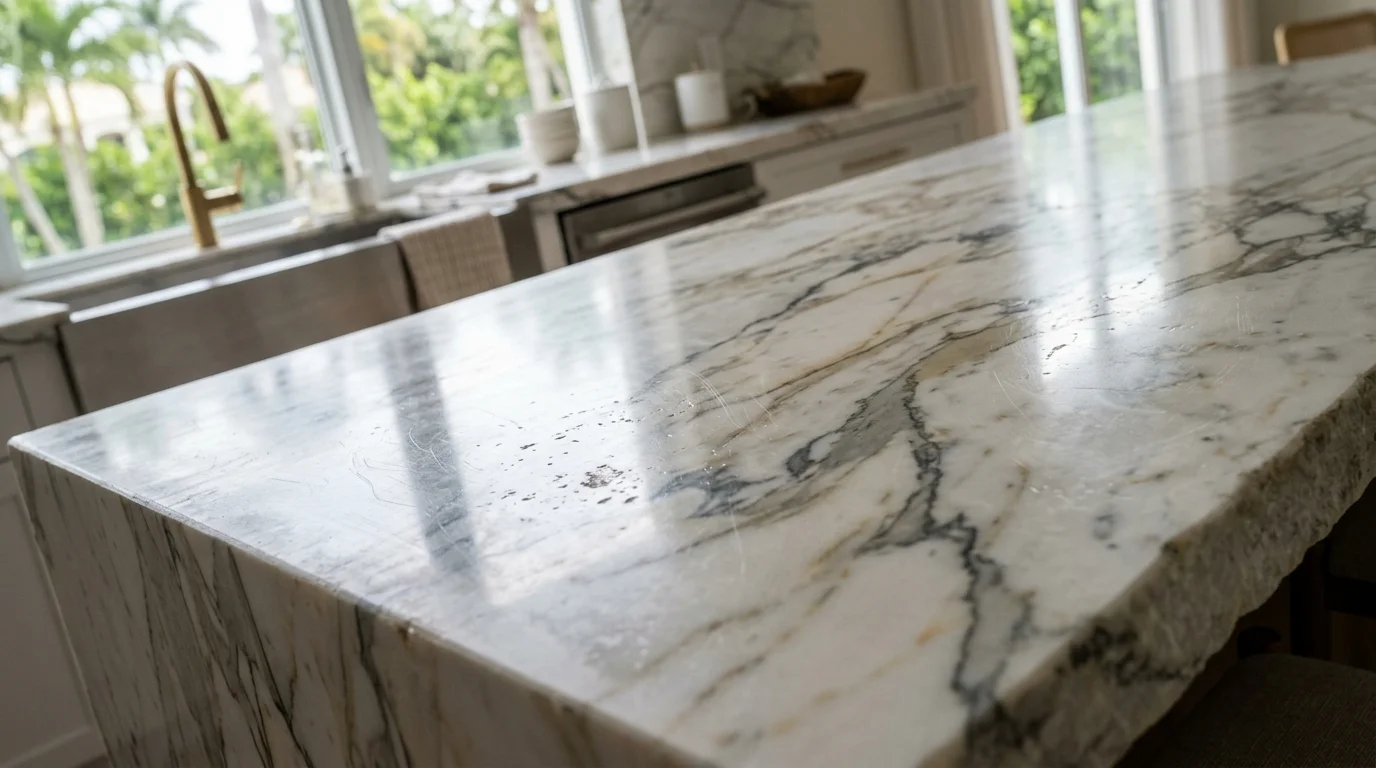
Etching is unavoidable. Etching is not a stain, it's a chemical reaction. When acidic substances (lemon juice, wine, coffee, tomato sauce, even sparkling water) contact marble, they dissolve a microscopic layer of calcium carbonate, leaving a dull mark that changes the surface's light reflection. Sealing does not prevent etching. Let that sink in. You can seal marble perfectly and still get etch marks from a glass of OJ sitting on the counter for 20 minutes. On polished marble, etch marks are obvious. On honed marble, they're less visible but still there.
In a Florida household where citrus is practically a food group, fresh lime in the guacamole, grapefruit halves on the counter, mojito night, etching is going to happen. The question is whether you can accept a surface that develops character marks, or whether it will drive you crazy.
Staining requires vigilance. Marble is porous. Oil, wine, dark juices, and even hard water with high mineral content (very common in South Florida) can penetrate the surface and leave discoloration. Sealing slows absorption but doesn't create an impenetrable barrier. You need to wipe spills quickly, ideally within minutes, not hours. Our article on removing stains from marble countertops goes deeper on remediation options when it does happen.
Sealing schedule.** Marble needs to be sealed regularly, every 6 to 12 months in a working kitchen, sometimes more frequently on high-use counters. This is not optional. An unsealed marble counter in a Florida kitchen (humidity, heat, hard water) degrades much faster than one in a dry climate. Factor that maintenance cost and time commitment in before you commit.
Scratching. Marble scratches more easily than granite or quartzite. Dragging cookware, keys landing on the counter, abrasive cleaners, all can leave marks. For most marble, fine surface scratches can be polished out by a stone restoration professional, but that's another cost and inconvenience.
Cost of mistakes is high. If you use the wrong cleaner, anything acidic, bleach-based, or abrasive, you can permanently damage the surface. Many homeowners don't realize that popular countertop sprays sold at grocery stores are too harsh for marble. You need pH-neutral stone cleaner. Our detailed guide on how to clean marble countertops covers exactly what to use and what to avoid.
Weight. Marble slabs are heavy. Cabinet structures need to support that load, and your general contractor should confirm that your existing cabinet boxes and subfloor can handle it, particularly in older Boca Raton or Delray Beach homes where original cabinetry may not have been built for heavy stone.
Marble Countertop Cost Guide for Palm Beach County
Marble pricing in Palm Beach County varies significantly based on slab origin, veining pattern, thickness, and finish. What you see advertised online rarely reflects what you'll pay locally once you add fabrication and installation. Here's what we see in the current market:
A complete kitchen countertop refresh with mid-grade Calacatta marble, including removal of existing counters, new slab, fabrication, and installation, typically runs $4,500-$9,000 for an average Palm Beach County kitchen. If you're doing a broader remodel, understanding total kitchen remodel costs in Palm Beach County helps you see where countertops sit within the overall budget.
Marble costs more upfront than Carrara-look porcelain or quartz, and it carries ongoing maintenance costs that those materials don't. Price alone shouldn't drive the decision, but go in clear-eyed about the full cost of ownership.
For edge profile options that affect both cost and final look, this guide to countertop edge profiles in Palm Beach County walks through the most popular choices and what they add to a project.
South Florida Considerations
Marble behaves differently in South Florida than it does in cooler, drier climates. A few factors specific to our market that every homeowner should think through:
Hard water and mineral deposits. Palm Beach County water is notoriously hard. The calcium and magnesium in the water leave mineral deposits on stone surfaces, and those deposits are alkaline, meaning they don't dissolve with the acidic cleaners you'd normally use on hard water stains. On marble, using an acidic cleaner to remove hard water deposits will etch the stone. You're stuck using a pH-neutral remover or calling a stone professional. This is an ongoing battle in kitchens near dishwashers or sinks where water spray is constant.
Humidity affects sealer life. South Florida's year-round humidity accelerates how quickly sealers break down. A sealer that lasts 18 months in a dry climate might need refreshing every 8-10 months here. The Natural Stone Council's technical resources have good guidance on sealer selection for high-humidity environments. We recommend penetrating sealers (impregnating sealers) over topical coatings for Florida marble, they don't peel or cloud in the heat.
HOA and condo board considerations. In many Boca Raton and Wellington communities, countertop replacements don't require permits since they're finish-level changes that don't move plumbing or alter electrical. But if your project involves a layout change, sink relocation, or wall modifications, your general contractor will need to pull the appropriate permits, the scope determines what's required. For condo remodels specifically, understanding HOA requirements for condo kitchen remodels in Palm Beach County is important before you start.
Outdoor kitchens, don't do it. We get asked about marble for outdoor kitchen countertops regularly. Our answer is always no. Florida sun, rain, humidity, salt air near the coast, and direct UV exposure will destroy a marble surface faster than you'd believe. For outdoor spaces, look at porcelain, granite, or purpose-built outdoor materials. This guide to outdoor kitchen countertops covers what actually holds up in Florida conditions.
Florida light amplifies everything. South Florida's intense natural light is one reason marble looks so spectacular here, and also why every etch mark, water ring, and smear shows up more clearly than it would in a darker northern kitchen. If you're going polished marble, accept that you'll be wiping it down constantly. If that sounds exhausting, honed is the smarter call for Florida lifestyles.
Marble-Look Alternatives Worth Considering
This is where we'll give you our honest opinion, not just a neutral listing. The alternatives have gotten genuinely good. Not identical to real marble, but good enough that the trade-offs are worth considering seriously.
Porcelain slabs. This is our top recommendation for homeowners who love the marble aesthetic but cook frequently, have kids, or just don't want to think about maintenance. Large-format porcelain slabs, 3cm thick, produced in full slab format, now replicate Carrara, Calacatta, and Statuario with remarkable accuracy. They're non-porous (no sealing ever), acid-resistant (no etching), scratch-resistant, and handle Florida humidity without complaint. The cost is comparable to mid-grade marble, around $70-$120 per sq ft installed. The downside is that if you look closely, the pattern repeats, it's printed, not unique. And the edge can reveal the layered structure of the tile if not finished carefully. Porcelain vs. quartz countertops is a comparison worth reading if you're narrowing down the alternatives.
Quartzite. If you want real stone with marble-like veining but better durability, quartzite, particularly white quartzite varieties like Taj Mahal or Super White, is worth serious consideration. It's harder than marble, more resistant to etching, and still has that natural stone depth. It does require sealing, but less frequently than marble and without marble's calcium carbonate vulnerability to acids. The trade-off is cost: premium quartzite slabs can run $100-$160 per sq ft installed, putting it in the same price range as high-end marble. For more on quartzite sealing requirements, we have a dedicated guide.
Quartz (engineered stone). Quartz countertops are non-porous, don't require sealing, and resist stains and etching completely. The marble-look quartz options, Calacatta Laza, Brittanicca, and others from brands like Silestone and Cambria, are very convincing in photos and decent in person. Our honest opinion: quartz marble-looks are better for bathrooms and laundry rooms than for main kitchen counters in design-forward Palm Beach County homes. At the kitchen level, real stone still wins on visual impact for buyers and design clients who know what they're looking at. But for practicality and budget, quartz is a legitimate choice. For full pricing context, see quartz countertop costs in Palm Beach County.
The hybrid approach. Several of our clients in Delray Beach and Boca Raton have done what we consider the smartest compromise: real marble on the perimeter counters (lower traffic, lower splash risk), and porcelain or quartz on the island where daily prep happens. You get the genuine marble presence in the kitchen without putting it in the highest-abuse location. It's a practical solution that lets the design lead without creating a maintenance nightmare.
Whatever direction you're leaning, our guide to the best countertops for Florida kitchens lays out the full comparison across all major materials with Florida-specific performance notes.